
The Relationship Between Suicidal Behaviour and Cortical Inhibition

What's the science?

Within a year, 18% of adolescents will consider suicide, and identifying adolescents at risk for suicide or identifying a ‘suicide biomarker’ in the brain is difficult. There is some evidence that adolescents with suicidal behaviours have an imbalance between two major neurotransmitters (chemicals) in the brain: GABA (inhibitory) and glutamate (excitatory). This week in Neuropsychopharmacology, Lewis and colleagues use transcranial magnetic stimulation (TMS) to assess how excitation and inhibition might differ in the brains of these adolescents.

How did they do it?

They recruited 20 healthy adolescents, 37 depressed adolescents and 17 depressed adolescents with a history of suicidal behaviours. They used TMS to apply magnetic pulses to the motor cortex in the brain. These pulses, when applied to a particular region of the motor cortex, temporarily affect activity in certain muscles in the body. They measured the motor evoked potentials (i.e. electrical signal recorded from the muscle) in the thumb after stimulating the motor cortex using a variety of inhibitory/excitatory paradigms, including long-interval intracortical inhibition (LICI) where two TMS pulses are applied and the two motor evoked potential responses are compared. The second response is usually smaller, and this is thought to be mediated by GABA-B. They compared responses a) across the three groups and b) in relation to the severity of the history of suicidal behaviour.
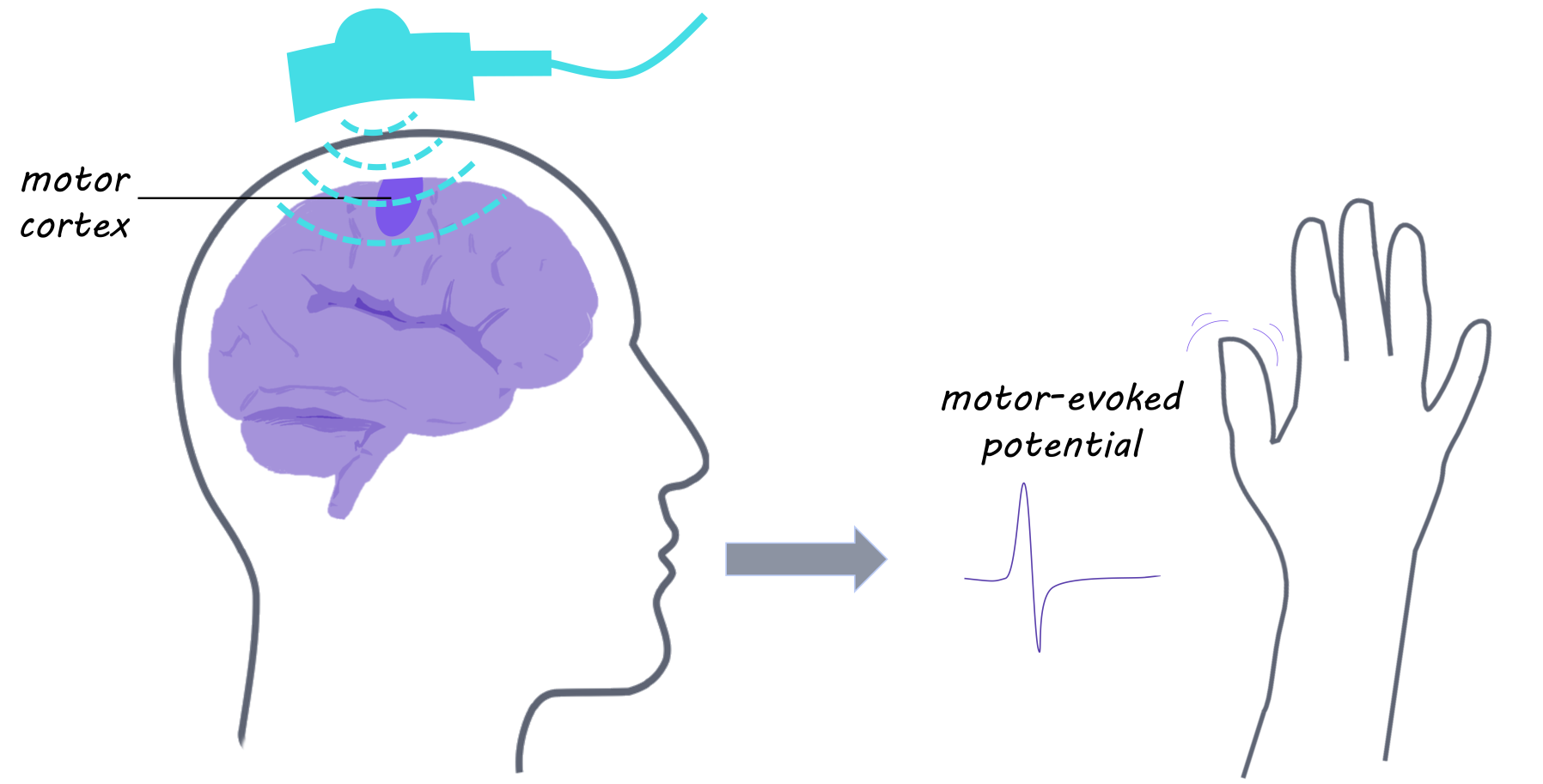
Stimulation of motor cortex, motor-evoked potential

What did they find?

As expected, the motor evoked potential after the second TMS pulse was much smaller (it was inhibited) compared to the motor evoked potential after the first pulse in healthy and depressed adolescents. In comparison, depressed adolescents with a history of suicidal behavior showed less inhibited (i.e. stronger) motor evoked potentials after the second pulse. These effects were found at inter-stimulus intervals of both 100 and 150 ms. Further, the amplitude of the responses was correlated with the severity of past suicidal behaviour.

What's the impact?

This study suggests that GABA-B activity (involved in inhibition in the brain) may be abnormal in adolescents with past suicidal behaviors. This neurotransmitter could potentially act as a biomarker for suicide risk in the future. However, individuals currently experiencing an acute episode of suicidal behaviour were not studied, and neurotransmitter profiles may be different in this group.

grey2quote_afterink.png

C.P. Lewis et al., Cortical inhibitory markers of lifetime suicidal behavior in depressed adolescents. Neuropsychopharmacology (2018). Access the original scientific publication here.
An Unconscious Intervention for Fear

What's the science?

One typical treatment for anxiety disorders involves exposure to the feared stimulus (i.e. exposure therapy). Going through exposure therapy can be uncomfortable, so approximately 15% of participants drop out. Currently, there are no effective treatments to avoid this discomfort. This week in PNAS, Taschereau-Dumouchel and colleagues tested a new method to reproduce fear representations in the unconscious (unaware) brain in order to reduce fear. 

How did they do it?

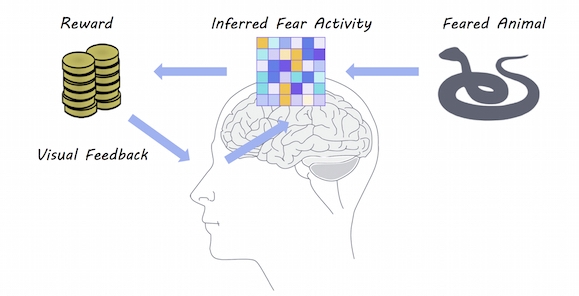
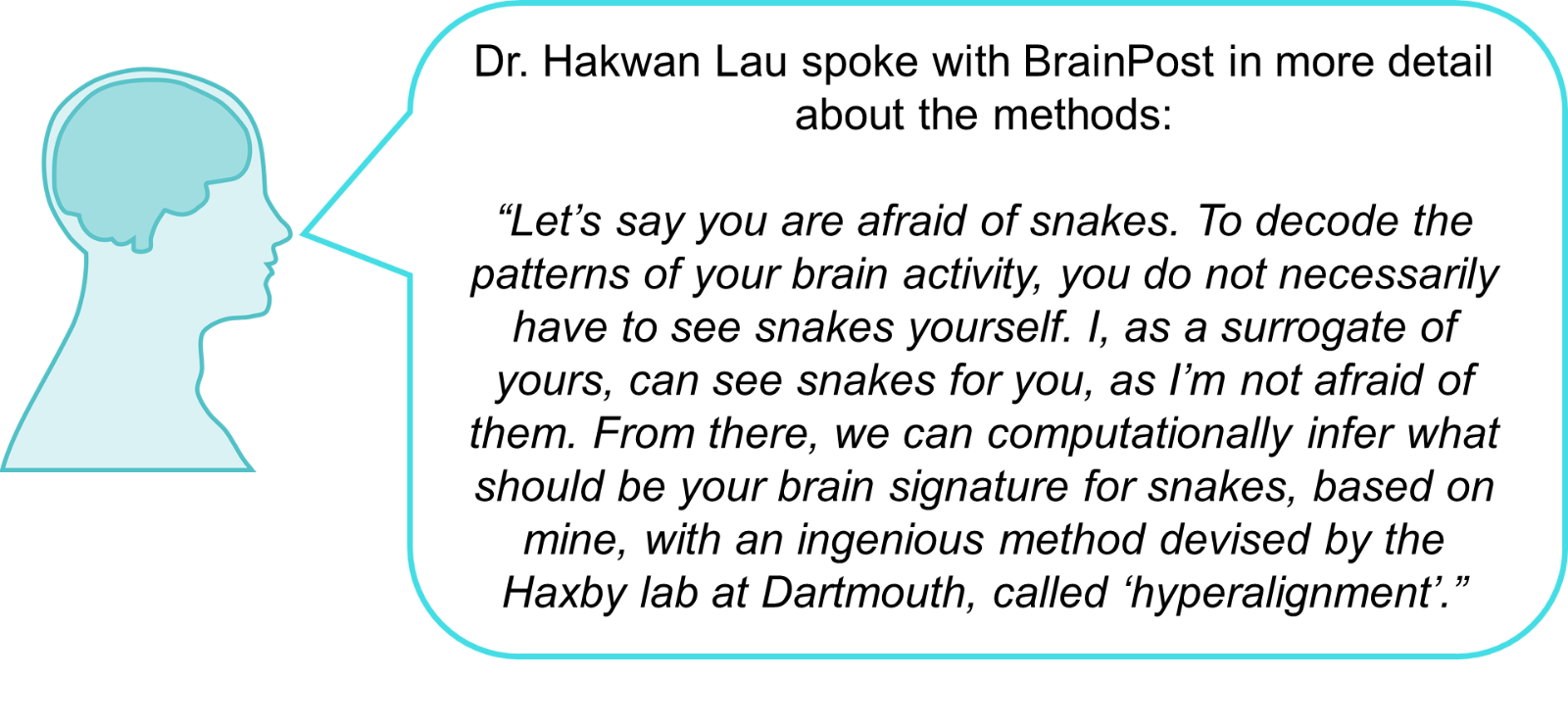
A group of individuals were shown images of feared animals during fMRI scans and brain activity patterns were decoded (using machine learning). These fear-related brain activity patterns were used to infer fear-related brain activity in the main study participants. The main group of participants underwent 5 days of neural reinforcement sessions. The goal was to use visual feedback to reinforce fear-related brain activity patterns, without actual exposure to the feared animal stimulus. During these sessions, a disc was shown on a screen to participants; the disk grew bigger in real time when participants’ brain activity better matched the brain activity pattern associated with a feared animal. Participants were awarded money in an amount proportional to the size of the disc. Both participants and researchers were blinded (i.e. did not know what the size of the disk represented). They then tested how well the neural reinforcement worked using well-established physiological fear responses: skin conductance and amygdala (a brain region processing fear) activation.

Pattern of brain activity corresponding to a fear'

What did they find?

Participants were able to learn to activate a particular brain activity pattern corresponding to a feared animal with consistency. They found that two physiological fear responses - both amygdala activation and skin conductance - were reduced after the neural reinforcement sessions but remained unchanged for the placebo condition (i.e. participant did not receive intervention). These responses were just as effective as responses seen for traditional exposure therapy. The participants remained unaware of whether their brain activity patterns corresponded to fear or not, meaning they had no conscious awareness of the treatment. The brain areas important in predicting the neural reinforcement effects were the fusiform, inferior temporal and lingual cortices.

What's the impact?

This is the first study to show that unconscious neural reinforcement could be used as a treatment for fear. Previously, there were no effective treatments to avoid exposing a patient to uncomfortable stimuli. Unconscious neural reinforcement could be used to help treat disorders such as post-traumatic stress disorder or anxiety and prevent dropout.

turquoisequote.png

Reach out to study authors Dr. Vincent Taschereau-Dumouchel and Hakwan Lau on Twitter: @Vincent_T_D and @hakwanlau

V. Taschereau-Dumouchel et al., Towards an unconscious neural reinforcement intervention for common fears. PNAS (2018). Access the original scientific publication here.
A Lack of New Neurons in the Adult Hippocampus

What's the science?

Throughout fetal development and into childhood, many new neurons are being made in the brain -- this process plays an important role in learning and memory. In adults, things slow down, but it has been generally accepted that new neurons are still being made in a particular brain region called the hippocampus. Understanding whether or not new neurons are made in adults is critical because neurogenesis represents an important target for neurological diseases. This week in Nature, Sorrells and colleagues assessed neurogenesis across the lifespan in humans. 

How did they do it?

They assessed the young neurons and progenitor cells (cells that would eventually become neurons) in the hippocampus of 59 individuals. These individuals ranged in age between 14 weeks gestation and 77 years. Brain tissue was examined either a) after death or b) following resection due to epilepsy. Using light and electron microscopy, and staining, they imaged and counted rapidly dividing cells (Ki-67+ progenitor cells), and young neurons (DCX+PSA-NCAM+ neurons).

What did they find?

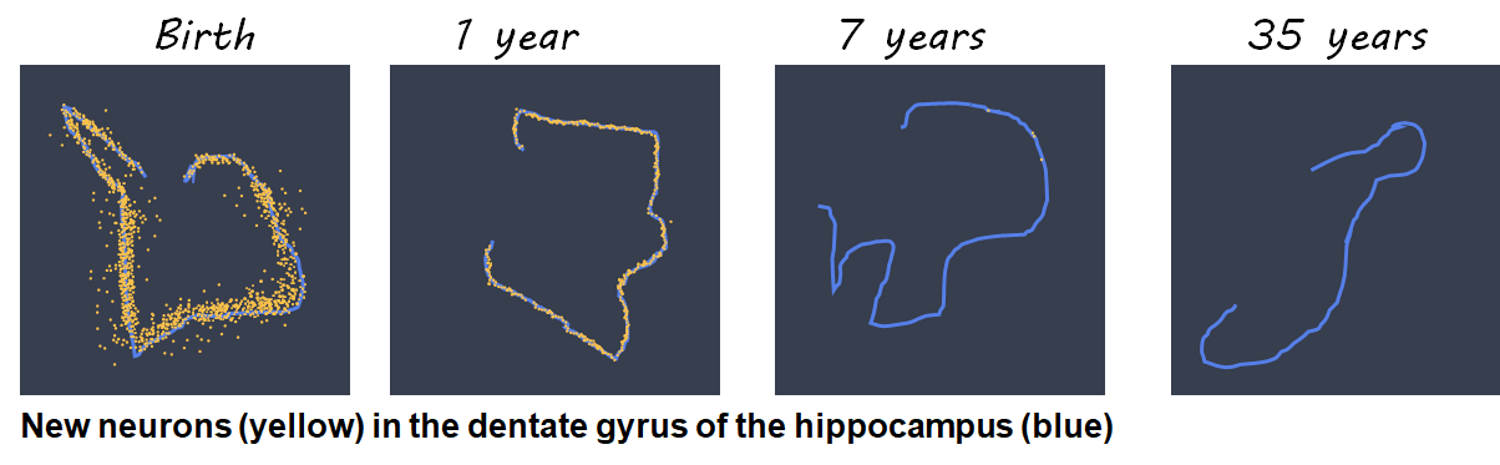
Many progenitor cells and young neurons were found during fetal development stages, but few were found after 7 years of age. There were no rapidly dividing Ki-67+ cells located in the subgranular zone of the hippocampus (where progenitor cells usually are) in brains older than 22 weeks gestational age. In surgical resections from epileptic patients, young neurons were found at 10 months gestational age (in the dentate gyrus region of the hippocampus), but few were found by 7 years and none were found in adults.

New neurons in the dentate gyrus of the hippocampus

What's the impact?

This study suggests that the generation of new neurons in the hippocampus of adults may be rare or non-existent in humans, contrary to commonly held beliefs. Researchers are now examining other species with little neurogenesis during the adult years, in order to find clues about why new neurons might not be generated in adults, despite their role in learning and memory.

S.F. Sorrells et al., Human hippocampal neurogenesis drops sharply in children to undetectable levels in adults. Nature (2018). Access the original scientific publication here.