Astrocytes Become Reactive with Normal Aging

What's the science?

Astrocytes are are the most abundant cell in the brain. They help to respond to injury and are important for maintaining overall brain health by supporting neurons, recycling neurotransmitters and regulating the formation and elimination of the connections between neurons. Astrocyte dysfunction is known to play a role in neurodegenerative diseases, but how astrocytes change throughout normal aging is not well known. One way to understand these changes is by looking at the transcription of genes in astrocytes. This week in PNAS, Clarke and colleagues performed RNA sequencing in mice at different stages of life to understand how astrocytes change over time.

How did they do it?

RNA sequencing was performed in mice at five time points between adolescence and old age, in three different brain areas: the cortex, hippocampus (involved in memory), and striatum (involved in movement and reward). They validated their findings using fluorescence in situ hybridization and quantitative polymerase chain reaction (qPCR) techniques (these techniques can confirm gene expression changes). To investigate whether the resident immune cells of the brain - microglia - play a role in inducing changes in astrocytes with aging, they compared astrocyte gene expression in mice with and without (knock-out mice) cytokines. Cytokines are released by microglia in response to neuroinflammation. 

What did they find?

Using RNA sequencing, they found that as astrocytes age, they are more likely to express genes associated with reactivity (this is when astrocytes become dysfunctional -- typically associated with neuroinflammation). Astrocytes were especially likely to become reactive in the hippocampus and striatum, which are areas particularly susceptible to neurodegeneration in aging. Using qPCR, a method used to observe DNA sequences, they found that reactive gene expression was not increased in the knock-out mice without cytokines, indicating that microglia expression of cytokines may be partially responsible for changes in astrocyte gene expression. Aged brains also formed many more reactive astrocytes in response to the neuroinflammation inducer ‘lipopolysaccharide’, which may indicate vulnerability of the aged brain to disease and inflammation.
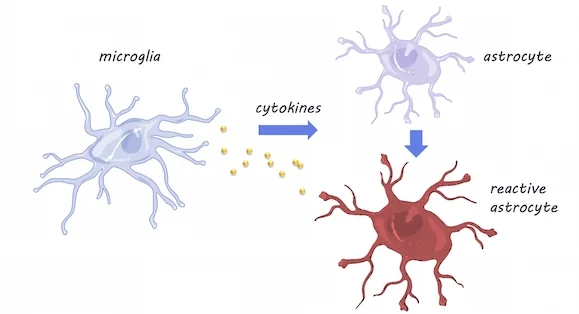
                       Microglia & Astrocytes, Servier Medical Art, image by BrainPost, CC BY-SA 3.0

                       Microglia & Astrocytes, Servier Medical Art, image by BrainPost, CC BY-SA 3.0

What's the impact?

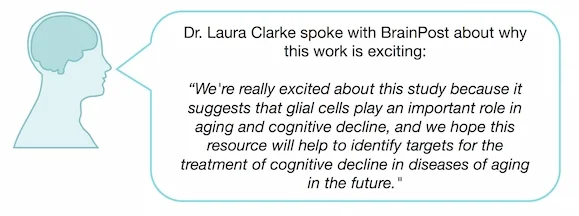
This is the first study to demonstrate that astrocytes become reactive as they age and that microglia- the immune cells of the brain- may be responsible through cytokine activity. More reactive astrocytes were found in brain regions vulnerable to degeneration, suggesting that changes in astrocyte gene expression may help explain neurodegenerative diseases or cognitive decline in aging.
Clarke_comment_new_small.jpg

Reach out to study author Dr. Laura E. Clarke on Twitter@ClarkeLauraE

Clarke et al., Normal aging induces A1-like astrocyte reactivity. (2018). Access the original scientific publication here.
Resting Brain Activity Predicts Who Responds to Cognitive Behavioral Therapy for OCD

What's the science?

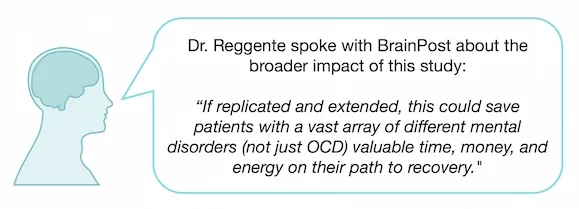
Obsessive Compulsive Disorder (OCD) affects 1-2% of the population and can affect quality of life. Cognitive behavioral therapy (CBT) is a method of treatment that has been shown to be effective in some individuals, but not all. Currently, there is no method to predict who will benefit from CBT. Recently, functional MRI of individuals at rest has emerged as a promising tool for predicting treatment outcomes. This week in PNAS, Reggente and colleagues test whether resting brain activity patterns can predict treatment response.

How did they do it?

Adults with a diagnosis of OCD underwent resting state functional MRI scans before and after 4 weeks of daily CBT. They analyzed the resting state fMRI scans using a multivariate approach and machine learning to detect whether patterns of resting state activity before treatment could predict individual OCD symptom severity scores after treatment. Resting brain activity was extracted from 196 brain regions and patterns of activity in all regions were correlated with one another. Multivariate analyses have the ability to capture multiple patterns of brain activity, and may be better than univariate approaches for predicting individualized responses to treatment. OCD symptom severity was also assessed before and after the 4 weeks of treatment.

What did they find?

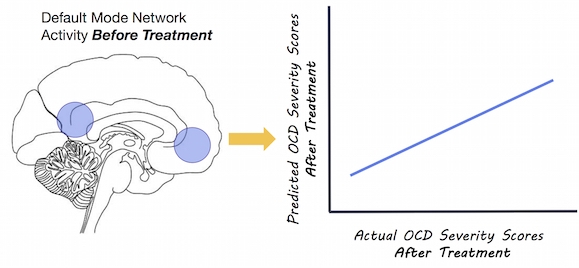
OCD symptom severity scores improved after treatment in almost all participants. The authors found that pre-treatment resting state patterns in two brain networks -the default mode network and the visual network - strongly predicted individual variability in OCD symptom severity score. The default mode network (active while an individual is at rest) accounted for 67% of the variation in post-treatment symptom severity scores, while the visual network accounted for 51%. The activity in these networks better predicted post-treatment severity scores than the severity of OCD before treatment.

Brain by cronodon.com, Image by BrainPost

Brain by cronodon.com, Image by BrainPost

What's the impact?

Knowing who will respond to treatment is important as CBT is time consuming and expensive. This is the first study to report resting state network patterns as a reliable predictor of individual response to CBT treatment for obsessive compulsive disorder. Individual resting state patterns could reflect the plasticity or adaptability of brain networks to treatment. This study brings us one step closer to using individualized treatment plans for complex disorders.

Reggente_author_week5_small.jpg

Reach out to study author Dr. Nicco Reggente on Twitter @mobiuscydonia

N. Reggente et al., Multivariate resting-state functional connectivity predicts response to cognitive behavioral therapy in obsessive–compulsive disorder. PNAS. (2018). Access the original scientific publication here.
Accelerating Transcranial Magnetic Stimulation Treatment for Depression

What's the science?

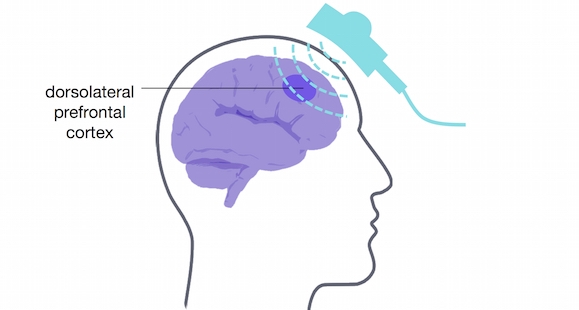
Thirty percent of people with depression are resistant to treatments like anti-depressant medication or psychotherapy. Some people with treatment-resistant depression respond to repetitive transcranial magnetic stimulation (rTMS) treatment. This technique involves inducing a magnetic field using pulses from a magnetic coil in a device resting on the scalp. However, it might take a patient many weeks of rTMS to see mood improvement, so having a faster acting treatment for those with severe depression is optimal. This week in Neuropsychopharmacology, Fitzgerald and colleagues tested a new ‘accelerated rTMS’ paradigm, to see if the same effects could be achieved faster.

How did they do it?

The authors conducted a randomised controlled trial, in which adults with depression received 63 00 rTMS pulses in total over the course of several rTMS sessions. Pulses were targeted at the dorsolateral prefrontal cortex, known to be involved in emotion regulation.  Fifty-eight adults followed the accelerated schedule: They received 3 treatments per day, for 3 days the first week, 3 treatments over 2 days the second week, and 3 treatments in one day the third week. Fifty-seven adults followed a standard schedule (not accelerated): one treatment per day, 5 days a week, for 4 weeks. They measured depression scores 1, 2, 3, 4, and 8 weeks after treatment.

dorsolateral prefrontal cortex

What did they find?

Depression scores slowly decreased over the 8-week period in both the accelerated and standard treatment groups. The accelerated treatment did not appear to improve mood faster than the standard treatment, and participants in the accelerated group were more likely to experience discomfort such as headache. There were no differences in the efficacy of the accelerated treatment versus the standard treatment, indicating the accelerated treatment worked just as well as the standard treatment.

What's the impact?

This is the first randomised controlled trial to test whether accelerated rTMS could be used as a treatment for depression. This study clarifies the effectiveness of  accelerated rTMS as a treatment for depression. Accelerated rTMS might be a viable option for individuals with depression who cannot commit to long periods of daily rTMS treatment. Depression comes in many different forms, so determining which treatments work best for which patients, and their potential side effects, is critical for treatment optimization.

Fitz_author_week5_small.jpg

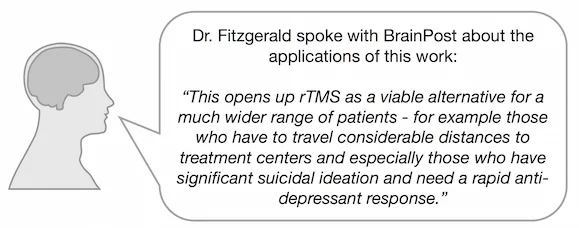
Reach out to study author Dr. Paul Fitzgerald on Twitter @PBFitzgerald

P.B. Fitzgerald et al., Accelerated repetitive transcranial magnetic stimulation in the treatment of depression. Neuropsychopharmacology. (2018). Access the original scientific publication here.