Ketamine Blocks Burst Firing to Provide Depression Relief

What's the science?

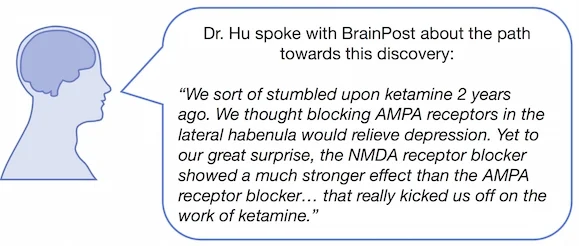
Ketamine is a drug that binds to and blocks NMDA receptors found on neurons. It provides fast acting and sustained relief of depression symptoms, however, the mechanisms underlying ketamine’s effectiveness are unknown. A brain region called the lateral habenula, involved in reward processing and negative emotions, is known to have abnormal “burst” activity in patients with depression. This week in Nature, Yang and colleagues determine whether abnormal activity in the lateral habenula can drive depression-like behaviours, and how this might be reversed by ketamine.

ketamine blocks NMDA receptor

How did they do it?

They tested to see if ketamine infusion into the lateral habenula relieved depression symptoms (improved mobility in the forced swim test) in learned helpless (depressed) rats. Next, they performed whole-cell patch-clamp (a method used to measure the electrical currents in a neuron) on lateral habenula neurons to determine : 1) whether the spontaneous neuronal activity in these cells is abnormal in depressed rats, 2) whether these abnormalities could be reversed by NMDA blockers and, 3) if changing the resting state membrane potential of the cell can alter the pattern of spiking activity in the lateral habenula. They then used optogenetic techniques to mimic the bursting activity seen in the lateral habenula of depressed mice to determine whether this activity was sufficient to induce depression behaviours.

What did they find?

Ketamine administered in the lateral habenula alleviated the depression symptoms in rats. Increased burst firing occurred in neurons in the lateral habenula of depressed rats. These burst patterns were completely blocked by ketamine, but not by other typically used antidepressant drugs. The bursting properties of the lateral habenula could be altered by changing the membrane potential of the cell, suggesting a new potential therapeutic target, the T-type calcium channel. They were also able to induce depression-like symptoms in rats by using optogenetics to control the pattern of burst firing in the lateral habenula.

What's the impact?

This is the first study to describe the mechanisms by which ketamine has fast acting depression relief. We now know that burst firing underlies depressive symptoms in rats, and that this can be blocked with ketamine. Understanding how and where ketamine acts in the brain is an important step towards developing new therapies for depression.  
Hu_author_week5_small.jpg

Yang et al., Ketamine blocks bursting in the lateral habenula to rapidly relieve depression. Nature. (2018). Access the original scientific publication here.

Rachel Bosma, PhD contributed to this BrainPost

A Model for the Spread of Tau through Connected Tracts in the Human Brain

What's the science?

In Alzheimer’s disease, tau proteins accumulate in the hippocampus resulting in neurofibrillary tangles. Beta-amyloid plaques, another form of protein aggregation, are thought to help tau proteins spread. One way that tau may spread from neuron to neuron is through neural connections, while another possibility is that it simply spreads to neurons located close by. This week in Nature Neuroscience, Jacobs and colleagues used brain imaging to ask: ‘How does  tau spread?’

How did they do it?

Healthy older participants from the Harvard Aging and Brain Study were scanned over several years with positron emission tomography (PET) imaging to measure tau and beta-amyloid in the brain, and diffusion tensor imaging (DTI) to measure connectivity (of white matter tracts) in the brain. They tested whether beta-amyloid in the brain at baseline predicts hippocampal volume loss. They then measured whether this volume loss predicts abnormalities in the hippocampal cingulum bundle (a white matter tract that innervates the hippocampus and connects it with the posterior cingulate cortex) and in turn, whether these abnormal connections predict the accumulation of tau in the posterior cingulate cortex. They ran control analyses with another tract (that does not innervate the hippocampus) and another close by region. Associations with memory and executive functions were also assessed to understand the clinical relevance. 

What did they find?

Brain beta-amyloid level at baseline predicted hippocampal volume loss. The hippocampal volume loss also predicted abnormal white matter tract connectivity over time in the hippocampal cingulum bundle, but not in other white matter tracts close by that do not directly connect with the hippocampus. The abnormal connectivity in this tract predicted the accumulation of tau in a connected region called the posterior cingulate cortex, but not in another adjacent control region. Collectively, these changes were associated with memory decline over time. This means that early Alzheimer’s pathology (beta-amyloid) initiates a cascade of hippocampal volume loss followed by abnormal tract connectivity and the spreading of tau along this tract. 

Spread of tau and beta-amyloid accumulation over time

What's the impact?

This is the first study to confirm that tau likely spreads via neural connections (rather than just to regions close by) from the hippocampus, facilitated by beta-amyloid in the brain. Clarifying the order in which Alzheimer’s pathology spreads, as well as the mechanism through which it spreads is critical for helping to target the advancement of Alzheimer’s disease.

DrJacobs_small.jpg

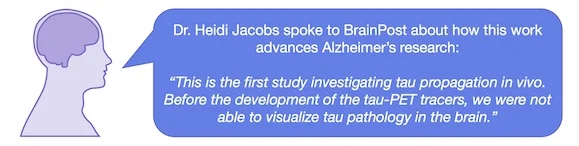
You can reach out to her about her work at @DrHeidiJacobs on Twitter.

H. I. L. Jacobs et al., Structural tract alterations predict down-stream tau accumulation in amyloid positive older individuals. Nat. Neurosci. (2018). Access the original scientific publication here.

Rapid Synthesis of Proteins in Human Brain Tissue

What's the science?

All cells in the body produce proteins, and certain tissues synthesize these proteins and recycle them (to produce new ones) faster than others. Skeletal muscle is an example of one tissue that recycles proteins quickly, at a rate of 1-2% per day. Historically, we have assumed that the brain does not regenerate itself as much as other tissues. This week in Brain, Smeets and colleagues report that brain protein turnover is much higher than previously assumed. 

How did they do it?

Six participants that were scheduled to undergo surgery for drug-resistant temporal lobe epilepsy were recruited. Amino acids are the precursors to proteins. Patients were given continuous intravenous infusion (before and during surgery) of an amino acid called phenylalanine, which was radiolabeled with a stable isotope. Blood and tissue samples from the cortex and hippocampus were taken, as well as from two muscle tissues throughout the surgery. These tissue samples were examined for the incorporation of phenylalanine into tissue protein. They then calculated protein synthesis rates based on phenylalanine enrichment in the tissue, and also identified what type of proteins are present in brain tissue.

What did they find?

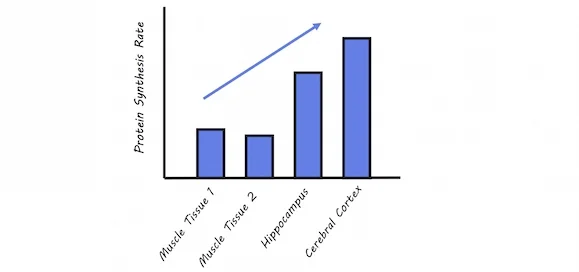
Tissue phenylalanine enrichments were found in muscle tissue and brain tissue; however, they were higher in brain tissue, indicating that protein synthesis rates were 3-4 times higher in brain tissue compared to skeletal muscle tissue. Protein synthesis rates were higher in the cortex compared to the hippocampus. They were able to identify 1192 different proteins in brain tissue, and the most abundant form of proteins were cytoskeletal proteins (proteins that make up the structure of the neuron). 

Artistic rendering of Figure 3. Brain and skeletal muscle tissue protein synthesis rates.

Artistic rendering of Figure 3. Brain and skeletal muscle tissue protein synthesis rates.

What's the impact?

This is the first study to report protein synthesis rates in the living human brain. It is well established that skeletal muscle tissue regenerates itself rapidly in order to adapt to repeated use. Until now we didn’t know that brain tissue regenerates at an even higher rate than skeletal muscle. This rapid tissue regeneration could underlie the ability of the brain to adapt and remodel itself throughout life.

J. S. J. Smeets et al., Brain tissue plasticity: protein synthesis rates of the human brain. Brain. (2018). Access the original publication here.