
How Bilingual Brains Handle Grammar in Two Languages at Once
Post by Amanda Engstrom
The takeaway
The bilingual brain must compute different grammar rules for different languages at millisecond resolution. This computation relies on a shared brain network spanning the left frontal and temporal lobes, using flexible, reusable rules rather than a separate network for each language.
What's the science?
Human language requires the speaker to alter the pronunciation of words to account for changing information such as the plural form of an object, but the phonological rules for this are different across languages. This raises the question as to whether the brain utilizes language-specific neural systems or if it relies on a shared abstract mechanism that generalizes across linguistic contexts. Prior brain imaging work on this question has produced mixed results and has mostly examined language comprehension, leaving open whether the same holds true during the split-second demands of planning and producing speech. This week in Journal of Neuroscience, Chen and colleagues aimed to resolve this by using magnetoencephalography (MEG) to track millisecond-scale brain activity in Spanish/English bilinguals, using a task designed to separate the mental act of changing a word's grammatical form from other factors like the word's meaning or how it sounds, allowing them to pinpoint when and where this computation occurs in the brain as bilinguals produced singular and plural nouns in both languages.
How did they do it?
The authors recruited 23 highly proficient Spanish-English bilinguals to complete a phrase-completion task: participants saw a written noun (e.g., "boat"), then heard a spoken cue ("one," "two," or "say") prompting them to produce the singular form, plural form, or simply repeat the word aloud. The task varied language, whether grammatical change was needed, and whether that change altered the word's sound, all independently of one another.
While participants performed the task, the authors recorded brain activity using MEG, a non-invasive technique that detects magnetic fields from active neurons at a millisecond timescale, critical for capturing the split-second planning between hearing a cue and speaking. They also collected structural MRI scans and combined them with MEG data through source localization, which estimates where in the brain each signal originated using each participant's own anatomy. First, they compared brain activity when transforming versus simply repeating a word. Second, they trained a computer algorithm to recognize that activity pattern in one language (e.g., English) and then tested whether it could detect the same pattern in the other (Spanish). Successful detection across languages ("cross-decoding") would show that English and Spanish rely on a common neural code, rather than separate systems.
What did they find?
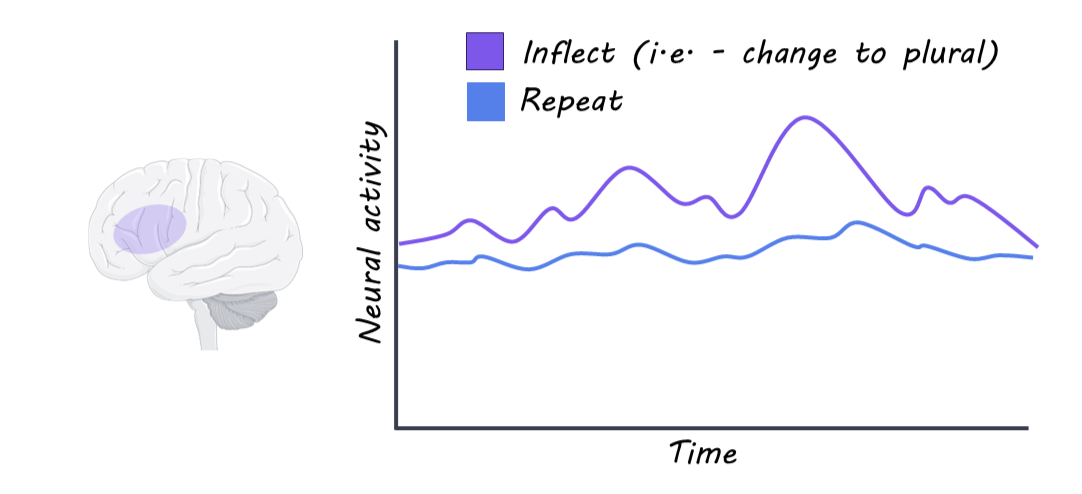
The authors found that transforming a word's grammatical form (e.g., "boat" to "boats") activated the left frontal and temporal regions much more strongly than simply repeating a word, even for words that don't change sound when pluralized (like "tuna/tuna"). This suggests that these brain regions carry out grammatical transformation as an abstract computation, rather than one tied to a specific sound pattern. Comparing English and Spanish separately, both languages activated nearly the same brain regions, with Spanish showing activity about 110 milliseconds earlier than English. A decoding algorithm trained to detect grammatical transformation in one language successfully detected it in the other, suggesting that English and Spanish rely on a shared brain mechanism for this computation rather than two separate systems, with the timing difference simply reflecting how quickly each language can be processed. Finally, this same pattern held even for words that don't exist in either language, and cognates (like "chocolate/chocolate") showed no added advantage over other real words. This suggests that the brain's grammar system is highly generalizable: it can apply grammatical rules to entirely novel words and doesn't depend on having a matching or overlapping vocabulary entry to work with.
What's the impact?
This study found that Spanish-English bilinguals engage in a shared left frontal-temporal network to process the grammatical transformation of pluralizing a word in both languages, suggesting the bilingual brain uses flexible, reusable rules rather than separate networks per language. These findings support a growing body of work showing that the brain favors efficient, generalizable abstract computations that can be reused across different contexts. Further, this study demonstrates how bilingualism can be used to interrogate general principles of neural organization.