
Changing the Direction of Traveling Brain Waves Influences Attention and Memory
Post by Shalana Atwell
The takeaway
Neural information spreads across the cortex through brain oscillation patterns called “traveling waves.” Altering the direction of these traveling waves using traveling-wave transcranial alternating current stimulation (twtACS) influences cognitive performance.
What's the science?
Cortical “traveling waves” are rhythmic patterns of brain activity that move across the surface of the cortex, like ripples spreading across a pond, and they have been observed across species and during many different cognitive tasks. Cognitive dysfunction is a hallmark of many neurodegenerative diseases, psychiatric disorders, and aging populations, and previous research has shown that standard tACS can enhance certain aspects of human cognition. While tACS can synchronize brain rhythms, its effect is confined to one location and cannot generate dynamic patterns of neural activity. This week in PNAS, Lee and colleagues created and validated a stimulation method to impose a directionally controlled traveling electric field across the cortex and demonstrated how the wave's directionality influences specific cognitive tasks.
How did they do it?
The authors used computer models of human head and brain anatomy to calculate how currents from multiple scalp electrodes would flow through the brain and then optimized the phases of the injected sinusoidal currents so that the location of the maximal electric field (the “peaks”) would sweep across the cortex over time (backward: from anterior to posterior), forming a traveling phase gradient. The team applied twtACS to two human patients with electrocorticography (ECoG) electrodes implanted for clinical reasons and showed that the measured phase at cortical electrodes closely matched the target pattern from the simulations and exhibited clear traveling phase gradients in the backward direction.
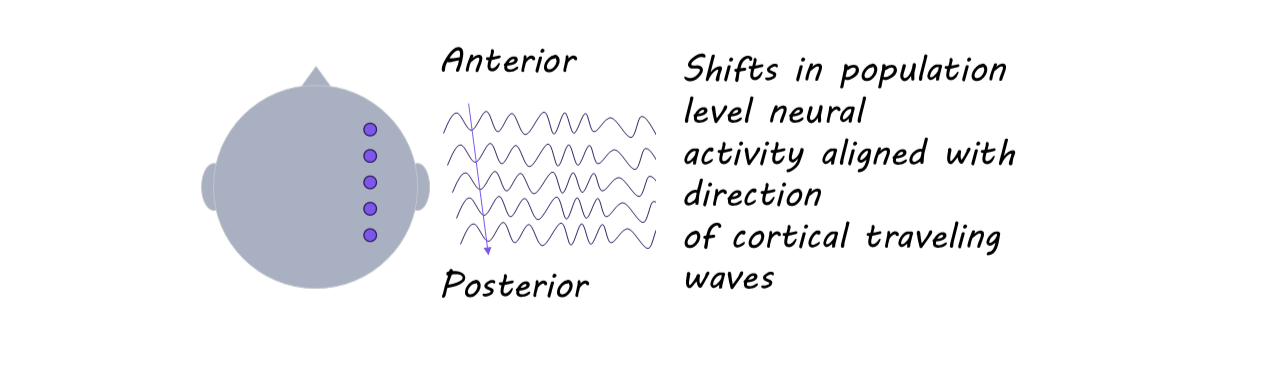
A nonhuman primate was implanted with a dense grid of intracortical microelectrodes spanning frontal to motor cortex, allowing measurement of multiunit activity (MUA; pooled local spiking) across space. The animal underwent four consecutive conditions at 10 Hz: baseline (no stimulation), standard tACS (same phase everywhere), forward twtACS (from posterior to anterior), and backward twtACS. For each condition, the authors computed the preferred phase of spiking relative to the stimulation cycle at each electrode. They confirmed that neural population activity aligned with the propagation of twtACS-induced electric fields.
Healthy participants received 10 Hz twtACS targeted to right frontal and parietal regions, with conditions optimized to produce either forward or backward traveling fields. During 20 minutes of stimulation, participants performed two tasks in fixed order: (1) A visual attention task where they covertly attended to flickering disks on the left or right, reporting whether a brief target appeared in the attended disk. (2) An episodic memory task where they encoded 60 images during stimulation, then, after a 10-minute rest, performed an old/new recognition test.
What did they find?
In ECoG patients, the phase of the recorded electric fields across electrodes showed robust gradients, confirming that twtACS can impose direction-specific electric fields across the human cortex that mimic observed cortical traveling waves.
Compared to tACS and baseline, twtACS produced systemic shifts in the preferred phase of spiking along the anterior-posterior axis. The spatial phase gradients in the MUA closely matched those of the electric field, indicating that population spike timing aligned with the propagating twtACS-induced field.
In the visual attention task, performance differed between forward and backward stimulation and depended on whether participants attended to the left or right visual field. Specifically, performance accuracy was higher with backward twtACS when participants attended to the right visual field. In the memory task, accuracy was higher under forward twtACS conditions. Together, these tasks indicate that the directionality of the imposed wave was critical to performance, and they are broadly consistent with previous work linking forward waves to feedforward sensory processing and memory encoding and backward waves to top-down control and spatial attention.
What's the impact?
This study provides evidence that manipulating the direction of traveling cortical waves can actively shape cognition. These findings support the idea that the direction of traveling waves is closely related to task demands, with different directions favoring feedforward vs feedback processing. This approach could eventually provide new therapeutic strategies for cognitive dysfunction in aging and psychiatric or neurological disorders that are thought to involve disrupted large-scale brain coordination.