
A Mega-Analysis of the Effects of Psychedelics on Brain Networks
Post by Anastasia Sares
The takeaway
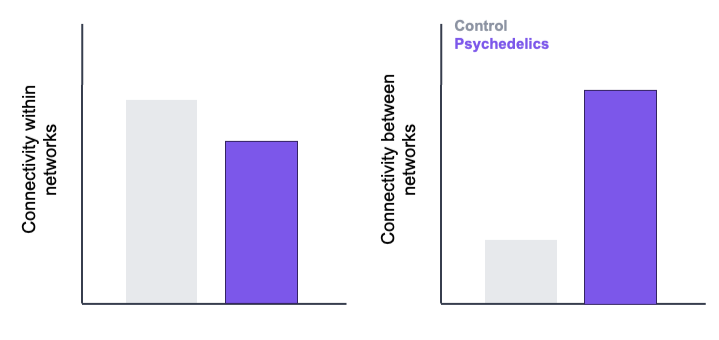
In a re-analysis of data from 11 different MRI studies, researchers found that psychedelics increase connectivity between many different brain networks, but only slightly decrease connectivity within networks. This analysis synthesizes and harmonizes findings in a field where research to date has been inconsistent and contradictory.
What’s the science?
Psychedelics are a class of compounds that primarily target serotonin receptors in the brain, changing neuronal activity and connectivity (see a previous BrainPost for more information on how these drugs work on a molecular level). There are currently many clinical trials looking at their potential therapeutic benefits for neuropsychiatric disorders like depression. Alongside this, researchers are trying to understand how exactly psychedelics act in the brain.
While we are beginning to understand the effect of psychedelics on brain networks, the picture is not consistent from study to study. Each psychedelic compound is a little bit different, and sample sizes in this kind of research tend to be small, so each brain network study has somewhat different findings—in fact, some papers report opposite results. Recently, in Nature Medicine, Girn and colleagues performed a “mega-analysis” from 11 different magnetic resonance imaging (MRI) datasets from studies on psychedelics to try to settle some of these debates and uncover the general effects of psychedelics on brain function.
How did they do it?
One common way of studying brain function that has been applied to many research topics, including psychedelics, is called resting-state functional MRI (or rs-fMRI). In regular functional MRI (fMRI), researchers measure the blood flow in the brain while a person lies in the scanner doing some kind of task: seeing images, hearing sounds, or thinking about certain things. As neurons use glucose and oxygen, the blood vessels in the brain open and increase the flow to supply them with more, and this can be tracked with the fMRI signal. However, in rs-fMRI, this signal is measured while people lie in the scanner doing nothing in particular—in other words, they are “at rest.” The brain is still active at rest, and a lot can be learned from studying this kind of data.
The authors collected and re-analyzed data from multiple laboratories that had scanned people under the effects of psychedelics using rs-fMRI. Most of these studies were randomized controlled trials with some kind of psychedelic versus a placebo. They didn’t just compile the results: instead, they started from scratch with the raw data and re-analyzed it with their own pipeline. MRI analysis is complex, and there is room for a lot of variation in processing methods, so by re-analyzing the data themselves, they hoped to iron out some of those inconsistencies. The type of analysis they conducted looked at functional connectivity, which tracks the fMRI signal to see which parts are correlated in their activity over time (and are therefore probably working together). They were primarily interested in testing one finding from previous studies: that psychedelics decrease connectivity within regions that usually work together, and they increase connectivity between regions that are usually distinct.
What did they find?
The main claim the researchers were testing was partially confirmed: compared to participants with a placebo, people who were under the influence of psychedelics showed increased connectivity between networks, especially general networks having to do with attention, self-reflection, sensory processing, and executive function. On the other hand, while they did see somewhat decreased connectivity within brain networks, these effects were much less robust. This amounts to more “cross-talk” between regions and only slightly less “internal chatter.” However, the one study using ayahuasca showed a completely different pattern: there was an overall decrease in connectivity between most brain areas. Since there was only one study on ayahuasca that had only 9 participants and lacked a placebo condition, more research will be needed to understand its effects. Overall, these results align better with some theories about how psychedelics work (like the subcortical connectivity account) while providing less support for others (like the ‘network disintegration’ account).
What’s the impact?
As clinical trials progress and potential therapies are identified, this research helps us understand the mechanisms behind those therapies and the mental health conditions they could treat. Knowing about the brain mechanisms of psychedelics might help us to better predict who could benefit from their use (personalized medicine), identify potential side effects, and develop sensible regulations.