
Microdelays Impair Students’ Online Learning Outcomes
Post by Kate Windsor
The takeaway
Delays in screen loading time impair online learning outcomes. Even load times of 1-2 seconds are tied to increased distraction and decreased engagement with the lesson.
What’s the science?
Laptops and online learning are now commonplace for both K-12 schools and self-directed courses. But while basic internet access is increasingly universal, bandwidth disparities persist. Slower internet speed may disrupt student learning by introducing “microdelays” (i.e., brief pauses while content loads). This week in Nature Human Behavior, Mazar and colleagues explored and quantified the relationship between screen loading time and learning outcomes across various student populations.
How did they do it?
To explore the effect of microdelays on learning, the authors designed three separate studies:
Study #1: A randomized controlled experiment as a preliminary test of microdelay effects. The purpose of this study was to demonstrate a causal link between microdelays and assignment completion. In this study, adult participants were assigned to read popular science articles (like the one you’re reading now!). The articles were loaded with or without an artificial delay of 3 seconds. The authors measured whether participants finished reading the article with and without the delay.
Study #2: A field study on mathematics learning with US primary and secondary school students. The purpose of this study was to examine the real-world effects of microdelays on student performance. In this study, the authors recorded 3 months of data from a widely used online math education platform in the U.S. From this data, the authors analyzed each attempt on an assignment for the following measures:
Load time: How long did it take for the assignment to load?
Distraction: How long did it take for the student to start the assignment after it was loaded?
Completion: Did the student complete the assignment?
Sessions: How many separate sessions did it take for the student to complete the assignment?
Score: How many problems did the student answer correctly?
Each of these measures was normalized to the load times of each individual participant to account for person-level characteristics such as socioeconomic status, which could otherwise confound the results.
Study #3: A field study on programming education with primarily Latin American professionals. The purpose of this study was to extend the results of Study #2 to a global sample. The authors recorded 2 months of data from an online self-directed Spanish language coding course and quantified measures similar to Study 2.
What did they find?
Study #1: In their preliminary test, the authors found that the 3-second microdelay reduced the number of participants who completed reading an assigned article.
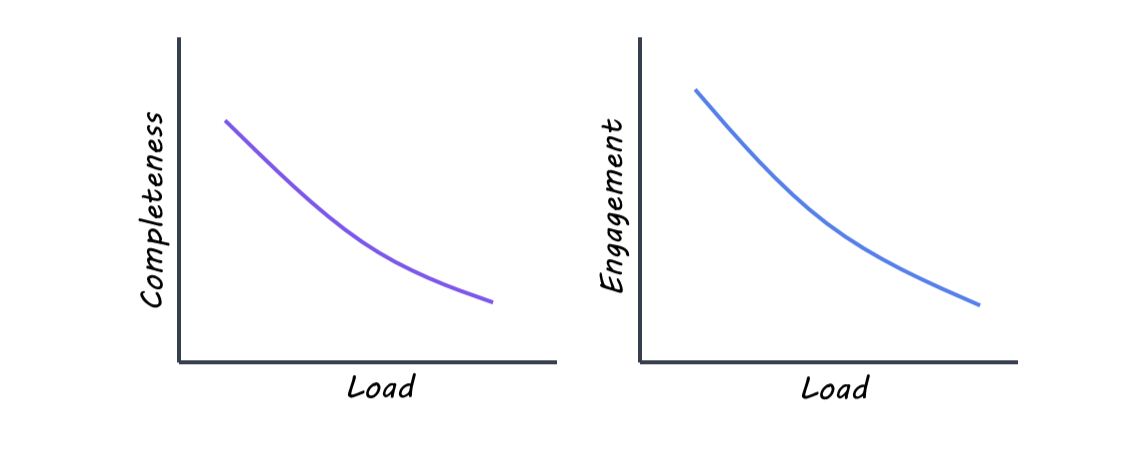
Study #2: In their study on US students, the authors found that microdelays were tied to increased distraction, lower assignment completion rates, increased number of sessions to complete an assignment, and lower assignment scores.
Study #3: In their international study, the authors found that microdelays were also tied to increased distraction and fewer completed lessons.
Taken together, these results suggest that seemingly minuscule delays in loading time may significantly impact a student’s ability to learn.
What’s the impact?
This study provides evidence that delays in loading time may causally impair online learning, even if that wait is only 1-3 seconds. The impact of this effect would disproportionately affect lower-income households with a slower internet connection. These findings have implications for both our education system and our social infrastructure. For the education system, online learning platforms should focus on optimizing their services to account for lower bandwidth users. For our social infrastructure, politicians should consider high-speed internet a basic utility and work towards policies that reduce the bandwidth disparity, which can compound existing educational inequalities.