
Contrasting Effects of LSD and Psilocybin on Brain Connectivity and Blood Flow
Post by Shalana Atwell
The takeaway
Although LSD and psilocybin act primarily through the same serotonin receptor (5-HT2AR), their differing effects on brain function remain poorly understood. Researchers found that LSD produced a delay before participants experienced the strongest effects, increased brain blood flow, and decreased global brain connectivity. These findings contrast with psilocybin’s effects and suggest distinct underlying mechanisms.
What’s the science?
As LSD and psilocybin are increasingly being studied in clinical trials for anxiety and depressive symptoms, it is important to understand how these psychedelics act in the brain. Previous research has found a delay between peak LSD concentrations in the blood and peak subjective effects, as well as changes in brain connectivity. However, it remains unclear how these effects relate to LSD’s interaction with its primary target, the serotonin 2A receptor (5-HT2AR). Recently in Nature Neuroscience, McCulloch and colleagues utilized simultaneous brain imaging techniques to investigate how LSD binds to this receptor and influences subjective effects, brain connectivity, and brain blood flow, compared to psilocybin.
How did they do it?
1. LSD administration and subjective effects: Eleven healthy adults received a single oral dose of LSD (25-200 µg), with the dose concealed from participants. The authors collected blood samples to measure LSD concentrations and asked participants to rate the intensity of their psychedelic experience on a scale of 0-10 throughout the session, allowing them to compare changes in subjective effects with circulating drug levels.
2. Receptor binding and brain imaging: To track LSD’s binding to 5-HT2AR, participants were injected with a radioactive tracer ([¹¹C]Cimbi-36) and underwent simultaneous positron emission tomography (PET) and magnetic resonance imaging (MRI) scans. These techniques allowed them to estimate receptor occupancy (the proportion of receptors occupied by LSD) and examine how receptor binding related to drug concentrations and subjective effects.
3. Brain blood flow and connectivity: Using specialized MRI techniques, they measured cerebral blood flow, or the amount of blood flowing through the brain, and blood flow through the internal carotid arteries, which supply blood to the brain. They also used functional MRI (fMRI) to assess global functional connectivity, a measure of how strongly activity patterns across different brain regions fluctuate together.
4. Comparison with psilocybin: Finally, they compared LSD-induced changes in brain blood flow and functional connectivity with previously collected data from healthy volunteers who received psilocybin. This comparison allowed them to investigate whether two psychedelics acting primarily through the same receptor produce similar or distinct effects on brain function.
What did they find?
1. LSD concentrations and subjective effects: Investigators found that LSD concentrations in the blood peaked approximately 30 minutes before participants reported their strongest subjective effects. Interestingly, participants reported weaker effects while LSD concentrations were increasing than when they were decreasing, even at equivalent concentrations in the blood (a phenomenon known as a counterclockwise hysteresis loop). This suggests that LSD’s subjective effects are delayed relative to its concentration in the blood, a pattern not observed with psilocybin.
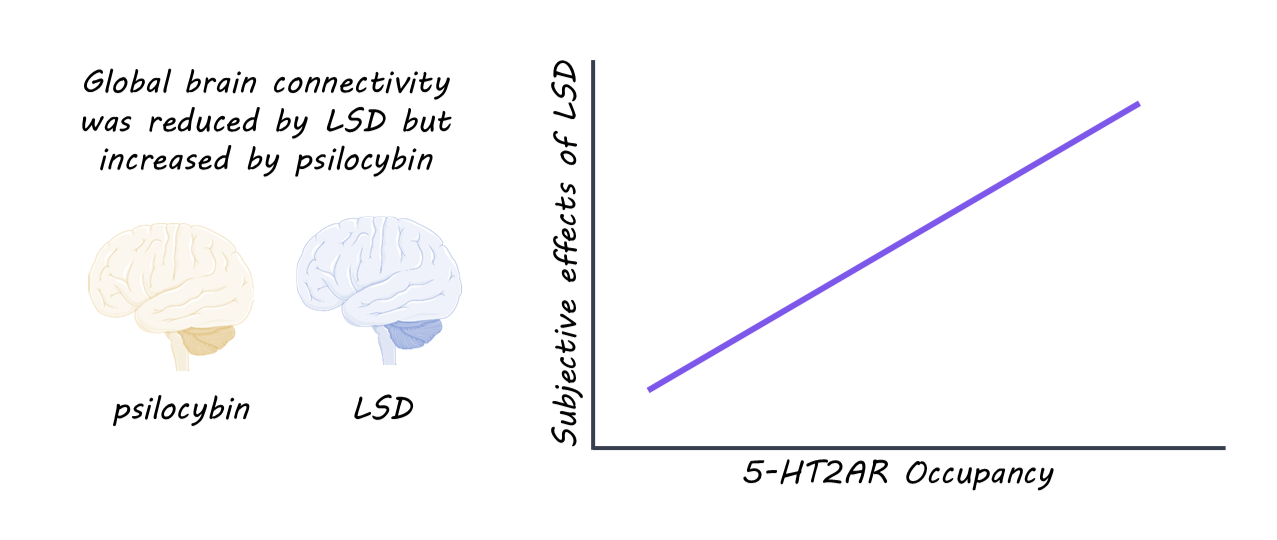
2. Receptor binding and subjective effects: They demonstrated that greater LSD occupancy of 5-HT2AR in the neocortex (the outer region of the brain involved in higher-order functions) was generally associated with stronger subjective effects, meaning participants generally reported more intense effects when more receptors were occupied by LSD. However, one participant continued to show high receptor occupancy even after their subjective effects had substantially diminished.
3. Brain blood flow and connectivity: LSD increased global cerebral blood flow by 19.3%, with the strongest increases observed in the occipital cortex and thalamus and more modest increases in the hippocampus and amygdala. Additionally, blood flow through the internal carotid arteries increased by 28% without substantial changes in artery diameter. LSD also decreased global brain connectivity across most of the neocortex, particularly in visual regions and posterior default mode network regions. These decreases in connectivity were associated with increases in brain blood flow and greater 5-HT2AR occupancy. In contrast, psilocybin increased global brain connectivity while decreasing cerebral blood flow, suggesting that these psychedelics have distinct effects on brain function.
What’s the impact?
This study is the first direct characterization of LSD’s receptor occupancy in the human brain and its relationship with subjective effects, brain connectivity, and blood flow. The authors also highlight a disconnect between LSD concentrations in the blood, receptor occupancy, and subjective effects that were not observed with psilocybin, suggesting differences in downstream or off-target mechanisms. These findings provide valuable insight into LSD’s pharmacological effects and may help guide future dosing in clinical populations while advancing our understanding of the neural mechanisms underlying its effects.