
The Dentate Gyrus Discriminates Learned Sensory Information
Post by Deborah Joye
What's the science?
To help us navigate an unpredictable world, our brain continuously learns about the environment and integrates important information into a cognitive map. But how does our brain learn about important stimuli and incorporate them into a cognitive map of the environment? One role of the hippocampus is learning about non-spatial stimuli such as sounds and smells, but we don’t know exactly how learning new associations changes that information in the hippocampus. In general, evidence suggests that the cortex sends generalized sensory representations to the hippocampus. The hippocampus takes that general representation and enhances distinctions between important and unimportant sensory memories. This process helps us use previously learned information to safely and productively engage with our environment (like, “that smells like a rotten egg, so it might make you sick”). This week in Neuron, Woods, and colleagues demonstrate that specialized cells in the hippocampus create an internal representation of particular odors that predicts behavioral ability to differentiate smells.
How did they do it?
To test how cells in the hippocampus represent olfactory stimuli, the authors used two-photon microscopy to monitor cellular activation (measured by increases in calcium) in awake mice. Mice were exposed to various odors as the authors studied cellular activity in dentate gyrus granule cells of the hippocampus. The authors also studied cellular activity in lateral entorhinal cortex cells, one of the primary input regions into the hippocampus. To investigate whether the lateral entorhinal cortex is the main input of olfactory information into the dentate gyrus, the authors blocked cellular communication between these two regions using a form of tetanus toxin and imaged cellular activity in each region during odor exposure and behavioral tasks.
To test the extent to which dentate gyrus granule cells and lateral entorhinal cortex cells change their responses with learning, the authors trained mice on both fear and reward-based learning tasks and recorded activity in cells from each region before and after conditioning. In the fear-learning task, mice were first allowed to explore three contexts with distinct ambient odors. Mice were then trained to associate one odor with a mild foot shock (creating a fear association) and then were later tested with that same odor to determine how fearfully the mouse responded when exposed to that smell by measuring freezing behavior. In the reward-learning task, mice were trained to associate an odor with a sucrose reward and the authors measured this learned association by quantifying appetitive behavior (in this case, licking before the reward).
What did they find?
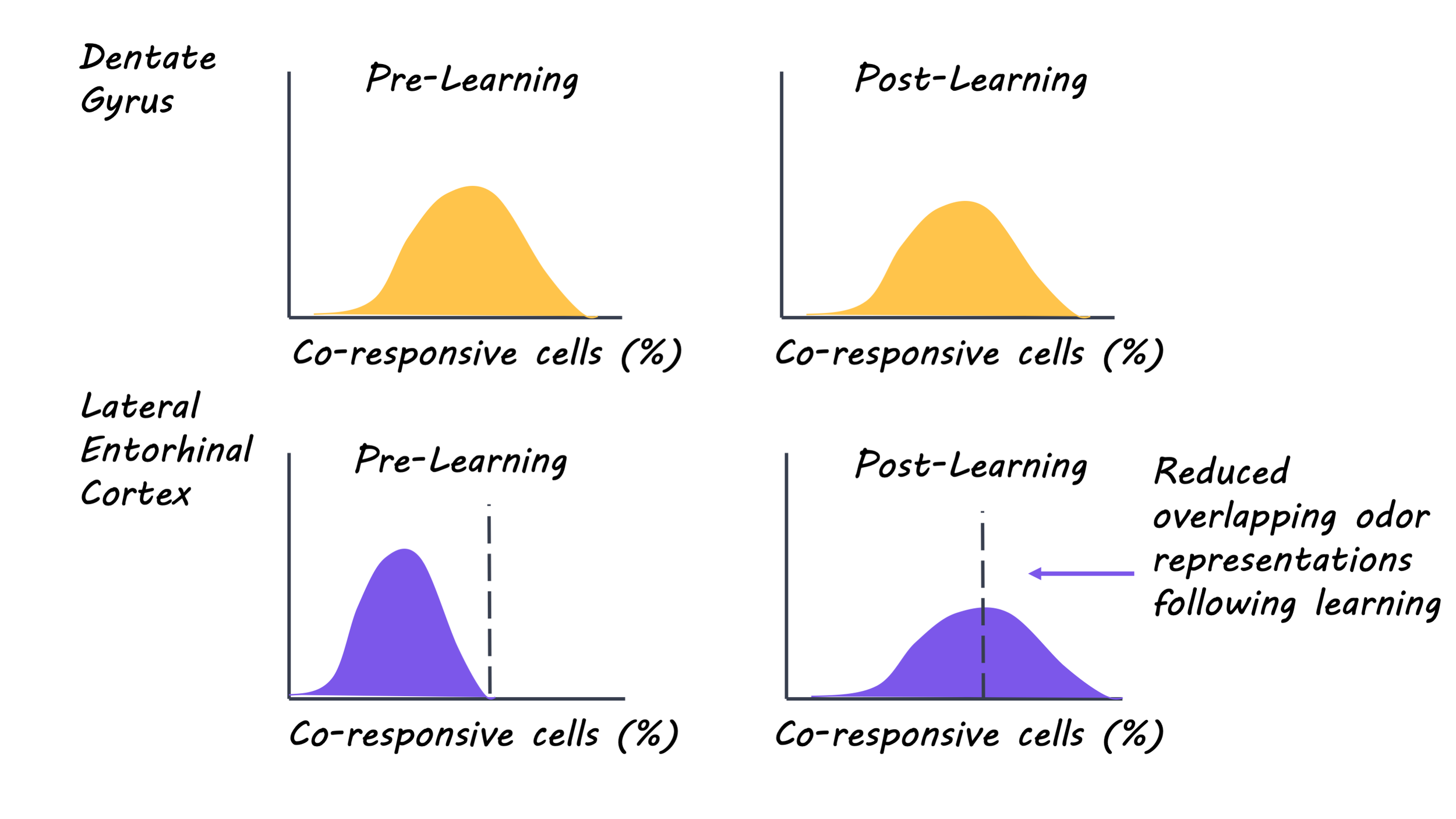
The authors found that dentate gyrus granule cells can represent odors based on how the population of cells fire, and that they require input from the lateral entorhinal cortex to do so. Mice with blocked communication between the lateral entorhinal cortex and the dentate gyrus did not show cellular activity in the dentate gyrus granule cells that predicted odor discrimination. The authors also found that the ability for dentate gyrus granule cells to accurately classify odors correlated with the mouse’s ability to behaviorally discriminate between odors. Mice that had the lowest smell decoder accuracy predicted by dentate gyrus cell firing were the worst at behaviorally discriminating between similar odors. Similarly, mice that had the highest smell decoder accuracy amongst dentate gyrus cells were the best at discriminating between similar smells. Finally, the authors found that in response to both fear and reward training, dentate gyrus granule cells change their responses to stimuli to set apart mental representations of the conditioned odor relative to unconditioned odors. Specifically, dentate gyrus cells began to respond more to the conditioned odor versus the unconditioned ones.
What's the impact?
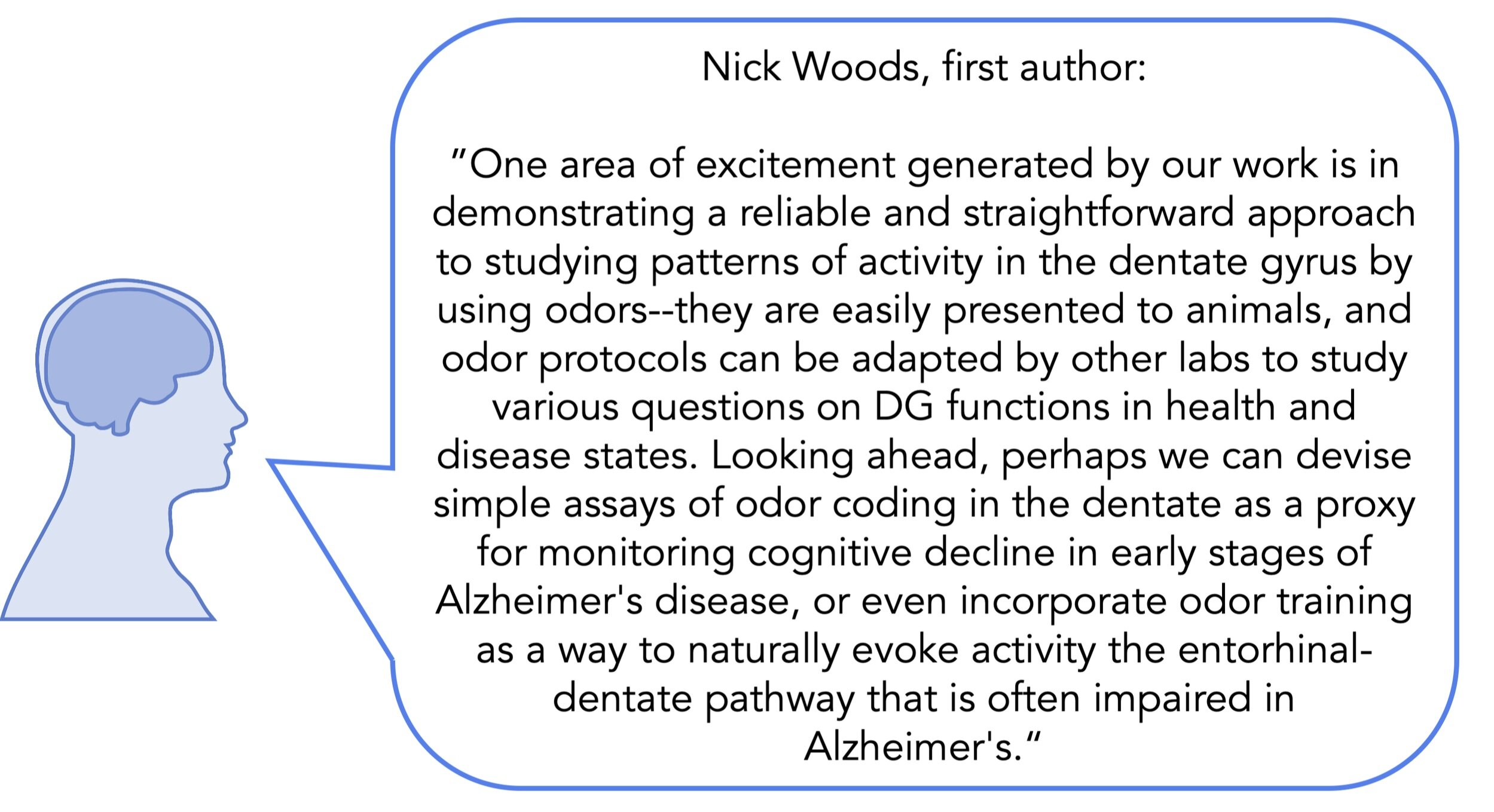
This study uses olfaction as a novel way to study memory formation in the hippocampus. The authors expand on previous work investigating upstream regions in the odor recognition circuit but are the first to demonstrate how dentate gyrus cells change an external odor stimulus into an internal representation that can be stored, acted upon, and modified by learning. These data potentially identify a location in the cortex-hippocampal circuit where information is modified into a behaviorally relevant format. This work has implications for the study of memory formation in the hippocampus in health and disease because the loss of smell is an early risk factor for neurodegenerative diseases such as Alzheimer’s disease, and the earliest aggregation of brain-damaging plaques happens specifically in the lateral entorhinal cortex, which this study highlights as an important region in odor discrimination.
Woods et al., The Dentate Gyrus Classifies Cortical Representations of Learned Stimuli, Neuron (2020). Access the original scientific publication here.