
Cortical Network Connectivity Tracks Working Memory Load
Post by Shireen Parimoo
What's the science?
Working memory is the ability to maintain and manipulate information in your mind – like trying to keep directions in mind while navigating. Working memory is critical for a wide range of cognitive functions such as learning, problem-solving, and decision-making, however, it is restricted in its capacity, meaning that only a limited amount of information can be processed in working memory at a given time. Thus, performance suffers when working memory load – or the amount of information to be processed – is higher than the working memory capacity. Interestingly, research shows that the connectivity between different brain regions is consistent across different working memory loads. However, it is possible that conventional analysis techniques do not capture subtle changes in connectivity patterns during working memory tasks. This week in NeuroImage, Eryilmaz, and colleagues used functional magnetic resonance imaging and machine learning techniques to identify load-dependent differences in functional connectivity during a working memory task.
How did they do it?
Participants were 177 healthy adults who completed the Sternberg item recognition task while undergoing fMRI scanning. In the encoding portion of the task, participants were shown a list of 1, 3, 5, or 7 consonants to remember. After a brief delay period, they were sequentially presented with 14 probe letters and had to indicate if they had seen those letters before (targets) or not (foils). Working memory load typically increases with an increasing number of targets (1T-7T) at encoding, resulting in longer response times (RT) at retrieval.
The authors first investigated how the functional connectivity of various brain regions during retrieval changed with increasing working memory load. These brain regions were assigned to one of seven brain networks, such as the dorsal and ventral attention networks (DAN/VAN), default mode network (DMN), and the frontoparietal control network (FPCN). A linear support vector machine (SVM) classifier (machine learning) was used to determine if the different working memory load conditions could be distinguished based on the patterns of functional connectivity within and between different brain networks. The authors further identified the strongest patterns of functional connectivity that could discriminate the lowest (1T) from the highest (7T) working memory load conditions using Neighborhood Component Analysis (a clustering machine learning technique). Finally, they used a leave-one-out cross-validation approach to determine whether connectivity within individual brain networks and across the entire cerebral cortex (global connectivity) predicted behavioral performance.
What did they find?
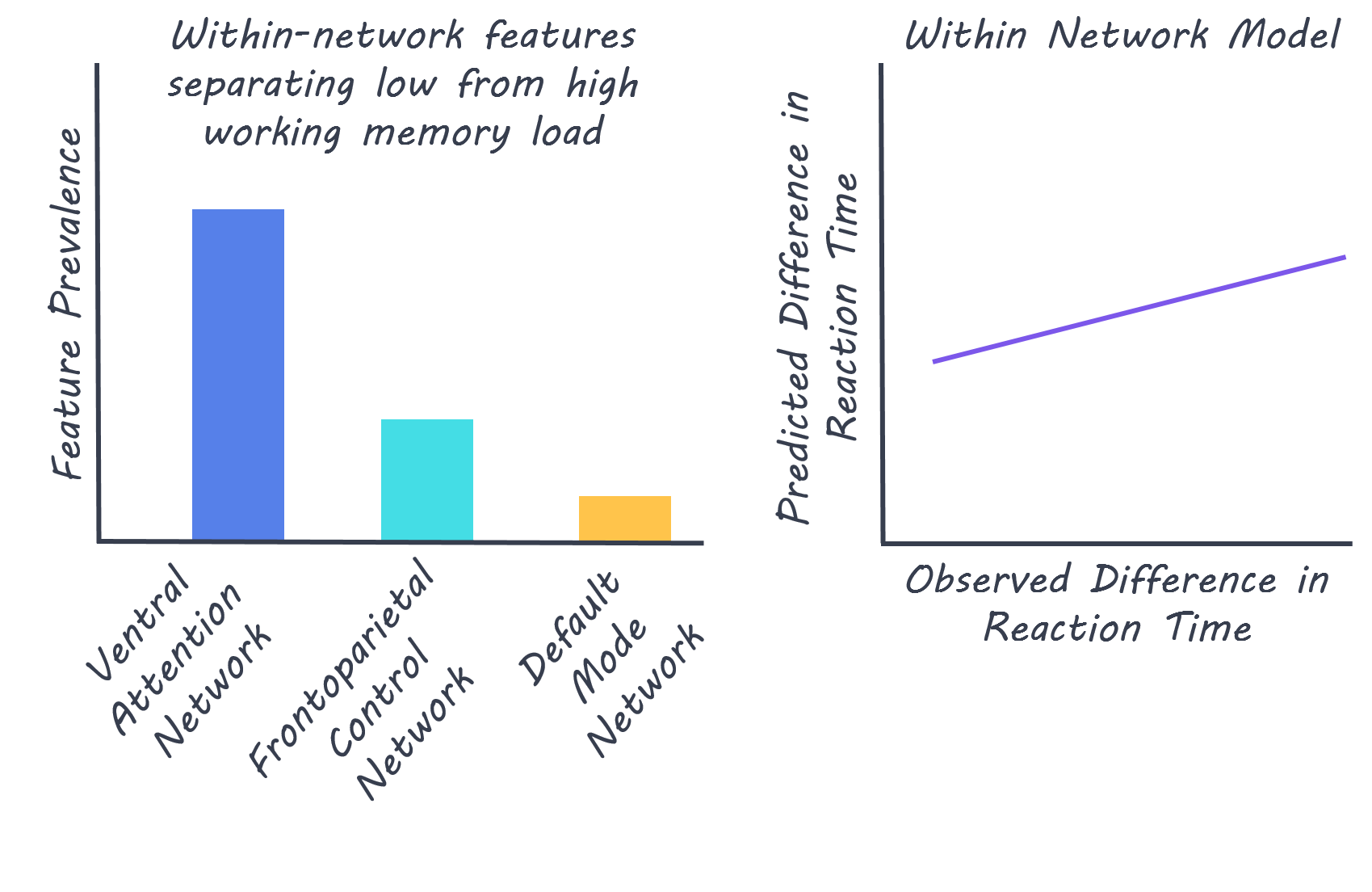
As expected, participants’ response times increased linearly with increasing working memory load. The load conditions could be reliably decoded from functional connectivity patterns across the brain using the SVM classifier. Classifier accuracy was greater when distinguishing between conditions with larger load differences (e.g., 3T vs. 7T) than between conditions with a smaller difference in working memory load (e.g., 5T vs. 7T). Functional connectivity of brain regions both within and between different brain networks tracked working memory load. For example, within-network connectivity in the VAN and the FPCN most strongly distinguished between the lowest (1T) and highest (7T) load conditions. Similarly, connectivity between regions in the FPCN and the DMN, along with VAN-DMN, DAN-VAN, and VAN-FPCN networks could also be used to distinguish between these load conditions. Finally, differences in connectivity within each individual network was not correlated with behavioral performance. However, a measure of network strength derived from total within-network connectivity as well as from global connectivity during the 1T and 7T conditions successfully predicted the differences in participants’ RT during the task.
What's the impact?
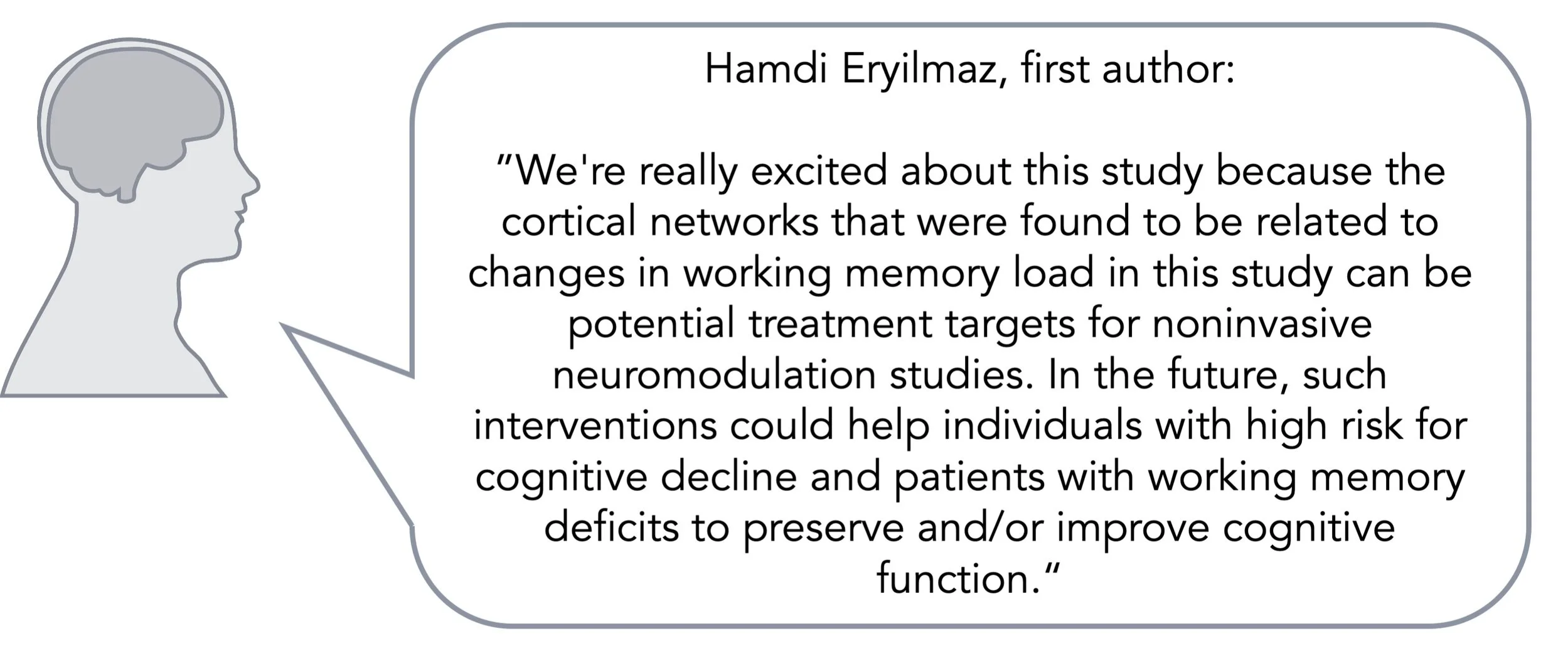
The authors of this study used machine learning techniques to demonstrate how the reconfiguration of connectivity patterns between a distributed network of brain regions varies with working memory load. Moreover, these connectivity differences were also predictive of behavioral performance in healthy adults. This is exciting because this approach can be further extended to improve our understanding of subtle differences in brain network dynamics in neuropsychiatric conditions, such as those characterized by working memory deficits.
Eryilmaz et al. Working memory load-dependent changes in cortical network connectivity estimated by machine learning. NeuroImage (2020). Access the original scientific publication here.