
Step Count Could Lower Risk of Cognitive Decline

Post by Anastasia Sares

The takeaway

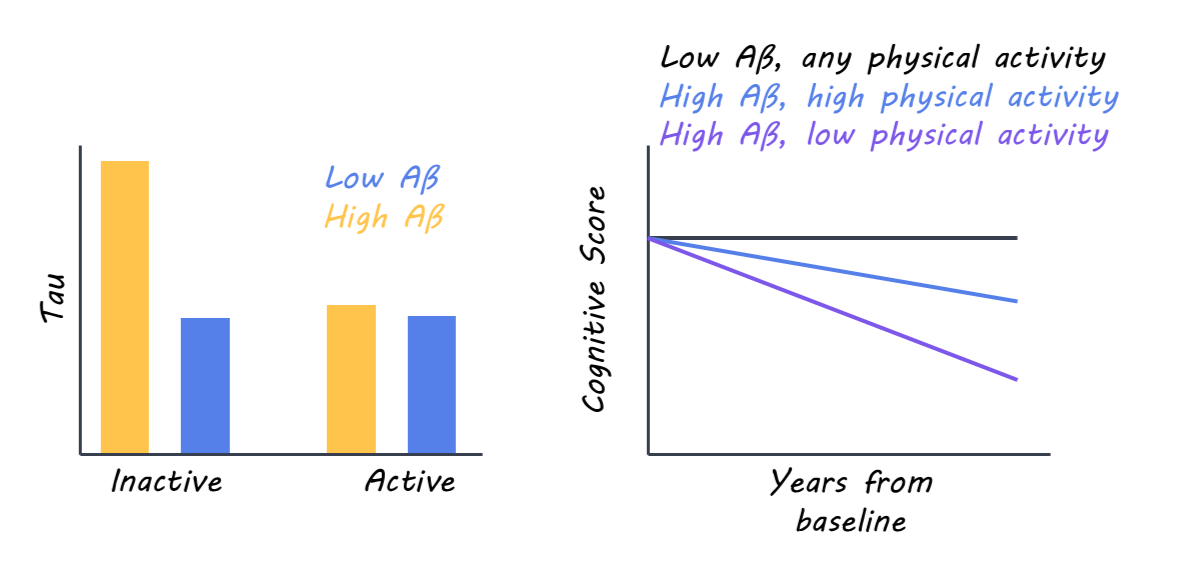
A 14-year-long study on the changes in cognition of older adults showed that for those at higher risk for cognitive decline (higher Aβ), a moderate level of activity (5,000+ steps) was associated with less cognitive decline. For these people, physical activity was linked to levels of the protein called tau in the brain, and this accounted for most of the changes in cognition.

What's the science?

Alzheimer’s disease and other dementias are an area of intense medical interest, especially now that people are living longer. There have been many studies establishing an association where greater exercise is linked to decreased cognitive decline (previous BrainPost on the subject here); however, these studies are just that—associations. There are a few elements that scientists can improve to better understand this link.

First of all, many studies are cross-sectional. That is, the data are gathered at a single point in time. So, while a cross-sectional study may sample people across different ages, they do not follow the same participants over time to see how their health evolves based on different factors. In contrast to this are longitudinal studies, which do follow participants over time, but these are relatively rare since they are more time and resource-intensive.

Second, variables like “exercise” and “memory” are often measured via a questionnaire, since this is more convenient. However, this can be problematic if respondents do not answer reliably, which is a concern when studying people with potential cognitive decline. More objective methods of measuring these variables exist: step counters are very common and can gather objective data about daily activity levels.

This week in Nature Medicine, Yau and colleagues reported the results of a longitudinal study (part of the Harvard Aging Brain Study or HABS), which included activity measured with step counters, cognitive testing, and brain imaging. They show the relationship between moderate physical activity and preserved cognitive function, along with a potential mediating mechanism in the brain.

How did they do it?

The study included 296 people from the HABS study who were cognitively unimpaired when they first signed up for the research. Participants were asked to wear a pedometer for a week near the beginning of their participation to measure their step counts. In addition, the authors selected participants who had undergone at least two rounds of cognitive testing (PACC5) as well as PET imaging at the time of the study.

PET (Positron Emission Tomography) is a neuroimaging technique used to identify different molecules in the brain with the help of a tiny amount of radioactive tracers. The researchers used PET imaging to measure levels of Aβ and tau, two proteins known to be involved in Alzheimer’s pathology. People with naturally high levels of Aβ are more at risk for cognitive decline, and the accumulation of tau proteins in the brain may be one part of that process of decline. The authors suspected that higher physical activity might be related to less accumulation of tau in the brain, which would in turn be associated with better cognition, but only for people with high Aβ (which puts them at higher risk). This kind of relationship is called a mediation.

What did they find?

Participants with low Aβ levels experienced less cognitive decline than those with high Aβ levels, and physical activity did not have much of an effect. However, for those with high Aβ, there was a significant effect of physical activity, with participants who logged more than 5,000 steps seeing the best results. Mediation analyses showed that for these people, cognitive decline was fully mediated by tau accumulation: that is, physical activity was related to less tau accumulation, and less tau was related to less cognitive decline. The activity didn’t have any further relationship with cognitive decline after accounting for the relationship with tau. The effect of activity plateaued after 5,000 steps, suggesting this is a good target for older adults to start increasing their step count.
What's the impact?

This study strengthens our confidence in the ability of exercise to stave off cognitive decline. Increasing step count is one way for older adults to improve physical activity and lower their risk of cognitive decline with aging. To further validate the effectiveness of exercise to combat aging, we need randomized controlled trials where people are assigned randomly to different levels of exercise and see whether the effect holds.

Access the original scientific publication here.

Astrocyte Ensembles are Involved in Memory Stabilization and Recall

Post by Amanda Engstrom

The takeaway

Engrams are the physical traces of memory in the neurons of the brain. This study reveals that astrocytes play a more direct role than previously thought, forming lasting ensembles that reactivate during memory recall. These astrocytic ensembles, driven by noradrenergic signaling, act as a multiday trace that helps stabilize and preserve memories over time.

What's the science?

Memory formation and stabilization involve specific neuronal ensembles, or groups of interconnected neurons that work together. Chemical and physical changes in these neurons then form memory traces – called engrams – to be activated during learning and recall. Remembering something transiently destabilizes memories, but the mechanism that subsequently re-stabilizes the memory is not completely understood and cannot be explained by neuronal engrams alone. Astrocytes are highly abundant non-neuronal cells within the central nervous system (CNS) that interact both structurally and functionally with neurons and other glial cells. They are known to be developmentally diverse and adaptive to physiological and pathological changes; however, the role of astrocytes in forming or stabilizing experience-dependent memories is not clear. This week in Nature, Dewa and colleagues investigated astrocytes that respond to memory formation and recall in order to assess their contribution to memory stabilization.

How did they do it?

The authors developed a tool to identify behaviorally relevant astrocyte ensembles in an unbiased manner by generating mice that allow them to label astrocytes that have been activated (marked by an increase in Fos gene expression) during a specific time window. For their studies, the authors “tagged” astrocytes either during a fear conditioning protocol or 24 hours later in a fear memory recall session. They then compared astrocyte activation with neuronal engram activity in the same fear conditioning paradigm. Once the authors identified the astrocyte ensembles, they performed a pharmacological screening for molecules that can activate astrocyte Fos expression and validated these target molecules through circuit analysis, imaging, and single-cell transcriptomics. Next, the authors determined the transcriptional response to memory formation and recall at different timepoints. Finally, they perturbed the astrocyte ensemble by using a peptide inhibitor to silence the target signaling cascade, as well as enhanced the ensemble signaling by overexpressing downstream signaling targets. Then they tested the efficiency of fear conditioning and recall using the same behavioral fear paradigm.  

What did they find?

The density of activated (Fos+) astrocytes did not significantly increase immediately after fear conditioning. However, 24 hours later, during recall, there was a significant increase in the number of activated astrocytes across the entire brain, especially in the amygdala, compared to fear conditioning without recall. This is unique to astrocytes, as neurons are activated both during fear conditioning and recall. There was a significant regional correlation between neuronal and astrocyte activation at recall, suggesting that astrocyte ensembles are recruited in regions of active neuronal engrams. The authors identified noradrenaline (NA) as a strong inducer of Fos expression in astrocytes, and using fiber photometry, (an imaging technique to measure cellular activity) determined that during fear recall, NA signals are stronger and last longer than during fear conditioning.

The single-cell transcriptomics on astrocytes in the amygdala revealed that after fear conditioning, astrocytes upregulate adrenergic receptor genes (Adra1a and Adrb1), which increased in expression over 24 hours, indicating a “priming” state that develops over a day and then decreases over time. Disrupting the astrocyte ensemble disrupted memory stability and reduced the mouse’s response in the fear recall test. When the ensemble was enhanced through the overexpression of Adrb1 in astrocytes, the density of activated astrocytes increased, and improved memory retention and recall. Together, these results show that fear conditioning induces an astrocyte ensemble that is primed via NA signaling and persists for roughly one day. Upon recall, the astrocyte ensemble is activated and stabilizes the memory.

What's the impact?

This study is the first to show that astrocytes form their own experience-dependent ensembles that reactivate during memory recall and help stabilize memories over multiple days. This work expands the traditional neuron-centric view of memory consolidation and argues for the critical role of astrocytes in memory stabilization and recall. 

How Psychedelics Affect Neurovascular Function

Post by Shireen Parimoo

The takeaway

Psychedelics like psilocybin exert their hallucinogenic effects by acting on 5HT2A serotonin receptors in the brain, and fMRI has been used to measure how this is reflected in neuronal activity. This research shows that psychedelics affect not only neuronal activity but also vascular activity (i.e., blood vessel activity) in the brain in distinct ways, meaning both need to be considered when using fMRI.

What's the science?

Psychedelic compounds like psilocybin have seen a surge of interest in recent years due to their potential to treat mood and substance use disorders. Many psychedelics have hallucinogenic effects through their action on serotonin receptors (5HTRs) in the brain. These serotonin receptors are primarily located in brain areas associated with higher-order cognitive functions, such as the default-mode network regions, including the retrosplenial cortex. In humans, functional magnetic resonance imaging (fMRI) studies show that psychedelics reduce functional connectivity within DMN regions but increase connectivity between the DMN and other areas of the brain. 

Functional MRI records the hemodynamic response that occurs following neural activity, but is not well-suited to differentiate between neural activity and vascular activity in the brain. Moreover, 5HTRs are located on both neurons that give rise to neural activity and astrocytes, which are involved in vascular coupling between neurons and blood vessels. Thus, it is presently unclear whether psychedelics exert their effects by modulating neural activity, vascular responses, or both. This week in Nature Neuroscience, Padawer-Curry and colleagues used optical imaging techniques to investigate the neurovascular origins of psychedelic-induced hemodynamic responses and functional connectivity in the brain.

How did they do it?

The authors performed wide-field optical imaging in mice during a whisker stimulation task and during rest. This technique can be used to measure both neural activity via calcium imaging and vascular or hemodynamic activity simultaneously. Mice were injected with either (i) 2,5-dimethoxy-4-iodoamphetamine (DOI), a hallucinogenic agonist of the 5HT2A receptor, (ii) MDL, a selective antagonist of 5HT2A receptors, (iii) DOI + MDL, (iv) saline, or (v) lisuride, a non-hallucinogenic 5HT2A receptor agonist. Notably, administering DOI and MDL together enabled them to determine whether the effects of psychedelics are specific to the 2A serotonin receptor, while administering lisuride helped determine whether these receptors were important for hallucinogenic as compared to non-hallucinogenic receptor activation.  

To distinguish between vascular and neuronal origins of the HRF, they recorded changes in hemodynamic and neural activity in response to whisker stimulation (i.e., task) and at rest. Power spectral density (PSD) was used as a measure of neural and hemodynamic activity across different frequency bands. The authors examined PSD in the infraslow (0.01-0.08 Hz), intermediate (0.08 – 0.50 Hz), and the delta frequency bands (0.50 – 4.00 Hz), which helped distinguish the neural and hemodynamic responses at different timescales. Finally, resting-state functional connectivity between regions was calculated from the neuronal and hemodynamic responses to obtain measures of intra- and inter-network connectivity

What did they find?

Administration of DOI altered hemodynamic and neuronal activity in a regionally specific manner. For instance, hemodynamic responses increased in regions like the somatosensory and auditory cortex. In contrast, neuronal activity in the retrosplenial cortex and somatosensory regions was reduced. The shape of the HRF following DOI was narrower, while simultaneous injection of MDL and DOI did not have this effect on the HRF, indicating that DOI disrupts neurovascular coupling through its effect on 5HT2A receptors

There was a divergence in the effects of DOI on neuronal compared to hemodynamic activity across frequency bands. Specifically, global neuronal activity increased in the delta band but decreased in the intermediate frequency band following DOI injection. Global hemodynamic activity, on the other hand, only increased in the delta band. At a regional level, neuronal activity in the infraslow band increased in frontal and motor regions, while hemodynamic activity increased in somatosensory regions. In the intermediate frequency band, neuronal activity showed broad reductions but an increase in frontal and cingulate regions, whereas hemodynamic activity decreased in the frontal and cingulate cortex. In the delta band, both neuronal and hemodynamic activity increased in response to DOI, but in different regions. 

Finally, DOI altered network-level organization as measured by neuronal responses. Across most of the cortex, DOI reduced intra-network connectivity and increased inter-network connectivity, while the cingulate cortex showed greater intra-network connectivity with the DMN. Conversely, hemodynamic-based network dynamics showed minimal connectivity changes in response to DOI. Interestingly, co-administration of MDL largely reversed the effects observed following DOI administration alone. This demonstrates that DOI acts specifically through the 5HT2A receptors and differentially disrupts vascular and neuronal processes in the brain

What's the impact?

This study found that psychedelics disrupt both neuronal and vascular responses through their action on 5HT2A receptors in the brain, identifying a potential mechanism through which psychedelics induce changes in brain network connectivity. Importantly, this indicates that hemodynamic measures of brain activity – such as those measured using fMRI in humans – may be capturing signals other than neural activity in psychedelic states.

Access the original scientific publication here.