Striving for a Happier Brain

Post by Rebecca Glisson 

The takeaway

Recent studies have examined how happiness originates in the brain. The more we understand how we feel happy, the better we can work toward improving happiness at a societal level.

Searching for happiness in a stressful time

If you’ve been feeling stressed lately by recent events – climate change, political events, economic hardships – and you’re wondering how to find happiness and stay resilient, rest assured that scientists are wondering alongside you. Recent studies are exploring the link between stress and how our brains create the feeling of happiness. The World Health Organization, for example, reports that mental health issues are on the rise globally and that mental health impacts our ability to function in our daily lives. Another study has found that the more income inequality a nation experiences, the greater the inequality in national happiness. By understanding the neurobiology of happiness and how stress interferes, we can work to shape our society to increase overall happiness levels.

Dopamine and social media

Dopamine is a neurotransmitter that is widely associated with rewarding behavior. For example, when you eat something enjoyable, dopamine is released in the brain, you feel pleasure, and are more likely to repeat that behavior. However, stress can negatively impact how dopamine functions in response to pleasurable behaviors. Studies in rats have found that chronic stress is associated with less dopamine production in response to rewarding stimuli. In people, chronic stress could lead to a smaller and smaller dopamine response over time, which can result in more and more reward-seeking behavior to achieve the same dopamine response. You may have experienced this if you’ve ever gotten caught in a loop of endlessly browsing social media: looking at a new video or seeing a notification only releases a small amount of dopamine that disappears quickly, which starts a loop of further scrolling that releases even more dopamine. Limiting this kind of social media use is recommended, as it prevents you from developing a higher and higher tolerance to the dopamine response.

Oxytocin and social bonding

Another molecule associated with happiness in the brain is oxytocin, a hormone released in response to social bonding. One study found that if given an extra dose of oxytocin, a person will be more friendly to a stranger who gives them help. Another study showed that oxytocin given to depressed patients helps to maintain attention to a happy face. It is no wonder, then, that forced separation from regular social interaction due to pandemic shutdowns would lead to less oxytocin in our systems and less happiness from social lives.

What can we do to increase our happiness?

One science-backed way to increase happiness is by developing and maintaining strong social bonds, which are crucial for our well-being. We can work towards creating spaces for social bonding by designing our cities and living areas to foster meaningful social connections. Libraries and parks are great examples of places such as these where local events can lead to positive social interactions that can decrease our stress levels and increase our happiness over time.

References +

Alexander, R., Aragón, O. R., Bookwala, J., Cherbuin, N., Gatt, J. M., Kahrilas, I. J., ... & Styliadis, C. (2021). The neuroscience of positive emotions and affect: Implications for cultivating happiness and wellbeing. Neuroscience & Biobehavioral Reviews, 121, 220-249.

Bates, C. R., Bohnert, A. M., & Gerstein, D. E. (2018). Green schoolyards in low-income urban neighborhoods: natural spaces for positive youth development outcomes. Frontiers in psychology, 9, 805.

Berridge, K. C., & Kringelbach, M. L. (2011). Building a neuroscience of pleasure and well-being. Psychology of Well-Being: Theory, Research and Practice, 1, 1-26.

Di Chiara, G., Loddo, P., & Tanda, G. (1999). Reciprocal changes in prefrontal and limbic dopamine responsiveness to aversive and rewarding stimuli after chronic mild stress: implications for the psychobiology of depression. Biological psychiatry, 46(12), 1624-1633.

Domes, G., Normann, C., & Heinrichs, M. (2016). The effect of oxytocin on attention to angry and happy faces in chronic depression. BMC psychiatry, 16, 1-8.

Human, L. J., Woolley, J. D., & Mendes, W. B. (2018). Effects of oxytocin administration on receiving help. Emotion, 18(7), 980.

Macit, H. B., Macit, G., & Güngör, O. (2018). A research on social media addiction and dopamine driven feedback. Journal of Mehmet Akif Ersoy University Economics and Administrative Sciences Faculty, 5(3), 882-897.

Pressman, S. D., Jenkins, B. N., & Moskowitz, J. T. (2019). Positive affect and health: What do we know and where next should we go?. Annual review of psychology, 70(1), 627-650.
The Body Responds to “Cold Memories”

Post by Anastasia Sares

The takeaway

This study shows that bodily responses to warm and cold environments can be changed through conditioning, just like other behaviors. It also identifies a network of neurons including the hippocampus (important for forming memories) and the hypothalamus (important for controlling basic bodily states) that, when stimulated in mice, can reactivate these “cold memories,” causing their body to act as if it is in a cold environment even when the temperature is normal.

What's the science?

In Pavlovian conditioning, an animal learns to associate a stimulus with a consequence, and soon, the animal reacts to the stimulus alone, even when the consequence is absent. Classically, Pavlovian conditioning was demonstrated by teaching a dog that it would get food after the sound of a bell. Soon, the bell alone is enough to make the dog begin to salivate, even in the absence of food. In modern days, we have methods that allow us to record and stimulate specific brain circuits to figure out what parts of the brain are responsible for this conditioning.

This week in Nature, Muñoz Zamora and colleagues combined Pavlovian conditioning and modern cell neuroscience techniques to first locate—and then stimulate—the brain network in mice that connects contextual memories to our temperature regulation system.

How did they do it?

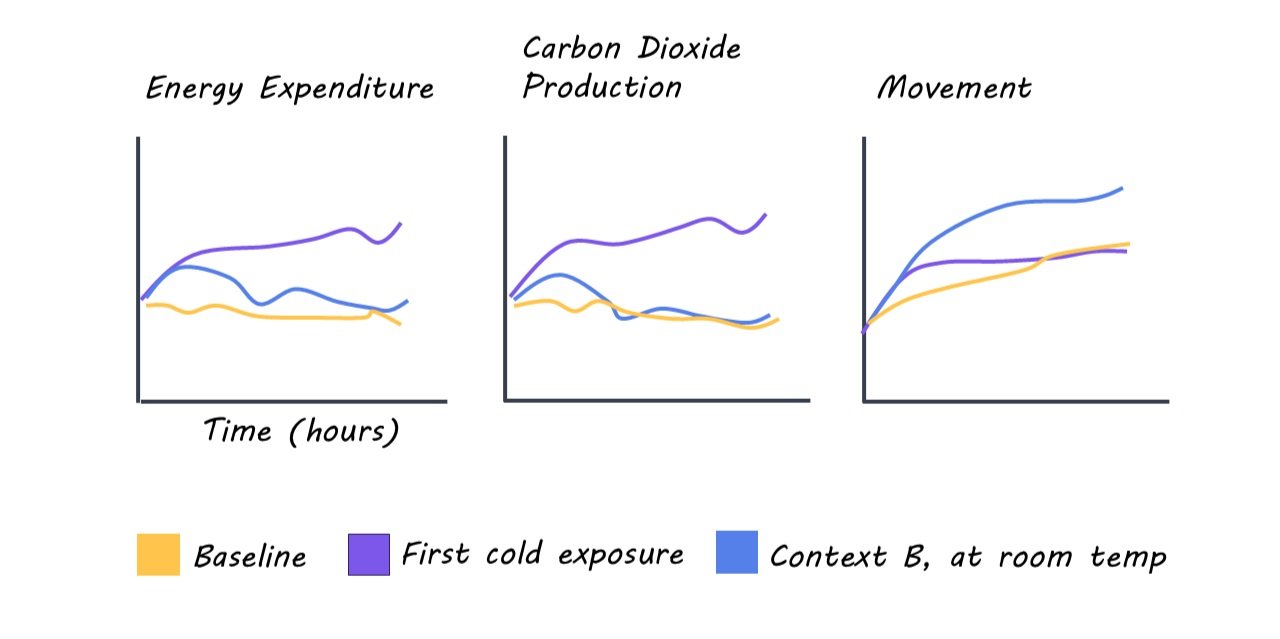
The authors placed mice into two different contexts over several training days: context A was a unique environment that was always at room temperature (21°C), while context B was a different unique environment that was always around refrigerator temperature (4°C). Being in a cold environment changes the mouse’s metabolism, burning a special kind of fat and consuming more oxygen and energy. At test time, they exposed the mice to context B but at room temperature. This way, whatever brain and body responses the mice had would be from their memory of the cold, not any actual cold.

To tell which cells are active while learning this association, the authors euthanized some mice after each of three phases: baseline (normal temperature, context A), first cold exposure (cold temperature, context B), and cold memory test (normal temperature, context B). They tested the brains for a type of gene (FOS) that is turned on in response to recent neural activity.

Finally, the authors were able to activate or suppress the groups of cells that had been involved in the temperature response. The method used to activate specific cells is called optogenetics, and it involves inserting a gene that makes neurons fire when exposed to light. Implanted lights can then be used to turn certain cells on in a precise manner. To suppress the circuit, the authors used a different process that relies on chemicals that bind to specific cells and inhibit their activity.

What did they find?

Upon exposure to a cold environment, oxygen use, energy use, and movement increased as mice responded to the new temperature. The mice’s metabolism also accelerated, as indicated by an increased amount of RNA in their cells relating to temperature regulation. After being trained to experience cold temperatures in context B, the mice’s brains and bodies went into this same “cold mode” anytime they were exposed to context B, even when it was no longer cold. This confirmed that the Pavlovian conditioning had worked.

The authors observed that the brains of mice that had recently done the cold memory test (context B, but room temperature) had higher FOS expression in certain brain areas, including the hypothalamus, which is responsible for regulating bodily states, and parts of the hippocampus, a structure involved in forming memories. They concluded that these two structures worked together to create this learned cold response. Further experiments confirmed that this pattern of expression was not a general stress response, but specific to cold. Targeting these cells with optogenetics allowed them to activate this network. Activating the network re-created cold response behaviors in mice. Chemical inhibition also removed the cold response in mice that had already learned it.

What's the impact?

The ability to regulate body temperature efficiently is important to survival, especially in climates with harsh weather. If mammals are able to use context to anticipate temperature changes, this could have helped them immensely in their evolutionary path. This research shows that our experiences and memories can affect bodily processes that we usually think of as “purely physical.”

Access the original scientific publication here.

How Does Early-Life Environment Influence the White Matter Architecture of the Brain?

Post by Soumilee Chaudhuri 

The takeaway

Early-life environments exert broad, system-level influences on white matter architecture across the brain. These structural differences, in turn, predict meaningful variation in cognitive abilities during adolescence. 

What's the science?

While white matter tracts in the brain are present at birth, they continue to mature in a highly experience-dependent manner throughout childhood. This maturation is influenced by neuronal activity and environmental exposures, particularly those characterized by adversity. Early-life adversity can affect white matter development through altered myelination, immune activation, and inflammatory processes—factors that may underlie the established links between adverse environments and later cognitive outcomes. Recently, in PNAS, Carozza and colleagues investigated how early life environments—both adverse and protective—are associated with brain development in children. 

How did they do it?

Using diffusion MRI data from 9,291 children (mean age 9.5 years) in the Adolescent Brain Cognitive Development (ABCD Study), researchers assessed the associations between socioeconomic status, adversity, and resilience and white matter microstructure, which supports brain connectivity and function. Cognitive abilities were assessed using three tests: a language ability test, an inhibitory control test, and a math ability test. The language test involved matching words with pictures, the inhibitory control test assessed how well children could ignore distractions while reading emotional words, and the math ability test measured how quickly and accurately children could solve math problems. For analysis, the researchers used partial least squares (PLS) regression to explore the relationship between early-life factors, such as socioeconomic status, and brain structure. They employed matching techniques to test whether adversity-associated white matter differences were relevant for cognition.

What did they find?

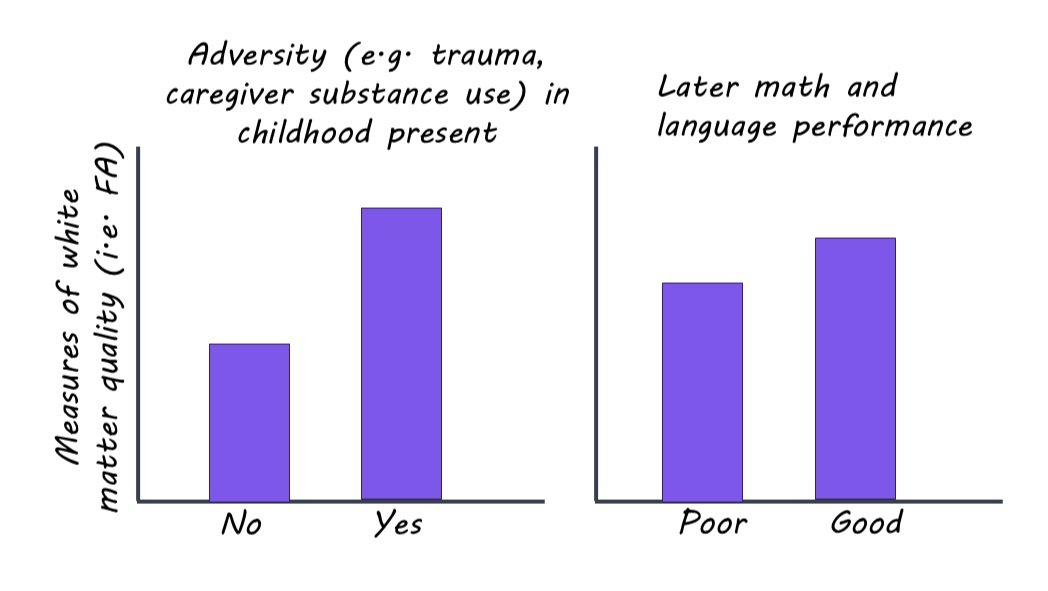
The study found that higher family income was significantly associated with higher Fractional Anisotropy (FA), a measure of white matter quality, in key areas, and these associations held even after adjusting for age, sex, differences in MRI scanner site, and body mass index.

Next—in the data-driven analysis used to examine 73 major white matter tracts and their relationship to 19 environmental variables; the researchers found that greater neighborhood vulnerability, trauma exposure, and caregiver substance use were each significantly associated with lower white matter integrity across the whole brain, while higher income and two-parent households were associated with higher white matter quality. Importantly, these associations between the environment and the brain formed one single pattern, rather than individual factors having selective relationships with specific white matter tracts. Among children living below the poverty line, lower global white matter quality was significantly associated with lower cognition, including math and language performance.

Overall, the researchers confirmed earlier findings showing that children from lower-income households or those exposed to adversity tend to have differences in their brain’s white matter. It was shown that children who experienced more adversity or lacked supportive environments had lower levels of white matter integrity across nearly the entire brain, not just in a few areas. These brain differences were related to how well children later performed on tasks involving language and math. Importantly, social and environmental supports—like positive parenting or strong neighborhood ties—were linked to healthier white matter development, suggesting they might help protect the brain despite difficult circumstances. 

What's the impact?

This study is a comprehensive examination of how early-life environments shape the brain’s white matter development on a whole-brain level, using a large, population-representative adolescent cohort. This research shows that supporting children’s environments early in life can make a real difference in brain and cognitive development, and that we should think about the brain as a connected system, not just isolated pieces. In particular, growing up in environments with lower economic resources and social support is linked to widespread differences in how white matter develops. These brain differences matter: they are connected to how well children do later in important areas like language and problem-solving.