
The Body Responds to “Cold Memories”
Post by Anastasia Sares
The takeaway
This study shows that bodily responses to warm and cold environments can be changed through conditioning, just like other behaviors. It also identifies a network of neurons including the hippocampus (important for forming memories) and the hypothalamus (important for controlling basic bodily states) that, when stimulated in mice, can reactivate these “cold memories,” causing their body to act as if it is in a cold environment even when the temperature is normal.
What's the science?
In Pavlovian conditioning, an animal learns to associate a stimulus with a consequence, and soon, the animal reacts to the stimulus alone, even when the consequence is absent. Classically, Pavlovian conditioning was demonstrated by teaching a dog that it would get food after the sound of a bell. Soon, the bell alone is enough to make the dog begin to salivate, even in the absence of food. In modern days, we have methods that allow us to record and stimulate specific brain circuits to figure out what parts of the brain are responsible for this conditioning.
This week in Nature, Muñoz Zamora and colleagues combined Pavlovian conditioning and modern cell neuroscience techniques to first locate—and then stimulate—the brain network in mice that connects contextual memories to our temperature regulation system.
How did they do it?
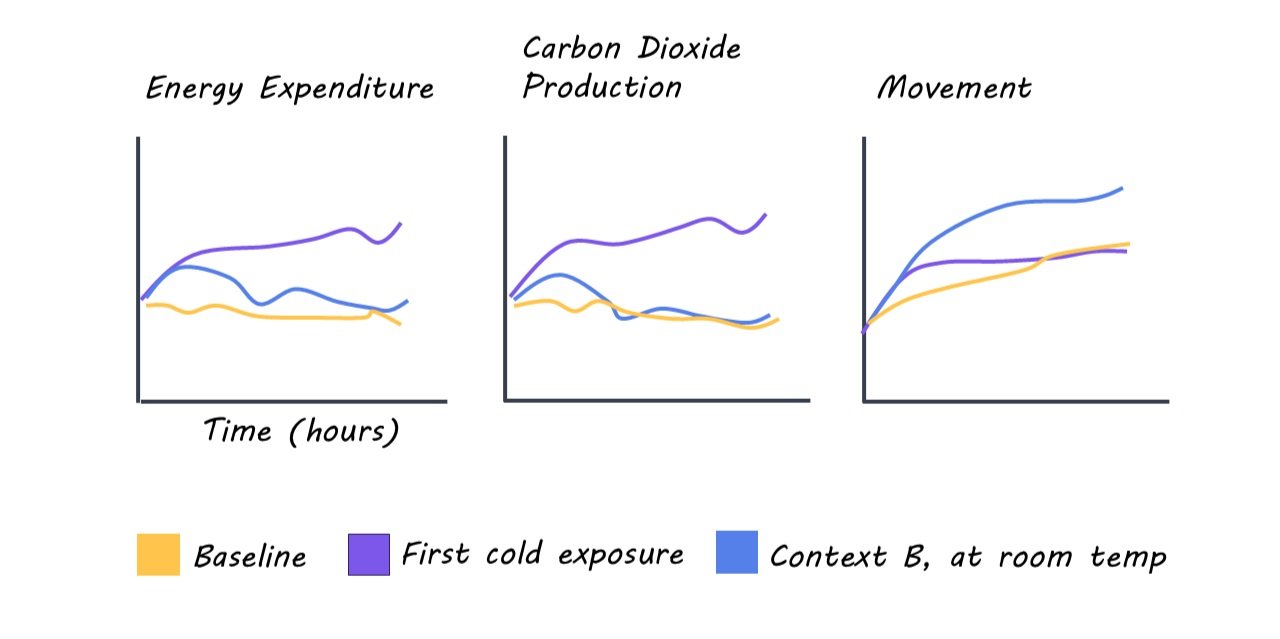
The authors placed mice into two different contexts over several training days: context A was a unique environment that was always at room temperature (21°C), while context B was a different unique environment that was always around refrigerator temperature (4°C). Being in a cold environment changes the mouse’s metabolism, burning a special kind of fat and consuming more oxygen and energy. At test time, they exposed the mice to context B but at room temperature. This way, whatever brain and body responses the mice had would be from their memory of the cold, not any actual cold.
To tell which cells are active while learning this association, the authors euthanized some mice after each of three phases: baseline (normal temperature, context A), first cold exposure (cold temperature, context B), and cold memory test (normal temperature, context B). They tested the brains for a type of gene (FOS) that is turned on in response to recent neural activity.
Finally, the authors were able to activate or suppress the groups of cells that had been involved in the temperature response. The method used to activate specific cells is called optogenetics, and it involves inserting a gene that makes neurons fire when exposed to light. Implanted lights can then be used to turn certain cells on in a precise manner. To suppress the circuit, the authors used a different process that relies on chemicals that bind to specific cells and inhibit their activity.
What did they find?
Upon exposure to a cold environment, oxygen use, energy use, and movement increased as mice responded to the new temperature. The mice’s metabolism also accelerated, as indicated by an increased amount of RNA in their cells relating to temperature regulation. After being trained to experience cold temperatures in context B, the mice’s brains and bodies went into this same “cold mode” anytime they were exposed to context B, even when it was no longer cold. This confirmed that the Pavlovian conditioning had worked.
The authors observed that the brains of mice that had recently done the cold memory test (context B, but room temperature) had higher FOS expression in certain brain areas, including the hypothalamus, which is responsible for regulating bodily states, and parts of the hippocampus, a structure involved in forming memories. They concluded that these two structures worked together to create this learned cold response. Further experiments confirmed that this pattern of expression was not a general stress response, but specific to cold. Targeting these cells with optogenetics allowed them to activate this network. Activating the network re-created cold response behaviors in mice. Chemical inhibition also removed the cold response in mice that had already learned it.
What's the impact?
The ability to regulate body temperature efficiently is important to survival, especially in climates with harsh weather. If mammals are able to use context to anticipate temperature changes, this could have helped them immensely in their evolutionary path. This research shows that our experiences and memories can affect bodily processes that we usually think of as “purely physical.”