
Investigating the Organization of Brain Tumor Cells Using New High-Resolution Technologies

Post by Natalia Ladyka-Wojcik

The takeaway

Using new technologies for studying the spatial architecture of gliomas reveals both local and global organization that are largely driven by hypoxia (i.e., when oxygen is not sufficiently available at the tissue level), providing critical insights for the future of cancer treatment research.

What's the science?

Glioma is a type of cancer that starts as a growth of cells in the brain or spinal cord, rapidly invading and destroying healthy surrounding tissue. Critically, gliomas are characterized by a very complex spatial architecture, making it difficult to determine the organization of their cell types and cellular states. Until recently, histopathology – or the examination of cancerous tissue under a microscope – was the dominant method for studying cell types and cellular states of gliomas, but histopathology lacks the granularity to fully capture the spatial architecture of gliomas. New technological developments have been made in spatial transcriptomics, a molecular profiling method allowing researchers to measure all gene activity in a tissue sample. When paired with advances in the study of proteins (i.e., proteomics), researchers are enabled to measure all gene activity in a tissue sample, offering new opportunities to map the complex spatial architecture of gliomas. This week in Cell, Greenwald and colleagues profiled glioma tissue samples using these new technologies to develop a framework for systematically describing the spatial organization of gliomas.

How did they do it?

The authors investigated glioma samples from patients who had undergone tumor resection across multiple hospital sights, and whose tumors ranged in their specific location in the brain as well as in their key biomarkers. These samples were frozen by liquid nitrogen for preservation and then profiled using spatial transcriptomics within one week. Broadly, the goal of spatial transcriptomics is to count the number of transcripts of a gene at distinct spatial locations in a tissue. More specifically, the authors used a commercialized transcriptomics technique, called “Visium”, to spatially profile the glioma samples at a high level of spatial granularity. This allowed the authors to investigate not only the patterns of organization across gliomas but also to determine to what degree the spatial location of gliomas affects the diversity of cellular states.

What did they find?

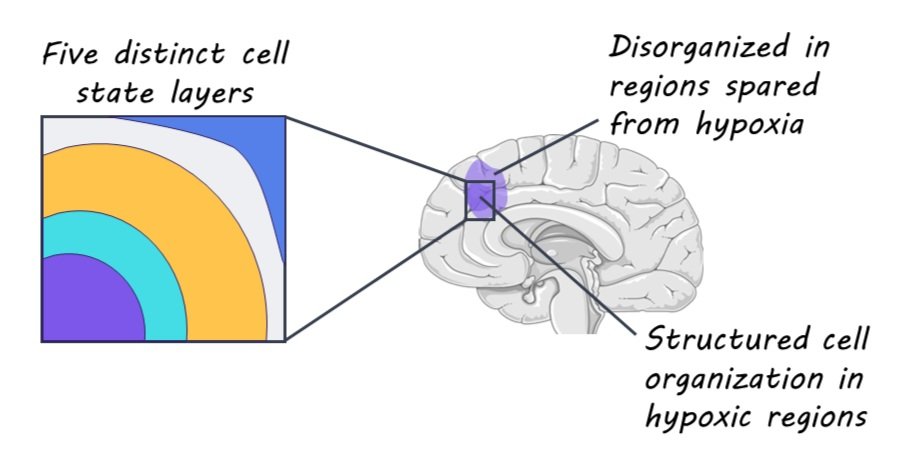
The authors identified three key modes of glioma organization, each respectively focused on 1) the local environment of glioblastoma tumors, 2) the pairing of cellular states across tumors, and 3) the global architecture of the tumors. The first key mode of glioma organization that the authors found is that cells tend to be surrounded by other cells in the same state, forming local environments that are highly homogeneous in configuration and gene expression. This finding suggests that spatial location plays an important role in the regulation of the cell state. The second key mode of glioma organization that the authors reported had to do with how pairs of states are arranged across multiple scales. That is, pairs of cellular states or gene expression patterns tend to be consistently associated with each other across different scales within the tumor tissue. Importantly, understanding these state-to-state associations across different spatial scales can help us to better understand the developmental processes of gliomas. Finally, the third key mode of glioma organization that the authors found is related to global arrangement of tissue layers. Specifically, the authors detected five distinct layers, with cell states in each layer being associated with the same layer or adjacent ones. Critically, the authors discuss that hypoxia might drive the organizational characteristics of glioma tumors such that regions spared from hypoxia are actually relatively disorganized in comparison.
What's the impact?

This study is the first to characterize both local and global organizational features of glioma tumors at a highly granular level using new advances in spatial transcriptomics and proteomics. The three key organizational modes identified in this study provide critical insights into how hypoxia drives the spatial architecture of gliomas, which in turn can support the development of targeted treatments for glioblastoma.  
Access the original scientific publication here.

Antibody Therapy Slows Symptoms in Rapidly Progressing Parkinson’s Disease

Post by Baldomero B. Ramirez Cantu

The takeaway

Treatment with the monoclonal antibody Prasinezumab slows the progression of motor deficits in individuals with Parkinson's disease, particularly in subpopulations characterized by rapid progression.

What's the science?

Parkinson's disease (PD) is a progressive neurological disorder characterized by tremors, stiffness, and impaired movement due to the loss of dopamine-producing neurons in the brain. Monoclonal antibody treatments involve the use of antibodies that target specific proteins implicated in disease processes, promoting clearance of pathological agents, and offering a promising avenue for targeted therapeutic intervention. Recently, the use of monoclonal antibody therapy has shown promise for the treatment of Alzheimer’s disease, however, these treatments remained relatively unexplored for Parkinson's disease. This week in Nature Medicine, Gennaro Pagano and colleagues published an article exploring the impact of the monoclonal antibody Prasinezumab on the progression of motor symptoms in PD.

How did they do it?

Researchers analyzed data collected during the Trial of Prasinezumab in Early-Stage Parkinson’s Disease or PASADENA study, which involved screening 443 individuals, with 316 ultimately enrolled. Participants were randomly assigned to receive either a placebo or varying doses of Prasinezumab (1,500 mg or 4,500 mg).

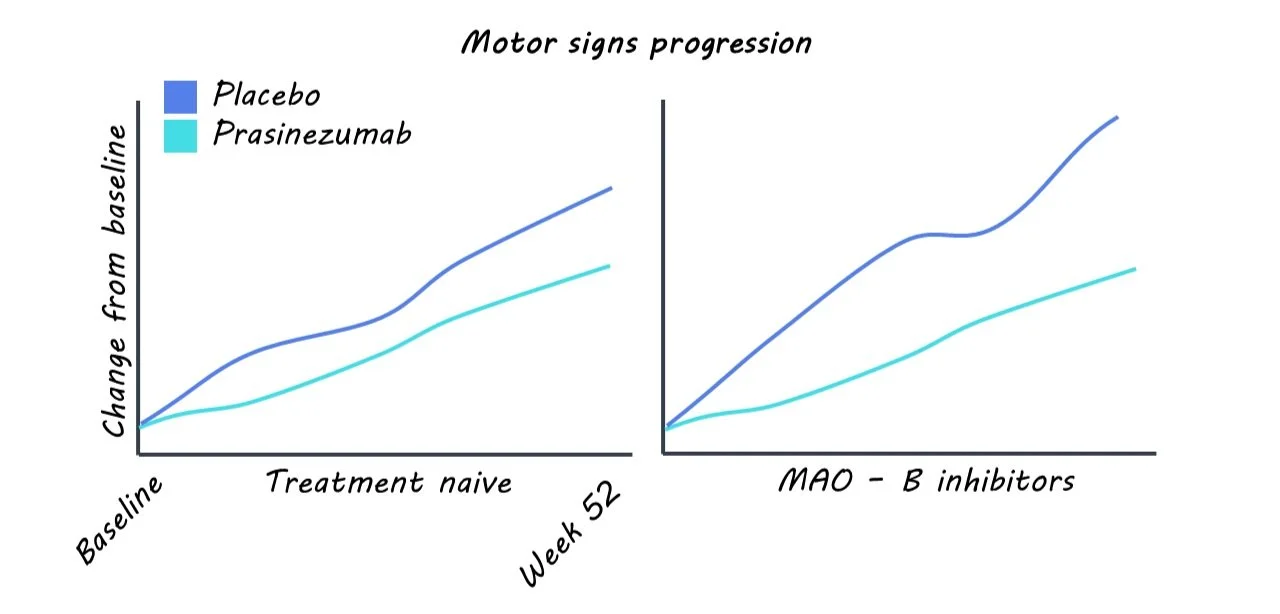
The progression of motor signs was assessed using the Movement Disorder Society Unified Parkinson's Disease Rating Scale (MDS-UPDRS) Part III score, a tool for evaluating the severity of motor symptoms in PD patients. This assessment was conducted over 52 weeks, allowing for longitudinal tracking of changes in motor function. Subpopulations were defined based on factors such as the participants’ use of monoamine oxidase B (MAO-B) inhibitors, Hoehn and Yahr stage, presence of rapid eye movement (REM) sleep behavior disorder, and motor subphenotypes.

Linear regression models were employed to analyze the relationship between Prasinezumab treatment and the progression of motor signs within each subpopulation. These analyses were adjusted for potential confounding variables, such as concurrent drug usage and genetic susceptibilities.

What did they find?

Participants in rapidly disease-progressing subpopulations exhibited a greater benefit from Prasinezumab treatment compared to those in non-rapidly progressing subpopulations. Specifically, individuals treated with MAO-B inhibitors at baseline showed a more pronounced treatment effect, as evidenced by a greater reduction in the progression of motor signs compared to individuals who did not receive the monoclonal antibody treatment. Similarly, participants with more advanced disease stages, as indicated by higher Hoehn and Yahr stage, also demonstrated a more favorable response to Prasinezumab treatment.  

These findings show that Prasinezumab is effective at slowing the progression of motor deficits in Parkinson's disease, and appears to have differential effects based on the underlying characteristics of patients, with greater benefits observed in subpopulations characterized by more rapid disease progression.

What's the impact?

This study identified a treatment capable of slowing down the progression of motor symptoms in PD, specifically in the subpopulation experiencing rapid progression. Research like this is critical to developing effective therapies for alleviating motor symptoms in individuals with PD.

ChatGPT, Creativity, and the Risks of Artificial Intelligence

Post by Rebecca Hill

The takeaway

ChatGPT, a promising tool for gathering and paraphrasing information, has recently been studied for its ability to mimic human creativity. However, ChatGPT has a darker side to it as well, taking information without consent, contributing to plagiarism, and spreading misinformation. 

What is ChatGPT?

Artificial intelligence (AI), or training computers to learn human skills, is an exciting new technology that can be used for a wide range of applications. Large language models are a relatively new type of AI, trained by large amounts of text to create new strings of similar text. One of the most popular new AIs is a chatbot called ChatGPT, powered by a large language model created by OpenAI that has been trained on a variety of text sources, from Wikipedia and journal articles to blogs across the internet. Users ask ChatGPT a question and it responds with paraphrased information, from a few sentences to several paragraphs long. However, these responses don’t automatically provide sources for their information, and sometimes even provide inaccurate information.

Can artificial intelligence be more creative than humans?

With this new technology, many are curious about its ability to not only mimic human language but also human skills such as decision-making and creativity. To measure creativity, researchers test both AI and humans with divergent thinking tasks – those that involve coming up with creative solutions to a problem. While one study claimed that ChatGPT created more original and elaborate solutions during these tasks than humans, another found that the best of the human ideas were better than the ChatGPT ideas. Studies like these have sparked active discussions around the idea of what constitutes creativity. Some researchers believe that AI chatbots like ChatGPT can create new ideas by making connections that humans often miss due to bias or fixed mindsets. Others argue that human creativity is too unique and complex to copy with AI and that since AI requires human input, it is not able to come up with any truly new ideas. Also, emotions are often seen as a crucial part to creativity, and AI doesn’t have the life experiences that humans channel into works of art.

The impact of AI on art

While ChatGPT is a text-based AI, there are also AIs that are used to create visual art, which has in turn triggered its own scientific discussion. Recent studies have found that people prefer art that was labeled as created by humans rather than AI, suggesting that there is a negative bias against AI-created artworks. While some of these studies purport that AI-created artwork is often indistinguishable from human-created, others emphasize the impact this has on the artists themselves. Artists spend years honing their craft and developing their artistic style, and many are insulted by the idea that art created by a person simply providing a prompt to an AI could be equivalent to their own art. Even more upsetting to many artists is that AI-created art is trained on the very same art that humans have spent hours creating, effectively stealing from the artists.

AI threatens the integrity of circulating information

While visual art being scraped for training data for AI is a hotly debated topic, the same can be said for the art of writing. Since ChatGPT is trained using data from the internet, it uses writing from any freely accessible source it can find. However, free to access does not mean free to use. A recent article points out that while there are exceptions to using copyright-protected material, these exceptions require not making money off of this use, and ChatGPT does have an option for users to pay for subscriptions for better access. Even more concerning is the use of ChatGPT in scientific writing, which can lead to bias, plagiarism, and the spread of misinformation. This can have dire consequences when it comes to medical and health research. While ChatGPT is a mystery to many and a fun tool for some, it is important to understand that it is more than a tool for gathering information. The foundations of ChatGPT are built on information not freely given, and the effects of it may be longer lasting and wider reaching than many have anticipated. 

References +

Bellaiche, L., Shahi, R., Turpin, M. H., Ragnhildstveit, A., Sprockett, S., Barr, N., Christensen, A., & Seli, P. (2023). Humans versus AI: Whether and why we prefer human-created compared to AI-created artwork. Cognitive Research: Principles and Implications, 8(1), 42. https://doi.org/10.1186/s41235-023-00499-6

Chiarella, S. G., Torromino, G., Gagliardi, D. M., Rossi, D., Babiloni, F., & Cartocci, G. (2022). Investigating the negative bias towards artificial intelligence: Effects of prior assignment of AI-authorship on the aesthetic appreciation of abstract paintings. Computers in Human Behavior, 137, 107406. https://doi.org/10.1016/j.chb.2022.107406

Guleria, A., Krishan, K., Sharma, V., & Kanchan, T. (2023). ChatGPT: Ethical concerns and challenges in academics and research. The Journal of Infection in Developing Countries, 17(09), 1292–1299. https://doi.org/10.3855/jidc.18738

Hubert, K. F., Awa, K. N., & Zabelina, D. L. (2024). The current state of artificial intelligence generative language models is more creative than humans on divergent thinking tasks. Scientific Reports, 14(1), 3440. https://doi.org/10.1038/s41598-024-53303-w

Kane, S., Awa, K., Upshaw, J., Hubert, K., Stevens, C., & Zabelina, D. (2023). Attention, affect, and creativity, from mindfulness to mind-wandering. The Cambridge Handbook of Creativity and Emotions, 130-148.

Koivisto, M., & Grassini, S. (2023). Best humans still outperform artificial intelligence in a creative divergent thinking task. Scientific Reports, 13(1), 13601. https://doi.org/10.1038/s41598-023-40858-3

Runco, M. A. (2023). AI can only produce artificial creativity. Journal of Creativity, 33(3), 100063.

Teubner, T., Flath, C. M., Weinhardt, C., Van Der Aalst, W., & Hinz, O. (2023). Welcome to the Era of ChatGPT et al.: The Prospects of Large Language Models. Business & Information Systems Engineering, 65(2), 95–101. https://doi.org/10.1007/s12599-023-00795-x