The Presence of an Onscreen Instructor Improves Learning

Post by Natalia Ladyka-Wojcik

The takeaway

Students show better learning outcomes and greater synchrony of brain activity, despite lower visual attention to material, when an onscreen instructor is present during video lectures of multimedia information.  

What's the science?

The COVID-19 pandemic prompted a significant shift towards online learning using multimedia instructional videos — a shift that persists in educational settings today. The multimedia learning framework suggests that combining pictures and words in instructional videos can create a more interactive learning context which in turn boosts motivation and attention among students. Within this framework, previous research supports the principle of embodiment: that human facial expressions and voice are critical for students’ socio-emotional responses and sustained attention during learning. However, it remains unclear whether the onscreen image of the instructor itself called the “image principle”, actually engages students’ cognitive processing of the information to be learned. This week in PNAS, Ping Li and colleagues investigated whether seeing the instructor on-screen during online learning promotes learning and attention, or instead serves as a distractor.

How did they do it?

The authors recruited over 70 college-aged participants to watch video lectures of novel information in biology, psychology, and meteorology while undergoing functional magnetic resonance imaging (fMRI). Their eye movements were tracked as they looked around the screen. Critically, participants were excluded if they had prior expertise in one of the topics presented, thus ensuring that the material to be learned was introduced during the study. Participants were shown video lectures with either an on-screen human instructor, an animated instructor, or no on-screen instructor. Finally, the participants completed a post-learning assessment to determine how much information they had learned from the lecture videos, in addition to a series of tests of their cognitive and socio-emotional abilities.

Using the fMRI and eye movement data collected, the authors studied neural synchrony; a correlational measure of brain activity over time amongst a group of people sharing a particular context (in this case, the presence of an instructor during video lecture watching). The authors also used eye movement fixations to the on-screen video lectures as a measure of attention during learning.

What did they find?

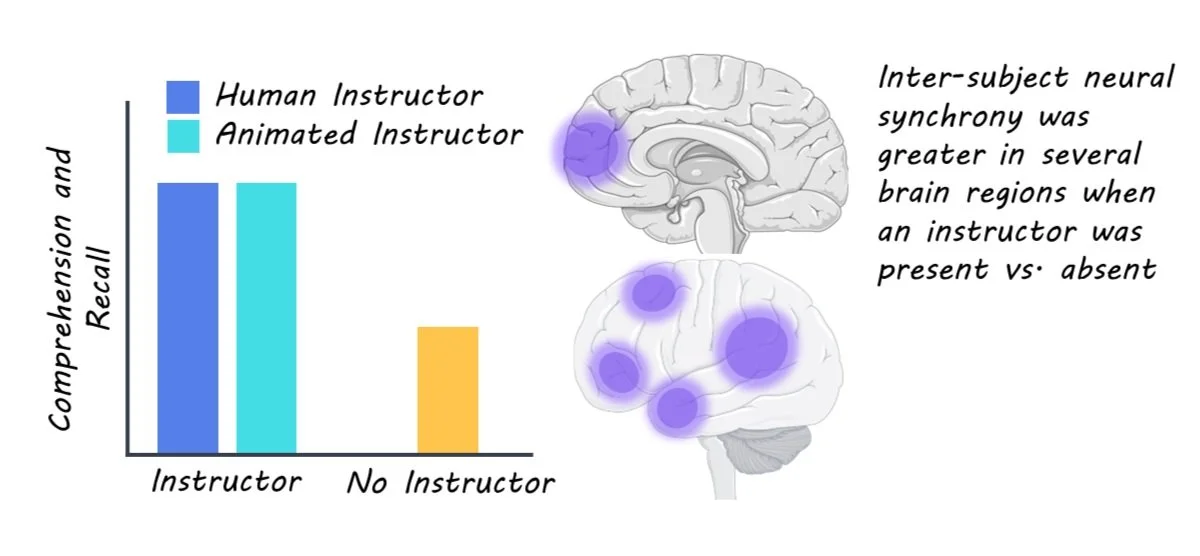
In support of the image principle of multimedia learning, the authors found that students learned better with an on-screen instructor than without. However, a caveat is that learning was not affected by whether the on-screen instructor was human or animated, which suggests that the embodiment type of the instructor does not affect learning performance. Curiously, the authors found that students were more attentive to the instructional slides – as measured by eye movements – without a human instructor onscreen but this did not improve learning performance, reflecting a trade-off between visual distractors and socio-emotional processing.  

The authors also found higher neural synchrony between participants during learning when an instructor was present, compared to when no instructor was on-screen. This neural synchrony was most evident in regions of the brain involved in cognitive processing, as well as in socio-emotional processing. Importantly, greater eye movement and neural synchrony predicted better learning of the information, especially among participants with higher cognitive and socio-emotional abilities. Together, these findings strongly support the inclusion of an on-screen instructor during multimedia learning.
What's the impact?

This study found that the presence of on-screen instructors during online video learning benefits students’ comprehension of material, providing higher socio-emotional cues and outweighing the impacts of visual distraction. Although these benefits were found to vary across individuals, the study broadly highlights the importance of creating engaging and interactive learning opportunities, even in online educational settings.  

The Role of the Immune System and Blood-Brain Barrier in Brain Fog Associated with Long COVID

Post by Soumilee Chaudhuri

The takeaway

Research has hypothesized that the breakdown of the blood-brain barrier (BBB), is mainly responsible for the neurological symptoms in patients of SARS-COV-2 infection. Researchers from Trinity College, Dublin found critical evidence that lingering neurological symptoms such as cognitive decline or brain fog in Long COVID patients were due to loss of BBB permeability and a persistently activated immune system. 

What's the science?

Following the global COVID-19 pandemic, clinical investigations found that many individuals infected with the acute SARS-COV-2 virus were failing to recover fully from COVID-19 infection. This phenomenon was termed Long COVID and is characterized by chronic pain, shortness of breath, and intense fatigue. It is also associated with long-term neurological symptoms such as cognitive impairment. However, the basis of these neurological symptoms, known as ‘brain fog’ has remained unclear. This week in a groundbreaking article in Nature Neuroscience, using an innovative imaging technique Dr. Greene and colleagues show that leaky blood vessels in the BBB alongside a hyperactive immune system could drive these neurological symptoms associated with Long COVID.

How did they do it?

The researchers hypothesized that COVID-19 infection causes neurological issues including cognitive decline in some patients by breaking down the BBB, resulting in blood serum components leaking into the brain. They investigated BBB function and integrity in both acute COVID-19 patients as well as Long COVID patients by splitting the study into two separate cohorts. First, they examined the serum samples from the first cohort (acute COVID-19) patients for known proteins that would signify a dysregulated BBB or biomarkers of BBB disruption. Thereafter, they used a novel MRI-based imaging technique to image the brains of the second cohort (Long COVID) for an extended period of time by injecting a special dye that has low penetrability across the BBB. Any signal detected from this injected dye after 20 minutes was suggested to be associated with BBB disruptions as a result of the leakage of the dye through the disrupted BBB. Through this innovative contrast MRI imaging technique, the researchers could objectively measure and track the extent of BBB disruption in these patients. Additionally, the researchers also looked at gene expression changes in immune cells from the patients of these two cohorts to understand if immune cell activation was related to BBB dysfunction in Long COVID. 

What did they find?

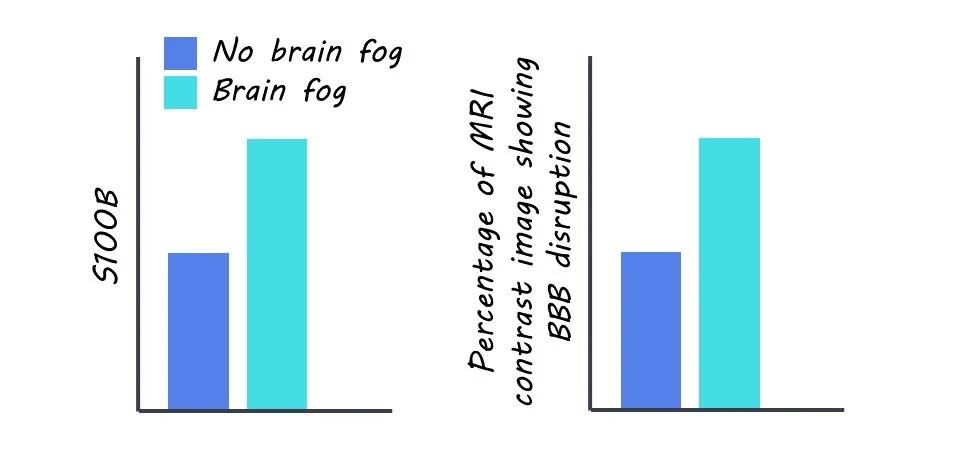
The researchers found that in acute COVID-19 patients who were experiencing brain fog, one of the biomarkers of BBB disruption (S100B) was elevated compared to acute COVID-19 patients not experiencing brain fog. Results of contrast MRI imaging also found that in Long COVID patients with brain fog — but not those without brain fog — BBB permeability was increased, indicating BBB disruption was associated with this lingering post-infection condition. Imaging found that patients with Long COVID and brain fog had more leakage in their whole brain compared to patients without brain fog. Gene expression changes from immune cells in these patients showed that there was a widespread disruption of the coagulation system and adaptive immunity unique to the cohort of Long COVID patients with brain fog. These critical findings suggest that brain fog symptoms of Long COVID are a result of BBB disruption and a sustained inflammation trajectory.

What's the impact?

This is the first study to use a dynamic contrast imaging method and objectively map a biomarker associated with BBB integrity related to neurological symptoms in Long COVID. This will be very significant for understanding other post-infection neurological conditions as well as crafting targeted clinical interventions regulating BBB integrity in Long COVID. Foremost, we now know that there is an integrated role of the immune system and BBB disruption, at the forefront of neurological symptoms underlying patients of Long COVID.

Access the original scientific publication here

Early Psychedelic Use Linked to Lower Risk of Psychotic Symptoms

Post by Baldomero B. Ramirez Cantu

The takeaway

Adolescents who have tried psychedelics may show a reduced likelihood of developing psychotic symptoms, but familial factors like a history of bipolar disorder or schizophrenia could influence the connection between psychedelics and manic symptoms.

What's the science?

Psychedelics represent a class of substances known for their relatively safe profiles and non-habit-forming nature, capable of inducing profoundly altered states of consciousness. Despite these characteristics, there's a notable gap in understanding the relationship between psychedelic use, particularly among teenagers, and psychiatric symptoms. This week, Simonsson et al. addressed this gap by publishing a study in JAMA Psychiatry, aiming to unravel the intricate interactions between adolescent naturalistic psychedelic use and the emergence of psychotic or manic symptoms.

How did they do it?

The study leveraged data from the Swedish Twin Registry, consisting of a longitudinal analysis of Swedish twins and their parental figures from age 9 onwards, with follow-up assessments at ages 15, 18, and 24. At age 15, a robust sample exceeding 16,000 twins provided detailed insights into their psychedelic usage patterns and reported manifestations of psychosis and manic symptoms. In tandem, polygenic scores were employed to probe potential genetic predispositions to schizophrenia and bipolar disorder.

Statistical analyses, including sophisticated linear regression models, were then employed to scrutinize the relationship between psychedelic use and mental health outcomes. Notably, adjustments were made for confounding variables such as concurrent drug usage and genetic susceptibilities. Using these analyses, the study aimed to elucidate the nuanced associations between psychedelic usage and mental health outcomes.

What did they find?

A drug-adjusted statistical analysis revealed fewer psychotic and manic symptoms among psychedelic users. This shift in association persisted across various additional adjustments to statistical models. Furthermore, exploring familial confounding unveiled compelling insights. Monozygotic twins who reported psychedelic use exhibited a noteworthy divergence from their non-user cotwins. Specifically, they showcased a lower prevalence of psychotic symptoms, a finding consistent across both unadjusted and drug-adjusted analyses. This suggests a potential protective effect of psychedelic use against the development of psychotic symptoms within genetically identical pairs. This points to the necessity for further investigation to understand the underlying mechanisms at play.

Additionally, gene-environment interactions shed light on nuanced associations between psychedelic use and mental health dynamics. While no significant group differences emerged for genetic vulnerability to schizophrenia or bipolar disorder in relation to psychotic symptoms, interactions were observed for manic symptoms. Significant associations surfaced between psychedelic use and genetic vulnerability to both schizophrenia and bipolar disorder, underscoring the multifaceted nature of these relationships.  

What's the impact?

This research has significant implications for public health policy and interventions concerning adolescent psychedelic use. By uncovering the intricate relationship between naturalistic psychedelic use and psychiatric symptoms, particularly in light of familial factors, the study provides valuable insights for policymakers, educators, and mental health professionals. These findings can inform evidence-based strategies for harm reduction, substance use prevention, and targeted psychiatric interventions.

Access the original scientific publication here.