Could a Vaccine Prevent the Onset of Parkinson’s Disease?

Post by Rebecca Hill

The takeaway

a-Synuclein, a protein that misfolds and clumps in Parkinson’s disease, can’t be targeted normally by our immune systems. A genetically modified protein can be used to vaccinate against these malfunctioning proteins and trigger an immune response that delays symptoms of Parkinson’s. 

What's the science?

Parkinson’s is caused by the misfolding and clumping of a-Synuclein (a-syn) proteins. Since we produce a-Synuclein proteins naturally, when they malfunction, our immune systems are unable to recognize and destroy them. HET-s is a protein found in a fungus that is completely unrelated to a-syn proteins in Parkinson’s. This week in Brain, Pesch and colleagues attempted to genetically modify HET-s proteins to create a vaccine against a-syn that could prevent the progression of Parkinson’s disease.

How did they do it?

Using mutagenesis, a technique that alters DNA at specific locations, the authors changed the surface of HET-s in a way that could be identified by our immune system. This caused HET-s proteins to resemble the a-syn proteins that malfunction in Parkinson’s disease. They injected these altered HET-s proteins into mice as a vaccine to train their immune system to be able to recognize and destroy malfunctioning a-syn. They injected mice every two weeks for eight weeks and then collected blood plasma samples to analyze. The authors then injected both vaccinated and unvaccinated mice with a-syn proteins either in their brains or in their stomachs to simulate two types of Parkinson’s disease. The authors also tested mice behaviorally to examine motor strength performance. 

What did they find?

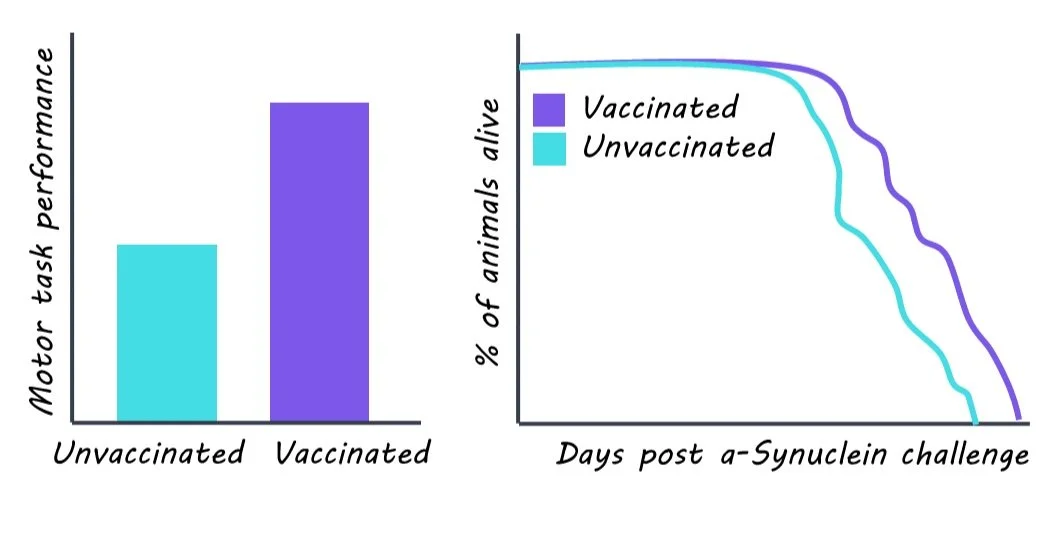
Mice vaccinated with modified HET-s proteins survived 8% longer than controls when a-syn was injected into their brain and survived 22% longer than controls when a-syn was injected into their body. The authors found antibodies for the a-syn proteins in the vaccinated mice, which shows that the vaccines can lead to a better immune response to the progression of Parkinson’s disease. For both the mice that had a-syn injected into their brain or their body, vaccinated mice performed better on behavioral tests than unvaccinated mice. This means that vaccination led to better motor ability after a longer period. 
What's the impact?

This study is the first to show that vaccination with engineered proteins can trigger an immune response that will delay Parkinson’s disease progression. Since Parkinson’s disease usually occurs in older adults, any delay in symptom progression could significantly impact a patient’s health outcomes. With the development of vaccines such as this, the quality of life may be significantly improved for people as they age. 
Identifying Aging Subtypes with Machine Learning

Post by Lani Cupo

The takeaway

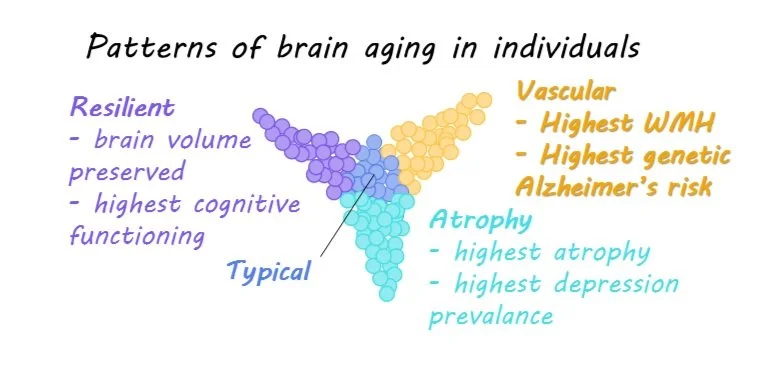
Three patterns of brain aging were identified in a large dataset of cognitively normal adults by a semi-supervised machine-learning algorithm: one subtype associated with typical aging, one with vascular factors, and one with higher levels of brain atrophy. The patterns were associated with different genetic backgrounds, lifestyle risk factors, and later cognitive decline. 

What's the science?

The process of aging is associated with many changes in neuroanatomy, some of which emerge before noticeable pathology, such as cognitive impairment or memory loss. Variables such as genetic background, demographics, and lifestyle factors can impact these neuroanatomical changes. Identifying subtypes of age-related changes early on could help clinicians to identify and intervene in pathological aging processes, however, early changes may be subtle and require large datasets to accurately identify. This week in JAMA Psychiatry, Skampardoni and colleagues investigated whether there are aging subtypes.

How did they do it?

By pooling data from 11 neuroimaging studies, the authors assembled 58,113 scans from 27,402 individuals aged 45-85. They used several metrics to assess brain health including regional volume and white-matter hyperintensity (WMH) volume (a measure of changes in the brain vasculature). First, the authors used principal component analysis (a data reduction technique) to identify participants with the lowest atrophy levels at each age group (45-55, 55-65, 65-75, and 75-85). This “resilient aging” group (A0) was used as a reference to identify subtypes of aging. Then, the authors used a machine learning algorithm known as Semi-Supervised Clustering via Generative Adversarial Networks (Smile-GAN) to identify subtypes with different trajectories of aging relative to A0. The subgroups were first identified in each age group but then assessed for consistency in trajectories across age groups. Then, the subgroups were compared for differences in genetics, clinical, and cognitive features. A subset of the full dataset included longitudinal data, allowing the authors to examine whether the identified groups were associated with long-term outcomes.

What did they find?

The authors identified three subtypes of aging consistent across the age groups. The first group, A1, showed mild atrophy mostly localized near the Sylvian fissure (the noticeable sulcus, or crease, that can be seen when viewing a brain from the side). The second group, A2, was associated with hypertension, showed greater atrophy, and had the highest burden of WMH. The third group, A3, showed more severe and dispersed atrophy across the brain and was associated with greater cognitive decline. Because group A1 was the largest with the least severe atrophy, it was considered typical aging. Older individuals in both groups A2 and A3 showed worse cognitive scores than groups A0 and A1, with A2 showing more cardiovascular risk factors and genetic risk factors for Alzheimer’s Disease, and group A3 showing the greatest levels of depression. Of note, these cognitive differences were still considered “sub-threshold”, as the included participants had no diagnosis. Groups A2 and A3 showed the greatest longitudinal cognitive decline, with group A2 showing the greatest progression of WMH.

What's the impact?

This study identified generalizable subtypes of aging identifiable from mid-life. By highlighting two trajectories of atypical aging and characterizing them in terms of cognitive, lifestyle factors, and genetic phenotypes, as well as long-term outcomes, this study shows groups that may be differentially susceptible to neurodegenerative disorders.

 Access the original scientific publication here.

The Complementary Roles of Dopamine and Serotonin in Decision-Making

Post by Shireen Parimoo

The takeaway

People are more likely to reject unfair monetary offers when they come from humans compared to computers. In the brain, serotonin levels are sensitive to the value of the offer itself while dopamine levels are sensitive to the change in the offer value from the previous trial as well as to the social agent providing the offer. 

What's the science?

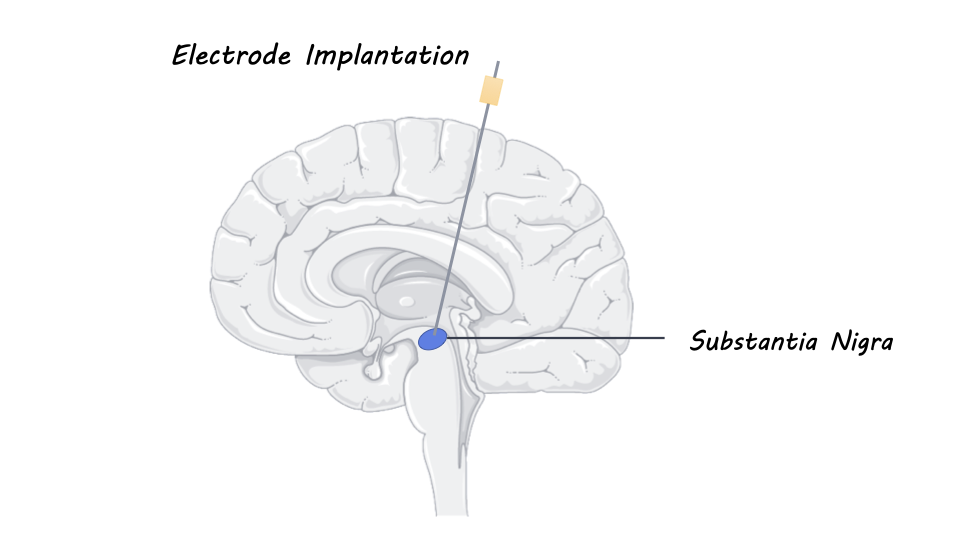
Neuromodulators play an important role in guiding behavior and decision-making. Dopamine, for example, is known to be important for reward-based processing. Pharmacological studies have provided insight into the causal role of neuromodulators like dopamine and serotonin in various social contexts. However, it is difficult to study the mechanisms through which they act because non-invasive brain imaging techniques like fMRI are limited in their spatial and temporal resolution. When given a drug that increases serotonin levels in the brain, for example, it is difficult to pinpoint precisely where and how long it takes for it to act in the brain. This week in Nature Human Behavior, Batten and colleagues used deep brain electrode recordings to monitor neuromodulator fluctuations in a region of the brainstem called the substantia nigra to understand the roles of dopamine and serotonin during social decision-making.

How did they do it?

The authors recruited four patients with Parkinson’s disease who played the ultimatum game while undergoing brain surgery across two sessions. For clinical purposes, the patients had electrodes implanted into the substantia nigra pars reticulata, which receives both dopaminergic and serotonergic inputs from other regions of the brain. Using a statistical model (convolutional neural network) applied to the electrochemical currents recorded from the electrodes, and knowledge of how dopamine and serotonin concentrations typically change this signal, the researchers were able to estimate changes in these neuromodulators with high temporal precision.

The ultimatum game is a social fairness game in which participants are offered a certain split of a monetary amount (e.g., 40% of $20). If they choose to accept the offer, then the money is split accordingly (i.e., the participant receives $8) but if they reject the offer, then no one receives any money. Participants played against the computer player that either had a human or a computer avatar and made offers valued between $1-9 that participants could accept or reject. The authors examined whether participants were more or less likely to accept the offers based on the value of the offer, human vs. computer avatar condition, and offer history, which is the change in the value of the offer from the previous trial. They also investigated how dopamine and serotonin levels fluctuated after they were given an offer. Specifically, neuromodulator levels were examined with respect to participants’ decisions, the offer values, offer history, and across the two avatar conditions. 

What did they find?

Participants were more likely to accept larger offers (i.e., $9 vs $3 offer) and offers made by the computer avatar but offer history did not affect their decision to accept or reject the offer. Participants also took longer to reject than to accept offers overall. Neither dopamine nor serotonin levels were altered by the decision to accept or reject an offer, but dopamine increased when the offer came from the human avatar compared to the computer avatar. This suggests that dopamine tracks social context (i.e., avatar condition) but not necessarily the decision itself. Dopamine was also sensitive to offer history, as it decreased when the value of the offer dropped but increased when the offer value increased. Serotonin, on the other hand, was sensitive to the value of the offer itself, but not to offer history. That is, serotonin levels were higher when the offers were high and lower in response to lower offers. Altogether, these findings show that serotonin is involved in value-based processing while dopamine is important for social context and for tracking the change in offer value across trials. 

What's the impact?

This study is the first to use electrochemistry in the awake human brain to demonstrate the differential roles of dopamine and serotonin in value-based processing in a social context. This study not only advances our understanding of neuromodulators in decision-making processes but also showcases the utility of electrochemistry as an exciting new method for human neuroscience research. 

Access the original scientific publication here.