How Listening to Live and Pre-Recorded Music Changes Brain Activity

Post by Meredith McCarty

The takeaway

Listening to music is not only an enjoyable and common pastime but has been found to correlate with changes in brain activity in many key regions involved in emotional processing. Live music is found to be more closely correlated with increased activity in key brain networks involved in emotional processing than pre-recorded music.

What's the science?

Music listening evokes strong feelings in listeners and has also been found to correlate with increased activity across the affective brain network which is involved in emotional processing and emotional recognition. Key regions associated with this affective network are the limbic system, most notably including a brain region called the amygdala, which is involved in emotional processing and processing of music-evoked emotions. Because of the influence of music listening on activity in this affective brain network, music can be a powerful tool to help us better understand brain dynamics. This week in PNAS, Trost and colleagues use a novel closed-loop music performance experimental setup in order to better understand the dynamics of music listening in the brain.

How did they do it?

To study how music listening affects brain activity, the researchers designed a novel closed-loop music performance setup, where the musician and the listener are influencing each other in real time. The researchers recruited 27 participants who had no musical experience to listen to different music through in-ear headphones while in a functional magnetic resonance imaging (fMRI) scanner. The fMRI scan captures brain dynamics that are then shown on a screen to a piano performer who can then adjust their playing to try and increase activity in key regions, including the amygdala. The performers were instructed to change the dynamics, density of notes, and articulation of the piece to try and increase activation in the amygdala of the listener.

The musicians performed 12 30-second pieces that varied in their musical features (arousal, valence, and acoustic features). Six pieces were composed to be perceived as “pleasant” and six as “unpleasant”. The key comparison in this study was that participants listened to the same series of musical pieces both live (with real-time feedback to the performer) and pre-recorded (from the same performer, but with no feedback aspect). Live and pre-recorded pieces were both played on the same digital piano connected to headphones; the only ‘live’ aspect of the live music was the use of the participants’ neurofeedback by the performers. Through analyzing changes in brain activation, as well as changes in information flow between regions of the brain, this design allows for the careful study of music perception in the brain, and how differences in music performance change brain activation.

What did they find?

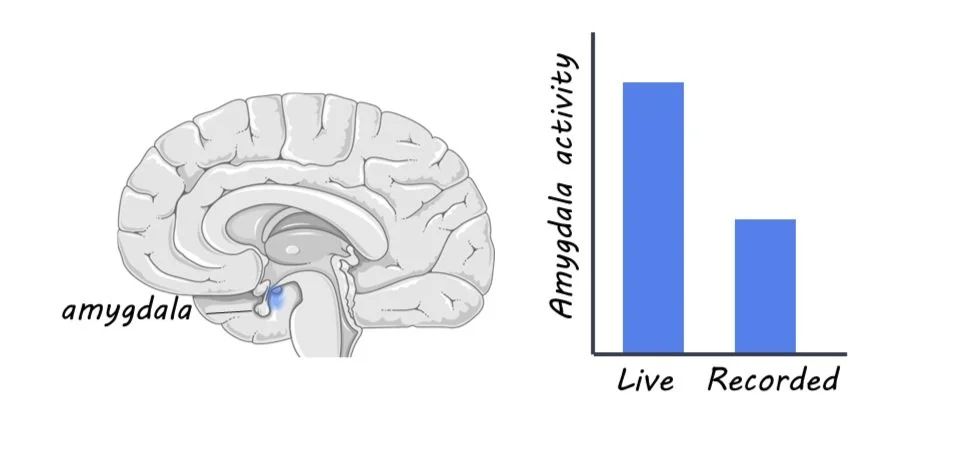
When comparing overall activation in different brain regions, the researchers found that live music significantly increased activity in the amygdala and other music-processing regions when compared with pre-recorded music. This suggests that live music has features that increase emotional music processing in the listener’s brain. In a novel finding, the pulvinar nucleus of the thalamus showed significantly elevated activation in response to live music, suggesting that live music involves higher attentional demands than pre-recorded music. 

The directed functional connectivity analysis, which quantifies information flow between regions of the brain, revealed overall increased connectivity between numerous limbic regions for live music more so than pre-recorded music. Live unpleasant music recruited an even larger network of regions than live pleasant music, indicative of greater emotional processing.

When comparing how correlated the musical features of the piano performance were with the listener’s brain dynamics during the real-time feedback condition, the researchers found high correlations for live music and an absence of this correlation in the pre-recorded music condition. Interestingly, the auditory cortex showed the most significant correlation between recorded brain activity and musical features, indicating an important role for this region in emotional information integration.
What's the impact?

This study found that live music consistently elicits higher brain activity in key limbic regions, including the amygdala, relative to pre-recorded music. As the first study to implement a real-time neural feedback design where the performer and the listener influence each other, these results have strong implications for research into how music is processed in the brain.
Access the original scientific publication here.

Tau Protein in Human Neurons is Essential for Amyloid Beta-Driven Toxicity in Alzheimer’s Disease

Post by Laura Maile

The takeaway

Amyloid beta and tau are two proteins that aggregate in the brain of patients with Alzheimer’s Disease and are linked to the degeneration of neurons and symptoms of the disease. When tau is depleted in human neurons, hyperactivity and neurodegeneration caused by amyloid beta is reduced.  

What's the science?

Alzheimer’s Disease (AD) is characterized by the buildup of plaques and tangles, which are aggregates of amyloid beta and tau proteins, among other pathologies. One of the prominent theories of the primary cause of AD, the “amyloid hypothesis,” states that the buildup of amyloid beta leads to toxicity of neurons and neurodegeneration.  Though the physical pathology of the disease has been well-described, scientists do not yet fully understand the interplay between amyloid beta, tau, and neurodegeneration, especially in human experimental models. Mouse models with tau genetically knocked out have shown that amyloid beta toxicity is dependent on tau. This week in Molecular Psychiatry, Ng and colleagues used gene-edited human cells to deplete tau and examine its role in amyloid beta-driven toxicity. 

How did they do it?

The authors used Crispr-Cas9 to genetically modify the gene for tau in human induced pluripotent stem cells (hIPSCs). hIPSCs are generated using human cells that are induced back into being stem cells and then differentiated into specific cell types, such as neurons. Using this method, the authors could disrupt the tau gene in human cells. They confirmed that they had effectively depleted the tau transcript and protein in the cortical neurons generated from hIPSCs. They first examined the effects of tau depletion on neuronal activity, using electrodes to measure extracellular field potentials. Using the same methods, they measured neural activity over time in cells treated with homogenate from post-mortem AD brain tissue. To determine the specific effects of amyloid beta on synapse loss seen in AD, they extracted amyloid beta from post-mortem brains of AD patients and treated neurons both with and without tau. They then examined the effects on synapse loss using immunocytochemistry to label synaptic markers. Next, the authors investigated the effect of tau loss on the movement of mitochondria down axons by plating the hIPSC-derived neurons on one side of a chamber and live imaging the movement of mitochondria. This was followed by a similar experiment where they added amyloid beta oligomers to the neurons to mimic a toxic amyloid beta insult, and monitored mitochondrial movement. Finally, they tested whether the depletion of tau could protect against neurodegeneration caused by amyloid beta. To do this, they again used amyloid beta oligomers to provide a toxic insult to hIPSC-derived cortical neurons with and without tau, and compared cell death in each set of neurons.

What did they find?

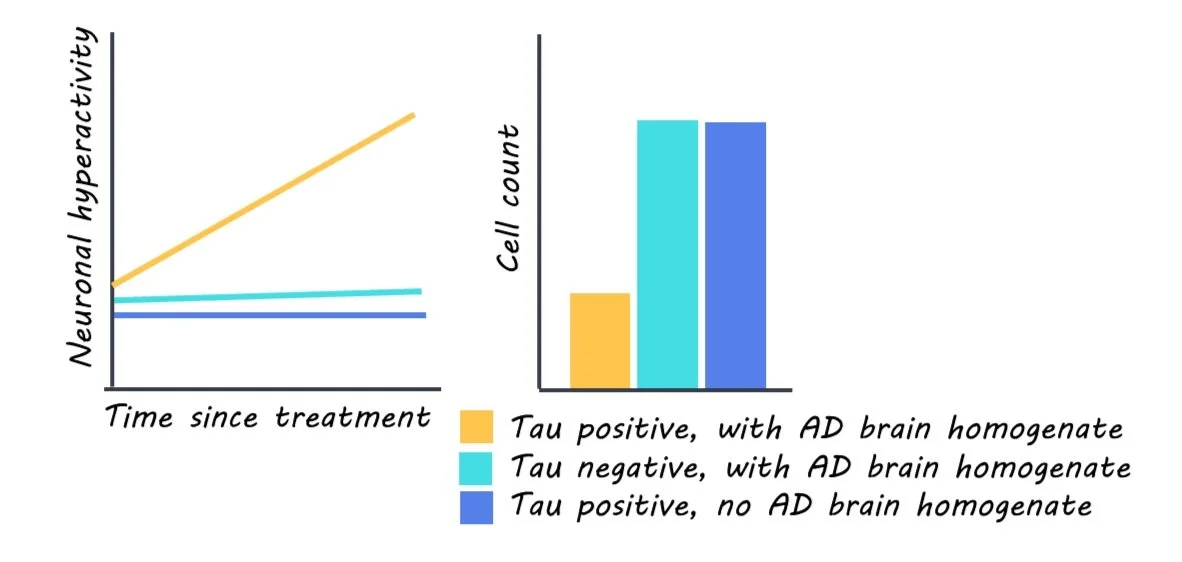
The authors discovered that cortical neurons with the tau protein depleted showed reduced neuronal activity. Neurons with tau that were treated with homogenate from the brains of AD patients showed hyperactivity over time, but both neurons without tau and neurons treated with an amyloid beta blocker were protected from this hyperactivity. This means that the hyperactivity observed was caused by amyloid beta and was dependent on tau. Treatment with amyloid beta from AD brains leads to synapse loss in normal neurons, but not in tau-deficient neurons, meaning that tau is essential for amyloid beta-induced synapse loss. When normal neurons were treated with amyloid beta, axonal transport of mitochondria was reduced. This effect was reversed in neurons missing tau, while the movement of mitochondria was not changed in cells missing tau that had not been treated with amyloid beta. This suggests that the dysfunction in mitochondrial transport caused by amyloid beta is dependent on tau. When regular hIPSC-derived cortical neurons were treated with amyloid beta, cell death increased. Partial and full depletion of tau reduced this amyloid beta-driven neurodegeneration, suggesting that even partial reduction of tau can prevent cell death. 

What's the impact?

This study found that amyloid beta-driven neuronal hyperactivity, synapse loss, axonal transport dysfunction, and neurodegeneration are dependent on tau in human cells. This suggests the continued importance of generating treatments to decrease tau in patients with AD.

How the Brain Accumulates Evidence to Make a Decision

Post by Natalia Ladyka-Wojcik

The takeaway

Intracranial electroencephalography was used in a large group of pre-surgical epilepsy patients to identify where in the brain perceptual decision-making begins and to show how brain activity might accumulate to support the strength and accuracy of decisions.

What's the science?

Perceptual decision-making involves selecting one choice from a set of alternatives based on incoming information from our senses. For example, a football player is engaged in perceptual decision-making when judging which player to pass the ball to during a game. When we make these decisions, our brain is also planning the corresponding motor actions, like the player gripping the football behind his head to throw it to his teammate. Recent research has identified parts of the brain involved in making these decisions, even in complex situations when the appropriate motor action might not be known in advance, but it remains unclear where exactly in the brain this process actually starts. This week in Nature Human Behavior, Gherman and colleagues pinpoint the signals in the brain responsible for these abstract decision-making processes.

How did they do it?

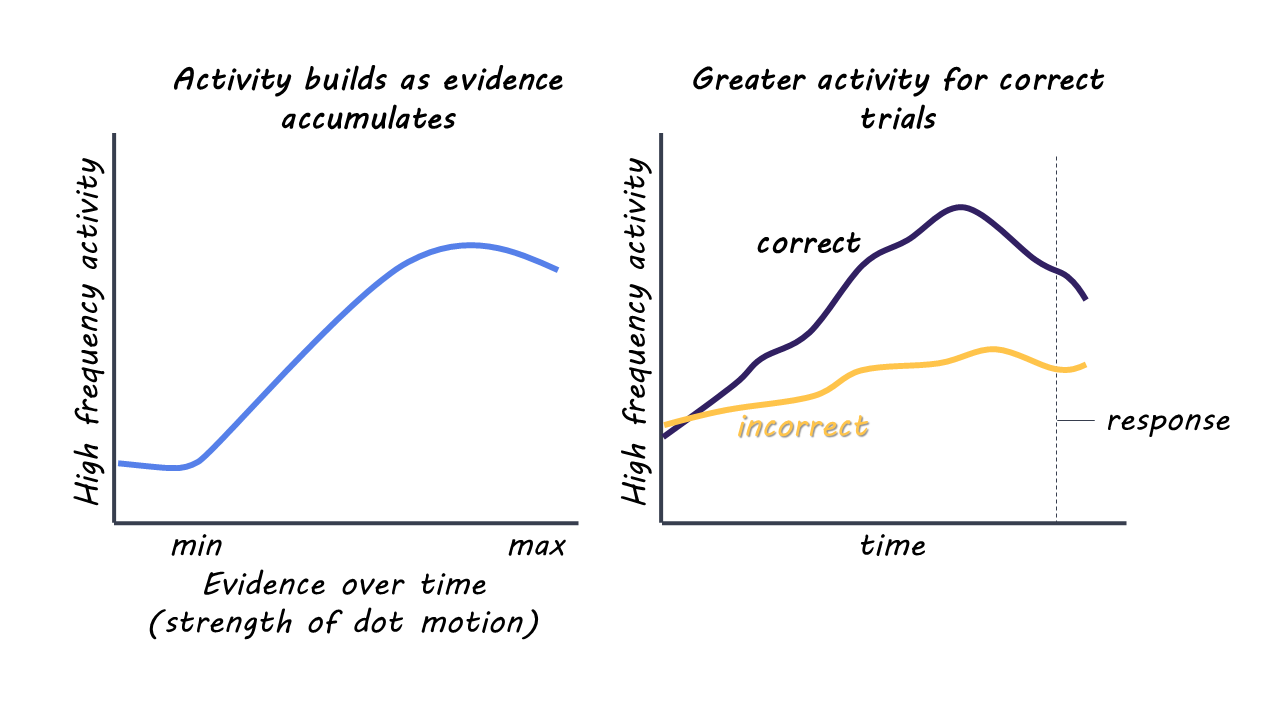
Previous research has found that brain activity linked to decision-making builds gradually over time, proportionally to the strength of incoming sensory information. As this evidence accumulates, it reaches a fixed threshold just before the animal makes a response and this threshold predicts both the animal’s choice and response time. In human neuroimaging research where resolution at the single neuron level is often not feasible, past studies have instead relied largely on functional magnetic resonance imaging (fMRI) to investigate brain regions involved in perceptual decision-making. However, fMRI has low temporal resolution, meaning that it doesn't show changes in brain activity quickly enough to demonstrate if there is a signal related to evidence accumulation. To overcome this limitation, the authors measured brain activity directly using intracranial EEG in a group of pre-surgical epilepsy patients who were asked to perform different perceptual decision-making tasks. This technique allows for measurement of a larger portion of the brain compared to single-neuron recordings and with better temporal resolution than fMRI.

First, the authors showed patients two simultaneous random-dot patches and asked patients to report the direction of the moving dots. The researchers measured the patients’ responses and the time it took to press a button to make their decision while recording their brain activity using intracranial EEG. Some patients also had to do the same task but with verbal responses after a delay, helping the researchers find brain activity related to perceptual decision-making, not just motor responses.

What did they find?

The authors found a widely distributed network of brain regions associated with perceptual decision-making, including the prefrontal cortex, parietal cortex, as well as inferior temporal and insular regions. Importantly, this network of brain regions showed high-frequency activity consistent with evidence accumulation in decision-making (whereas lower-frequency activity tends to be associated with motor preparation signals). This work suggests that activity in these regions gradually builds up until enough evidence is accumulated to make a decision (here, in response to the direction of dots) even before the patient presses a button or verbalizes their decision. The authors observed a gradual buildup of activity following the onset of sensory evidence at a rate that scaled with the strength of that sensory evidence. This activity reflected both the choice accuracy and response times of patients.

What's the impact?

This study found that activity in a distributed network of brain regions accumulates in response to sensory information to enable perceptual decision-making. It is the first to use intracranial EEG to directly measure high-frequency activity in these regions in humans, enabling an investigation into brain responses for decision-making even before motor response planning

Access the original scientific publication here.