Alzheimer’s Disease Creates a Positive Feedback Loop of Excitatory Signaling in Brain Networks

Post by Rebecca Hill

The takeaway

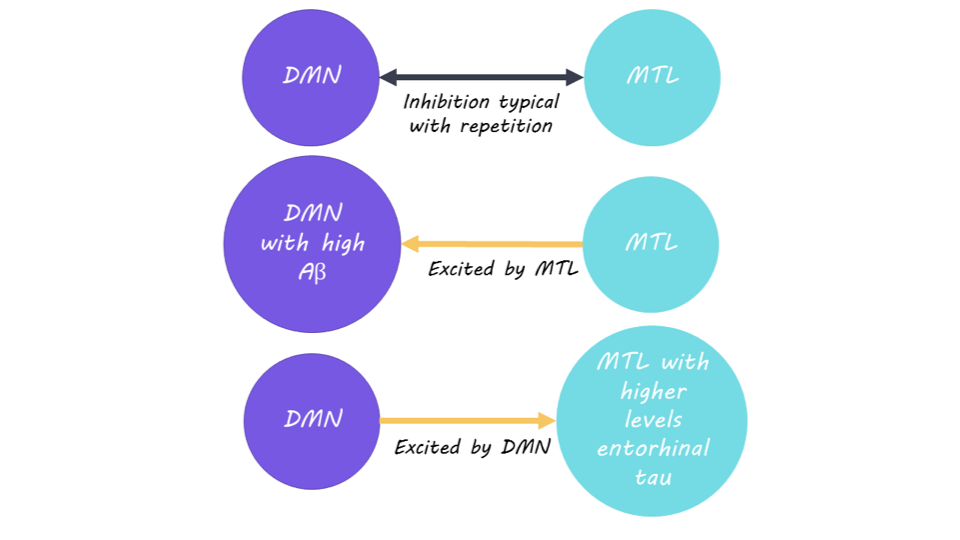
Beta-amyloid and tau are proteins that aggregate in two distinct networks in the brain in Alzheimer’s disease. When there are higher beta-amyloid and tau protein levels, the neuronal networks switch from inhibitory to excitatory signaling, leading to a positive feedback loop of excitation and further protein build-up.

What's the science?

In individuals affected by Alzheimer’s disease, the disruption of normal brain functioning is linked to a build-up of b-amyloid and tau proteins. Early in the progression of Alzheimer’s disease, beta-amyloid proteins build up in the association cortex (the default mode network, also known as the DMN), which is usually active when a person is daydreaming or at rest. Tau proteins on the other hand tend to appear in the entorhinal cortex (in the medial temporal lobe, also known as the MTL), which mainly facilitates memory processing. It’s still unclear why this protein aggregation occurs in two different networks in the brain. This week in Neuron, Giorgio and colleagues investigated this difference in protein aggregation by examining how these two different networks in the brain interact using brain imaging.

How did they do it?

The authors recruited 66 individuals (45 older adults without symptoms of Alzheimer’s and 21 young adults) for this study. A subset of these individuals had evidence of beta-amyloid and tau protein build-up reminiscent of early-stage Alzheimer’s disease. The authors asked participants whether an image presented to them was new or repeated while undergoing brain imaging to measure activity in the association and entorhinal cortices. Typically, neuronal activity is suppressed when viewing an image that has already been seen before. However, previous research has found that Alzheimer’s patients cannot suppress neuronal activity well during these tasks. The authors used functional MRI (fMRI) to measure brain activity and PET scans to measure the amount of beta-amyloid and tau proteins present in the two brain regions.

What did they find?

For participants with low levels of b-amyloid and tau proteins, there was inhibitory signaling between the DMN and the MTL for repeated images, indicating normal brain functioning with an ability to suppress neuronal activity. However, for participants whose protein levels were higher in the two brain regions, there was excitatory signaling instead. This indicates that Alzheimer’s disease alters normal brain functioning by causing neurons to fire excitatory signals from each brain region to the other. As more beta-amyloid builds up in these networks, there is more excitatory signaling to other networks, further increasing the amount of tau building up in the other networks. This creates a positive feedback loop of excitation between these networks, leading to further build-up of beta-amyloid and tau proteins.

What's the impact?

This study is the first to show how Alzheimer’s disease develops in the association and entorhinal cortices by creating a positive feedback loop of excitatory neuronal signaling. This causes abnormal brain functioning in individuals with Alzheimer’s disease by preventing their ability to suppress brain activity in response to new stimuli. Understanding how Alzheimer’s disease develops may help with our ability to diagnose and treat individuals affected by it. 

Access the original scientific publication here.

5 Important Advances in Neuroscience this Year

Post by Meredith McCarty

The takeaway

As the field of neuroscience continues to advance, we highlight 5 notable research advancements from 2023. While this is by no means a comprehensive list, we sought to outline some important advances and exciting future research directions. With these technological and theoretical advances, we step closer to understanding brain function and ways to implement these findings for clinical application.

Mapping the whole brain of the mouse and fly

Mapping the neural diversity and connectivity patterns of the brain has been a research goal of neuroscience for many decades. The idea behind this pursuit is that, through mapping the cells and connections of the brain, we can gain insight into network dynamics, neurodevelopment, and functionality. Within the past year, this has culminated in several major feats: a whole brain atlas of the mouse brain, as well as a whole brain connectome in the fly.

The BICCN (BRAIN Initiative Cell Census Network) has published numerous articles this year outlining their work in developing a whole brain atlas of the mouse brain. They used a variety of methods to measure the connectivity and genetic diversity of both neuronal and non-neuronal cells; a massive effort with broad implications for future work in the field.

The goal of connectome research is to reconstruct each neuron’s connectivity pattern using electron microscopy. As such, this method is comprehensive yet quite methodologically complex and time consuming. The first neuronal wiring diagram of the fly brain has been released this year, outlining the connectivity and diversity of the 130,000+ neurons in the adult fly brain. These efforts to quantify the connectivity patterns and cellular diversity of the brain at many scales have enormous utility for future neuroscientific research, as these resources will help us map out and understand how the brain works.

Advances in decoding brain activity in humans

The goal of neuroprosthesis research is to assist in decoding intended movement, speech, and other faculties in the impaired brain. To implement this process, scientists use neural interfaces to record brain activity and relate these neural signals to behavior, in a process known as decoding. Within the past year, there have been numerous advances in the development and implementation of brain computer interfaces (BCIs) in humans.

In terms of advances in brain recording interfaces, several research groups have successfully used microelectrode devices to record activity from single neurons in the human brain. This scale of recording offers insight into neural dynamics at a level previously inaccessible in human research. Through careful implementation as a part of clinical treatment, these electrode recordings continue to offer invaluable insight into neural dynamics.

A prominent application of BCIs is to decode intended speech from neural data. Within the past year, the algorithms used to interface between neural data and speech output have advanced greatly with the implementation of predictive language models. Experimentally, by recording hundreds of trials’ worth of data from an individual, and labeling the speech sound or word presented in each one, researchers can decode words and syllables from repeated patterns of neural activity. With the use of predictive language models, this process has been advanced, with a higher success rate of predicting intended speech from neural activity within individuals. The continued advances in both BCI hardware and decoding software have exciting implications for clinical and research applications.

Progress in understanding human consciousness 

What exactly makes us human? Although numerous theories of consciousness have gained prominence over the years, there has not been much consensus in the field. In 2018, Melloni and colleagues at the Allen Brain Institute sought to remedy this through an open science adversarial collaboration, also known as COGITATE. The goal of this adversarial collaboration was to design careful experiments to test the predictions of several prominent theories of consciousness. The theories in question are the Global Neuronal Workspace and the Integrated Information theories. The first results from this collaboration have been released as a preprint. Interestingly, there has been much discourse surrounding the predictions, experimental design and analyses, and tentative conclusions ascertained in this collaboration.

The pursuit to experimentally quantify the neural correlates of consciousness (meaning the minimal neuronal mechanisms jointly sufficient for any specific experience) in the brain remains complex and controversial. However, the implementation of adversarial collaborations, both in consciousness research and other research areas, seems a profound and interesting way to collaborate across theories and disciplines. 

New ways of treating mental health disorders like depression and PTSD

In the past year, there has been much research into psychedelic therapy for the treatment of various psychiatric disorders. This area of research primarily implements non-invasive neuroimaging, such as functional magnetic resonance imaging, to study neural changes involved in psychedelic treatment. For example, recent work from Dai and colleagues revealed that nitrous oxide, ketamine, and LSD all led to changes in brain network connectivity, specifically increased between-network and decreased within-network connectivity. Additionally, recent research revealed that MDMA in combination with psychotherapy has promising therapeutic benefits for people with posttraumatic stress disorder (PTSD) and alcohol use disorder. To more clearly understand the mechanism of action of psychedelic therapy in the brain, Moliner and colleagues quantified changes in receptor binding in mice given psychedelics. They found evidence that psychedelics directly bind to a specific brain-derived neurotrophic factor receptor, and promote antidepressant-like effects.

These research directions have interesting implications for understanding the mechanism of action of psychedelic treatment in the brain. Of note, there is some dissent regarding whether psychedelics should be directly compared with psychotherapy and other treatment methodologies in a clinical setting. As such, both classical and psychedelic research offers continued insight and progress in the treatment of various psychiatric disorders.

Predicting language patterns using AI 

This year has seen a lot of excitement around AI systems helping us to analyze and predict language. AI is also being used to help advance our understanding of the human brain. Large language models (LLMs) are trained on enormous datasets, comprising trillions of words and more data than a human could process in their lifetime. While these LLMs have been successfully implemented in many applications, from data analysis to text generation, whether LLMs can tell us anything about how the brain performs language is another matter entirely. An interesting research project called the BabyLM Challenge, sought to explore these unanswered questions more directly. In this challenge, researchers train language models on linguistic data similar to what a human is exposed to while developing language. The results of research efforts like the BabyLM challenge have implications for neuroscientific, linguistic, and machine learning fields. For example, LLMs could be trained on large clinical data sets to identify patterns or associations that would be difficult for humans to detect manually.

The results from the BabyLM Challenge were just published, outlining the 31 submissions from research groups around the world. The submission that performed the best came quite close to human performance (88%) on tested language skills, with a training set of 100 million words. There is some debate as to the metrics used to quantify model performance, but these results have interesting implications. While LLMs are trained to capture the statistics of natural language and predict text generation, whether LLMs are learning any underlying structure or rules of language (and how this compares with human language development) remains an underexplored topic of research.

References +

(1) Krzysztofiak J, 2023. BICCN: The first complete cell census and atlas of a mammalian brain. Nature.

(2) Dorkenwald S. et al., 2023. Neuronal wiring diagram of an adult brain. bioRxiv.

(3) Schlegel et al., 2023. Whole-brain annotation and multi-connectome cell typing quantifies circuit stereotypy in Drosophila. bioRxiv.

(4) The year of brain-computer interfaces. Nat Electron 6, 643 (2023). https://doi.org/10.1038/s41928-023-01041-8

(5) Willett F.R. et al., 2023. A high-performance speech neuroprosthesis. Nature.

(6) Metzger S.L. et al., 2023. A high-performance neuroprosthesis for speech decoding and avatar control. Nature.

(7) Warstadt A., et al., 2023. Proceedings of the BabyLM Challenge at the 27th Conference on Computational Natural Language Learning. Association for Computational Linguistics.

(8) Charpentier L.G.G. & Samuel D., 2023. Not all layers are equally as important: Every Layer Counts BERT. Proceedings of the 27th Conference on Computational Natural Language Learning.

(9) Martinez H.J.V. et al., 2023. Evaluating Neural Language Models as Cognitive Models of Language. Association for Computational Linguistics.

(10) Melloni L., et al., 2023. An adversarial collaboration protocol for testing contrasting predictions of global neuronal workspace and integrated information theory. PLOS One.

(11) Mashour G.A. et al., 2020. Conscious Processing and the Global Neuronal Workspace Hypothesis. Neuron.

(12) Tononi G. et al., 2016. Integrated information theory: from consciousness to its physical substrate. Nature Reviews Neuroscience.

(13) Melloni L., et al., 2023. An adversarial collaboration to critically evaluate theories of consciousness. bioRxiv.

(14) IIT-Concerned et al., 2023. The Integrated Information Theory of Consciousness as Pseudoscience. PsyArXiv Preprints.

(15) Lau H., 2023. What is a Pseudoscience of Consciousness? Lessons from Recent Adversarial Collaborations. PsyArXiV Preprints.

(16) Wall M.B. et al., 2023. Neuroimaging in psychedelic drug development: past, present, and future. Molecular Psychiatry.

(17) Dai R. et al., 2023. Classical and non-classical psychedelic drugs induce common network changes in human cortex. NeuroImage.

(18) Gully B.J. et al., 2023. Treating posttraumatic stress disorder and alcohol use disorder comorbidity: Current pharmacological therapies and the future of MDMA-integrated psychotherapy. Journal of Psychopharmacology.

(19) Hasler G., 2023. Psychotherapy and psychedelic drugs. Lancet Psychiatry.

How Astrocytes Promote the Growth of New Neurons

Post by Anastasia Sares

The takeaway

Astrocytes are non-neuronal brain cells that react to brain injuries like trauma or stroke. Reactive astrocytes are a source of neural stem cells, which may encourage tissue regeneration at injury sites, including the birth of new neurons (also known as neurogenesis).

What's the science?

The brain is filled with many different cell types, and our understanding of non-neuronal cells lags far behind our understanding of neurons. One such non-neuronal cell type is the astrocyte, which has a multitude of roles in the healthy and injured brain. One of its many jobs is to maintain the blood-brain barrier: a seal around the brain’s blood vessels that keeps out blood cells and other unwanted substances. In mice, it has been shown that when the blood-brain barrier is disrupted by an injury, astrocytes multiply and acquire neural stem cell properties (stem cells can generate other cells of different types and are key to tissue regeneration). This astrocyte activity serves to restrain inflammation and tissue scarring at the site of brain injury.

This week in Nature Medicine, Sirko and colleagues showed that reactive astrocytes in the human brain can act in the same restorative way as in mice, multiplying and exhibiting neural stem cell properties. This happens specifically when there is blood leaking into the brain. 

How did they do it?

The authors obtained samples of human brain tissue and cerebrospinal fluid (the fluid that surrounds and bathes the brain and spinal cord) from patients undergoing surgery. The reasons for surgery varied, so they had cases with and without ruptured blood vessels in the brain. Based on previous research, the authors guessed that astrocytes would behave differently as they got closer to an injury, but only for the cases where there was blood vessel leakage.

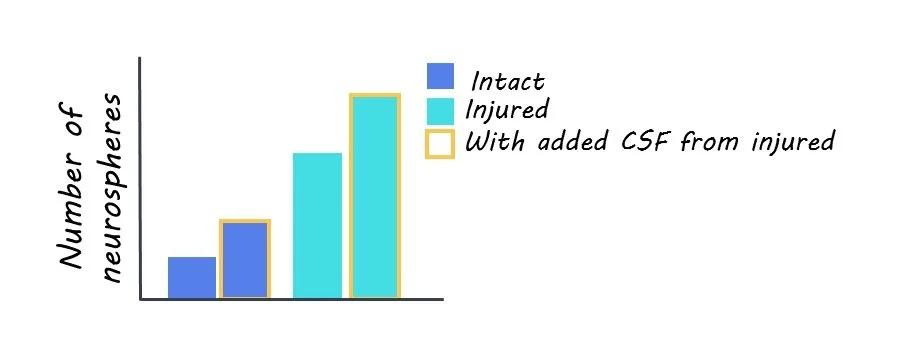
They sliced the sample tissue into pieces, with each slice being a different distance from the injury core. By bathing the slices in solutions with molecules that would stick to specific proteins and glow under the microscope, they could tag astrocytes to see where they were located and how they reacted to the brain injury. They also kept the brain cells alive in a culture: a container with a mixture of the different chemicals that mimic the right conditions for cells to multiply. They let the cell culture develop for 14 days and then looked for structures called neurospheres, which are blobs generated from single neural stem cells that are self-sustaining while also generating neurons, astrocytes, and other neural cells (click here for a visual). They looked at how the neurospheres developed on their own, and also what would happen if cerebrospinal fluid from a patient with a different type of brain injury was added to the culture.

What did they find?

When the blood-brain barrier was disrupted, astrocytes reacted by multiplying at the site of the injury. These astrocytes also produced a protein called Galectin-3. Related proteins could also be found floating in the cerebrospinal fluid, and there was a significant increase in neurospheres in the cultured tissue from those same patients. In tissue samples from cases with no blood vessel ruptures, there were hardly any neurospheres. However, if the cerebrospinal fluid with Galectin-3 related proteins was added, it induced the formation of neurospheres, regardless of the type of injury.

What does all of this suggest? It seems like astrocytes can produce proteins in response to bleeding that eventually allow them to become neural stem cells, which may then stimulate the formation of new brain tissue.

What's the impact?

This research helps us to understand the regenerative mechanisms at injury sites in the human brain, which could be harnessed for medical applications. Another highly relevant discovery of this research is that, in conditions where the brain’s blood vessels are compromised, there will be specific changes in the protein signature of cerebrospinal fluid, which could allow clinicians to determine the nature and progression of brain injuries.