The Role of Dopamine in Integrating Costs, Benefits and Motivation

Post by Soumilee Chaudhuri

The takeaway

Eshel and colleagues found that dopamine release in the striatum is related to both the costs and benefits of a decision and that higher motivational states are associated with lower dopamine release. 

What's the science?

Dopamine (DA) release in two distinct regions of the brain: ventral and dorsal striatum, has been associated with the motivation underlying decision making. But there is insufficient evidence as to whether DA released from these regions impact cost, benefit and how this might be influenced by motivation. An article published in Neuron this week investigated the role of dopamine in cost, benefit and motivation  using mouse models and optogenetics to understand 1) how dopamine responds to variation in the cost and benefit of an action and 2) how these changes in dopamine release are associated with the animal’s motivation to act.

How did they do it?

The researchers measured motivation in mice to obtain a natural reward (sucrose) or an artificial reward (optogenetic stimulation of DA in the brain) while recording DA release in the ventral and dorsal striatum. This helped them study how DA dynamics are involved in reward and behavior. First, mice were trained to poke their nose to get a sweet reward (sucrose); thereafter, the number of pokes to get the same reward was increased every 10 minutes, which the authors considered to be the “cost” associated with the reward. The concentration and amount of sucrose quantity were constant within a session but varied with different sessions. The mice were analyzed based on their sensitivity to changes in reward and cost. In a separate group of mice, the researchers used optogenetics to directly stimulate the dopamine neurons in the brain and record & analyze its release; this was done to see the impact of dopamine release on motivation, as the mice were taught to poke for the optogenetic stimulation accompanied by light and sound cues.

What did they find?

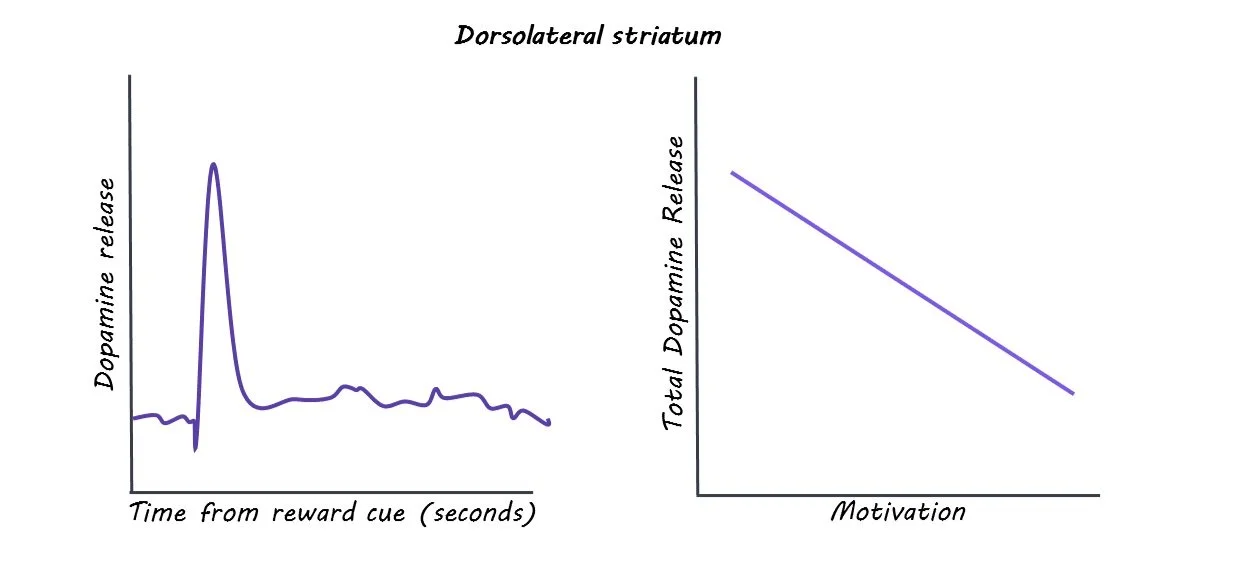
The researchers found that dopamine activity reflected both the size of the reward (i.e., benefit) as well as the effort that has already been made to achieve the reward (i.e., the cost). This was a key takeaway as it emphasized that DA was not preferentially associated with either benefit or cost associated with a task. The researchers also observed an unexpected and counterintuitive link between DA release and motivation: they found that highly motivated mice had lower dopamine release for a fixed reward and vice-versa. The authors speculate that this finding could be similar to what is observed in the cases of drug users, where high motivation is associated with low drug-induced dopamine release. Additionally, it was also found that optogenetics-induced DA stimulation was influenced by the environment, costs, rewards, as well as motivation. 
What's the impact?

This study shows that dopamine released in the brain’s striatum reflects the cost and benefit of a task, as well as the motivation underlying that task. Dopamine dynamics for each reward represents the size of the reward as well as the cost that’s already been paid for the task. The study also shows that dopamine release goes down in high-motivation states. Overall, the findings of this study are crucial to understanding the intricacies of the role of dopamine as a neuromodulator in the brain.

The Effects of Schizophrenia on Cognitive Mapping

Post by Christopher Chen 

The takeaway

We use cognitive maps to help make sense of the world, but these maps might be distorted and disorganized in people with schizophrenia (PScz). Researchers discovered that the reduced influence of semantic similarity and abnormal hippocampal ripples (i.e. transient bursts of high-frequency activity) in PScz contribute to cognitive disorganization found in PScz. 

What's the science?

Schizophrenia is a prevalent neuropsychiatric disorder causing conceptual disorganization, abstract reasoning difficulties, and language coherence issues. The presence of these symptoms, collectively known as "formal thought disorder," predicts impaired social functioning. Schizophrenia is also associated with abnormalities in association-guided cognition, where relationships between memories, concepts, or objects in the brain, known as "relational knowledge," are disrupted.

Recent studies suggest that the hippocampal–entorhinal cortex (HEC) encodes abstract relational knowledge. In rodents, researchers have shown that HEC cells encode spatial relationships during navigation of the environment and exhibit neural "replay" during rest. In humans, the HEC also encodes associations in abstract domains, supporting a domain-general "cognitive mapping" function that spans conceptual and semantic spaces. Furthermore, hippocampal ripple power, a neural output linked to cognitive map stabilization, is known to be disrupted in PScz. However, the impact of schizophrenia on cognitive maps as well as the neural signatures of these outputs are unknown. In a recent article in PNAS by Nour et al., researchers used a combination of verbal fluency analysis and brain imaging to help fill gaps in understanding the impact of schizophrenia on cognitive mapping. 

How did they do it?

To assess verbal fluency, 52 participants (26 PScz and 26 controls) were given 2 separate language-based tests, each 5 minutes long. For the first test, they were asked to name as many animals as they could in the allotted time (category fluency), while in the second test, they were asked to name as many words as they could that started with the letter "p" (letter fluency). 

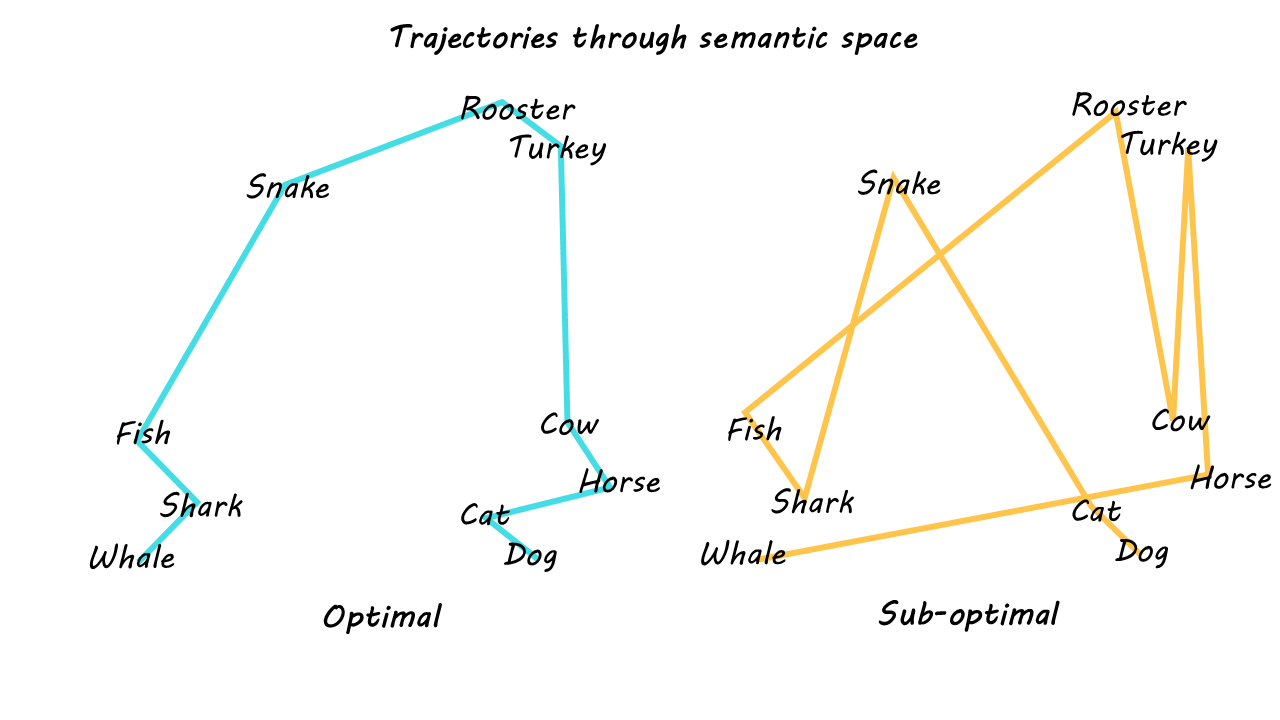
Researchers used several analysis tools, including a novel Natural Language Processing (NLP) machine learning approach, to measure semantic associations (i.e. similarities) between the words each patient provided. The researchers then measured how closely participants' word sequences approximated the “optimal path” of word sequences generated by mathematical algorithms, with greater divergences from the optimal path metrics suggesting “looser” conceptual organization. 

Researchers were also interested in investigating how neural signatures associated with verbal fluency manifested in PScz. To do so, researchers used a brain imaging technique called magnetoencephalography (MEG) to characterize brain activity in participants following verbal learned task sequences. Specifically, MEG data were collected from participants who had completed a sequence learning task and were resting quietly, to reveal whole-brain activity patterns of spontaneous neural replay of those learned task sequences.  

What did they find?

PScz showed less optimal word selection over time during the category fluency task, suggesting that their cognitive processes were more disorganized. Additionally, computational modeling demonstrated that the balance between category and letter-based information in task performance was notably influenced by the task goal (context). In other words, category-based (semantic) bias was seen in the animal-naming task while letter-based bias (similarity between words, letter by letter) was seen in the ‘p’ word task. The extent of this influence, referred to as "goal-induced semantic modulation," was significantly reduced in individuals with schizophrenia, again suggesting that PScz exhibits an impairment in how semantic information is used to guide the flow of thought. Furthermore, greater variability in goal-induced semantic modulation across participants correlated with greater difficulty with abstract conceptual reasoning, which is considered to be a “negative” symptom in schizophrenia. This suggests that the observed deficits in goal-induced semantic modulation may be linked to specific symptoms in schizophrenia, providing valuable insights into the cognitive mechanisms underlying the disorder.

As for brain imaging data, MEG traces showed that in both controls and PScz, participants with greater ripple power at the time of replay demonstrated a greater tendency to use semantic information for context-sensitive word selection. Essentially, greater ripple power was correlated with greater cognitive organization during verbal fluency behavior. Interestingly, the study did not find a correlation between goal-induced semantic modulation and a previously reported measure of spontaneous replay, providing valuable insights into the nuanced relationship between neural processes and semantic cognition in individuals with schizophrenia.

What's the impact?

This study provided preliminary support for the hypothesis that some symptoms of schizophrenia are linked to dysfunction in cognitive maps. Overall, these findings are some of the first to connect clinical features of schizophrenia to the neural processes underlying abnormalities in semantically guided cognition.

Neurogenesis During Pregnancy Influences Maternal Behavior

Post by Laura Maile 

The takeaway

Adult neural stem cells (NSCs) contribute to brain plasticity throughout life. During different phases of pregnancy, NSCs differentiate into distinct subtypes of olfactory bulb neurons, influencing maternal behavior. 

What's the science?

The adult mouse brain contains stem cells that are influenced by environmental changes and can differentiate into distinct cell types. Physiological states such as hunger and satiety are known to influence specific regional populations of adult NSCs. Pregnancy induces changes in several brain areas including the ventricular subventricular zone (V-SVZ), which contains neural stem cells (NSCs) that differentiate into olfactory bulb neurons and show increased proliferation at certain stages of pregnancy. It’s unknown, however, whether pregnancy and other physiological states can control specific populations of NSCs and whether there’s a functional outcome on brain plasticity and behavior. This week in Science, Chaker and colleagues investigated how distinct neural stem cells respond to pregnancy to produce specific olfactory bulb neurons that influence the behavior of mothers around the time of birth. 

How did they do it?

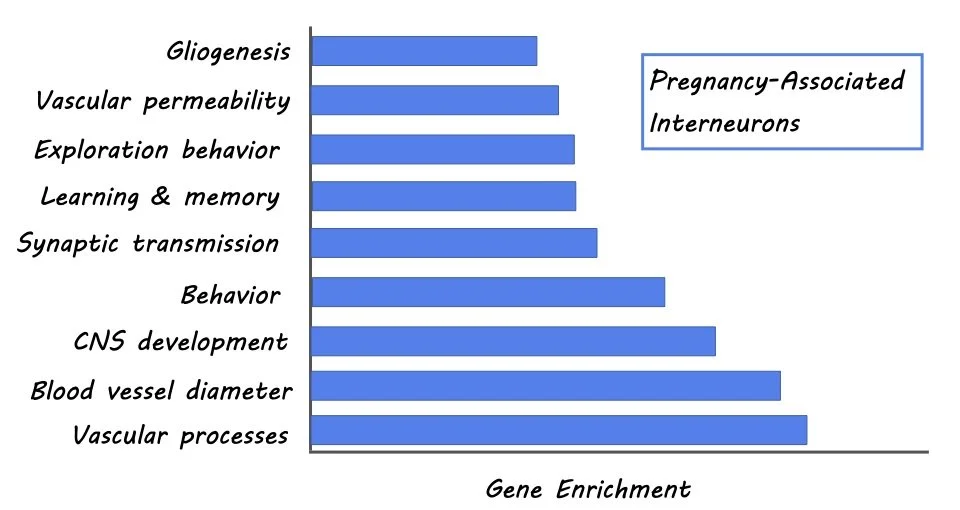
Using GFAP and Ki67 in mice, the authors labeled and quantified proliferating NSCs in the V-SVZ on different days of gestation and post-pregnancy. Next, they injected pregnant females with a thymidine analog on specific days of pregnancy to label newly born neurons and then analyzed their olfactory bulbs three weeks later when the labeled neurons would be integrated. This allowed them to determine whether specific populations of NSCs differentiate into distinct cell layers and subtypes of olfactory bulb neurons. To understand whether the newly differentiated olfactory bulb neurons were long-lasting past weaning (i.e., when the mice are separated from the mother), they quantified the surviving cells again 30 days post analog injection. They next performed spatial transcriptomics to characterize the genetic profiles of olfactory bulb layers that experience neurogenesis (i.e., growth of new neurons) during and after pregnancy. They then focused on one cluster that was enriched in mothers during pregnancy to determine what neuronal markers were associated with pregnancy. To determine the function of the transiently increased pregnancy-associated neurons, the authors measured their survival when maternal care was disrupted by prematurely removing pups, cross-fostering with new pups, or exposing mothers or virgin mice to pup nest odor. Finally, they conducted olfactory behavior tests in mothers during pregnancy who had specific populations of olfactory bulb interneurons depleted or maintained. 

What did they find?

The authors discovered that distinct regions of the V-SVZ showed activity and proliferation on specific days during pregnancy. This indicates that there are both temporally and spatially dynamic patterns of differentiation controlled by the phase of pregnancy of the adult mouse.  After injecting a thymidine analog on specific gestation days, they found that pregnancy induces neurogenesis in discrete sublayers of the olfactory bulb and that these new neurons become functionally integrated into the existing circuitry. Once pups began feeding on solid food and required less maternal care, however, the olfactory bulb showed decreased numbers of these newborn neurons, and nearly all of them disappeared by weaning. This confirms that pregnancy induces transient neurogenesis at specific stages of the perinatal period. Spatial transcriptomics revealed clusters of neurons corresponding to olfactory bulb layers, that showed upregulation in certain genes at specific time points, indicating the spatial and temporal control of neurogenesis in response to pregnancy.

When pups were removed from maternal care prematurely, certain interneurons were correspondingly lost early. Similarly, when cross-fostering with news pups, some pregnancy-related interneurons survived, while others were lost. The neurons lost shared genetic profiles and location in olfactory layers. Additionally, specific interneuron populations were rescued when mothers were exposed to new pup nest odor, and others were not, indicating the necessity of pup odor for the survival of pregnancy-related neurons. Loss of one type of pregnancy-related interneuron reduced the ability of mothers to discriminate between their own pups and new pups. This shows that pregnancy-related neurogenesis is important for own pup odor recognition, but not for general olfactory function. Loss of different types of interneurons decreased pup exploration index, suggesting that pregnancy-related neurogenesis is important for pup odor sensitivity during early motherhood. 

What's the impact?

This study demonstrated that neural stem cells can generate specific populations of neurons to help pregnant mothers prepare for maternal care. Different physiological states, such as hunger, satiety, and pregnancy, can influence adult neurogenesis to suit transient needs and influence behavior, according to environmental and physiological changes. 

Access the original scientific publication here.