
The Role of Dopamine in Integrating Costs, Benefits and Motivation
Post by Soumilee Chaudhuri
The takeaway
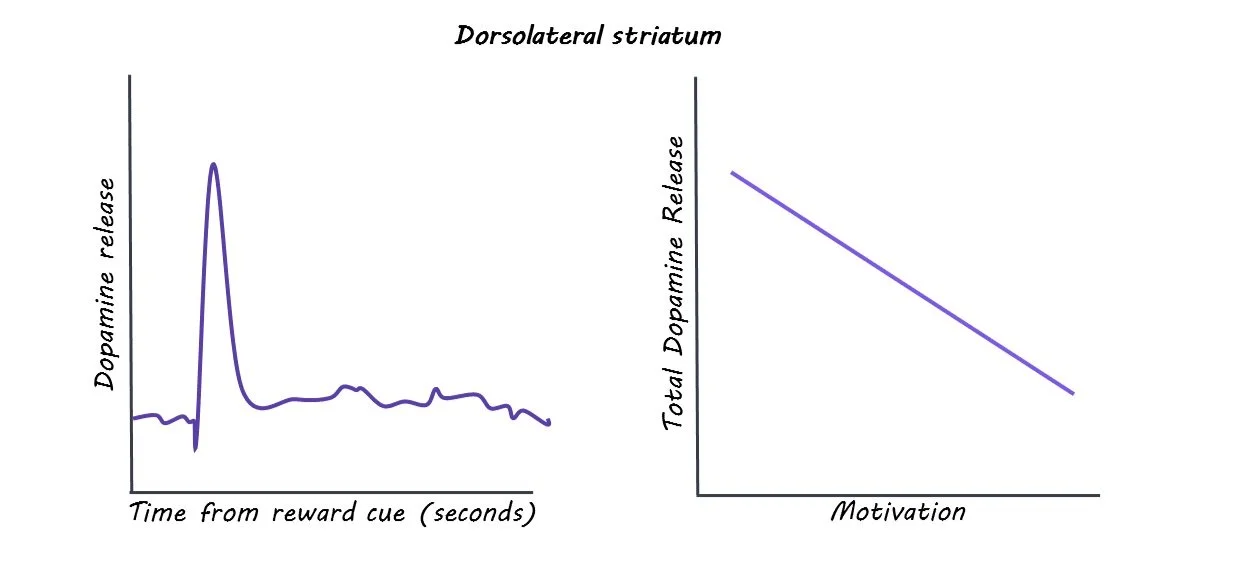
Eshel and colleagues found that dopamine release in the striatum is related to both the costs and benefits of a decision and that higher motivational states are associated with lower dopamine release.
What's the science?
Dopamine (DA) release in two distinct regions of the brain: ventral and dorsal striatum, has been associated with the motivation underlying decision making. But there is insufficient evidence as to whether DA released from these regions impact cost, benefit and how this might be influenced by motivation. An article published in Neuron this week investigated the role of dopamine in cost, benefit and motivation using mouse models and optogenetics to understand 1) how dopamine responds to variation in the cost and benefit of an action and 2) how these changes in dopamine release are associated with the animal’s motivation to act.
How did they do it?
The researchers measured motivation in mice to obtain a natural reward (sucrose) or an artificial reward (optogenetic stimulation of DA in the brain) while recording DA release in the ventral and dorsal striatum. This helped them study how DA dynamics are involved in reward and behavior. First, mice were trained to poke their nose to get a sweet reward (sucrose); thereafter, the number of pokes to get the same reward was increased every 10 minutes, which the authors considered to be the “cost” associated with the reward. The concentration and amount of sucrose quantity were constant within a session but varied with different sessions. The mice were analyzed based on their sensitivity to changes in reward and cost. In a separate group of mice, the researchers used optogenetics to directly stimulate the dopamine neurons in the brain and record & analyze its release; this was done to see the impact of dopamine release on motivation, as the mice were taught to poke for the optogenetic stimulation accompanied by light and sound cues.
What did they find?
The researchers found that dopamine activity reflected both the size of the reward (i.e., benefit) as well as the effort that has already been made to achieve the reward (i.e., the cost). This was a key takeaway as it emphasized that DA was not preferentially associated with either benefit or cost associated with a task. The researchers also observed an unexpected and counterintuitive link between DA release and motivation: they found that highly motivated mice had lower dopamine release for a fixed reward and vice-versa. The authors speculate that this finding could be similar to what is observed in the cases of drug users, where high motivation is associated with low drug-induced dopamine release. Additionally, it was also found that optogenetics-induced DA stimulation was influenced by the environment, costs, rewards, as well as motivation.
What's the impact?
This study shows that dopamine released in the brain’s striatum reflects the cost and benefit of a task, as well as the motivation underlying that task. Dopamine dynamics for each reward represents the size of the reward as well as the cost that’s already been paid for the task. The study also shows that dopamine release goes down in high-motivation states. Overall, the findings of this study are crucial to understanding the intricacies of the role of dopamine as a neuromodulator in the brain.
