Glioma Tumors Hijack Healthy Mechanisms of Neuroplasticity in Order to Grow

Post by Trisha Vaidyanathan 

The takeaway

Healthy neurons can form synapses with glioma tumor cells. These neuron-to-glioma synapses undergo a form of synaptic plasticity similar to healthy neurons, that is dependent on the release of brain-derived neurotrophic factor (BDNF), allowing tumor cells to proliferate and tumors to grow. 

What's the science?

Gliomas are the most common form of brain cancer in children and adults and glioma tumor progression is highly regulated by the activity of surrounding neurons. However, it is not known precisely how neuronal activity regulates tumor progression. Neurons and glioma cells can interact through the secretion of signals and through direct neuron-to-glioma synapses. One hypothesis is that neuron-to-glioma synapses are strengthened through a form of neuroplasticity in which glioma cells increase their sensitivity to the excitatory neurotransmitter glutamate by recruiting more AMPA glutamate receptors to the membrane. This form of neuroplasticity can occur between two healthy neurons via the signaling molecule BDNF and the BDNF receptor, TrkB. This week in Nature, Taylor and colleagues used patient-derived glioma cells and mouse models to demonstrate that gliomas recruit BDNF signaling to strengthen the neuron-glioma connection and drive tumor proliferation and progression.

How did they do it?

First, the authors transplanted patient-derived glioma cells into mice, a process called xenografting. This allowed the authors to manipulate each component of the BDNF signaling pathway and assess the effect on tumor proliferation and animal survival. In a series of experiments, the authors (1) removed neuronal release of BDNF with a mutant mouse model, (2) used CRISPR to remove the BDNF receptor, TrkB, from the glioma cells, (3) administered a potential therapeutic drug (entrectinib) that blocks the family of Trk BDNF receptors, and (4) used pharmacology to block AMPA receptors.

Second, the authors directly tested whether BDNF drives plasticity in glioma cells by using patch-clamp electrophysiology to measure the glioma cell response to glutamate with or without BDNF and with or without the BDNF receptor.

Third, to assess whether glioma cell plasticity led to increased AMPA receptor signaling, the authors created cultures of the glioma cells and used a sophisticated method called cell-surface biotinylation to quantity the amount of AMPA receptor protein on the glioma membrane with and without BDNF exposure. Additionally, the authors used the pH-sensitive sensor, pHluorin, to visualize AMPA receptors moving to the membrane in real time after BDNF exposure.

Fourth, the authors assessed how well the glioma cells with or without the BDNF receptor were able to associate with the surrounding neuronal network by quantifying the number of neuron-to-glioma synapses with immuno-electron microscopy.

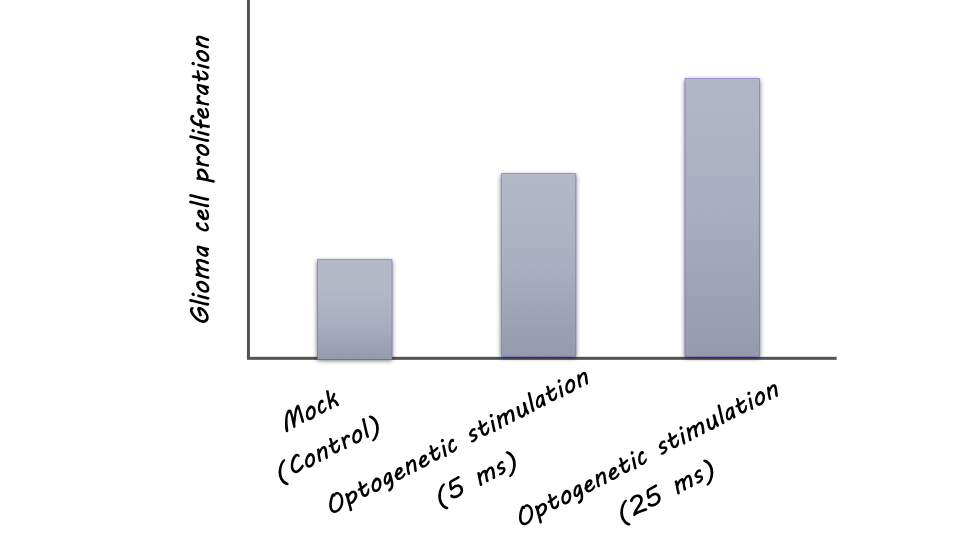
Lastly, the authors sought to validate their hypothesis that increased synapse strength led to higher tumor growth by stimulating glioma cells to varying degrees with optogenetics and measuring the resulting tumor growth.  

What did they find?

First, the authors found that disrupting any part of the BDNF neuroplasticity pathway – either removing neuronal release of BDNF, removing or blocking the BDNF receptor in glioma cells, or blocking AMPA receptors – increased the survival of the xenografted mice and reduced tumor proliferation. This demonstrated that BDNF signaling is a critical component of how neuronal activity promotes tumor growth.

Second, the authors demonstrated that BDNF was sufficient to increase the glioma cell response to a puff of glutamate. Further, BDNF could not elicit this response if the glioma cell lacked the BDNF receptor TrkB confirming the importance of the BDNF-TrkB signaling pathway for glioma plasticity.

Third, the authors found increased AMPA receptor protein at the membrane of glioma cell cultures that were exposed to BDNF. They also were able to visualize AMPA receptors moving to the membrane after BDNF exposure in real-time with their pH-sensitive sensor. This confirmed that BDNF signaling in glioma cells drives neuroplasticity by increasing the number of AMPA receptors at the membrane, the same mechanism used by healthy neurons.

Fourth, immuno-electron microscopy revealed that glioma xenografts that lacked the BDNF receptor TrkB had fewer neuron-to-glioma synapses than xenografts that had TrkB expression. These data revealed that BDNF-TrkB not only strengthens the synapse but also promotes the formation of synapses.

Lastly, the authors clearly demonstrated the importance of neuron-to-glioma synapse plasticity for tumor growth by showing that robust optogenetic stimulation to depolarize glioma cells resulted in more tumor proliferation than mild optogenetic depolarization.
What's the impact?

The finding that glioma tumor cells hijack a well-established method of neuroplasticity to strengthen their integration into neuronal networks and proliferate is critical to our understanding of how brain cancer both influences and is influenced by, the surrounding healthy tissue. This work will provide several novel targets that could result in effective treatment for brain cancer, some of which the authors have already started to explore in this paper. 
Access the original scientific publication here

The Role of Frontal Theta-Band Activity in Regulating Risk-Taking Behavior

Post by Kulpreet Cheema

The takeaway

Previous research suggests that frontal cortex theta-band activity - a rhythm of neural activity between 4-8 Hz - plays a significant role in modulating decision-making involving risk. Theta-band activity in the left dorsolateral prefrontal cortex (DLPFC) specifically, is associated with increased risk-taking behavior. 

What's the science?

We face risky choices constantly in everyday life, from small decisions like whether to take an umbrella out with us based on the weather forecast, to larger decisions like deciding how to invest our money in the stock market. Electroencephalography (EEG) studies have shown that frontal theta-band activity is associated with cognitive control, response inhibition, reward anticipation, and conflict detection processes that are essential in risk-taking behavior. The dorsolateral prefrontal cortex (DLPFC) and medial prefrontal cortex (MPFC) are two crucial frontal brain regions involved in decision-making, particularly in a risky context. This week in NeuroImage, Dantas and colleagues aimed to understand the role of frontal cortex theta-band activity in regulating risk-taking behavior. 

How did they do it?

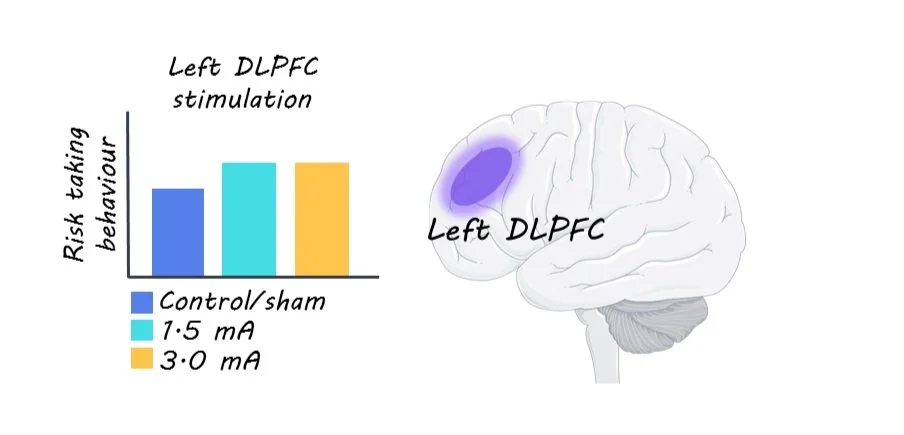
Thirty-nine participants performed the Maastricht Gambling Task (MGT) while their right or left DLPFC were stimulated with transcranial alternating current stimulation (tACS). tACS is a unique form of brain stimulation used to modulate brain activity and in some cases induce neural plasticity. The MGT was carefully selected to assess risk-taking behavior, controlling for the effects of other variables like loss aversion and memory and learning effects. In each trial, participants had to guess the color of a box hiding a token, with varying probabilities of success and corresponding payoffs. Two tACS stimulation intensities (1.5 mA and 3 mA) were applied to assess the impact of intensity on risk-taking. The researchers analyzed behavioral data, including risk, value, and response time, as well as EEG data, to understand how brain stimulation affected risk-taking behavior. 

What did they find?

The results showed that stimulating the left DLPFC with theta-band tACS led to increased risk-taking behavior. However, when the right DLPFC was stimulated, no significant changes in risk-taking were observed. Participants' ‘value’, which reflects their attraction to larger payoffs or rewards in a given trial of the gambling task, increased significantly during left DLPFC stimulation, especially with higher intensity. In contrast, right DLPFC stimulation, particularly at higher intensity, led to a significant reduction in value. EEG data revealed increased theta power after sham stimulation and an overall increase in frontal theta power after left DLPFC tACS. However, no significant EEG aftereffects were observed following right DLPFC tACS. 

What's the impact?

This study sheds light on the differential role of right and left frontal theta-band activity in risk-taking behavior. Researchers found that stimulating specific brain regions can influence decision-making under risk, with left DLPFC stimulation increasing risk-taking, and right DLPFC stimulation reducing it, particularly at higher intensities. Understanding these relationships has potential applications in clinical settings, as these findings could inform intervention in cases involving abnormal risk-taking behavior. The research also highlights the importance of tACS stimulation intensity, indicating that higher intensities may be necessary to induce consistent behavioral responses. 

Access the original scientific publication here.

A Less Invasive Form of Deep Brain Stimulation Enhances Memory Function in Healthy Adults

Post by Christopher Chen 

The takeaway

Deep brain stimulation (DBS) can be used to treat neurological and psychiatric disorders, but the technique can be invasive and cause unwanted side effects. Scientists have developed a non-invasive method of DBS called temporal interference (TI) and demonstrated its effectiveness in humans by focusing on the hippocampus, where TI helped improve memory accuracy in healthy subjects.  

What's the science?

Since its FDA approval in 1997 in the treatment of essential tremor, deep brain stimulation (DBS) – which relies on direct electrical stimulation of specific brain regions – has since been approved and used by clinicians to treat patients with neurological conditions such as Parkinson’s disease, epilepsy, and most recently, Alzheimer’s disease. However, DBS is quite invasive, with its use requiring patients to undergo brain surgery which can lead to additional complications. As such, researchers have sought safer, non-invasive forms of DBS such as transcranial magnetic stimulation and transcranial electrical stimulation (tES) to treat brain-related disorders. Unfortunately, these techniques can also elicit harmful side effects through unintended activation of brain areas close to but not part of the target stimulation region. 

Recently, scientists have developed a method called temporal interference (TI) stimulation, which uses multiple electric fields delivered at different frequencies to target specific brain regions. By changing the distribution of current intensities between different scalp electrodes, researchers can also direct, or steer, TI to different areas. This technique offers a way to stimulate deep brain structures without the risks of surgery, while also providing a level of precision not found in other tES techniques.

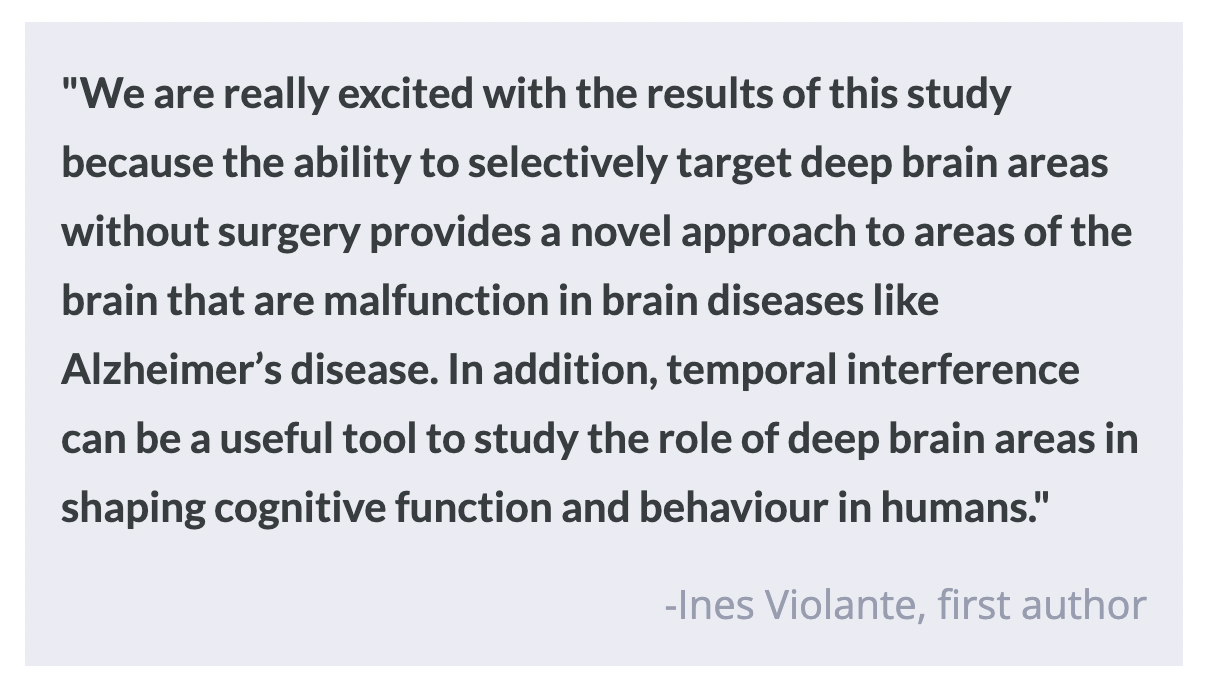
Recently in Nature Neuroscience, Violante and colleagues described how scientists used TI to perform non-invasive, targeted stimulation of the hippocampus in humans under several different conditions. Data also demonstrated that TI-mediated stimulation of the hippocampus augmented memory function in healthy human subjects, highlighting the potential therapeutic benefits of TI in the near future. 

How did they do it?

Considering one of the main drawbacks of other forms of neuromodulation is non-specificity, the researchers wanted to see if they could apply TI to an exclusive region of the hippocampus without disturbing the overlying cortex as well as reliably steer TI to other parts of the hippocampus. To test this, the researchers relied on an anatomical model of the human brain that could measure the effects of electrical field stimulation. They measured electrical field differences between the hippocampus and overlying cortex as well as the ability of the signal to be steered to different parts of the hippocampus. Following application in computer models, this experimental paradigm was applied to human cadavers.   

The researchers used neuroimaging in live human subjects to assess the physiological impact of TI stimulation on the hippocampus. To do so, they applied TI to 20 healthy participants while monitoring their brain activity via functional magnetic resonance imaging (fMRI). Specifically, they transiently applied TI stimulation on the hippocampus during a face-name paired associative task known to measure the encoding of episodic memory and measured the evoked hippocampal blood-oxygen-level-dependent (BOLD) signal in different hippocampal regions. 

A subsequent behavioral experiment involved a new cohort of 21 participants undergoing a similar face-name associative task paired with fMRI, albeit with a longer TI stimulation duration. This experiment was designed to probe the behavioral consequences of TI stimulation on memory, and stimulation was applied during the encoding, maintenance, and recall stages. 

What did they find?

Electric field modeling using computer simulations as well as measurements in a human cadaver validated the ability to localize TI stimulation to the human hippocampus with minimal exposure to the overlying cortex. The electric fields generated by TI also had amplitudes consistent with previous computational studies and were within the range to synchronize neural spiking activity in the desired frequency range.

Results from the neuroimaging experiments in live human subjects showed that TI stimulation, when transiently applied during the encoding of episodic memory, reduced the BOLD signal. Importantly, this reduction was specific to the hippocampus, with no significant effect on the overlying cortex. The strongest reduction occurred when TI stimulation was targeted to the anterior hippocampus, which plays a central role in memory encoding. These data collectively show that TI can be successfully localized to a specific region of the hippocampus known to be involved in memory formation.  

In the behavioral experiments involving longer stimulation durations and multiple components of memory processing, data showed a small but significant improvement in memory accuracy in participants when TI was applied. However, memories formed during TI stimulation were forgotten at a rate similar to those during sham stimulation. Overall, data suggests that TI-mediated augmentation of memory may be specific to memory accuracy. 

What's the impact?

This study is the first to characterize the functionality of TI in live human subjects and show that TI can be localized to the anterior hippocampus. As for TI’s functional significance, this study suggests that TI may have the potential to enhance memory accuracy, although the magnitude of the effect was relatively small. The article’s authors suggest that future research should explore the longer-term effects of TI stimulation on memory and investigate optimal stimulation timing, frequency, and duration to achieve stronger and sustained memory benefits. Overall, this study represents a significant step in demonstrating the feasibility and potential benefits of TI in humans, particularly in the context of memory modulation.