Do You Have a Voice Inside Your Head?

Post by Shireen Parimoo

Our inner auditory world

Inner speech - also known as the "voice inside our head" or an internal dialogue - is a part of our subjective experience of thinking that is often taken for granted. Much like mental visual imagery (often referred to as ‘the mind’s eye’), those of us who have experienced inner speech may find it difficult to imagine a time without this form of internal auditory imagery. So, why do we have inner speech at all? According to Vygotsky’s social origin theory of inner speech, speech is initially social in nature during childhood and its main purpose is communication, typically with parents. Over time, children develop egocentric or private speech where they verbalize their thoughts out loud, often while engaging in problem-solving activities. In late childhood, egocentric speech is internalized and transforms into inner speech that children can use flexibly for various cognitive functions. Inner speech is therefore separate from private speech, or “talking to ourselves out loud”, even though both are forms of language directed toward the self rather than toward others.

Theoretical perspectives vary in the extent to which inner speech is thought to differ from outer speech. Motor simulation theories state that inner speech shares all the same characteristics of outer speech production except for the actual articulation of speech. This view is supported by studies showing the activation of muscles that would be used to produce those words out loud. Alternatively, abstraction theories take the view that the processes underlying inner speech are independent of articulatory processes associated with outer speech, as inner speech first occurs with the activation of abstract linguistic concepts. This idea is supported by the fact that silent reading is faster than reading aloud and that articulatory suppression does not necessarily impact inner speech. 

What are the components of inner speech?

Vygotsky originally differentiated inner speech from outer speech based on four main characteristics: 

1. Word sense: words used in inner speech capture the overarching context and sentiments rather than precise meanings (e.g., the statement, “waves!” alone can capture the sense of awe at watching big waves while on the beach). 

2. Agglutination: individual words are combined into complex new ideas while retaining the meaning of the individual words (e.g., help-less-ness). 

3. Word senses flow from and influence each other during inner speech.

4. Predication: the absence of subjects from the contents of inner speech (e.g., “waves!” as opposed to “wow, I am so in awe of these huge waves!”). 
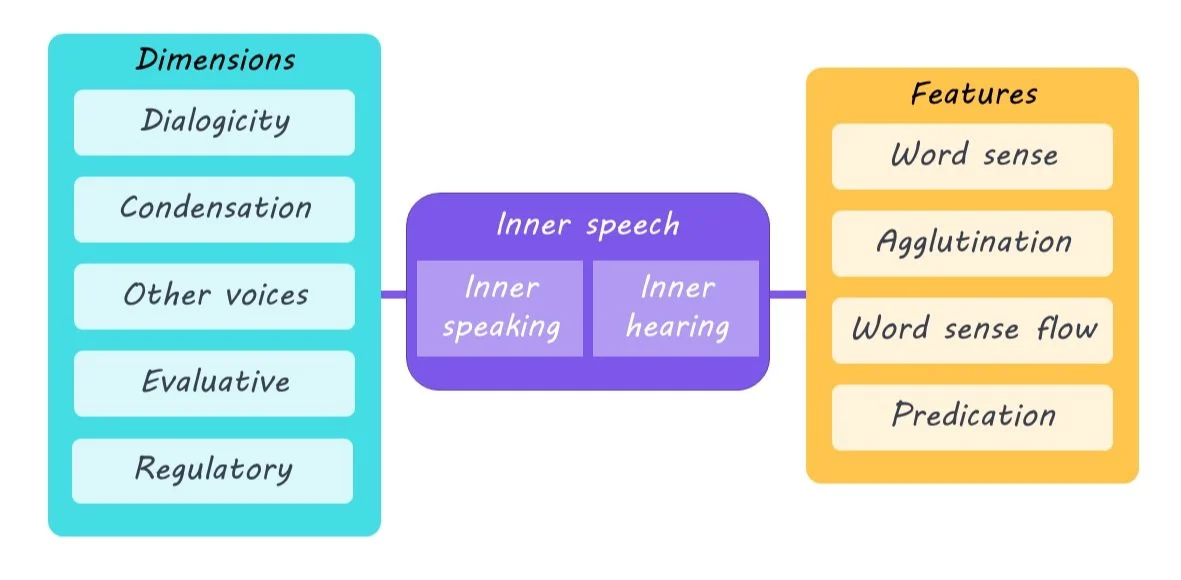
Newer perspectives on inner speech have also included a distinction between inner speaking (e.g., self-talk) which is intentional and strategic in nature as the individual ‘produces’ the speech, and inner hearing (e.g., remembering something), which occurs passively as the individual ‘receives’ the contents of speech. Similarly, inner speech is now thought to include distinct speaker positions (e.g., voices of other people during an internal dialogue), rather than a self-referential perspective alone.

Inner speech is notoriously difficult to study because its study relies mainly on self-report and experience sampling measures. For example, the Descriptive Experience Sampling approach involves prompting individuals at random time points to note down what they were thinking at that moment, which is later followed by an interview that probes the contents of their thoughts in more detail. This method has been useful in providing insights into the phenomenological characteristics of inner speech, such as the distinction between inner speaking and inner hearing. In contrast, the Varieties of Inner Speech Questionnaire-Revised measures the quality of inner speech according to five dimensions:

1. Dialogicity, or the extent to which inner speech is conversational.

2. Condensation, or the use of abbreviations that are normally absent in overt speech (such as the “waves!” example above). 

3. The degree to which other voices are present in the inner speech.

4. Critical or evaluative quality.

5. Positive or regulatory quality.

Is inner speech useful?

Different dimensions of inner speech are related to different aspects of the self. For example, the evaluative component is associated with lower self-esteem, depression, anxiety, and generally a negative self-concept. Individuals with a higher frequency of evaluative or critical inner speech are also likely to show perfectionistic and ruminative tendencies. On the other hand, higher rates of regulatory inner speech correspond to increased motivational self-talk and a positive self-concept, which may benefit individuals in performance-related domains like sports and public speaking. Indeed, inner speech is important for the formation and evolution of our self-concept. Thinking about the past and imagining the future can involve both inner speaking and inner hearing, which in turn, are related to the cognitive processes of metacognition and introspection that all contribute to our sense of self. 

Inner speech also serves various cognitive functions. Positive or regulatory inner speech, for instance, likely supports the ability to regulate emotions as people process their feelings through an inner monologue. Relatedly, self-talk during sports boosts performance by increasing motivation and maintaining engagement with the actions required to play. Inner speech is also useful for planning actions (e.g., thinking through the steps required to complete a task), problem-solving (e.g., considering different outcomes), creative thinking, cognitive flexibility, and language learning. During development, children can use inner speech to build upon their knowledge base by adding newly acquired words and concepts through a process known as linguistic bootstrapping. Similarly, internal monitoring of dialogue is beneficial for perceptual discrimination and categorization when it involves processing abstract concepts. 

However, not everyone has the experience of inner speech. Anendophasia is the lack of inner speech and is associated with lower verbal working memory, but only when participants are not allowed to process the words out loud. The use of inner speech is also not related to task-switching ability or perceptual discrimination performance, suggesting that it may not be necessary for cognitive functioning or that individuals with anendophasia may have developed compensatory strategies for carrying out these cognitive functions that otherwise rely on inner speech. 

Lastly, patterns of inner speech are related to psychopathological symptoms. In autism spectrum conditions, there is a lower frequency of inner speech overall. This pattern is thought to underlie lower performance on executive functioning tasks such as planning and cognitive flexibility, as well as emotional regulation. On the other hand, individuals with schizophrenia who experience auditory hallucinations tend to report a higher frequency of intrusive inner speech which, in turn, is related to worse executive functioning because it interferes with cognitive processing. Thus, inner speech is not only important for helping us maintain our sense of self but also supports various cognitive functions and provides numerous benefits to aspects of our day-to-day lives.

References +

Abend et al. (2017, Cognition). Bootstrapping language acquisition.

Albein-Urios et al. (2021, Journal of Autism and Developmental Disorders). Inner speech moderates the relationship between autism spectrum traits and emotion regulation.

Alderson-Day et al. (2018, Consciousness and Cognition). The Varieties of Inner Speech Questionnaire – Revised (VISQ-R): Replication and refining links between inner speech and psychopathology.

Ehrich, J. F. (2006, Australian Journal of Educational and Developmental Psychology). Vygotskian inner speech and the reading process.

Fernyhough & Alderson-Day. (2016). Chapter 6: Descriptive experience sampling as a psychological method. In Callard, Staines, Wilkes (Eds.). The Restless Compendium: Interdisciplinary Investigations of Rest and its Opposites. Basingstoke, UK: Palgrave Macmillan.

Fernyhough & Borghi. (2023, Trends in Cognitive Sciences). Inner speech as a language process and cognitive tool.

Hemmers et al. (2022, Frontiers in Psychiatry). Are executive dysfunctions relevant for autism-specific cognitive profile?

Hurlburt et al. (2013, Consciousness and Cognition). Toward a phenomenology of inner speaking.

Nedergaard & Lupyan. (2023). Not everyone has an inner voice: Behavioral consequences of anendophasia. In Goldwater, Anggoro, Hayes, & Ong (Eds.). Proceedings of the 45th Annual Conference of the Cognitive Science Society.

Petrolini et al. (2020, Frontiers in Psychology). The role of inner speech in executive functioning tasks: Schizophrenia with auditory verbal hallucinations and autism spectrum conditions as case studies.
The Cytokine IL-12 Protects Against Neuroinflammation by Signaling to Neurons

Post by Trisha Vaidyanathan

The takeaway

The cytokine interleukin-12 (IL-12) has a protective effect in neuroinflammatory diseases. The neuroprotective effect of IL-12 is mediated by neuronal sensing of IL-12 via the IL-12 receptor, resulting in transcriptional changes that increase survival, proliferation, and protection.

What's the science?

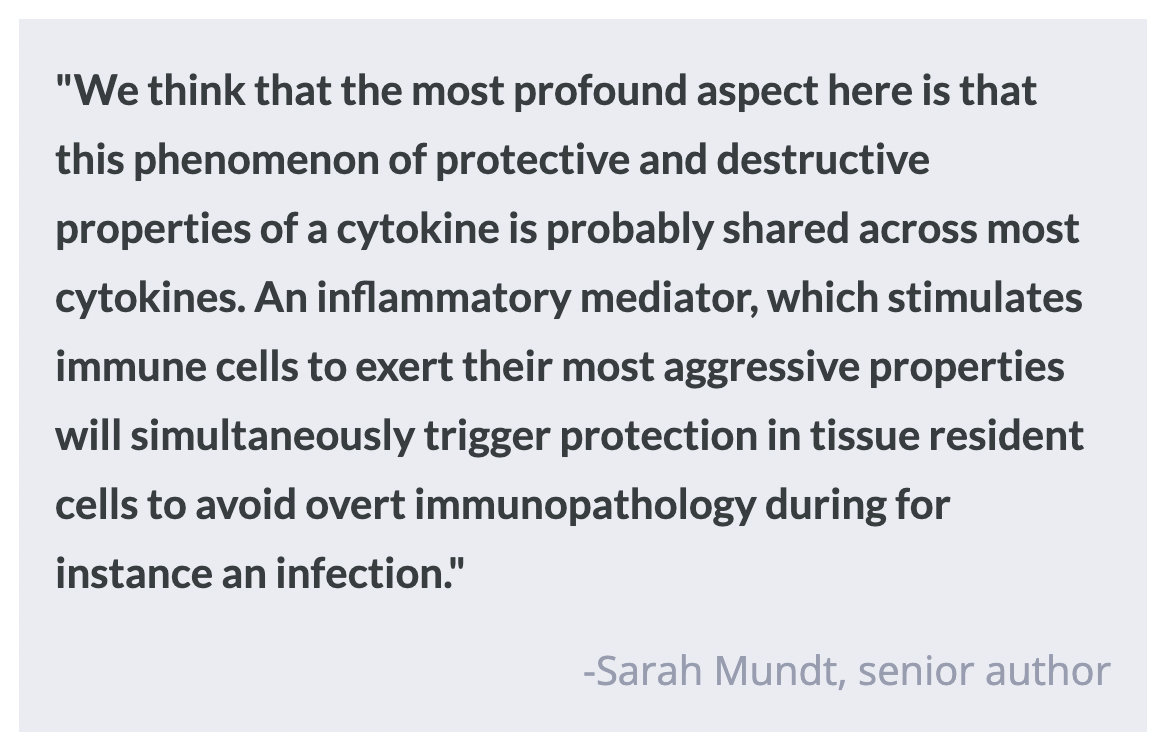
Central nervous system autoimmune disorders like multiple sclerosis (MS) are characterized by cytokine dysregulation, in which the body’s own immune system attacks tissue, causing inflammation that ultimately damages the brain. The cytokine IL-12 is a well-established driver of this type of inflammation. Paradoxically, mice lacking IL-12 develop worse neuroinflammation and clinical outcomes in several disease models, suggesting IL-12 also has a protective role. This week in Nature Neuroscience, Andreadou, Ingelfinger, and colleagues address this paradox by investigating the hypothesis that IL-12 elicits different effects depending on the cell type receiving the signal.

How did they do it?

First, the authors asked which cells are necessary to mediate the neuroprotective effect of IL-12. Using the cre-lox system, the authors were able to delete the IL-12 receptor from specific cell populations in a mouse model of MS (the EAE model) and investigate which cell-type specific deletion altered clinical outcomes.

Second, the authors used immunohistochemistry and RNA-fluorescence in situ hybridization to visualize IL-12 receptors and IL-12 receptor mRNA transcripts, which allowed them to identify which cell types in the brain are capable of sensing IL-12. Additionally, the authors confirmed their findings from the mouse in humans by analyzing human RNA-sequencing datasets and performing immunohistochemistry in MS patient tissue.

Third, the authors performed single nuclei RNA sequencing on mice where the IL-12 receptor was deleted in neurons and oligodendrocytes in order to reveal several cell-type specific transcriptional changes induced by the absence of the IL-12 receptor. Lastly, the authors used a neuronal cell culture system to test the effect of IL-12 on isolated mouse neurons and confirm their findings on the role of neuronal IL-12 signaling in neuroprotection.

What did they find?

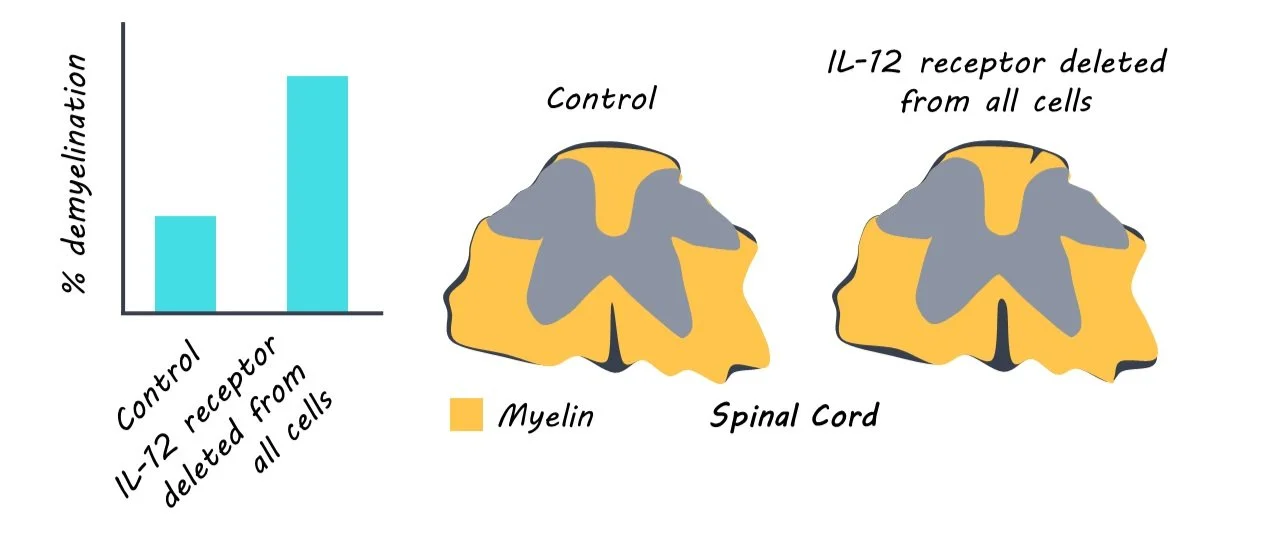
First, the authors deleted the IL-12 receptor from all cells and found the mice exhibited worse MS clinical symptoms, confirming previous findings that IL-12 can be protective. Next, the authors demonstrated that the protective effect was not driven by the sensing of IL-12 in immune cells because deleting the IL-12 receptor in all bone-marrow-derived immune cells, just T-cells, or just natural killer (NK) cells, did not change clinical disease symptoms in the mice.

Second, the authors demonstrated that both neurons and oligodendrocytes in the mouse brain express the IL-12 receptor. These findings were also confirmed in human MS patient tissue and sequencing datasets. Deleting the IL-12 receptor in neurons and oligodendrocytes led to worse disease symptoms and neuroinflammation, revealing that the neuroprotective effect was dependent on these cells.

Third, the authors answered the question of what IL-12 signaling in the brain does. The deletion of the IL-12 receptor in neurons and oligodendrocytes led to several transcriptional changes across many cell types. Overall, they found a reduction in gene expression for neuroprotection and survival, as well as a broad class of proteins called trophic factors released by cells to protect and support other cells.

Lastly, the authors narrowed in to identify that neuroprotection is mediated by neurons, not oligodendrocytes: When the authors deleted the IL-12 receptor only in oligodendrocytes there was no change in the MS clinical symptoms. To confirm this, the authors administered IL-12 to a cell culture system where only mouse neurons were present and found IL-12 increased the expression of genes that promote neuroprotection and remyelination as well as induced the release of trophic factors that are important for oligodendrocyte survival and function.

What's the impact?

This study is the first to settle the paradox of IL-12 by demonstrating that IL-12, a well-established driver of inflammation, can protect against inflammation by signaling to neurons. Understanding the protective effect of IL-12 can provide critical insight for clinical interventions in autoimmune disorders or neurodegenerative diseases that cause neuroinflammation. 

Modelling Human Psychological Responses to Robots: The Positive, the Negative, and the Competent

Post by Rachel Sharp

The takeaway

As robots become increasingly present in our everyday lives, human reactions to them become more complex. Human responses to robots can be categorized into three dimensions – positive, negative, and competence-related, and predictors can be identified for each response category, thereby establishing the positive-negative-competence (PNC) model.

What's the science?

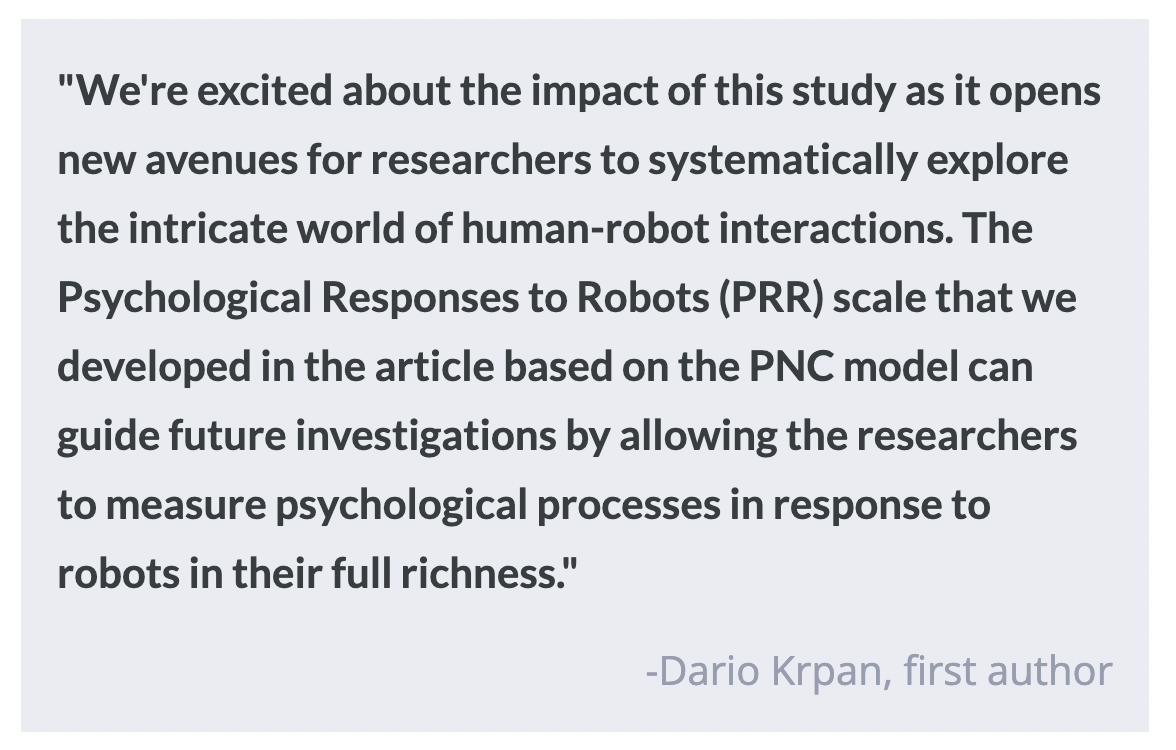
Robots are becoming increasingly more integrated with human society, resulting in more common and diverse human-robot interactions. Understanding how we think, feel, and react to robots in different spaces informs how we incorporate robots into pre-existing social structures. Previous studies on this topic have not included a comprehensive framework for the range of psychological responses we have, nor the diverse types of robots that humans interact with today. This week in Nature Human Behavior, Krpan, Booth and Damien sought to develop a model that could classify the broad spectrum of psychological responses to robots, organize these responses into grouped patterns (dimensions), and identify thought patterns that most strongly predicted these dimensions.

How did they do it?

The authors conducted 7 studies over 3 phases to develop a framework of robots (Phase 1; studies 1 & 2), develop a categorization for how we respond to robots (Phase 2, studies 3-5), and determine what best predicts these responses and why (Phase 3, studies 6 & 7). Across studies, participants responded to stimuli of robots as images and descriptions across 28 areas of human activity where robots are present. First, a group of participants were asked to generate characteristics they associated with robots, resulting in 277 unique characteristics. Then, a new set of participants grouped these characteristics into categories, from which 5 clusters of robot characteristics were found using hierarchical clustering. The authors then linked the themes of these clusters, forming a general definition of robots. Participants were then given this definition and asked to list all human domains they could think of that robots operate within. A new set of participants were given this comprehensive list of domains and asked to list all thoughts, feelings, and behaviors they could think of regarding robots operating in these domains. Based on their responses, the authors generated prompts to probe the reported thoughts and feelings, and asked new participants to answer them in response to an example of a robot from one of the original 28 domains (i.e. “This robot is like a human”). Responses to these prompts were used to generate statistical models to measure underlying factors representing the diversity of responses.

They found that responses could be most appropriately represented by 3 categories: positive, negative, and competence-related. They then confirmed that the model remains accurate across changes in participant demographic information or robot type. Lastly, the authors trained machine learning models for the positive, negative, and competence dimensions separately and identified the key predictors for each response type. They validated the identified predictors and used parallel mediation analysis to analyze potential mediators of the relationship between a predictor and the associated PNC dimension. For example, general risk propensity was a predictor for the positive dimension because people who scored highly for this trait valued the risks associated with using robots in society and were curious about how they would influence the world.  

What did they find?

The authors established the positive-negative-competence (PNC) model to represent the spread of human psychological responses to robot representation. They also identified unique predictors for each of these dimensions and were able to identify mediators for 3/3 of the positive dimension predictors, 2/4 of the negative dimension predictors, and 2/2 of the competence dimension predictors. The key positive predictors of each dimension with an example of an identified mediator of the predictor in parenthesis, where applicable, were: general risk propensity (valued risks of robot use), anthropomorphism (felt positively towards inanimate objects with human features), and parental expectations (felt robots could help humans fulfill their high expectations). The key predictors for the negative dimension were trait negative affect (were more likely to be in a state of displeasure), psychopathy (felt inferior towards technologies they were not proficient in), anthropomorphism (no mediator found), and expressive suppression (no mediator found). For the competence dimension, key predictors were approach temperament (valued exceptional skills and competencies) and security-societal (linked advanced technologies with the degree of societal advancement). 

What's the impact?

While previous research on human-robot relations has examined psychological responses to robots, this is the first study to investigate the spectrum of human psychological reactions under a comprehensive construct. Importantly, the authors illustrated that while the spectrum of human responses to robots is diverse, they can be explained by three dimensions of psychological processing: positive, negative, and competence-related. The proposed model allows future research to measure responses to robots more easily and accurately, helping us to construct a framework to understand how humans think, feel, and react to robots encountered in society.