A Protein in Microglia That Influences Alzheimer’s Disease Risk

Post by Trisha Vaidyanathan

The takeaway

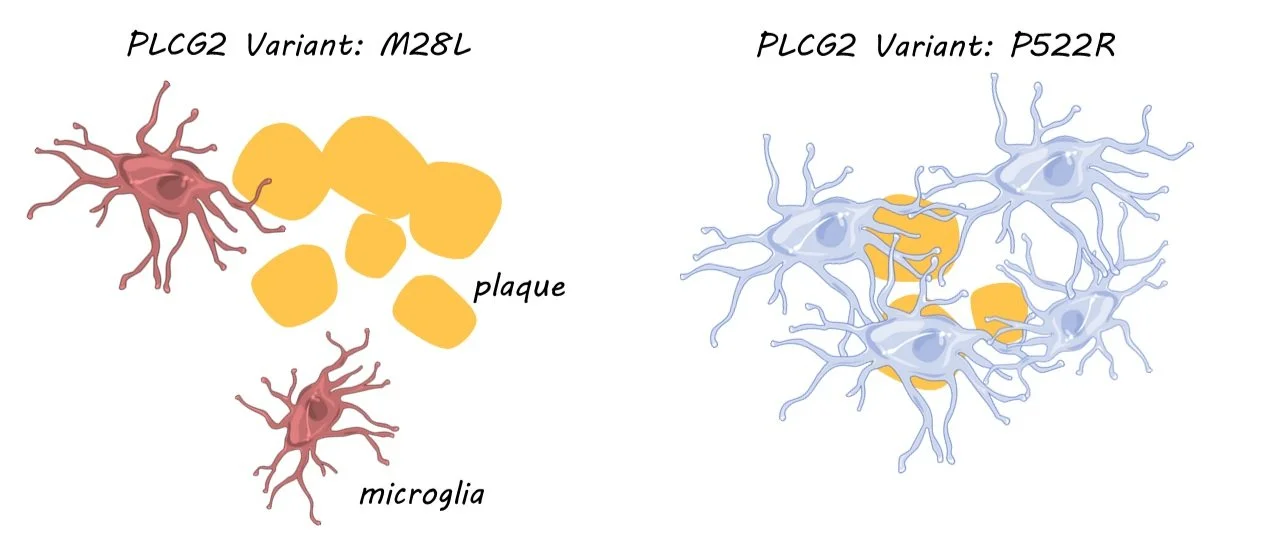
Two variants of the gene encoding phospholipase C-gamma-2 (PLCG2) have opposing effects on Alzheimer’s disease pathology via their opposing effects on microglia. The first variant (M28L) results in lower PLCG2 levels which reduce the microglial response to plaques and elevate disease risk, while the second (P522R) protects against Alzheimer’s disease by increasing PLCG2 activity, enhancing the ability of microglia to remove plaques and protect synaptic function.

What's the science?

Genetic studies have linked a variant of the gene PLCG2, termed PLCG2-P522R, with reduced risk for Alzheimer’s disease. PLCG2 encodes an enzyme found only in microglia and acts as a critical component of immune signaling within the brain. However, the function of PLCG2 in Alzheimer’s disease is not well understood. This week in Immunity, Tsai and colleagues investigated the “protective” P522R variant and identified a new variant that increases Alzheimer’s disease risk, called PLCG2-M28L. The authors demonstrated that both variants differently alter microglia function, leading to opposing effects on Alzheimer’s disease pathology.

How did they do it?

To investigate the function of PLCG2, the authors first generated mice that had either the “protective” P522R variant or the “detrimental” M28L variant of PLCG2 and determined the effects of this variant on PLCG2 levels. These mice were then crossed to a well-established Alzheimer’s mouse model (called 5xFAD) that is known to develop amyloid plaques, a hallmark of Alzheimer’s pathology. Throughout the study, the authors compared the mice carrying the “protective” and “detrimental” variants of PLCG2 with the typical Alzheimer’s mouse model and healthy control mice.

First, the authors used magnetic resonance imaging (MRI) and immunohistochemistry to measure the buildup of amyloid plaques. Since microglia are known to clean up amyloid plaques, the authors then investigated the proximity of microglia to plaques and measured the ability of microglia to clean up plaque proteins

Next, the authors tested the health of the neurons by measuring synaptic strength and plasticity with electrophysiology, and the mice’s cognitive ability and memory using a Y-Maze. Lastly, the authors used single nuclei RNA sequencing to identify distinct microglia subtypes and microglia functions that are altered by the PLCG2 variants.

What did they find?

The authors first determined that the “detrimental” M28L variant decreased PLCG2 levels, and is thus considered a loss-of-function mutation. In contrast, the “protective” P522R variant is known to increase PLCG2 activity and is considered a gain-of-function mutation

Compared to the typical Alzheimer’s disease mouse model, the loss-of-function M28L variant had more plaque deposits, and the plaques were associated with fewer microglia. The gain-of-function P522R variant had fewer deposits and more microglia coverage. Next, the authors found that microglia with the M28L variant took up less fluorescent amyloid, while P522R took up more, demonstrating that PLCG2 is critical for microglia to eat plaques.

Next, the authors found that mice with the loss-of-function M28L variant had impaired synaptic plasticity (long-term potentiation) and worse cognitive performance than typical Alzheimer’s mice. In contrast, the P522R variant behaved more like healthy controls, confirming that the P522R variant of PLCG2 is protective in Alzheimer’s disease and preserves brain functionality.

Lastly, single nuclei RNA sequencing revealed several subtypes of microglia, including baseline homeostatic microglia, two types of disease-associated microglia, and microglia in states of transition from baseline to disease. The disease-associated microglia expressed several genes related to immune responsiveness and are likely critical to protect against Alzheimer’s disease. Interestingly, the loss-of-function M28L variant resulted in more baseline microglia and fewer disease-associated or transitioning microglia, suggesting that PLCG2 is necessary for microglia to transition into a responsive, disease-associated state. 
What's the impact?

This study characterized two variants of PLCG2 with opposing effects on microglia and Alzheimer’s disease risk. Together, this demonstrated that PLCG2 is critical for mediating Alzheimer’s disease risk via its role in modulating the microglial response to disease. These findings may provide critical insight into PLCG2-directed therapies for Alzheimer’s disease that can enhance the protective ability of microglia to fight disease pathogenesis.  
Access the original scientific publication here.

Neuronal Network Engagement in the Unconscious Human Brain

Post by Laura Maile

The takeaway

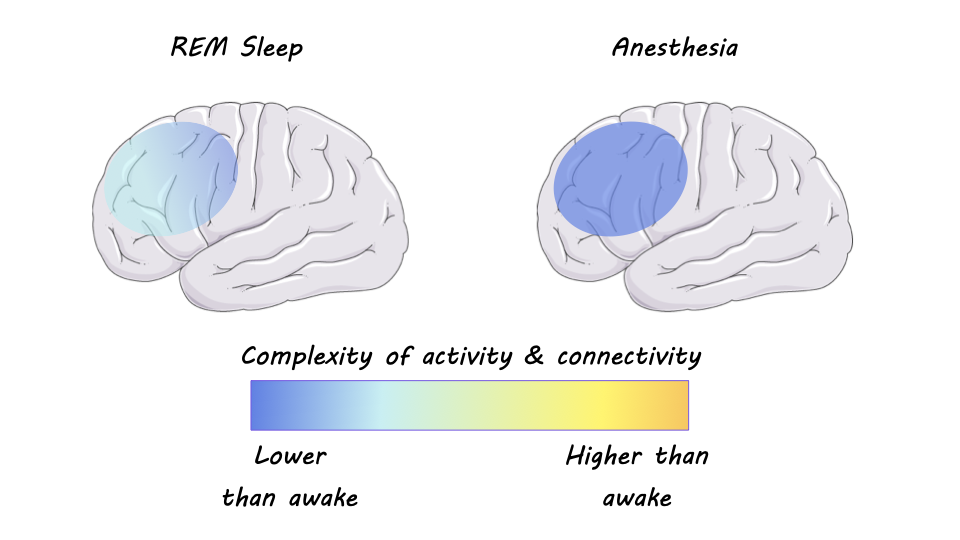
The unconscious brain looks and acts differently from the awake brain. While you are asleep, there is a reduction in complex neural activity and connectivity across the whole brain. While under general anesthesia, however, there is a more pronounced reduction in complex activity and connectivity, which is concentrated in the prefrontal regions of the brain. 

What's the science?

Despite decades of research the neural networks and mechanisms underlying consciousness have yet to be agreed upon. Questions remain about whether changes in regional network activation differ between altered states of consciousness. This week in Neuron, Zelmann and colleagues aimed to distinguish the specific neural networks involved in wakefulness versus two distinct types of unconsciousness: natural sleep and general anesthesia.  

How did they do it?

In a group of participants with electrodes clinically implanted in the brain to help find the origin of their epileptic seizures, single pulses of electrical stimulation were delivered while recording intracranial electroencephelogram (iEEG) to measure brain activity. This method allowed the authors to measure and analyze cortico-cortical evoked potentials (CCEPs) in response to stimulation, which indicates network connectivity, response variability, and other complex network dynamics. Patients were tested while awake in different environments, during non-REM sleep in the hospital, and while under general anesthesia in the operating room. Various measures were used to compare how complex, connected, and variable the responses were in different states. For instance, the perturbational complexity index (PCI), which measures the complexity of iEEG responses to stimulation, was used to distinguish the functional differences between different levels of consciousness. The PCI value is higher when the region measured has a more complex response to stimulation. These measures of the complexity of brain responses, network connectivity, and variability were compared between unconscious states and different anatomical regions of the brain. 

What did they find?

The authors found reduced network connectivity and reduced PCI in both states of unconsciousness compared to consciousness in the same environment. The variability of responses to stimulation was increased in both natural sleep and general anesthesia compared to conscious states. They found decreased cortico-cortical evoked potentials in both unconscious states, but the connectivity and complexity of brain responses were lower in anesthesia conditions than in natural sleep. This means that the brain shows reduced connections when not awake, but that the state of the brain while under anesthesia is distinct from the state while sleeping, demonstrating even less complex activity and connectivity between regions during unarousable conditions. When analyzing differences between anatomical brain regions, they found that the changes in brain activity were uniform throughout the brain during sleep, but were most pronounced in the frontal regions of the brain during anesthesia. The prefrontal cortex showed lower PCI and connectivity when comparing anesthesia to sleep. This means that during anesthesia, the prefrontal cortex is disconnected from other regions of the brain, which is distinct from how the brain functions during sleep. 

What's the impact?

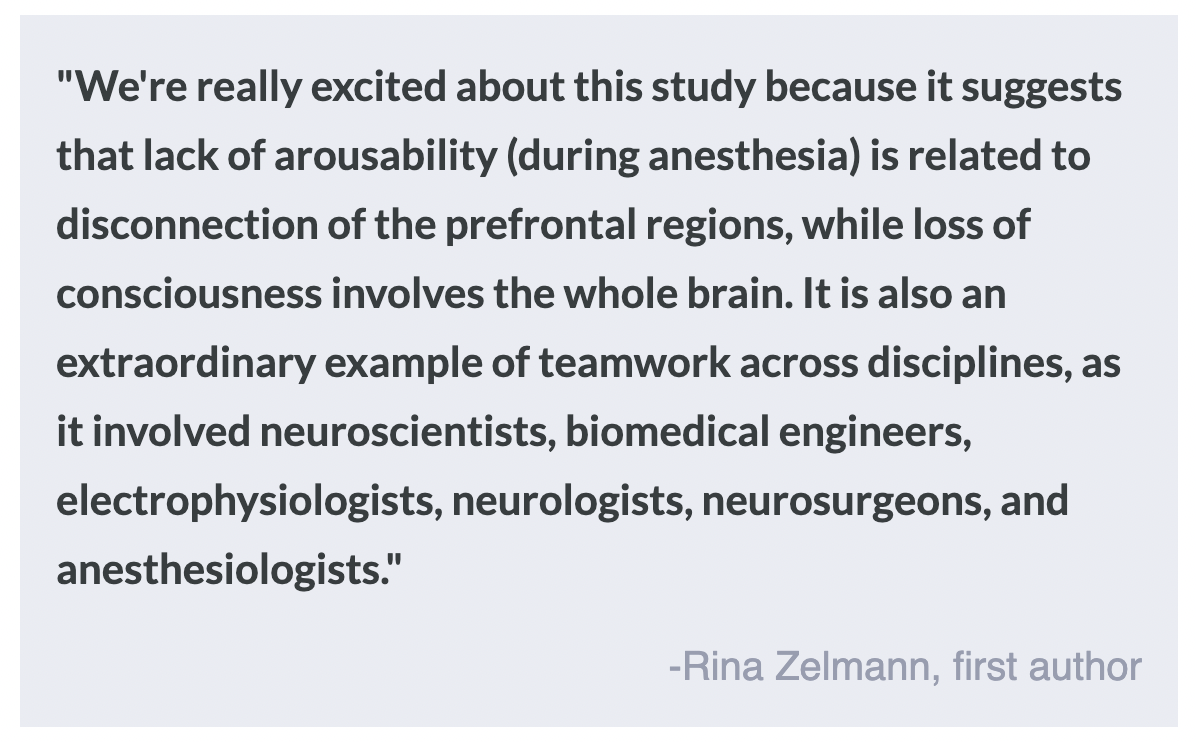
This study found that changes in network activity and complexity of brain activity are distinct between different states of unconsciousness, with the prefrontal cortex showing the most dramatic reduction in both measures while under general anesthesia. This work furthers our understanding of the mechanisms of consciousness and the distinct involvement of the prefrontal cortex in arousal. It also demonstrates the therapeutic potential of using direct brain stimulation for recovery of consciousness and in treatments for disorders of consciousness. Future study is needed to understand the specific pathways involved in loss of consciousness and to understand how therapeutics like deep brain stimulation affect sleep and consciousness.

Deep Brain Stimulation Improves Motor Ability in Stroke Survivors

Post by Rebecca Hill

The takeaway

Stroke survivors’ motor abilities are often impacted over the longer term, especially in their arms and hands. Deep brain stimulation applied to the area in the brain involved in motor coordination results in an improvement in motor abilities in the arms and hands of stroke survivors.

What's the science?

Strokes can cause lasting and life-impacting effects on motor capabilities that leave survivors reliant on others for care. Neuroplasticity, the ability of neural cells to change their pathways and adapt to trauma, can be induced using continuous deep brain stimulation. Previous work in rodent models of stroke found that deep brain stimulation in the cerebellar dentate nucleus, part of the pathway in the brain that coordinates motor function, can promote recovery from brain trauma - but this has not yet been explored in humans. This week in Nature Medicine, Baker and colleagues used deep brain stimulation to activate neural plasticity and improve stroke survivor’s upper-extremity motor abilities in the arms and hands.

How did they do it?

The authors enrolled 12 participants in the study who were survivors of stroke and showed moderate-to-severe weakness in the arms and hands. The participants were implanted with a deep brain stimulation system and had stimulation delivered continuously for 4 months while also completing physical rehabilitation. Rehabilitation involved repetitive strength-building exercises in the clinic with a physical therapist and independently at home for 3-5 other days of the week. Deep brain stimulation implants consist of electrodes that can deliver stimulation to the target brain area: the cerebellar dentate nucleus. Participants were scored on their motor abilities using an assessment that evaluates motor impairment in the arms and hands.

What did they find?

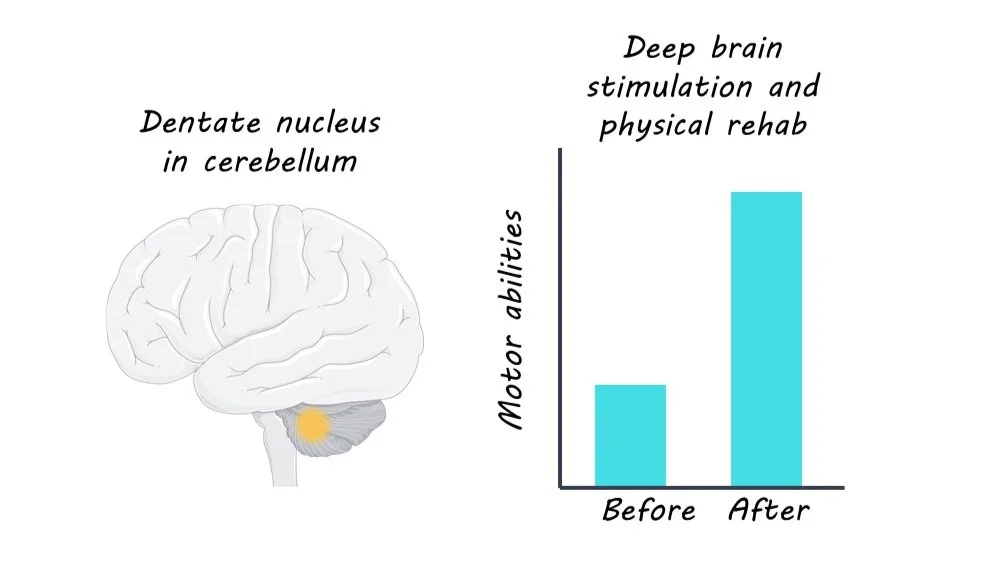
The authors found an overall increase in participants’ arm and hand motor abilities after deep brain stimulation combined with physical rehabilitation. This suggests that this combination of treatments targeting the dentate nucleus could effectively treat stroke survivors with impaired motor function. The strength of the effect of treatment was not related to the amount of time it had been since the stroke had happened. This suggests that this treatment can be helpful and effective for survivors of stroke even up to 3 years after the initial incident.

What's the impact?

This study is the first to show that the dentate nucleus in the cerebellum is a promising target location for DBS to improve motor function in stroke survivors. These results support a new and safe approach to treating stroke survivors with seemingly no adverse effects. With more testing, this treatment may be broadly applied to the great population of stroke survivors and greatly improve health outcomes after stroke.

Access the original scientific publication here.