Neuronal Network Engagement in the Unconscious Human Brain

Post by Laura Maile

The takeaway

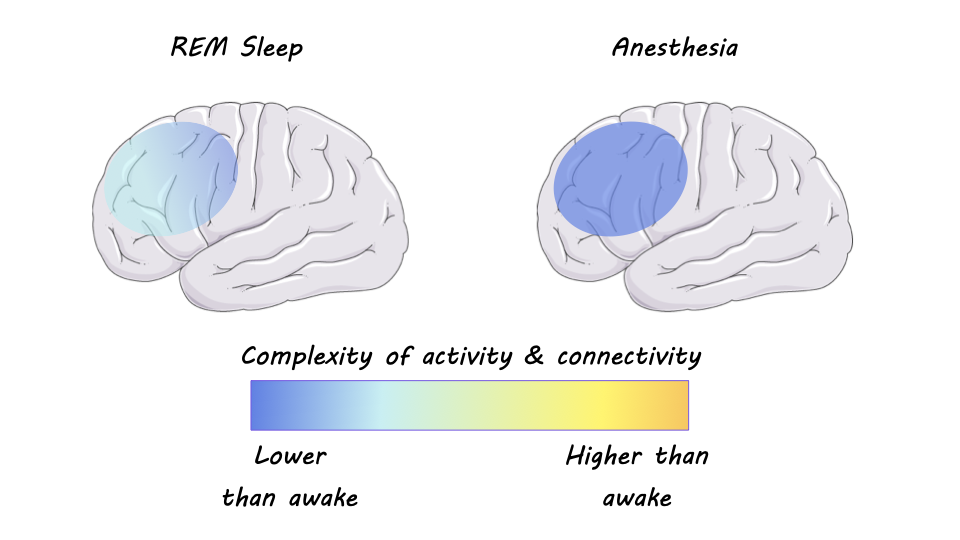
The unconscious brain looks and acts differently from the awake brain. While you are asleep, there is a reduction in complex neural activity and connectivity across the whole brain. While under general anesthesia, however, there is a more pronounced reduction in complex activity and connectivity, which is concentrated in the prefrontal regions of the brain. 

What's the science?

Despite decades of research the neural networks and mechanisms underlying consciousness have yet to be agreed upon. Questions remain about whether changes in regional network activation differ between altered states of consciousness. This week in Neuron, Zelmann and colleagues aimed to distinguish the specific neural networks involved in wakefulness versus two distinct types of unconsciousness: natural sleep and general anesthesia.  

How did they do it?

In a group of participants with electrodes clinically implanted in the brain to help find the origin of their epileptic seizures, single pulses of electrical stimulation were delivered while recording intracranial electroencephelogram (iEEG) to measure brain activity. This method allowed the authors to measure and analyze cortico-cortical evoked potentials (CCEPs) in response to stimulation, which indicates network connectivity, response variability, and other complex network dynamics. Patients were tested while awake in different environments, during non-REM sleep in the hospital, and while under general anesthesia in the operating room. Various measures were used to compare how complex, connected, and variable the responses were in different states. For instance, the perturbational complexity index (PCI), which measures the complexity of iEEG responses to stimulation, was used to distinguish the functional differences between different levels of consciousness. The PCI value is higher when the region measured has a more complex response to stimulation. These measures of the complexity of brain responses, network connectivity, and variability were compared between unconscious states and different anatomical regions of the brain. 

What did they find?

The authors found reduced network connectivity and reduced PCI in both states of unconsciousness compared to consciousness in the same environment. The variability of responses to stimulation was increased in both natural sleep and general anesthesia compared to conscious states. They found decreased cortico-cortical evoked potentials in both unconscious states, but the connectivity and complexity of brain responses were lower in anesthesia conditions than in natural sleep. This means that the brain shows reduced connections when not awake, but that the state of the brain while under anesthesia is distinct from the state while sleeping, demonstrating even less complex activity and connectivity between regions during unarousable conditions. When analyzing differences between anatomical brain regions, they found that the changes in brain activity were uniform throughout the brain during sleep, but were most pronounced in the frontal regions of the brain during anesthesia. The prefrontal cortex showed lower PCI and connectivity when comparing anesthesia to sleep. This means that during anesthesia, the prefrontal cortex is disconnected from other regions of the brain, which is distinct from how the brain functions during sleep. 
What's the impact?

This study found that changes in network activity and complexity of brain activity are distinct between different states of unconsciousness, with the prefrontal cortex showing the most dramatic reduction in both measures while under general anesthesia. This work furthers our understanding of the mechanisms of consciousness and the distinct involvement of the prefrontal cortex in arousal. It also demonstrates the therapeutic potential of using direct brain stimulation for recovery of consciousness and in treatments for disorders of consciousness. Future study is needed to understand the specific pathways involved in loss of consciousness and to understand how therapeutics like deep brain stimulation affect sleep and consciousness.
Deep Brain Stimulation Improves Motor Ability in Stroke Survivors

Post by Rebecca Hill

The takeaway

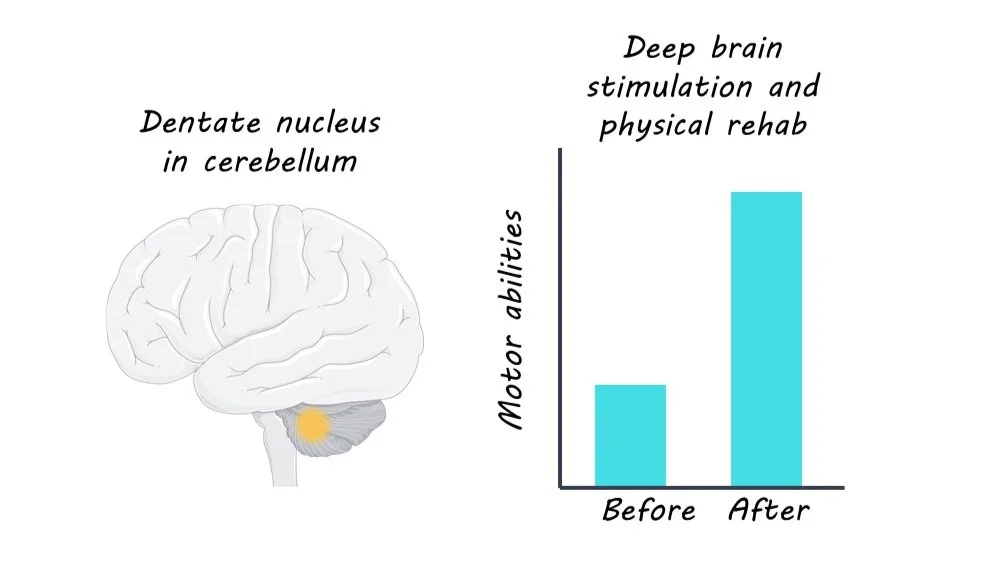
Stroke survivors’ motor abilities are often impacted over the longer term, especially in their arms and hands. Deep brain stimulation applied to the area in the brain involved in motor coordination results in an improvement in motor abilities in the arms and hands of stroke survivors.

What's the science?

Strokes can cause lasting and life-impacting effects on motor capabilities that leave survivors reliant on others for care. Neuroplasticity, the ability of neural cells to change their pathways and adapt to trauma, can be induced using continuous deep brain stimulation. Previous work in rodent models of stroke found that deep brain stimulation in the cerebellar dentate nucleus, part of the pathway in the brain that coordinates motor function, can promote recovery from brain trauma - but this has not yet been explored in humans. This week in Nature Medicine, Baker and colleagues used deep brain stimulation to activate neural plasticity and improve stroke survivor’s upper-extremity motor abilities in the arms and hands.

How did they do it?

The authors enrolled 12 participants in the study who were survivors of stroke and showed moderate-to-severe weakness in the arms and hands. The participants were implanted with a deep brain stimulation system and had stimulation delivered continuously for 4 months while also completing physical rehabilitation. Rehabilitation involved repetitive strength-building exercises in the clinic with a physical therapist and independently at home for 3-5 other days of the week. Deep brain stimulation implants consist of electrodes that can deliver stimulation to the target brain area: the cerebellar dentate nucleus. Participants were scored on their motor abilities using an assessment that evaluates motor impairment in the arms and hands.

What did they find?

The authors found an overall increase in participants’ arm and hand motor abilities after deep brain stimulation combined with physical rehabilitation. This suggests that this combination of treatments targeting the dentate nucleus could effectively treat stroke survivors with impaired motor function. The strength of the effect of treatment was not related to the amount of time it had been since the stroke had happened. This suggests that this treatment can be helpful and effective for survivors of stroke even up to 3 years after the initial incident.

What's the impact?

This study is the first to show that the dentate nucleus in the cerebellum is a promising target location for DBS to improve motor function in stroke survivors. These results support a new and safe approach to treating stroke survivors with seemingly no adverse effects. With more testing, this treatment may be broadly applied to the great population of stroke survivors and greatly improve health outcomes after stroke.

Access the original scientific publication here.

Myths and Facts: Left-Brain, Right-Brain Function, Learning Styles and Sensory Processing

Post by Lani Cupo

The brain is a complex organ embedded in a dynamic system, and there is still much about it that we do not know. Over the decades, some myths and misconceptions have permeated popular culture and even educational curricula. While some are mere rumors, others stem from outdated scientific theories that have since been debunked. Here we explore several prevalent myths about the brain, describe the evidence against them, and offer some brain facts in their stead.

Myth #1: One of the most enduring myths in neuroscience is that the left hemisphere of the brain is responsible for logical thought, the right hemisphere is responsible for creativity, and that individuals are governed mainly by one hemisphere or the other, determining if they are left-brained (more logical), or right-brained (more creative). Despite the popularity of this myth (you can find a lot of beautiful merchandise on Etsy), there is no neuroscientific evidence to support this hypothesis (Nielsen et al., 2013). So, where does this myth originate?

History and facts: This myth certainly is not new. In the 1980s it became popular among art educators (Wieder, 1984), and was born out of earlier research. In the 1960s, patients with severe epilepsy underwent a surgical procedure known as a corpus callosotomy, where the corpus callosum, or the white matter bundle connecting the two hemispheres, is severed. This procedure helps to reduce the severity of seizures and also reveals fascinating discoveries about the two hemispheres (Corballis, 2014).

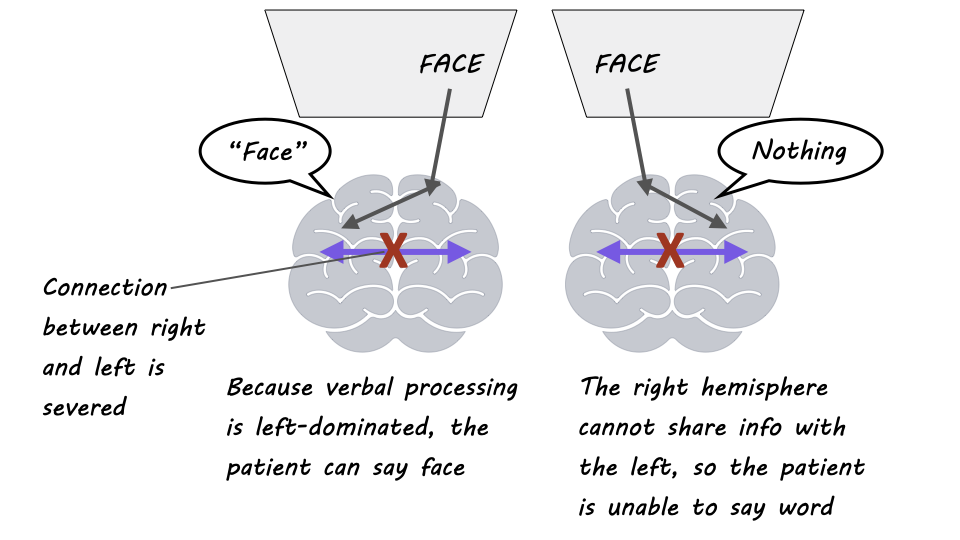
You may know that each hemisphere of the brain is responsible for the opposite side of the body. In groundbreaking experiments researchers would display a word (e.g., “face”) to either the left or right eye. If the right eye saw the word, the split-brain participant could answer that they saw the word “face”. However, if the left eye sees the word “face”, and the participant is asked what they saw they would respond “nothing”. But if the participant is asked to draw what they saw, they can do so. This is because speech is heavily left-lateralized—that is, speech and language computation largely take place in the left hemisphere of the brain. Roger Sperry was awarded a Nobel Prize in Physiology or Medicine for this work in 1981(Wolman, 2012). People may find the left-brain-right-brain dichotomy so compelling because it is based on a nugget of truth—that some brain functions are regionally specific. It also appeals to the so-called Barnum Effect, where people accept vague, often flattering character assessments as true and specific, as is the case with horoscopes.

Prevalence: If you believed or were taught the left-brain/right-brain myth, you are not alone! One study in 2017 revealed that 64% of adults sampled from the general population agreed with this myth, making it one of the most prevalent misconceptions about the brain (Macdonald et al., 2017).

Myth #2: One of the most prevalent neuromyths is that individuals absorb information better if it is presented in a particular learning style, such as visual, auditory, written, or kinesthetic (touch). This theory of ‘learning styles’ seems to make intuitive sense and appeals to educators who want to make education accessible to their diverse student populations. Unfortunately, there is currently no scientific evidence to support it (Newton et al., 2020).

History and facts: The origins of this myth are even older than the last. In 334 BC, Aristotle referenced individual differences among children, pointing out their “specific talents and skills” (Reiff, 1992), however the theory of ‘learning styles’ gained traction throughout the 1900s. Studies suggest that teachers from across the world use the learning styles myth in the classroom, and that there has been no noticeable decrease in this belief over time (Newton et al., 2020). Many U.S. states that require teachers to pass a computerized test for licensing (29 of 34) even provide free study material that teach ‘learning styles’ (Furey, 2020). While it may seem harmless to present information to students through a variety of methods, some argue that the technique can have insidious consequences (Zwaagstra, 2022). First, it can be self-fulfilling: if students are told they are visual learners, they may not pay close attention to reading assignments they believe they are unsuited for. Second, it can drastically overburden teachers who already carry a heavy load, as they may feel obliged to present an entire lesson through three or more different techniques (Zwaagstra, 2022).

Prevalence: Were you taught the ‘learning style’ myth? This misconception is particularly widespread, with 93% of adults in the general population stating they believe it. Not only that, but 78% of individuals who have taken a college or university course related to the brain or neuroscience believe it as well (Macdonald et al., 2017)!

Myth #3: Like me, many of you probably learned about the tongue map in school. Sweet is up front, right? Actually, no! The tongue map is a myth of sensory perception, and one that is still frequently taught today.

History and facts: In 1901, a German scientist published a paper reporting on his research that parts of the tongue, namely the edges, are more sensitive to taste than the center of the tongue (Haenig, 1901). This is actually true! But he also published an illustration that seemed to suggest slight variation in where each flavor (salty, sweet, bitter, and sour—no umami at that time) were most noticeable (Munger, 2017). Then, in the 1940s, Edwin Boring published a book with a diagram of a tongue, the regions for each flavor delineated (Munger, 2017; Boring, 1942). One possible reason for this map’s popularity is its apparent simplicity, which appeals to educators teaching children about the senses (Spence, 2022). In reality, taste is more complex than Boring would have readers believe. Taste buds (clusters of 10-50 nerve endings) line the tongue, soft palate, and pharynx (throat), and all receptors are capable of responding to all tastes (Spence, 2022; Institute, 2016). Incidentally, the bumps you may notice on your tongue are not taste buds, they are taste papillae, structures that contain several taste buds, and the sensory cells in taste buds are renewed once a week. When a food or liquid comes in contact with the sensory cells, the cells are activated by the chemicals responsible for taste. While about half of the cells respond to all five basic tastes (Institute, 2016), they each have a ranking of preferred tastes. For example, a cell may respond most to sweet, then bitter, sour, umami, and salty. The signal travels through nerves to the medulla, thalamus, “primary taste cortex” (insula and frontal operculum), and higher association cortices (Rolls, 2019). In the brain, taste information from the mouth can be integrated to form a representation of what we are eating.

Prevalence: While reliable statistics on the prevalence of belief in the taste map and whether it is still included in elementary school curricula today were difficult to find, there are many sources that debunk the taste map. Hopefully, today’s educators are teaching taste through a more nuanced lens. 

Brian myths and misconceptions permeate our modern discourse. Sometimes when a brain “fact” seems too simple to be true, it very well may not be. The more we learn about the brain, the more nuanced our understanding becomes. As good scientists and learners, we should always be open to changing our minds when presented with reasonable evidence.

References +

Khademi S, Hallinan CM, Conway M, Bonomo Y. Using Social Media Data to Investigate Public Perceptions of Cannabis as a Medicine: Narrative Review. J Med Internet Res. 2023;25: e36667.

Rolls ET. Chapter 7 - Taste and smell processing in the brain. In: Doty RL, editor. Handbook of Clinical Neurology. Elsevier; 2019. pp. 97–118.

How does our sense of taste work? Institute for Quality and Efficiency in Health Care (IQWiG); 2016.

Spence C. The tongue map and the spatial modulation of taste perception. Curr Res Food Sci. 2022;5: 598–610.

Boring EG. Sensation and Perception in the History of Psychology. 1942 [cited 7 Sep 2023]. Available: http://dx.doi.org/

Smithsonian Magazine. The Taste Map of the Tongue You Learned in School Is All Wrong. [cited 7 Sep 2023]. Available: https://www.smithsonianmag.com/science-nature/neat-and-tidy-map-tastes-tongue-you-learned-school-all-wrong-180963407/

Hänig DP. Zur Psychophysik des Geschmackssinnes. Engelmann; 1901. “Learning styles” myth damaging our education system: op-ed. In: Fraser Institute [Internet]. 20 Jul 2022 [cited 6 Sep 2023]. Available: https://www.fraserinstitute.org/article/learning-styles-myth-damaging-our-education-system

Furey W. The Stubborn Myth of “Learning Styles.” In: Education Next [Internet]. 7 Apr 2020 [cited 6 Sep 2023]. Available: https://www.educationnext.org/stubborn-myth-learning-styles-state-teacher-license-prep-materials-debunked-theory/

Reiff JC. Learning Styles. What Research Says to the Teacher Series. 1992 [cited 6 Sep 2023]. Available: http://files.eric.ed.gov/fulltext/ED340506.pdf

Newton PM, Salvi A. How Common Is Belief in the Learning Styles Neuromyth, and Does It Matter? A Pragmatic Systematic Review. Frontiers in Education. 2020;5. doi:10.3389/feduc.2020.602451

Macdonald K, Germine L, Anderson A, Christodoulou J, McGrath LM. Dispelling the Myth: Training in Education or Neuroscience Decreases but Does Not Eliminate Beliefs in Neuromyths. Front Psychol. 2017;8: 1314.

Wolman D. The split brain: A tale of two halves. In: Nature Publishing Group UK [Internet]. 14 Mar 2012 [cited 6 Sep 2023]. doi:10.1038/483260a

Corballis MC. Left brain, right brain: facts and fantasies. PLoS Biol. 2014;12: e1001767.

Wieder CG. The Left-Brain/Right-Brain Model of Mind: Ancient Myth in Modern Garb. Visual Arts Research. 1984;10: 66–72.

Corballis MC. Are we in our right minds? In: Sala SD, editor. Mind myths: Exploring popular assumptions about the mind and brain , (pp. Hoboken, NJ, US: John Wiley & Sons Ltd, xvi; 1999. pp. 25–41.

Nielsen JA, Zielinski BA, Ferguson MA, Lainhart JE, Anderson JS. An evaluation of the left-brain vs. right-brain hypothesis with resting state functional connectivity magnetic resonance imaging. PLoS One. 2013;8: e71275.

The Editors of Encyclopedia Britannica. Are There Really Right-Brained and Left-Brained People? Encyclopedia Britannica. 2017. Available: https://www.britannica.com/story/are-there-really-right-brained-and-left-brained-people