
A New Bird Model for Studying Vocal Production

Post by Rebecca Hill

The takeaway

There has been little focus on female birdsong until recently, leaving many questions unanswered about how the female brain is involved in singing. Male and female red-cheeked cordon bleus that sing at the same rate have similar hormone and brain composition.

What's the science?

Bird song learning can be used as a model for human vocal learning, but up until recently the field has focused on studying species where only male birds sing. Studying bird species where females sing will give us a more complete understanding of how hormones and the brain control vocal production. This week in Journal of Comparative Physiology, Rose and colleagues studied the red-cheeked cordon bleu, a bird species in which both males and females sing, by recording their song behavior, measuring their hormone levels, and analyzing the brain regions involved with vocal production.

How did they do it?

The authors first studied the song behavior of 20 birds (10 males and 10 females) by putting them in sound recording chambers, which cut down on background noise. They recorded each bird for one hour, eight times over a month, and found the recording with the most songs sung. They recorded the birds’ song rate by dividing 20 by the number of minutes birds took to sing 20 songs. They also counted the number of songs the birds sang in the first 30 minutes of singing on the day of tissue collection.

The authors also studied the hormones and brain regions involved in singing by collecting blood and brain tissue. They studied the sex hormones testosterone and progesterone, which are known to be involved in singing rate, by measuring the concentration of them in the blood. They studied three brain regions: 1) Area X of the striatum, which is involved in song learning, 2) RA (the robust nucleus of the arcopallium), which is involved with song production, and 3) HVC (the acronym is the proper name), which connects to both learning and song production pathway and is the central vocal production area in the brain. They measured the volume of these brain regions and the ZENK protein expression, which shows the level of activity in the brain in certain areas.

What did they find?

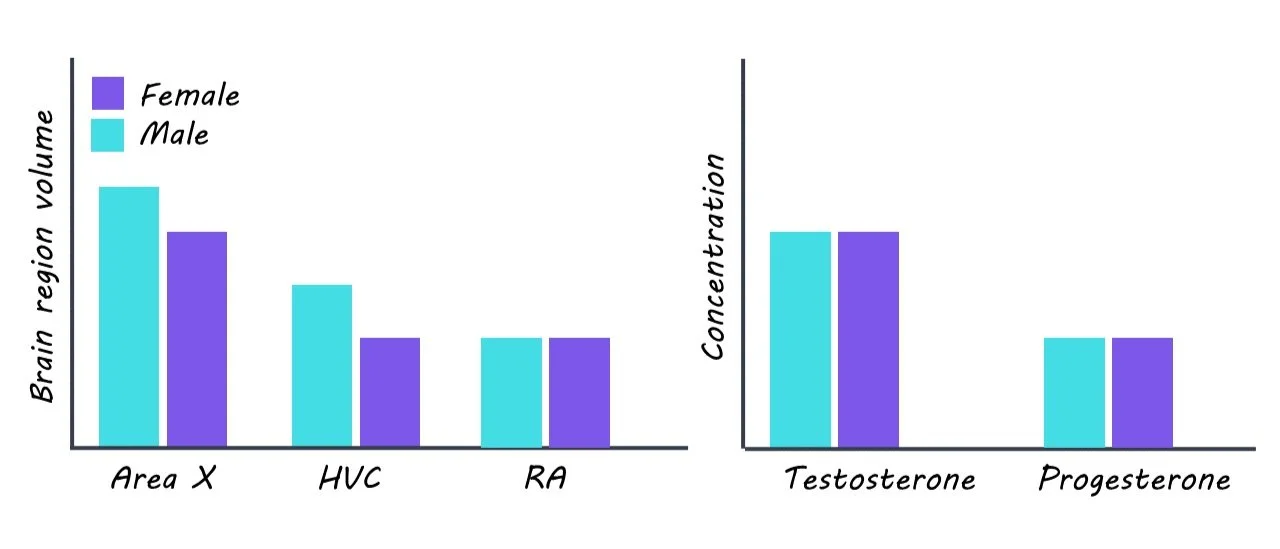
Male and female birds both sang at high song rates, and their songs were similar in total length and structure. Both testosterone and progesterone hormone blood levels were similar between males and females. This suggests both sexes have similar hormonal mechanisms that drive song behavior. Area X and HVC were larger in males than females, but RA volume was similar between the two sexes. This suggests that song production pathways are similar, but song learning pathways are different between the sexes. Birds that sang had more ZENK expression than birds that were not singing in both sexes, which suggests that there were similar levels of brain activity involved with producing singing.
What's the impact?

This study found that red-cheeked cordon bleus have very few behavioral, hormonal, and brain sex differences compared to other species often studied in the lab. This means they could be a good model species to study mechanisms controlling vocal behavior as a model for human vocal production. Understanding how the brain is involved with speech can help us to diagnose and treat speech and communication disorders.

Access the original scientific publication here

The Role of MicroRNAs in Stress and Psychiatric Disorders

Post by Laura Maile

Why study stress?

We all experience stress at some point in our lives. Stress induces a normal physiological response in the body and brain important for adaptation and continued survival. Ongoing or major stressful events, however, are a significant risk factor for the development of psychiatric disorders such as major depressive disorder, generalized anxiety disorder, and posttraumatic stress disorder. There is also evidence that individual responses to stress can be influenced by our environment, previous life experience, and individual genetic differences. The mechanisms involved in individual differences in response to stress are not fully understood, though recent findings indicate that epigenetics may play a role.  

What is epigenetics?

Epigenetics is the process of altering the expression of genes without changing the genetic code itself. In order for genes to be expressed, the transcriptional machinery must be able to access the DNA, which is folded around histones and other proteins, making up chromatin. The remodeling of chromatin allows access to the DNA to allow transcription (i.e., gene expression) to occur. Epigenetic changes, such as histone modifications, DNA methylation, and posttranscriptional regulation by microRNAs, are a part of this dynamic process that control which genes are expressed. If you think of your genome like a library, the DNA sequence is the collection of books, while epigenetics is the unique system that decides which books are open for reading (gene expression) and which are kept closed (gene suppression).

How do microRNAs work?

MicroRNA is a type of non-coding RNA that can affect the expression of DNA by binding with an mRNA with a matching sequence, preventing that mRNA from being translated into protein and thus reducing protein expression. In our library analogy, microRNA is like the librarian who puts certain books on display and hides others in the back, controlling which books (genes) get read. It is estimated that over 60% of human protein-encoding genes are targeted by microRNA, with each microRNA targeting potentially hundreds of mRNA sequences. When microRNA targets and silences a target mRNA, it does so only for a small proportion, giving it the ability to fine-tune gene expression and regulate the body’s responses to environmental changes, including those that induce stress. This means microRNA plays a dynamic role in epigenetics as we encounter and respond to the environment and events around us.   

How does microRNA impact stress response?

Changes in expression levels of microRNAs have been reported both in animal models of chronic stress and in post-mortem brains of patients with psychiatric disorders. These changes have been identified in brain areas known to be involved in the response to stress. Animal models of chronic stress are often used as a model of depression, mimicking both behavioral changes and cellular and molecular changes associated with major depressive disorder. Rodent models of chronic stress can lead to decreased expression of microRNAs like miR-9, while ketamine, a drug used in the treatment of major depression, can both alleviate the depressive behavior and return the altered microRNA levels back to normal. Additionally, clinical studies have shown either increases or decreases in the levels of different microRNAs in the CSF and blood serum of patients with major depressive disorder. Other studies that work to control the activity of specific microRNAs indicate that silencing these microRNAs in stress-related brain structures can rescue depressive-like behaviors in rodents.  

There are also specific types of microRNAs involved in stress. The miR-34 family, a group of microRNAs, has been shown to be related to chronic stress and the stress response in rodents. The involvement of miR-34 was also linked to the trans-generational effects of stress, where exposure to stress in a female rat could impact the anxiety-like behavior in her offspring. Further, miR-124 — another microRNA whose expression has been linked to the effects of several models of chronic stress and early life stress — can impact both the expression of receptors in the brain related to the stress response and depressive-like behaviors that result from stress.  

Controlling the expression of microRNAs can impact not only behavior but cellular and structural changes in the brain induced by rodent models of depression. MicroRNAs have been shown to play a role in influencing structural changes associated with psychiatric disorders, like changes in gray matter density, the number of dendritic spines, and synaptic changes between neurons.  

MicroRNAs not only affect protein expression and function within cells but they can also be incorporated into exosomes that migrate into the extracellular space. Exosomes are extracellular vesicles that play a role in communication between cells and are contained in almost all bodily fluids, making them a useful diagnostic target. Evidence shows a link between microRNA expression in exosomes and chronic stress and major depressive disorder.  Exosomes also have potential as a therapeutic tool for drug delivery since they can cross the blood-brain barrier. 

What does the future look like?

Research has revealed a strong link between microRNAs and their epigenetic modifications and psychiatric disorders. Despite this link, evidence is often contradictory, indicating the need for continued research in this complex field. MicroRNAs have the potential to serve as biomarkers in the diagnosis of disease and help in the measurement of drug efficacy in the treatment of those diseases. Tools have recently been developed to leverage the detection of microRNAs in tissues to aid in the diagnosis of cancer. There is potential for this type of tool to be used in the diagnosis and treatment of psychiatric diseases as well, though none have been developed yet. Continued research is necessary to advance the use of microRNAs as effective diagnostic and therapeutic tools.  

References +

Andolina D, et al., Effects of lack of microRNA-34 on the neural circuitry underlying the stress response and anxiety. Neuropharmacology. 2016.

Gheysarzadeh A, et al., Serum-based microRNA biomarkers for major depression: MiR-16, miR- 135a, and miR-1202. J Res Med Sci. 2018.

Grieve SM, et al., Widespread reductions in gray matter volume in depression. Neuroimage Clin. 2013.

Kos MZ, et al., Blood-Based miRNA Biomarkers as Correlates of Brain-Based miRNA Expression. Front Mol Neurosci. 2022.

Li D, et al., NK cell-derived exosomes carry miR- 207 and alleviate depression-like symptoms in mice. J Neuroinflammation. 2020.

Mannironi C, et al., Acute Stress Alters Amygdala microRNA miR-135a and miR-124 Expression: Inferences for Corticosteroid Dependent Stress Response. PLoS One. 2013.

Mingardi J, et al., miR-9-5p is involved in the rescue of stress-dependent dendritic shortening of hippocampal pyramidal neurons induced by acute antidepressant treatment with ketamine. Neurobiol Stress. 2021.

Mifsud KR, et al., Rapid Down-Regulation of Glucocorticoid Receptor Gene Expression in the Dentate Gyrus after Acute Stress in vivo: Role of DNA Methylation and MicroRNA Activity. Neuroendocrinology. 2017.

Musazzi, L., et al., Stress, microRNAs, and stress-related psychiatric disorders: an overview. Mol Psychiatry. 2023.

Tsankova, N., et al., Epigenetic regulation in psychiatric disorders. Nat Rev Neurosci. 2007.

Wang G, et al., Knockdown of miRNA-134-5p rescues dendritic deficits by promoting AMPK-mediated mitophagy in a mouse model of depression. Neuropharmacology. 2022.

Wang S-S, et al., microRNA-124 targets glucocorticoid receptor and is involved in depression-like behaviors. Prog Neuro-Psychopharmacology Biol Psychiatry. 2017. Access the original article here.

Zaidan H, et al., Pre-reproductive stress in adolescent female rats alters oocyte microRNA expression and offspring phenotypes: pharmacological interventions and putative mechanisms. Transl Psychiatry. 2021. Access the original article here.

How Does the Hippocampus Preserve Memory for Time?

Post by Baldomero B. Ramirez Cantu

The takeaway

The re-expression of hippocampal area CA1 and entorhinal cortex activity supports memory for time, particularly for long timescales. The activity in these two regions is predictive of temporal memory integrity.

What's the science?

Episodic memory refers to the ability to recall specific events, experiences, or episodes from one's past, involving the recollection of these events in a specific temporal context. It allows individuals to remember the content of past experiences and also when those events occurred (e.g., last week, last month, or last night). While the concept of episodic memory is well-defined, identifying the underlying neurobiological mechanisms responsible for appropriately recalling the temporal context of memories is still an area of active research. This week in Nature Communications, Zou et al. published a study that delves into the role of regions in the medial temporal lobe (MTL) in the recall of temporal memory context. Their findings shed light on how specific brain areas contribute to this crucial aspect of episodic memory.

How did they do it?

In this study, Zou and colleagues conducted a human functional magnetic resonance imaging (fMRI) experiment to explore the neurobiological basis of temporal memory precision. The experiment involved presenting participants with a vast number of natural scene images multiple times over 30-40 scan sessions spanning an 8-10 month period. Following the scanning sessions, the participants engaged in a temporal memory task, where they were asked to estimate the original encounter time for a subset of the previously presented images, using a scale ranging from days to months in the past.

These analyses were used to investigate whether the accuracy of temporal memory retrieval could be predicted based on the re-expression of neural activity patterns observed during the initial encounter with the images. The researchers hypothesized that the reinstatement of neural activity patterns, indicative of context reinstatement, might play a role in preserving temporally precise memories.

To achieve high-resolution imaging, the researchers employed ultra-high field strength (7 Tesla) and a spatial resolution of 1.8mm. This allowed them to specifically interrogate subregions of the hippocampus, including CA1, and surrounding MTL structures, such as the entorhinal cortex (ERC). These brain regions are known to be critical for memory processing.

What did they find?

Participants showed a high level of accuracy in recalling the temporal context of each image, highlighting the impressive nature of their temporal memory performance.

The authors found that greater activity pattern similarity in specific MTL regions (CA1 and ERC) across repeated exposures is associated with higher temporal memory precision. These findings support the idea of context reinstatement as a mechanism underlying the accurate recall of when events occurred in memory. Additionally, the results indicate that these effects are specific to temporal memory and not driven by general recognition confidence or overall memory strength.

The authors show that the similarity between the first and second exposures of an image is crucial for precise temporal memories. This finding supports the idea that context reinstatement during the second exposure (E2) plays a unique role in remembering when an event occurred. Furthermore, the study highlights the distinct neural processes involved in temporal and recognition memory, emphasizing the importance of initial exposure and second exposure (E1-E2) similarity for the precision of temporal memory.

What's the impact?

This study deepens our understanding of how the brain processes and retains temporally precise memories, with potential implications for memory-related research, clinical interventions, and advancements in neuroscience and cognitive science.

Access the original scientific publication here.