Closed-Loop Brain Stimulation Reduces Fear Responses

Post by Laura Maile

The takeaway

Patients with post-traumatic stress disorder (PTSD) have difficulty extinguishing fear responses, which leads to debilitating symptoms. Stimulating the brain’s reward circuitry while brain regions essential in memory consolidation are active can reduce fear.  

What's the science?

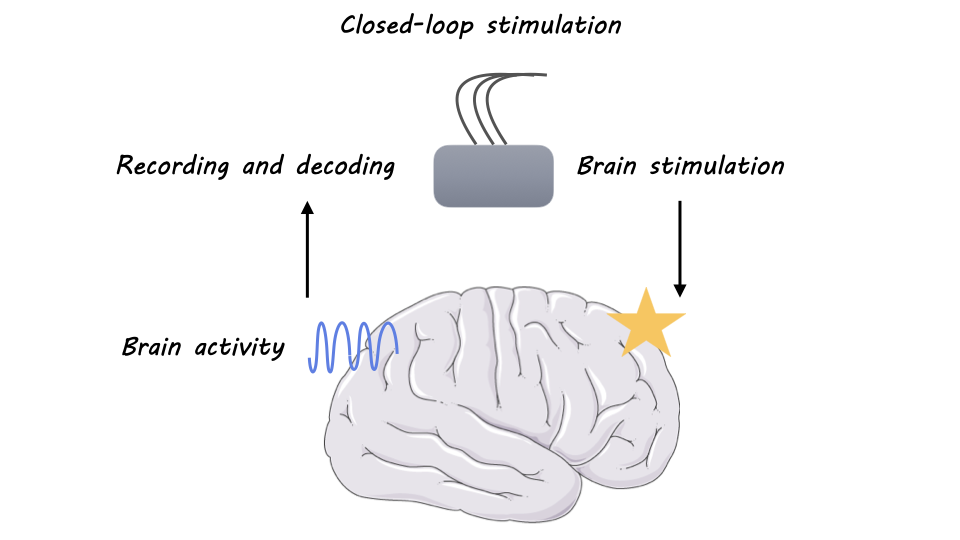
In PTSD, the brain’s ability to extinguish learned fear responses after removing a threat is diminished. Prior research indicates that the hippocampus and the mesolimbic reward network are important for memory formation and consolidation of fear memories. Closed-loop stimulation, or the automatic stimulation of a brain region when a device detects activity in a specific system, has been shown to enhance memory consolidation when used to activate the reward system. Though the involvement of regions such as the hippocampus, amygdala, and reward centers is known to be important in the maladaptive fear responses present in PTSD, the disease remains resistant to treatment. This week in Nature, Sierra and colleagues used hippocampal activity to initiate closed-loop stimulation of reward circuitry during extinction learning to augment the removal of fear memories. 

How did they do it?

The authors utilized fear conditioning to model PTSD in rats, using an auditory tone as the conditioned stimulus paired with foot shocks as the unconditioned stimulus. During extinction learning, animals were placed in a new context and repeatedly presented with the conditioned stimulus without the foot shocks.  Animals typically extinguish their fear response after repeated exposure to the conditioned stimulus without the associated foot shock and are considered to be in fear remission once they reduce their freezing to <20% of their initial freezing behavior. The authors used closed-loop stimulation of the medial forebrain bundle (MFB), a white matter tract central to the reward network, in response to hippocampal sharp-wave ripples to activate reward circuits during recall of extinction memories. Some rats received this closed-loop stimulation for one hour following the extinction protocol, while others received open-loop (continuous) stimulation or no stimulation. Persistence of fear reduction was tested by exposing animals to the conditioned stimulus again either 24 hours or 25 days following extinction. The authors then tested whether hippocampal sharp-wave ripples are necessary for fear extinction by silencing them with electrical stimulation of the ventral hippocampus following extinction procedures. Finally, they explored the involvement of Rac1, a protein involved in synapse formation, and dopamine D2 receptors in the basolateral amygdala by infusing a Rac1 inhibitor or a dopamine D2 receptor antagonist following each extinction session preceding the closed-loop stimulation. This allowed them to compare the freezing behavior of animals receiving different treatments during the extinction procedure.  
What did they find?

Compared to rats that received open-loop stimulation or no stimulation, rats in the closed-loop stimulation group showed reduced freezing during extinction learning, requiring fewer extinction sessions to achieve fear remission. This means that MFB stimulation in response to hippocampal sharp-wave ripples can help extinguish fear memories faster than controls and that this reduction in fear behavior persists over time. Silencing hippocampal sharp-wave ripples resulted in impaired extinction and increased freezing upon reexposure to the conditioned stimulus. This indicates that the hippocampal sharp-wave ripple activity is required to extinguish fear behavior. Finally, infusing either a Rac1 inhibitor or a dopamine 2 receptor antagonist into the BLA disrupted the closed-loop stimulation-induced improvement in fear extinction. This result suggests Rac1 signaling and dopamine D2 receptor activity in the BLA are involved in fear extinction mediated by neuromodulation of reward circuitry.  

What's the impact?

This study found that closed-loop stimulation of MFB reward circuitry in response to hippocampal sharp-wave ripple activity following fear extinction improved the animals’ extinction of fear over time. This means that enhancing the activity of reward circuitry by using biomarkers of memory consolidation as a cue can help animals displaying features of PTSD recover from cued fear conditioning. Deep brain stimulation, which has been successfully implemented in humans with a variety of neuropsychiatric conditions, could be a candidate for improved treatment of PTSD if utilized using the closed-loop design implemented in this study.  
How Sleep Deprivation Leads to Disrupted Neural Processing

Post by Meredith McCarty

The takeaway

Sleep deprivation leads to changes in sensory perception and arousal levels. The measured increase in neural population synchrony and decreased responses to auditory stimuli are similar across NREM sleep and sleep deprivation states. 

What's the science?

Sleep deprivation is known to alter cognitive performance in numerous ways, including the impairment of working memory, vigilance, cognitive speed, and executive attention. Despite the apparent cognitive impairments associated with sleep deprivation, the extent to which sleep deprivation alters neural processing remains underexplored. This week in Current Biology, Marmelshtein and colleagues recorded the auditory cortex of rats during different states of vigilance to determine what changes in neural activity are associated with sleep deprivation. 

How did they do it?

A total of 7 adult male rats were implanted with microwire arrays, and EEG and EMG electrodes and placed in a motorized running wheel apparatus for a ten-hour experimental paradigm. The microwire arrays allow for sampling of single neuron spiking activity, whereas the EEG and EMG electrodes allow for monitoring of slower brain rhythms across larger networks, as is relevant for determining arousal state. In order to induce vigilant and sleep-deprived states, the authors programmed the wheel to alternate between 3 seconds of forced running and 12-18 seconds of fixed wheel position over the first 5-hour experimental period. Following this 5 hours of sleep deprivation, the wheel was fixed for the final 5 hours in order to allow for a recovery sleep opportunity. Throughout the experiment, auditory stimuli trains were presented intermittently via speakers throughout the apparatus. This experimental design allows for the comparison of neural responses in the auditory cortex to auditory stimuli across vigilant, tired, and NREM and REM sleep

What did they find?

The authors compared many features of auditory processing across experimental conditions to determine whether arousal level had any effect on auditory processing. First, they found no significant effect of sleep deprivation on mean frequency tuning, onset responses, and spontaneous firing rate, which suggests that the rats’ arousal state had no effect on these neural responses. However, they found significant differences in population coupling measures, including increased population synchrony, and decreased entrainment to rapid auditory stimuli trains. These results suggest that sleep deprivation significantly affected how correlated individual neuronal firing rate was with the local population. When comparing neural activity during sleep deprivation and the recovery sleep experimental stages, they found that the neural effects of sleep deprivation - specifically increases in population synchrony - were very similar to NREM sleep. This suggests that low-arousal states, such as sleep deprivation and NREM sleep, lead to disrupted cortical processing of faster auditory inputs

What's the impact?

This study found that sleep deprivation leads to altered neuronal activity in early auditory sensory regions. While many aspects of neural processing were not affected by arousal level, the authors did reveal significant changes in population synchronization measures due to arousal level. The authors found similar increases in population synchronization and disrupted rapid sensory processing in both NREM and sleep-deprived states. These results have practical implications in the accurate monitoring of arousal levels, and theoretical implications in the continued study of how arousal and brain state influence brain activity.

Access the original scientific publication here. 

A Novel Subtype of Hypothalamic-Habenula Neurons Drives Aversive Behavior

Post by Trisha Vaidyanathan

The takeaway

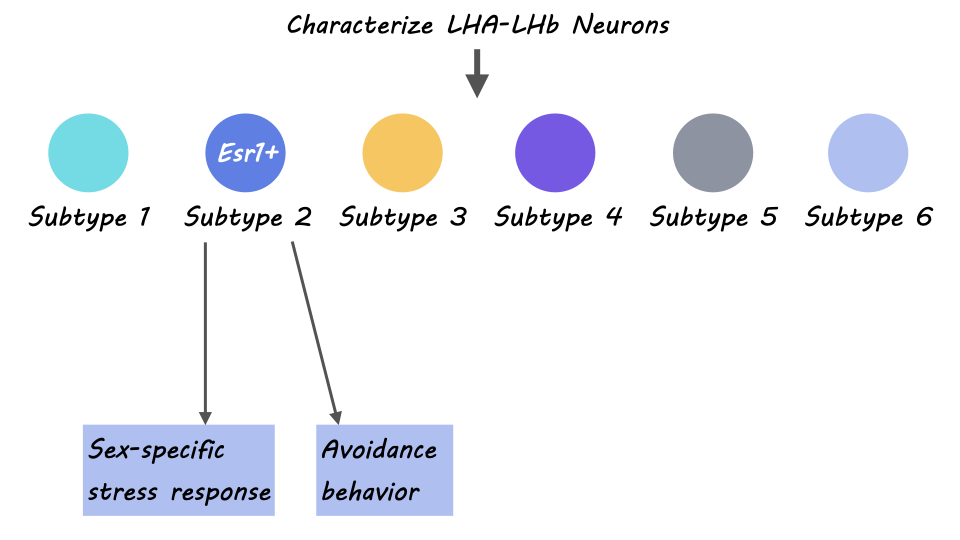
The population of glutamatergic excitatory neurons that project from the lateral hypothalamic area (LHA) to the lateral habenula (LHb) is composed of six molecularly, physiologically, and functionally distinct cellular subtypes. One specific subtype, characterized by the expression of estrogen receptor 1 (Esr1+), mediates aversive behavior and a sex-specific maladaptive response to stress.  

What's the science?

The LHA, the LHb, and the prefrontal cortex (PFC) are key nodes in the neural circuit that controls emotional behavior. The LHA is the primary input to the LHb and this LHA-LHb pathway has been shown to send negative signals that mediate avoidance behavior and depression. While recent work has demonstrated that neural populations in other hypothalamic regions are heterogenous, the LHA-LHb cells are still thought to be one homogenous population. This week in Nature Neuroscience, Calvigioni and colleagues used a combination of ex vivo electrophysiology, single-cell RNA sequencing, and mouse genetics to determine if the LHA-LHb population is heterogeneous, characterize any subtypes of LHA-LHb cells, and determine their function in mediating emotional behavior.

How did they do it?

The authors characterized the heterogeneity of LHA-LHb cells using a powerful technique called Patch-Seq, which allowed them to characterize both the electrophysiological properties (via patch clamp recordings) and the gene expression pattern (via single-cell RNA sequencing) of an individual LHA-LHb cell. The authors then used this gene expression data to create Cre mouse lines that enabled them to genetically modify specific LHA-LHb subtypes.

Next, the authors confirmed previous findings that activation of the entire LHA-LHb population leads to aversive behavior using a two-chamber real-time preference test, in which one chamber is associated with optogenetic stimulation and, if aversive, mice will avoid entering that chamber. They next repeated these experiments but only activated specific LHA-LHb subtypes, to identify which subtype is responsible for the aversive behavior. To confirm, they also silenced cells by inhibiting neurotransmitter release via expression of tetanus toxin

Lastly, the authors focused on the cellular subtype marked by expression of estrogen receptor 1 (Esr1+). First, they used high-density electrodes in vivo to compare the PFC response to Esr1+ cell activation with the PFC response to an aversive stimulus in the form of an air puff to the eye. Next, the authors explored the role of Esr1+ cells in a sex-specific maladaptive stress response by exposing male and female mice to an unpredictable foot shock while simultaneously inhibiting Esr1+ cells or, in separate experiments, performing patch clamp electrophysiology to characterize changes in Esr1+ cell properties following the shock stressor.    

What did they find?

First, the authors identified six subtypes of LHA-LHb cells based on the electrophysiological properties obtained with patch-clamp recordings and demonstrated each subtype has a topographical organization across LHA, a unique anatomical projection to LHb, and a unique morphology. Further, single-cell RNA sequencing data revealed unique expression markers for many of these subtypes which the authors then used to generate Cre mouse lines for subtype-specific genetic manipulation.

Next, using optogenetics, the authors demonstrated that only activation of the Esr1+ subtype, but not any other subtype, recapitulated the avoidance behavior caused by activating the entire LHA-LHb population. Further, silencing Esr1+ cells while simultaneously activating the rest of the LHA-LHb population prevented avoidance behavior. This demonstrated that the Esr1+ subtype is necessary and sufficient for mediating the LHA-LHb avoidance behavior. 

Lastly, the authors found that, similar to an external aversive stimulus (air puff to the eye), Esr1+ activation had specific and profound effects on PFC activity, suggesting that Esr1+ cells are a critical component of the broader emotional behavior circuit. The authors also found Esr1+ cells mediate a sex-specific stress response. They demonstrated that unpredictable shocks induced a maladaptive stress response specifically in female mice and this response was reduced if Esr1+ cells were silenced. They also found that unpredictable shocks shifted the intrinsic firing properties of Esr1+ burst-firing cells in female, but not male, mice, suggesting this shift underlies a female-specific susceptibility to stress.

What's the impact?

This study is the first to show that LHA-LHb cells are a heterogenous population and identified six distinct subtypes based on unique physiological, molecular, morphological, and anatomical markers. Further, they demonstrate that a specific subtype of LHA-LHb cells marked by Esr1 expression is necessary and sufficient for aversive behavior and sex-specific stress responses. Broadly, this research reveals the importance of characterizing the diversity of neuron subtypes that underlie complex emotional behaviors. 

Access the original scientific publication here