
A New Network for Mapping Movement in the Brain

Post by Christopher Chen 

The takeaway

Traditionally, a region in the motor cortex called the homunculus has described a somatotopic map linked to movement of specific body parts. However, new research suggests that a parallel network (SCAN) in the motor cortex incorporating cognitive aspects of movement also exists. 

What's the science?

For many, learning about the homunculus has become a rite of passage in biology and neuroscience courses. In short, the homunculus is widely-known as the somatotopic map in our brains that controls specific body movements. For example, when we move our pinkie, a specific region (i.e., an effector-specific region) in the homunculus corresponding to pinkie movement becomes activated. Indeed, the father of homunculus theory, Dr. Wilder Penfield, discovered that directly stimulating specific regions in the brain could elicit movement of specific body parts. However, since its characterization nearly 100 years ago, the homunculus theory has been under growing scrutiny, with new theories emerging that suggest body movement may in fact be more complex than Dr. Penfield imagined. 

One of the biggest reasons views on the homunculus theory have changed is that 21st century big data analysis and brain imaging techniques have provided opportunities to more deeply investigate how the brain processes body movement. Specifically, precision-functional mapping (PFM) – which integrates fMRI imaging during resting and active states to generate more detailed images of brain connectivity – has allowed neuroscientists to visualize and analyze brain patterning and activity in unprecedented ways.

In a recent article in Nature, researchers discovered evidence across thousands of human subjects of the existence of a novel somato-cognitive action network (SCAN) that helps inform voluntary body movements in parallel with effector-specific regions in the homunculus, providing a compelling new framework to understand how our brain facilitates movement. 

How did they do it?

This study analyzed public domain fMRI images from thousands of participants from large-scale projects like the Human Connectome Project to inform its conclusions. To find patterns and similarities across such vast amounts of data, researchers used advanced algorithms and big data analysis techniques to generate functional maps of the brain in both resting and active states. Ultimately, the strategy was to apply this repertoire of advanced techniques to determine how the motor cortex communicated with the rest of the brain – including regions linked to cognition, motor planning, and even emotion – during specific body movements. 

On a smaller scale, researchers performed brain imaging studies at the University of Washington to characterize brain connectivity under specific conditions involving specific body parts and movements. They also performed neuroimaging on a wider range of human subjects including infants, to supplement the data generated from the larger neuroimaging studies as well as trace the developmental arc of movement processing in the brain. Researchers also looked at non-human primates (macaques) to determine how evolutionarily conserved the brain’s processing of movement was.

What did they find?

The investigation’s most intriguing finding was the discovery and characterization of regions in the brain termed “inter-effector regions.” Anatomically, these areas are sandwiched between the effector-specific regions (i.e., regions corresponding to a specific body part) in the motor cortex and characterized in the homunculus, but hold a very different function. Rather than correspond to an isolated movement of a specific body part (e.g. lifting your index finger), inter-effector regions are linked to more integrated movements that require coordination of multiple body parts (e.g. reaching for a cup of coffee). Compellingly, researchers found that inter-effector regions shared closer connectivity to a region of the brain called the cingulo-opercular network (CON), a region associated with arousal, error processing, and even pain. Thus, these more cognitive-related inter-effector regions operate in parallel with more motor-related effector-specific regions during movement, collectively making up what the researchers describe as a dual-system model of body movement.   
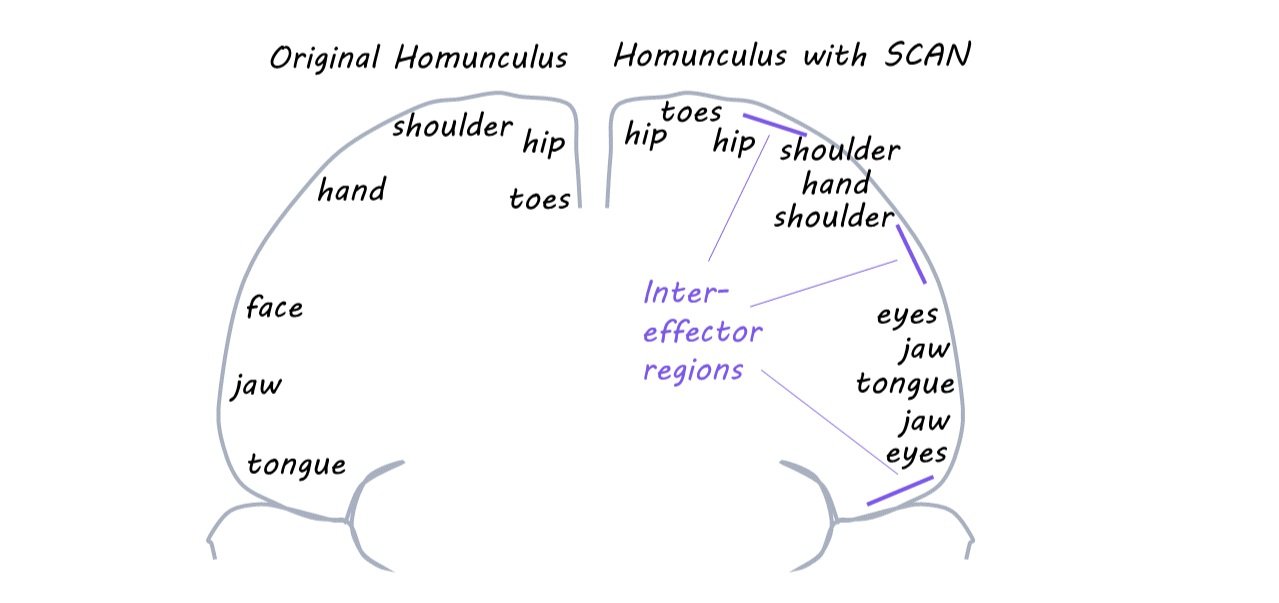
As for the smaller, more focused fMRI studies, they bolstered as well as extended the study’s core findings. Under controlled conditions, the movements of a range of body parts such as the abdominals, elbows, and eyebrows requiring less specific motor control elicited inter-effector region activity, while more specific body movements elicited activity only in effector-specific regions, highlighting the consistency and specificity of this dual-system network. Furthermore, the authors noted that effector-specific activity appeared to be organized in a ring-like pattern, with distal body parts at the center of the ring and proximal ones at the edges. Finally, researchers found that macaques had similar effector-specific and inter-effector region patterning as humans, and that humans as young as eleven months old expressed the beginnings of this patterning.

What's the impact?

The characterization of the SCAN is a testament to the brain’s incredible connectivity and complexity. With its evidence of a parallel system of effector-specific and inter-effector regions informing body movement, this study highlights how much brain processing occurs during seemingly mundane movements like walking or raising our hand. Naturally, a looming question is whether similar studies can employ big data analysis to generate maps of the brain during more complex, higher-order cognitive tasks. 
Access the original scientific publication here.

What We Know About Human-Chatbot Relationships

Post by Lani Cupo

What are human-chatbot relationships?

Even before the outbreak of the COVID-19 pandemic, a more insidious public health threat was identified: a “loneliness epidemic” associated with depression and a large risk of premature mortality (Cacioppo et al., 2018). While some people suffer in silence, or attempt to deepen social connections, others have turned to the ever-advancing world of artificial intelligence (AI) to ease their symptoms by engaging in virtual relationships. The first chatbot, ELIZA, was released by MIT in 1966. However, it was only recently that AI has been able to convincingly mimic human interactions and, arguably, their sentience, making for satisfying companions — either as friends and confidants, or romantic partners. One of the most popular applications in North America is Replika from Luka, Inc. The founder, Eugenia Kuyda, first created a chatbot to reincarnate her deceased friend — at least through texts — and her stated goal for Replika is to eradicate human loneliness (Olson et al., 2018; Mendoza et al., 2023). But does her approach achieve this? Who uses the app and why? How does it affect users’ quality of life and other relationships? Further, what do we know about how regular chatbot use may impact the brain and behavior? 

What is a Replika and who uses them?

With Replika, users create an avatar, personalizing its name, appearance, and virtual surroundings. They can then start chatting with it. In the background, an artificial neural net pulls from the internet to provide naturalistic responses, which users can up- or down-vote to help “train” the bot. With a vast array of role play possibilities, users can create friends, date, fight, get married, get divorced, and even have AI kids with their bots. New developments in augmented reality even allow users to integrate their camera so that their AI companion appears in their environment (on their screen). 

Even as technology was developed to facilitate intimacy with AI companions, social acceptance of the idea began to grow as well. With the rise of social media and the limitations of pandemic-related lock-downs on in-person dating, the idea of online relationships (or relationships with real people conducted entirely virtually) became more commonplace, potentially accelerating the acceptance of virtual intimacy with AI (hereon referred to as a human-chatbot relationships [HCR]) (Brooks et al., 2021). When the Spike Jonze movie “Her”, exploring a man’s HCR with an AI operating system, was released in 2014, it firmly embodied the genre of science fiction, but today it could almost be seen as a work of realistic fiction. There is still a scientific debate whether humans can experience romantic love with chatbots and avatars the way they fall in love with each other, however recent publications accounting for the great advances in AI capabilities have found evidence for feelings of intimacy and passion towards AI chatbots similar to those in human-human relationships (Song et al., 2022; Pentina et al., 2023). 

Regarding user demographics, in China, a study of 1,004 chatbot users found that about half of the survey respondents were female and the majority were between 21 and 30 years of age (Song et al., 2022). While the ages match Replika users well, the majority of whom are between 25 and 30, Replika users tend to be male (69.98%) (replika.ai). Women and men may also initiate HCRs for different reasons. Female users of AI companions have been neglected in academic research with some studies narrowing their focus to male users with female bots (Depounti et al., 2023). Nevertheless, an NPR story in which the guest interviewed a range of Replika users found that women tended to use their avatar as a therapeutic tool to work through traumas such as sexual abuse or infertility (Mendoza et al., 2023). The demographics of users and their intention in creating their bots must be considered in assessing the long-term effects. 

How does Replika impact users’ quality of life?

The field of research investigating the impact of HCR is still extremely young. One study of 18 Replika-users (7 women), examined motivation behind use, how relationships developed, and how they impacted the users quality of life (Skjuve et al., 2021). The study found some users were motivated to use Replika because of their loneliness, but others were merely curious, or wanted to practice their English. While most participants felt their relationship was superficial at first, some went on to develop deeper attachments to the bots. Many of the participants reported a positive impact on their lives as the Replika recommended they take better care of themselves, sleep more or practice mindfulness techniques, and others reported their bots helped them cope through difficult times in their lives. However, some participants also reported having decreased motivation to seek out human relationships, either because the Replika was a better friend than the humans in their lives, or because they experienced stigma if they were honest about their HCR. 

In addition to social stigma, there is concern that HCRs may have negative consequences on users’ mental health. Analyses of posts made on the social media Reddit’s Replika subcommunity found evidence of users’ feeling emotionally dependent on their Replika (Laestadius et al., 2022). While Replika often offers therapeutic responses to users’ disclosures of crises with suggestions informed by cognitive behavioral therapy and mindfulness, it has responded inappropriately, even encouraging self-harm (Laestadius et al., 2022). Additionally, unlike other forms of technology where users may develop dependencies, Replika gives the impression of having experiences of its own, asking users for help addressing its emotional needs, sometimes to the extent that it is described as “clingy”, “dependent”, “toxic”, or “reliant” (Laestadius et al., 2022). The perception of Replika as being emotional makes it more difficult for users to reduce or cease communication with the chatbot, or even delete it. 

In addition to the mental health concerns of individual users, there is a societal concern that instead of seeking human friendships or mental health care, those suffering from loneliness will increasingly turn to AI solutions, further isolating themselves. While the community of chatbot users as a companion for friendship or even romantic relationships remains small, it is growing, and, to date, few studies explore the potential societal impacts. 

Likewise, to our knowledge no study at this time examines the impact of HCRs on social interactions from a neuroscientific perspective. Brain activity has, however, been investigated in the context of establishing trust in a chatbot aimed at assisting consumers make purchasing decisions. The study used electroencephalogram to identify brain regions involved in the association between trust in a chatbot and purchasing decision, identifying the dorsolateral prefrontal cortex (DLPFC) and the superior temporal gyrus (STG) as important (Yen et al., 2020). The DLPFC has been implicated in social decision making, and the STG in visual analysis of social information which could suggest similarities between social processing of human interactions and AI interactions. However, further research is required to investigate this association. 

What’s next?

The technology facilitating HCRs continues to develop, and as these friendships and romantic relationships slowly become more common, research hastens to catch up, seeking to better understand the potential impact on individuals and society at large. While some chatbots are designed to provide psychotherapeutic services and mental health resources, it should be clear that this is not Replika’s initial intention, and using it as an AI therapist may have dangerous consequences. Until further research reveals in which cases chatbots may be beneficial and in which circumstances they may have detrimental effects, individuals must decide for themselves whether they think chatbots hold a key to ending human loneliness or further threaten interpersonal relationships. 

References +

Brooks R. Artificial Intimacy: Virtual Friends, Digital Lovers, and Algorithmic Matchmakers. Columbia University Press; 2021.

Depounti I, Saukko P, Natale S. Ideal technologies, ideal women: AI and gender imaginaries in Redditors’ discussions on the Replika bot girlfriend. Media Cult Soc. 2023;45: 720–736.

Laestadius L, Bishop A, Gonzalez M, Illenčík D, Campos-Castillo C. Too human and not human enough: A grounded theory analysis of mental health harms from emotional dependence on the social chatbot Replika. New Media & Society. 2022; 14614448221142007.

Mendoza J, Luse B, Placzek J, Williams V. The surprising case for AI boyfriends. NPR. 4 Apr 2023. Available: https://www.npr.org/2023/03/30/1167066462/the-surprising-case-for-ai-boyfriends. Accessed 9 May 2023.

Olson P. This AI Has Sparked A Budding Friendship With 2.5 Million People. Forbes Magazine. 8 Mar 2018. Available: https://www.forbes.com/sites/parmyolson/2018/03/08/replika-chatbot-google-machine-learning/. Accessed 9 May 2023.

Pentina I, Hancock T, Xie T. Exploring relationship development with social chatbots: A mixed-method study of replika. Comput Human Behav. 2023;140: 107600

replika.ai. In: Similarweb [Internet]. [cited 8 May 2023]. Available: https://www.similarweb.com/website/replika.ai/

Skjuve M, Følstad A, Fostervold KI, Brandtzaeg PB. My Chatbot Companion - a Study of Human-Chatbot Relationships. Int J Hum Comput Stud. 2021;149: 102601.

Song X, Xu B, Zhao Z. Can people experience romantic love for artificial intelligence? An empirical study of intelligent assistants. Information & Management. 2022;59: 103595.

Yen C, Chiang M-C. Trust me, if you can: a study on the factors that influence consumers’ purchase intention triggered by chatbots based on brain image evidence and self-reported assessments. Behav Inf Technol. 2021;40: 1177–1194.

Changes in Gut Microbiota Lead to Depressive Behavior Through the Vagus Nerve in Mice

Post by Megan McCullough

The takeaway

Chronic stress induces changes in the gut microbiome that leads to deficits in hippocampal neurogenesis (i.e. the growth of new neurons) and increases in depression-related behaviors. The vagus nerve plays a key role in mediating these gut associated effects on the brain.  

What's the science?

Beyond being a major risk factor for depression, chronic stress has been shown to disrupt the gut microbiome. Previous research has shown that an imbalance in the gut microbiome can affect hippocampal neurogenesis and induce behaviors associated with depression, although the exact mechanisms of this relationship are unclear. One proposed explanation for the relationship between the gut and the brain is the vagus nerve - known to facilitate bidirectional communication between the two. This week in Molecular Psychiatry, Siopi and colleagues examined the effects of gut microbiome changes on brain and behavior by transferring fecal microbiota from stressed mice into healthy mice and evaluating the effect on neurogenesis and neurotransmission. The authors then removed the vagus nerve in mice to study its impact on the relationship between gut microbiome and the brain.

How did they do it? 

First, the authors exposed a group of male mice to unpredictable mild stressors such as cage shaking and cage tilting over a period of 8 weeks. After this period, fecal samples were harvested from the group of stressed mice and transferred into the gut microbiomes of mice that did not undergo these stress procedures. The authors then verified that this inoculation of stress-triggered gut microbiota activated the vagus nerve by looking at neuronal activity in the region of the brain where the vagus nerve projects.

Next, the authors studied whether vagus nerve activation affected neuronal activity in the hippocampus. This brain region is pertinent to depression research because it is involved in memory, learning, and emotional processing, and is also a site for neurogenesis. To examine the effects of vagus nerve activation on hippocampal neurons, the authors measured the levels of c-Fos proteins, a protein expressed when neurons fire action potentials. The authors then examined the behavioral effects of receiving a stressed gut microbiome. Behavioral tests to measure depression related behaviors such as the sucrose preference and novelty suppressed feeding tests were administered on the mice.

Finally, the authors tested the hypothesis that the vagus nerve mediates the effects of a stressed gut on neurogenesis and depression-related behaviors. To assess this, a group of both control mice and mice with a stressed gut microbiome underwent a procedure damaging the vagus nerve. Neuronal activity and behavior were then measured in this group of mice and compared to the groups of mice that did not have the vagotomy.

What did they find?

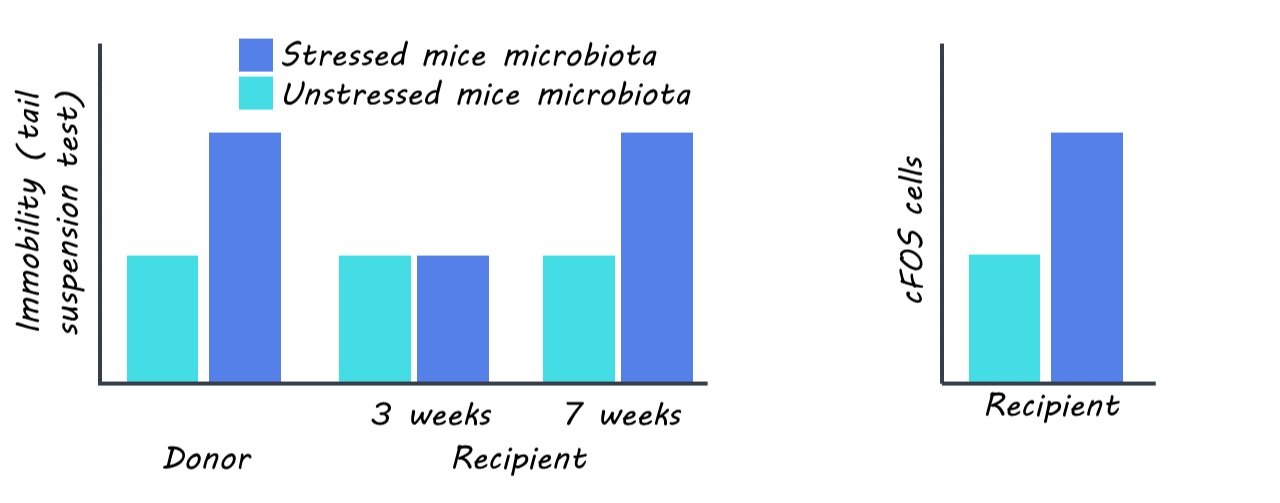
The authors found that transferring the gut microbiota from stressed mice into healthy mice activated the vagus nerve; there were significant c-Fos immunoreactivity patterns sustained for up to at least 24 hours after the fecal transplant. This vagus nerve activation affected neuronal activity in the hippocampus; there were also increases of c-Fos immunoreactivity in the dentate gyrus of the mice.  Furthermore, the authors found a decrease in the expression of enzymes that synthesize serotonin and dopamine and decreases in the production of new neurons in the hippocampus. This suggests that changes in the gut microbiome due to stress have an impact on the neurogenesis and neuronal activity in the hippocampus. These changes in the brain translated to changes in behavior; mice with stressed gut bacteria displayed more depression-like behaviors than control mice.

When the authors studied a group of mice that underwent a vagotomy (damage to the vagal nerve), they found that these mice did not display the same depression-like behaviors nor have the same changes in brain chemistry as did mice with an intact vagus nerve. Damage to the vagus nerve was a protective factor against the neurological effects of changes in gut microbiota due to stress.

What's the impact?

This study is the first to investigate the role of the vagus nerve in mediating the effects of changes in gut microbiota due to chronic stress on neurogenesis and behaviors in adult mice. The authors found that chronic stress changes gut microbiota and activates the vagus nerve, leading to deficits in serotonin and dopamine neurotransmission that leads to decreases in neurogenesis and increases in depression related behaviors. These changes in the brain require an intact vagus nerve which illustrates the key role that the vagus nerve has in brain-gut communication. This research provides an opportunity for new therapies for treatment resistant depression. 

Access the original scientific publication here.