Encoding Numerical Information is as Easy as 1-2-3 for Infants

Post by Lincoln Tracy

The takeaway

Infants as young as three months old have ‘number sense’, meaning they can automatically encode the number of tones they hear or the number of objects they see.

What's the science?

The ability to discriminate numbers – independently of physical quantities such as size or density – is an important human behavior that is also observed in mammals, birds, and fish. However, it is unclear whether humans are born with an innate ‘number sense’, or whether this is a learned response. This week in Current Biology, Gennari and colleagues tested the existence of a genuine ‘number sense’ by examining the neural activity of three-month olds, measured by electroencephalography (EEG), in response to different stimuli containing numerical and non-numerical information. 

How did they do it?

The authors played a variety of auditory sequences that differed in length, rate, instrument, and pitch to 26 drowsy or sleeping three-month old infants while a high-density EEG system recorded their neural responses. The tones composing the sequences could be “short” (a 40ms tone with a 20ms gap between tones), “medium” (120ms with a 60ms gap), or “long” (360ms with a 180ms gap). For the analysis of the EEG recordings, the authors used multivariate pattern analysis to individuate any potential purely numerical neural code that was separate from the neural activity patterns reflecting other characteristics of the auditory stimuli such as tone rate and duration. A key contrast in their analysis concerned the auditory sequences composed of 4 “long” tones vs 12 “medium” tones or 4 "medium" tones vs 12 "short" tones. These pairs of sequences lasted the same length overall but obviously contained a different number of notes.

What did they find?

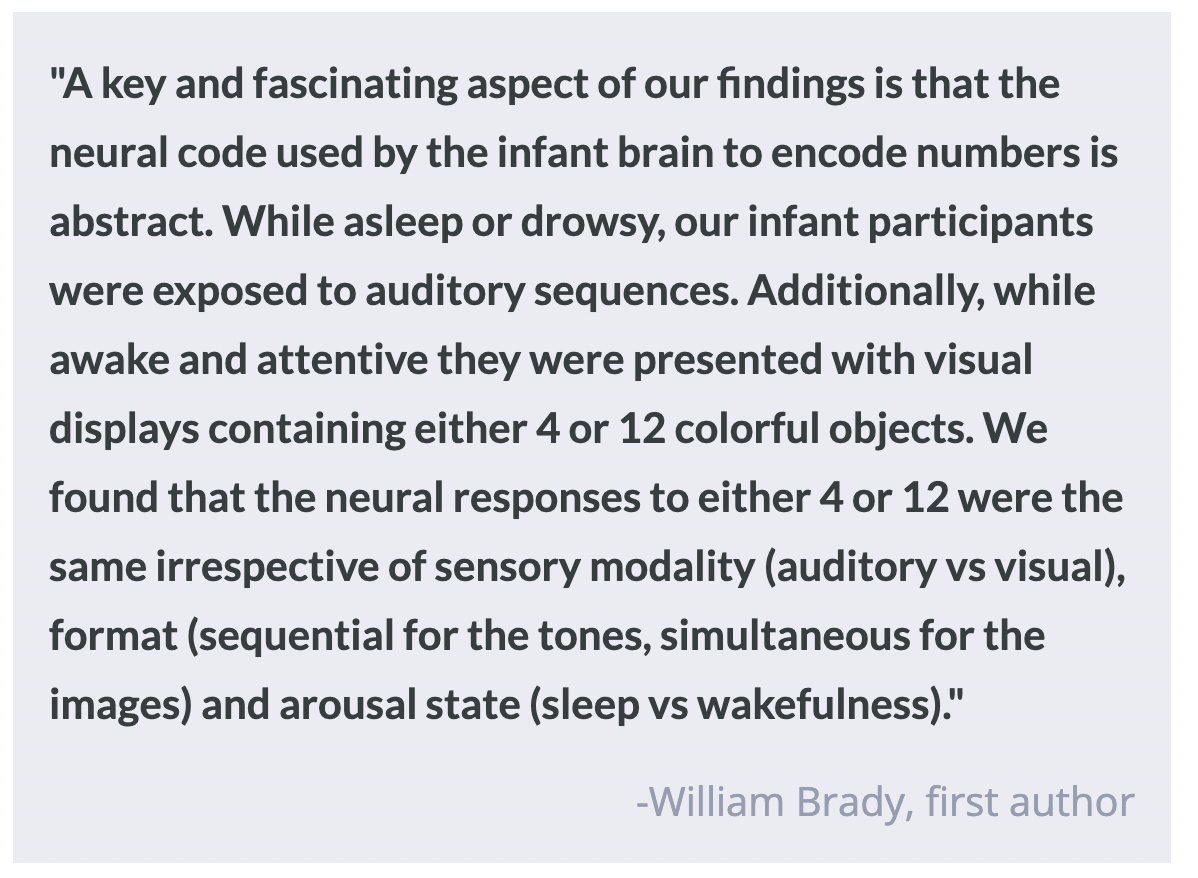
The authors found unique neural responses to different number conditions, demonstrating that three-month old infant brains can estimate the number of tones in an auditory sequence separately from other magnitudes. Further, infants were able to encode numbers even during sleep. This implies that number is a fundamental and critical dimension for representing the auditory environment around us.  

What's the impact?

These findings confirm that our brain treats number as a basic dimension of the environment from a very young age. As other researchers believe that the ability to process approximate numbers is the starting point for a deeper understanding of mathematics, these findings may have practical implications in educational and rehabilitative interventions.  

Overestimation of Moral Outrage in Twitter Users on Political Topics

Post by Lani Cupo

The takeaway

When people read posts on social media, they are likely to overestimate how much moral outrage the author of the post felt. Further, they are likely to attribute the same level of outrage to a larger group, misperceiving the extent of collective moral outrage.

What's the science?

For a democracy to function, citizens must be able to assess collective moral attitudes, accurately identifying common ground among citizens and understanding what topics are most important to the members of opposing political parties. The use of social media platforms for political conversations can warp and skew social perceptions about the values and opinions of others. It is still unclear how social media, in its current form, might distort perceived outrage among politically-partisan users. This week in Nature, Brady and colleagues examine perceptions of Twitter posts (tweets) to understand how accurately readers can assess moral outrage in the original tweet’s author.

How did they do it?

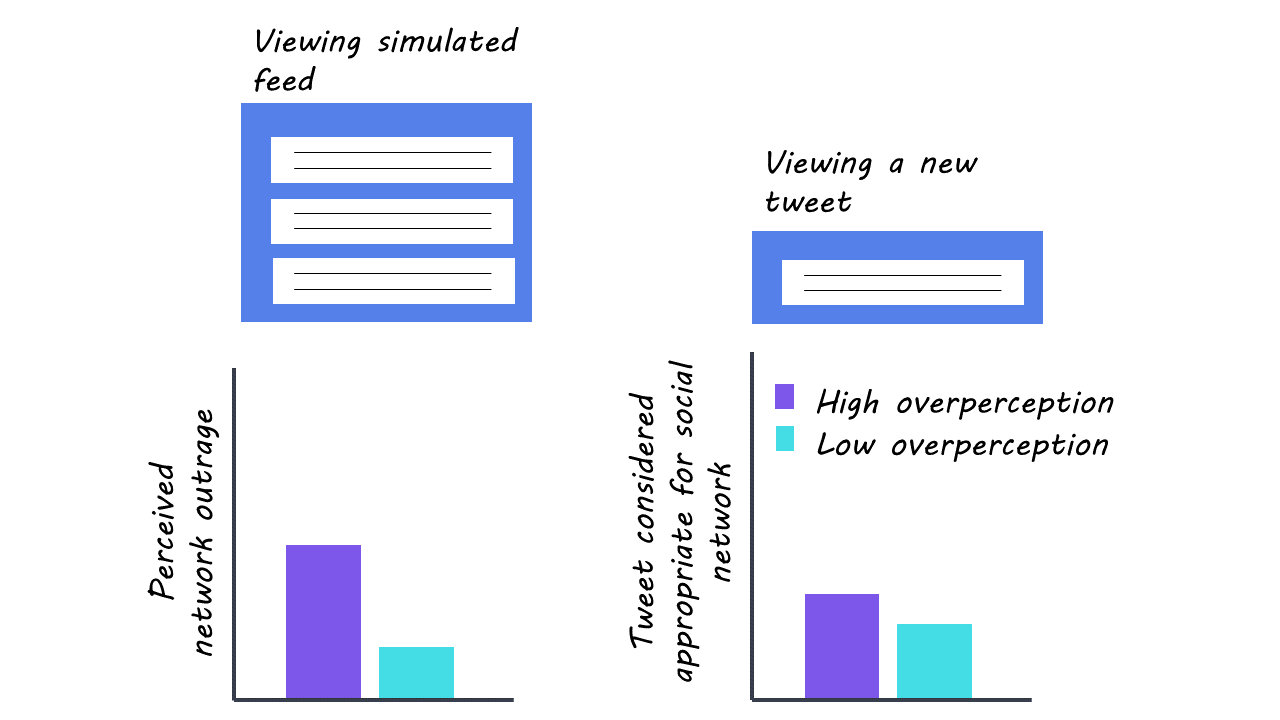
The authors first conducted a field study using Twitter as a naturalistic study environment. They employed a machine learning algorithm to identify users who often posted high or low levels of outrage while discussing topics in American politics. Then, within 15 minutes of them posting a tweet, the authors invited them to take a survey about how happy or outraged they were while writing the tweet. Then, the authors recruited a separate group of politically-partisan Twitter users to read the tweets and judge how happy or outraged they thought the tweet author was when they wrote the message. In a follow-up study, the authors examined whether overestimating outrage in an individual amplifies the perception of collective moral outrage (i.e. overestimating the outrage of an entire group). To do so, they created two mock Twitter feeds with the tweets from the first experiment that both contained the same amount of outraged tweets based on how the tweet-author rated them, but one feed contained more tweets that were overestimated for outrage (high-overperception feed) and one contained tweets that were not overestimated (low-overperception feed). After exposing different groups of participants to these feeds, they assessed whether they perceived collective outrage to be greater. In a final follow-up study, a new set of participants was shown one of the mock Twitter feeds (either high- or low-overperception) and then asked to assess ten political tweets that contained opinions with either outraged or neutral language. The participants were asked to judge how appropriate the tweet would be in the network they observed, how much they thought the social network they observed liked the opposite political group, and how extreme the network was.

What did they find?

First, the authors found that readers overestimated how outraged the author of the tweet was. Importantly, their ratings correlated with those of the tweet-author (if the tweet-author was slightly outraged, the reader perceived them as outraged), but the reader overestimated the amount of outrage nevertheless. The readers who spent more time on social media to learn about politics were more likely to overestimate outrage, regardless of how politically extreme they were themselves or how strongly they aligned with a political group. Second, in the follow-up experiment, the authors found participants in the high-overperception feed were more likely to judge the collective outrage of their social network as high than those in the low-overperception feed, suggesting that overestimation of social outrage increases the perception of collective outrage. Finally, the authors found the high-overperception network was assessed to be more politically extreme and to dislike their political opponents more. It was also deemed socially acceptable to post tweets with more outrage, showing that overperception of collective outrage altered the perception of social norms in a group.

What's the impact?

This study provides evidence that moral outrage on political topics is overestimated on social media platforms, and this overperception can alter societal expectations in the network. These results provide a foundation to understand how social media may distort social knowledge, especially on controversial political opinions. In time, they may form the basis for countering political antipathy that is amplified on social media platforms.

Prefrontal Neurons Regulate the Relationship Between Fear Memory and Pain Perception

Post by Leanna Kalinowski

The takeaway

A small subset of neurons in the prefrontal cortex regulates the association between long-term fear memory and pain perception. Fear memories in these neurons can then be blocked to alleviate chronic hypersensitivity to pain.

What's the science?

Pain and fear are two independent processes that are interrelated in some contexts. For example, when we are faced with a dangerous situation, our fear suppresses our perception of pain; this is a survival mechanism that is well understood. However, long-term fear memories caused by previous exposure to pain can also increase our future sensitivity to pain. This week in Nature Neuroscience, Stegemann and colleagues studied the association between long-term fear memory and pain perception by tagging and manipulating engrams, which are physical traces of memory in the brain.

How did they do it?

In the first experiment, the researchers aimed to identify the engram in the prefrontal cortex that is responsible for recalling previously encoded fear memories. To do this, they first injected a virus into the brain of mice that tags activated cells with mCherry (a fluorescent marker that can be viewed under a microscope). Then, mice received one of three pain stimuli: (1) foot shock, where they received occasional foot shocks over a five-minute period, (2) capsaicin injection, which is a substance that causes acute pain, or (3) fear conditioning, where they are first taught to associate a chamber and tone with a foot shock (training phase), and then are placed into the same chamber four weeks later where they are played the same tone but do not receive foot shocks (recall phase). Importantly, the researchers mixed doxycycline into the mice’s drinking water during the training phase of fear conditioning, as doxycycline temporarily deactivates the virus that tags activated cells with mCherry. This allowed them to only tag the cells being activated during the recall phase.

In the second experiment, the researchers aimed to assess the effects of optogenetically manipulating this engram on fear- and pain-related behaviors. To do this, two groups of mice received a prefrontal cortex injection of either (1) a virus that expresses archeorhodopsin (ArchT), which is a protein that turns off cell activity when exposed to a surgically-implanted fluorescent light, or (2) a virus that expresses channelrhodopsin-yellow fluorescent protein (ChR2-YFP), which is a protein that turns on cell activity when exposed to a fluorescent light. Both sets of mice then underwent the fear conditioning procedure with two rounds of fear recall: once without fluorescent light exposure, and once with fluorescent light exposure. In a different session, the researchers also measured pain behaviors after injecting both groups of mice with capsaicin and delivering the fluorescent light exposure.

In the third experiment, the researchers aimed to assess how the interaction between fear and pain differs in mice experiencing chronic pain. They first measured baseline pain behaviors in mice by measuring how quickly they withdrew their paw from a heat source or from mechanical stimulation. Next, the mice underwent fear conditioning and once again underwent pain behavior testing. Then, mice received one of the following chronic pain manipulations: spared nerve injury or paw inflammation. Finally, the mice underwent a third and final round of pain behavior testing.

In the final experiment, the researchers aimed to assess whether pain hypersensitivity in chronic pain mice can be reversed by silencing the fear memory engram with optogenetics. First, they again injected mice with a virus that expresses ArchT. The mice then underwent fear conditioning with two rounds of fear recall: one without fluorescent light exposure (i.e., cells are kept on), and one with ArchT activation (i.e., cells are turned off). Then, mice received one of the two chronic pain manipulations -- spared nerve injury or paw inflammation -- with pain behaviors being measured both at the peak of pain hypersensitivity and following several weeks of chronic pain hypersensitivity.

What did they find?

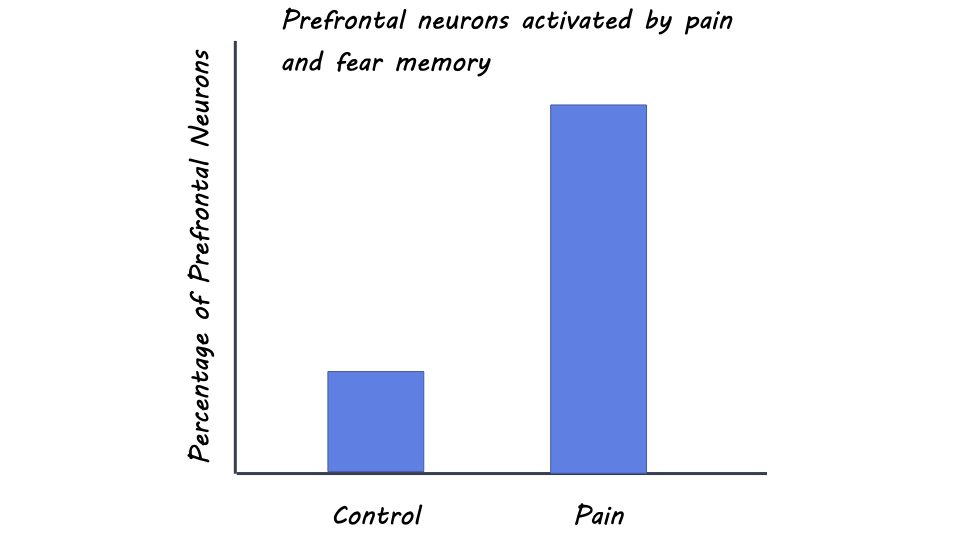
First, the researchers were able to identify an engram in the prefrontal cortex that was activated during both long-term fear memory and short-term pain. Results from this experiment informed their experimental manipulations for the remainder of the paper. Then, the researchers first found that optogenetic ArchT activation (i.e., turning off the cells) of the engram reduced both fear memory in the fear recall test, and pain-related behaviors (e.g., flicking, licking, or lifting the injected paw) following the capsaicin injection. They also found that optogenetic ChR2-YFP activation (i.e., turning on the cells) of the engram induced fear memory recall behaviors (e.g., freezing behaviors) even in the absence of auditory and contextual cues. This suggests that acute pain perception contains traces of a long-term fear memory from a previous pain experience. 

Next, the researchers found that while pain behaviors (i.e., rapid paw withdrawal) were not affected by prior fear conditioning in mice without chronic pain, mice with both types of chronic pain had greater pain sensitivity as evidenced by shorter paw withdrawal times. Chronic pain mice exposed to fear conditioning had a further increase in connectivity intensity to the mediodorsal thalamus, which is important for regulating emotion and the negative affect of pain.

Finally, the researchers found that, in mice whose long-term fear memory engrams were silenced, pain behaviors were reduced at both time points in both models of chronic pain. This shows that chronic hypersensitivity to pain can be reversed after suppressing the recall of long-term fear memory.

What’s the impact?

Taken together, results from this study show that a small subset of prefrontal cortex neurons is responsible for mediating interactions between long-term fear memories and pain perception, and they can be manipulated to alleviate pain hypersensitivity following chronic pain. These findings open the door to potential therapeutic strategies for chronic pain patients who experience fear-induced pain hypersensitivity. 

Access the original scientific publication here.