Later Initiation of Hormone Therapy after Menopause Increases Alzheimer's Disease Risk

Post by Kulpreet Cheema

The takeaway

Women who experience menopause at an earlier age or started hormone therapy later have elevated tau levels in the brain, which worsens in the presence of beta-amyloid plaques. 

What's the science?

The two hallmarks of Alzheimer's disease (AD) pathology in the brain are the presence of neurofibrillary tangles of tau protein and plaques made of beta-amyloid protein. Research has shown that females have greater levels of tau tangles than males. These differences can be attributed to sex-related risk factors like early onset of menopause and the use of hormone treatment (HT). HT has been suggested as one of the treatments to mitigate cognitive impairment and manage menopausal symptoms like hot flashes, night pain, and urinary issues. However, clinical trials have found evidence suggesting that starting HT after menopause is associated with an increased risk of developing dementia.  

This week in JAMA Neurology, Coughlan and colleagues sought to investigate the relationship between the onset of menopause, age at HT initiation, and Alzheimer’s disease-related pathology in the brain.

How did they do it?

Two hundred ninety-two cognitively unimpaired participants (193 females and 99 males) enrolled in the Wisconsin Registry for Alzheimer's Prevention study were selected for the study. Demographic data (like the age of menopause onset and HT use), lifestyle factors (like education level, menopause severity, and history of hysterectomy), and cognitive performance scores (memory and executive function) were collected. In addition, two specialized Positron Emission Tomography (PET) scans were performed to detect tau tangles and amyloid-beta deposition in parietal, temporal, and occipital brain regions. Linear regression models were run to study the association between sex, age of menopause, and HT use with regional tau and beta-amyloid plaque levels.

What did they find?

Higher levels of cortical tau in parietal and temporal brain regions were found in females than in males, worsened with the presence of beta-amyloid plaques. Precisely in females, younger age at menopause onset, and use of HT post-menopause were associated with high tau deposition. When HT was initiated more than five years after menopause onset, tau levels were significantly higher compared to females who started their HT closer to their menopause age. Finally, cognitive performance was lower in females with late initiation of HT compared to females with earlier initiation of HT. All these results suggest that late initiation of HT can explain the association between HT use and increased levels of tau protein in cognitively unimpaired women.

What's the impact?

Females have an elevated risk of developing dementia due to sex-related factors including the age of menopause and treatment with HT. This study adds to the recommendation of administering HT closer to the menopause onset rather than later. This finding is significant as it can help inform the discussions around hormone-based treatments and AD risk in women. 
Impact of DMT on Brain Function and Connectivity

Post by Lani Cupo

The takeaway

A joint fMRI and EEG experiment reveals the impact of the psychedelic DMT on brain activity, potentially lending insight into the neural correlates of consciousness.

What's the science?

N,N-Dimethyltryptamine (DMT) is a psychedelic that targets serotonin receptors and leads to an altered state of consciousness consisting of vivid imagery without a loss of consciousness. Previous functional magnetic resonance (fMRI) evidence suggests the role of recently-evolved association cortices (transmodal association cortex pole, or TOP) in the effects of DMT. However, these previous findings were obtained with fMRI, which captures not only neural activity but also vascular artifacts and other physiological noise. This week in PNAS, Timmermann and colleagues examined the acute effects of DMT on brain activity with concurrent fMRI and electroencephalograms (EEG), allowing them to correlate methodologies for increased specificity to neural activity. 

How did they do it?

Twenty healthy adults participated in the study, with each participant undergoing two lab visits separated by two weeks. At the first visit, half the participants received a placebo and the other half received DMT, with each participant receiving the other treatment at the second visit. For 30 minutes, fMRI and EEG were acquired simultaneously during rest as the drug or placebo was administered. Participants also provided subjective, real-time ratings of how intense the drug experience was

Initially, the authors examined each modality separately. With the fMRI data, they first calculated static resting state functional connectivity, or in other words they examined the degree to which activity of certain brain regions correlated with activity from other regions across the entire session. For the second fMRI analysis, they used a ‘sliding window’ approach to examine how functional connectivity changed over time throughout the scan, for example calculating correlations for the first minute, then the second minute, etc. They examined how the regional connectivity patterns related to subjective accounts of the intensity of the drug. With the EEG data, the authors looked at a) the signal over the entire period and b) the signal at different times with the sliding window approach. Finally, the authors examined the fMRI and EEG data together by incorporating EEG signals as covariates in regression models of functional connectivity (fMRI). 

What did they find?

With the static functional connectivity approach (fMRI data), the authors found DMT decreased the strength of connections within brain networks as well as the segregation between networks, suggesting regions that comprise a network were less strongly correlated with each other, but more correlated with activity in other regions outside of the network. From the sliding window approach, the authors found subjective reports of greater intensity were associated with increased connectivity among networks. Regions with increased functional connectivity were associated with previously published maps of serotonin receptors, consistent with DMT’s mechanism of action in the brain. 

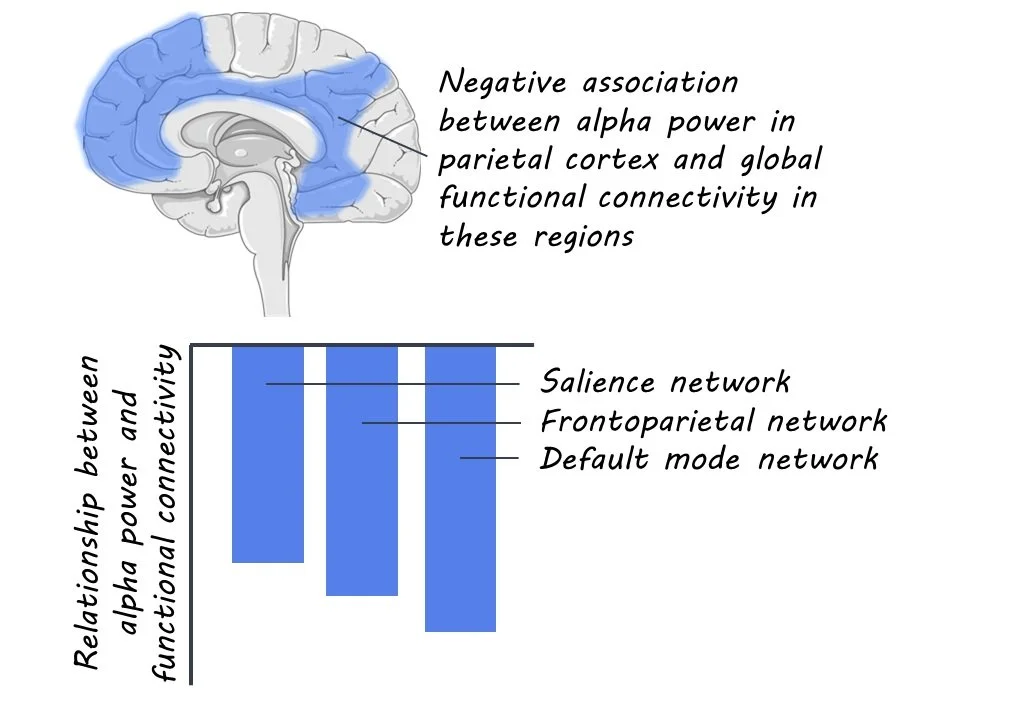
From the EEG data alone, the authors found DMT was associated with decreases in alpha power but increases in gamma and delta power. Alpha waves decrease during sleep, and delta waves are prominent during sleep, suggesting an altered state of consciousness. One hypothesis suggests gamma waves may play a role in communication between neuronal populations, consistent with the decreased segregation of brain networks seen in the fMRI data. More intense subjective ratings were associated with increased delta power but decreased alpha power. Finally, when examining the two modalities together, the authors found that increased delta power was associated with increased functional connectivity among networks across the brain. In contrast, decreased alpha power was related to increased connectivity, including in the TOP, consistent with prior DMT studies. 

What's the impact?

This study confirms previous results suggesting decreased segregation of brain networks while advancing an understanding of how psychedelics alter states of consciousness with multiple modalities. The findings imply that the high-level cortical regions that DMT affects may be necessary for human-specific cognitive traits that underlay human consciousness. 

Access the original scientific publication here

How Does the Brain Learn New Motor Tasks?

Post by Ewina Pun

What’s motor learning?

Humans possess a remarkable capacity to acquire new motor skills. Some motor skills can be readily transferred to a new task or context. For example, someone who can already play the guitar will have an easier time learning to play the bass, and mastering biking on flat terrain makes it less challenging to tackle mountain biking. However, learning entirely new motor skills can be more difficult. Through practice and repetition, our brain is capable of acquiring and refining those skills. Motor learning involves modifying the nervous system to enable movement generation in response to environmental changes or through practice. This overview highlights some of the neural mechanisms that guide motor learning.

How does the brain change during motor learning?

The brain may reorganize itself on various levels when we learn a new task. First, cortical maps may change over an extended period of deliberate practice. For example, a study revealed skilled musicians have a larger volume of grey matter than non-musicians. Second, learning can also result in short-term and long-term changes in tuning properties of individual neurons, synapses, and functional networks of neurons. Motor learning is complex because these processes may occur simultaneously over different timescales, and typically involve various brain regions depending on the type of learning.

During learning, cortical neurons in the motor cortex and sensorimotor cortex may reuse existing neural patterns for fast skill adaptation or create new neural patterns when learning skills that have not been encountered before. Changes in neural population activity also occur, which can be attributed to synaptic plasticity: synapses being strengthened, pruned, or created, allowing more efficient neural communication. These changes in connections affect the neural population's firing patterns, subsequently influencing behavior.

Reward-based learning in the basal ganglia

Reward-based learning in the basal ganglia plays a crucial role in the acquisition of new motor skills and refining existing ones. Also known as reinforcement learning, this process allows the brain to associate specific motor actions with positive or negative outcomes and adjust behavior to maximize rewards and minimize punishments. The basal ganglia create a feedback loop connecting motor planning and execution from the cerebral cortex with the evaluation of outcomes. This evaluation is facilitated by dopamine-releasing neurons that encode reward prediction information. This process considers rewards independently of sensory and motor aspects and integrates reward information into movement activities.

Error-based learning in the cerebellum

The cerebellum also plays an important role in acquiring and coordinating precise movements through error-based learning. Prediction error refers to the difference between the intended movement and the actual movement produced. To predict and correct errors and fine-tune movements, the cerebellum receives and integrates inputs from sensory systems, such as vision and proprioception (the sense of body position), as well as from the cerebral cortex. Research suggests that the cerebellum is involved in externally driven movements, while the basal ganglia participate in internally generated movements.

Why study motor learning?

Motor learning is an active and ongoing area of research in neuroscience, with many unanswered questions awaiting exploration. Understanding the neural mechanisms underlying movement control and learning is essential, as it holds practical applications in fields such as sports training (to enhance athletic performance) and rehabilitation (new therapies and technologies to help disabled individuals). Furthermore, understanding how we incorporate predictions and errors in the context of motor learning may contribute to the advancement of machine learning algorithms for tackling and solving new tasks. Future research may focus on emerging techniques or technologies, such as brain-computer interfaces, virtual reality, or advanced neuroimaging methods, which could further our understanding of how the brain learns new motor tasks.

References +

C. Gaser, G. Schlaug. Brain structures differ between musicians and non-musicians. J. Neurosci. (2003).

B. Jarosiewicz et al. Functional network reorganization during learning in a brain- computer interface paradigm. Proc. Natl. Acad. Sci. (2008).

C. S. Li, C. Padoa-Schioppa, E. Bizzi. Neuronal correlates of motor performance and motor learning in the primary motor cortex of monkeys adapting to an external force field. Neuron. (2001).

R. Shadmehr and F. A. Mussa-Ivaldi. Adaptive representation of dynamics during learning of a motor task. J. Neurosci. (1994).

E. R. Oby et al. New neural activity patterns emerge with long-term learning,” Proc. Natl. Acad. Sci. 2019.

K. Doya. Complementary roles of basal ganglia and cerebellum in learning and motor control. Current Opinion in Neurobiology. (2000).

Tobler et al. Adaptive Coding of Reward Value by Dopamine Neurons. Science. (2005)

W. Schultz. Reward functions of the basal ganglia. Journal of Neural Transmission (2016)

Y. Zang and E. De Schutter. Climbing Fibers Provide Graded Error Signals in Cerebellar Learning. Front. Syst. Neurosci. (2019).