Brain Recording and Stimulation— On the Go!

Post by Anastasia Sares

The takeaway

Researchers have designed a compact, portable device that can record brain activity from patients who already have electrodes implanted in their brain for medical reasons. The expanded capabilities of this device will allow us to test more complex forms of clinical neuromodulation, as well as provide a view into the neuron-level functioning of the human brain in life-like situations.

What's the science?

The number of people with therapeutic electrodes implanted in their brains, though small, is rising. The classic use of this technology is with epilepsy patients, to monitor a region suspected of generating seizures before operating. Nowadays, more permanent devices are being tested which could detect the beginnings of a seizure and deliver a pulse of electricity to stop it in its tracks. Another reason someone might have electrodes implanted is for deep brain stimulation (DBS), which can be used as a treatment for Parkinson’s disease and depression, among other disorders. In addition to their clinical applications, these electrodes are a unique opportunity for researchers to measure human brain activity at the single neuron level.

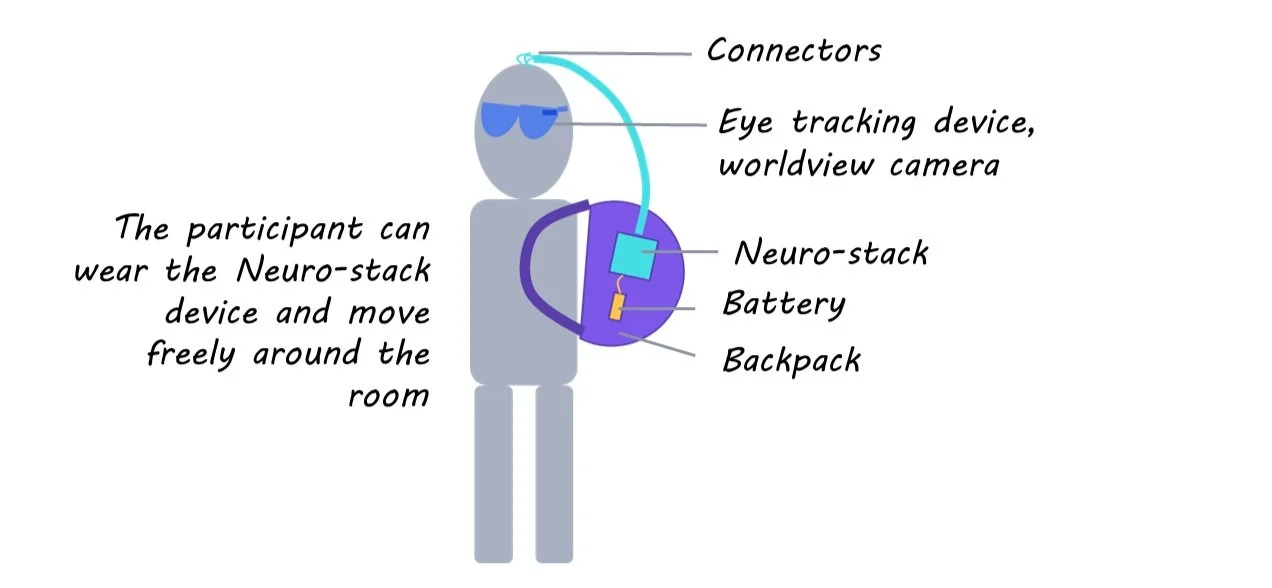
This week in the journal Nature Neuroscience, Topalovic and colleagues present their new system, Neuro-stack, a wearable device that can connect to a patient’s already-implanted brain electrodes, recording activity and also stimulating particular brain regions.

How did they do it?

The Neuro-stack combines many existing technological elements important to both research and clinical applications, while also increasing their resolution and power. Some features include: 

  • Portability: people can wear the device during an experiment and not be hampered by wires tethering them to computers or other devices.

  • Simultaneous recording of single-neuron activity and fluctuations of entire neuron populations (known as local field potentials or “LFPs”)

  • Precise electrical stimulation (sending a pulse of electricity into the brain at a targeted location)

  • Correction: Statistical techniques to account for electrical stimulations so they don’t interfere with recordings.

  • Neural networks that can learn what brain activity is relevant for a given task 

  • Eye tracking and a world-view camera, so information from a person’s environment can be synchronized with their brain activity.
What did they find?

The team demonstrated the capabilities of the Neuro-stack in a few small experiments. In one, participants walked around the room while the device recorded activity in the neurons of a region called the hippocampus. Just like in previous experiments with rodents, the hippocampus responded to the person’s location in the room, firing more often when they were close to the walls. This confirms that humans have some of the same navigation mechanisms as rodents when it comes to spatial boundaries.

Another validation experiment was a memory test. In each block, a participant was given a list of ten words to memorize. They then completed a math test as a distracter and finally were asked to recall the words at the end of the block. The authors used a machine learning algorithm (convolutional and recurrent neural networks) to predict which word would be remembered and which would be forgotten based on the activity in the brain at the time of hearing the word.

These experiments were small, proof-of-concept studies and studies with more people would be needed to fully flesh out the findings. However, these small demonstrations show that the Neuro-stack is a useful tool and works as intended.

What's the impact?

Portable implanted electrode systems are often used in animal research and have led to many discoveries about how the brain works. However, a rodent and a human still have many differences, and a rodent cannot converse with a researcher or give feedback about their experiences using language. In addition, certain psychological conditions are difficult to replicate or detect in rodents, limiting clinical research. The Neuro-stack could help to bridge the gap between animal and human research, increasing our understanding of the human brain. Of course, we will have to continue to be vigilant of the ethical implications as our digital and biological worlds collide.
Aggression-Specific Mirror Neurons Exist in the Hypothalamus

Post by Lincoln Tracy

The takeaway

A subset of neurons essential for aggression in the ventromedial hypothalamus of the mouse is activated when observing aggression in other animals, providing an example of mirror neurons for this specific social behavior. 

What's the science?

Mirror neurons are a subtype of neurons activated both during seeing and undertaking a behavior. Consequently, they have been suggested to be an important component of the cognitive substrates underlying successful social interactions. Activating neurons in the ventrolateral section of the ventromedial hypothalamus – the ‘attack’ center of the brain – elicits aggression in mice, but it’s unknown whether these neurons are also activated when observing aggression between other animals. This week in Cell, Yang and colleagues used calcium imaging and multiple types of genetically modified mice to determine whether neurons in the ventrolateral section of the ventromedial hypothalamus could perceive aggressive encounters between other mice.

How did they do it?

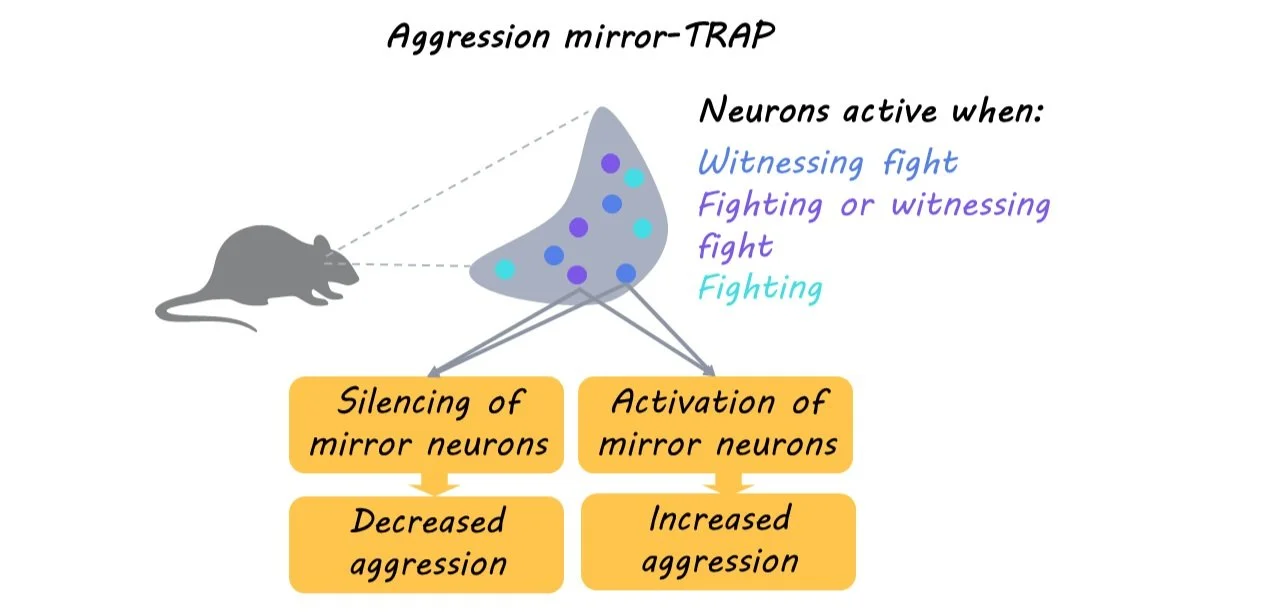
First, the authors used fiber photometry to determine whether aggressor neurons in the ventromedial hypothalamus of male mice were activated in response to social interactions with a male intruder in their cage. Second, they tested whether observing, but not participating in, aggression between two other mice activated the neurons in a similar fashion by separating the mice with clear, perforated plastic partition. Third, they tested which specific aspects of observing aggression were required for neuronal activation by altering the mice’s ability to smell and see the other animals. Fourth, they used socially naïve and experienced males to determine whether aggression mirroring requires the mouse to have previously participated in aggressive behaviors. Fifth, they used a TRAP2 mouse model to specifically test whether neurons activated in observers were also activated when the mouse participated in aggressive behaviors. Finally, they tested if the aggression-mirroring neurons were functionally relevant for fighting by using an aggression mirror-TRAP (aggression mirror neurons tagged with TRAP) to inhibit these neurons in a territorial aggression paradigm. 

What did they find?

First, the authors found aggressor neurons in the ventromedial hypothalamus of male mice were activated when a mouse interacted with and attacked a male intruder that had been placed in its cage. Second, just as when the mouse participated in aggressive behaviors, observing other mice be aggressive resulted in similar activation of ventromedial hypothalamic neurons. Third, they found that visual input is necessary for the activation of aggression-mirroring hypothalamic neurons, as repeating the experiment under infrared light did not activate aggressor neurons. Fourth, they found prior experience was not needed, as ventromedial hypothalamic activation was similar for both socially naïve and experienced mice when observing aggressive behaviors between other mice. Fifth, they found that there was an overlap of ventromedial hypothalamic neurons that were activated in observers and participants of aggression. Finally, they found the aggression mirroring neurons were essential for territorial fighting, as forced inhibition of these neurons reduced aggressive, but not non-aggressive social, behaviors. In additional studies, they also found that activating aggression mirroring neurons was sufficient to elicit aggression.

What's the impact?

These findings provide a genetic platform that can help us gain molecular and cellular insights into how individual neurons represent social behavior like aggression with respect to both mirroring and performing actions.  

Treating the Gut in Parkinson’s Disease

Post by Christopher Chen

The takeaway

A common symptom in people with Parkinson’s Disease (PD) is a compromised, pro-inflammatory gut bacteria profile that may lead to neuroinflammation and neurodegeneration associated with PD. Clinicians found that a short-term regimen of prebiotic fiber helped restore the gut’s anti-inflammatory environment in patients with PD and may even attenuate clinical symptoms. 

What's the science?

Though classified as a neurodegenerative disease, Parkinson’s Disease (PD) also manifests itself in the gut microbiota. Specifically, patients with PD express increased levels of pro-inflammatory bacteria (family Enterobacteriaceae) and decreased levels of anti-inflammatory bacteria (family Lachnospiraceae). This imbalance may lead to intestinal “leakiness” which allows for the infiltration of harmful substances like lipopolysaccharide (LPS) which may increase neurodegeneration. However, research has shown that anti-inflammatory bacteria can restore gut balance by producing molecules called short-chain fatty acids (SCFA). Scientists know that the body’s breakdown of substances called prebiotic fibers recruits the helpful bacteria that generate SCFAs. Recently in Nature Communications, Hall and colleagues investigate whether treating PD patients with prebiotic fiber can increase SCFA production, decrease pro-inflammatory bacteria, and potentially alleviate clinical symptoms of PD.    

How did they do it?

The researchers first determined the effects of different prebiotic fibers on SCFA production. To do so, they treated the stool of age-matched healthy controls and patients with PD with different types of prebiotic fiber and measured how much each fiber increased SCFA. Based on this data, the scientists created an edible bar containing an optimized mixture of prebiotic fibers (30% resistant starch, 30% resistant maltodextrin, 30% stabilized rice bran, and 10% agave branched inulin).

Over the course of ten days, the bar was given to two groups of PD patients, the first group being newly diagnosed and non-medicated PD patients and the second being medicated PD patients. Following the ten-day regimen, researchers assessed participant stool to assess microbiota composition and also assessed participants on a range of symptoms linked to gastrointestinal and neurological function, including UPDRS, a neurological assessment specifically linked to PD symptomology. These results were then compared to data from the same assessments taken prior to the prebiotic fiber intervention.  

What did they find?

Following treatment, both participant groups exhibited changes at the microbiome and cellular level as well as in behavioral assessments. In terms of microbiome composition, patient stool showed a decrease in the overall abundance of pro-inflammatory bacteria and an increase in the overall abundance of anti-inflammatory, SCFA-producing bacteria. Researchers also took blood samples from patients, which showed an increase in SCFA following the treatment. Additionally, a metabolic pathway linked to acetyl-CoA fermentation known to be upregulated in PD was downregulated following prebiotic fiber intervention. It should be noted, however, that while the overall amount of SCFA-producing bacteria increased, several species of SCFA-producing bacteria were downregulated following the treatment. In terms of neurological effects, no neuroinflammation markers showed decreases in patients, though levels of a neurodegeneration marker called NfL were reduced.   

Finally, an exploratory analysis was conducted to assess the effects of the prebiotic fiber regimen on clinical and behavioral outcomes. Most notably, both patient groups had minimal GI discomfort and scored significantly lower on the UPDRS following treatment, suggesting an improvement in PD symptomology.   

What's the impact?

Taken together, evidence from this study suggests that diets high in prebiotic fiber may be conducive to restoring anti-inflammatory, SCFA-producing bacteria in patients with PD. Furthermore, the resulting increase in SCFA-producing bacteria may be linked to functionally significant decreases in PD symptomology. Though this study was conducted on a relatively small patient group (twenty total participants) and the long-term effects of prebiotic fiber remain unclear, it offers a compelling glimpse into the therapeutic potential of non-pharmacological, microbiome-centric treatments for neurological disorders such as PD. 

Access the original scientific publication here.