How Do Psychedelics Promote Neuroplasticity?

Post by Leanna Kalinowski

The takeaway

Activating serotonin 2A receptors within the cell membrane is necessary for promoting the neuroplasticity-inducing and antidepressant-like effects of psychedelics.

What's the science?

Several neuropsychiatric diseases, including depression, are marked by a decrease in dendritic spine density in the cortex. Due to the ability of psychedelics to promote neuroplasticity (e.g., the regrowth of these dendritic spines) in the brain, psychedelics have emerged as a promising treatment for neuropsychiatric diseases. While it is known that neuroplasticity can be promoted by activating serotonin 2A receptors (5-HT2ARs) in the brain, the mechanisms by which this occurs following psychedelic administration are still poorly understood. This week in Science, Vargas and colleagues uncovered the mechanisms by which psychedelic-induced activation of 5-HT2ARs promotes neuroplasticity and antidepressive-like behaviors in mice.

How did they do it?

In the first experiment, the researchers determined the primary location of serotonin 2A receptors (5-HT2ARs) within neurons. To do this, they first tagged in vitro (i.e., in a petri dish) human embryonic kidney cells (a control) and cortical neurons with a fluorescent marker, and then tagged b2 adrenergic receptors (control receptors) and 5-HT2ARs with a different fluorescent marker. The location of each receptor type was then mapped relative to the cell membrane of each cell type.

In the second experiment, the researchers tested whether it was necessary for psychedelics to cross the cell membrane in order to promote neuroplasticity. To do this, they treated in vitro rat embryonic cortical neurons in a petri dish with either (1) psychedelics that are capable of crossing cell membranes (i.e., DMT & psilocin) or (2) versions of these psychedelics that were chemically modified into substances that are incapable of crossing cell membranes (i.e., TMT & psilocybin). Half of these substance administrations were done in the presence of electroporation, which creates temporary openings in the cell membrane so membrane-impermeable substances can cross, while the other half were not. Following substance administration, the researchers measured dendritogenesis, which is a form of neuroplasticity defined as the formation of new dendrites.

In the third experiment, the researchers tested whether importing serotonin into neurons promotes neuroplasticity in mice. To do this, they first engineered mouse neurons to express serotonin transporter (SERT), which acts as a gate to allow serotonin into the cell. Half of the mice received an intra-mPFC injection of the virus that causes its neurons to express SERT, while the other half of the mice received a control injection into the mPFC. Then, after three weeks, both groups of mice were given an intraperitoneal injection of para-chloroamphetamine (PCA), which is a drug that causes the release of serotonin. 24 hours following this injection, markers of neuroplasticity (i.e., dendritic spine density) were assessed.

The fourth and final experiment was like the third experiment, except this time, the researchers tested whether importing serotonin into neurons promotes antidepressant-like behaviors in mice. Three weeks after the procedure to create SERT-positive neurons in the mPFC, mice were placed in a container of water and given a baseline forced swim test to test depressive-like behaviors without the presence of serotonin. In this test, mice who stop trying to swim to escape the container after a shorter period of time are considered to be exhibiting more depressive-like behaviors. Two days after the baseline forced swim test, mice were injected with PCA to facilitate the release of serotonin, after which they were once again administered a forced swim test.

What did they find?

From the first experiment, the researchers found that within kidney cells (controls), both receptor types (b2 adrenergic & 5-HT2ARs) were localized along the cell membrane. However, within cortical neurons, b2 adrenergic cells (controls) were localized on the cell membrane, while 5-HT2ARs were localized within the cell membrane. This is unique from most other G-protein-coupled receptors that are generally located along the cell membrane.

From the second experiment, the researchers found that regardless of whether electroporation was applied, membrane-permeable psychedelics (i.e., DMT and psilocin) always promoted neuroplasticity within cortical neurons. On the other hand, membrane-impermeable psychedelics (i.e., TMT and psilocybin) were only able to promote neuroplasticity when temporary openings in the cell membrane were present due to electroporation. Together, these findings suggest that psychedelics can only promote neuroplasticity when they are able to cross neuronal cell membranes.

From the final two experiments, the researchers first found that SERT-expressing mice that were administered PCA displayed higher markers of neuroplasticity (i.e., dendritic spine density) compared to controls. In addition, they found that these mice also displayed a reduction of immobility in the forced swim test, which is indicative of anti-depressive-like behaviors. Together, these results suggest that importing serotonin into neurons promotes neuroplasticity and antidepressant-like effects in mice.

What's the impact?

Results from this study have the potential to transform how scientists think about psychedelics and other drugs that target the serotonin system. Now that we know that (1) 5-HT2ARs are located within the cell membrane, (2) serotonin generally cannot cross the cell membrane to bind to these 5-HT2ARs, and (3) many psychedelics can cross the cell membrane to bind to these 5-HT2ARs, scientists are equipped to develop future treatments for neuropsychiatric disorders in which 5-HT2ARs are implicated. Future studies should evaluate the potential of other drug classes to bind to intracellular targets and produce therapeutic effects. 

Access the original scientific publication here.

Functional Connections From the Thalamus Can Predict Concussive Symptoms After a Mild Traumatic Brain Injury

Post by Kulpreet Cheema

The takeaway 

Functional changes in the connectivity of a brain region called the thalamus in the acute phase after a mild traumatic brain injury (mTBI) can be used to indicate chronic symptoms.

What’s the science? 

After a person suffers from a mTBI, it’s often hard to predict long-term symptoms, with studies showing that clinicians often overestimate recovery rates. The thalamus is a brain region that is involved in the coordination of information between different brain regions. Disrupted thalamic activity is found to be associated with various post-concussive symptoms like headache, sleep disturbance, and fatigue. Additionally, a significant relationship has been found between thalamic activity and symptoms of depression, pain, and cognitive performance. However, these studies had small sample sizes and often investigated patients with pre-existing disorders. It is therefore unclear whether this relationship is due to mTBI alone. This week in Brain, Woodrow and colleagues aimed to study the pathophysiology of the thalamus and its relationship with the post-concussive symptoms that emerge after a mTBI.

How did they do it? 

The authors used magnetic resonance imaging (MRI) data from the CENTER-TBI study, which included 108 patients with mTBI with no history of previous concussion or neuropsychiatric disorder and 76 healthy control participants. All participants completed a structural MRI scan and a resting state functional MRI (rsfMRI) scan in the acute phase of their injury. Thirty-one patients also completed the same scans at 6- and 12 months post-injury. Behavioral assessments were conducted to measure cognitive, emotional, and somatic symptom recovery.

The thalamus' overall volume and functional connectivity (i.e., degree of correlated activity between the thalamus and other brain regions) and six blood-based injury biomarkers collected within 30 days were related to the outcome. In addition, functional connectivity was related to the density of receptors and transporters from nine neurotransmitter systems.

What did they find? 

In the acute phase after mTBI, the thalamus had an increased number of functional connections to other brain regions when compared to controls. Surprisingly, changes in routine imaging and blood-based biomarkers were not different between the patients and controls. Moreover, patients who developed persistent postconcussive symptoms had even more connections from the thalamus than those without symptoms, proposing this as a biomarker of chronic symptoms. Also, specific neurotransmitter profiles were related to the functional connectivity changes associated with post-concussive symptoms. Together, all these results suggest the chronic symptoms after a mTBI can be identified and better understood by examining the functional connectivity of the thalamus, in conjunction with different neurotransmitter profiles.

What’s the impact? 

The study found that functional connectivity of the thalamus can serve as an earlier biomarker after a mTBI injury. This can help clinicians identify patients who will develop post-concussive symptoms and improve appropriate treatment plans to alleviate these symptoms.  

A “Pro-Inflammatory” Diet is Associated with Increased Inflammation and Cognitive Decline

Post by Lani Cupo

The takeaway

A diet high in pro-inflammatory foods is associated with proteins related to inflammation in the blood and later-life cognitive impairment (associated with Alzheimer’s Disease [AD]) in a large cohort of caucasian women.

What's the science?

Previous studies have linked certain dietary patterns with elevated markers of inflammation. Additionally, increased inflammation has been associated with cognitive decline in aging. It is unknown, however, how diet relates to a wide array of inflammatory markers, and which of these play a role in cognitive decline in aging. This week in Molecular Psychiatry, Duggan and colleagues explore the relationship between dietary patterns, markers of inflammation, and cognitive decline in a large group of women over time.

How did they do it?

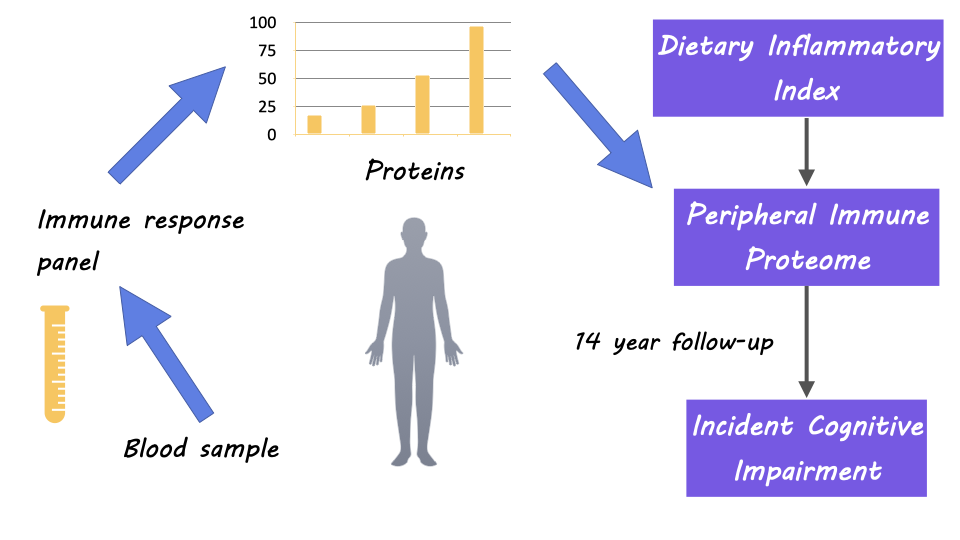
The authors used a subset of data from the Women’s Health Initiative Memory Study which includes samples from 1528 women, on average aged 71 at the first timepoint. At the first timepoint, researchers surveyed participants about their diet, collected blood samples to assess markers of inflammation, and performed assessments of cognition. Each annual follow-up included cognitive assessments as well. Using a pre-defined tool known as the Dietary Inflammatory Index, the authors placed each diet on a continuum from “anti-inflammatory” (e.g. tomatoes, fruits, nuts) to “pro-inflammatory” (refined carbohydrates, fried foods). 151 inflammatory and immune proteins were assessed in blood samples and included for analysis. Cognition was assessed by clinicians, who categorized participants as having “no impairment”, “mild cognitive impairment”, or a “probable dementia.” Importantly, the authors controlled for covariates that could confound the relationship between an inflammatory diet and cognitive decline, such as education. Finally, in separate datasets, the authors validated the association of proteins identified in the first study with a) age to onset of dementia in both sexes and b) brain atrophy measured with magnetic resonance imaging in both sexes in areas related to AD.

What did they find?

First, the authors found in the main sample that a more inflammatory diet at baseline was associated with 55 of the 151 inflammatory proteins in blood samples, including, for example, proteins involved in pro-inflammatory signaling (interleukin-6), and regulation of phagocytosis. They also found associations between an inflammatory diet and genes regulating inflammatory responses and responses to pro-inflammatory signals. Of the proteins associated with an inflammatory diet, the authors found 6 proteins were weakly associated with an increased likelihood of future cognitive impairment, with these proteins involved in processes such as gene transcription and immune signaling. In the first validation study, 5 of the 6 proteins had been measured, and all 5 of them were associated with increased risk of dementia and 3 of them were associated with earlier onset of dementia. From the second validation study, the authors found 3 of the 6 proteins were associated with greater brain atrophy in regions associated with AD-related dementia, and all 3 were also associated with increased rates of dementia in the first validation study.

What's the impact?

This study found a set of proteins that were associated with an inflammatory diet, a subset of which were also associated with cognitive impairment, the risk for AD, and AD-related brain atrophy. The genes that regulate these proteins could become possible therapeutic targets for AD treatments. An anti-inflammatory diet could also provide a protective effect for high-risk individuals, although further research is needed to confirm this.

Access the original scientific publication here.