
Microbiota-Induced Immune Activation Promotes Sensory Neuron Regeneration

Post by Leanna Kalinowski

The takeaway

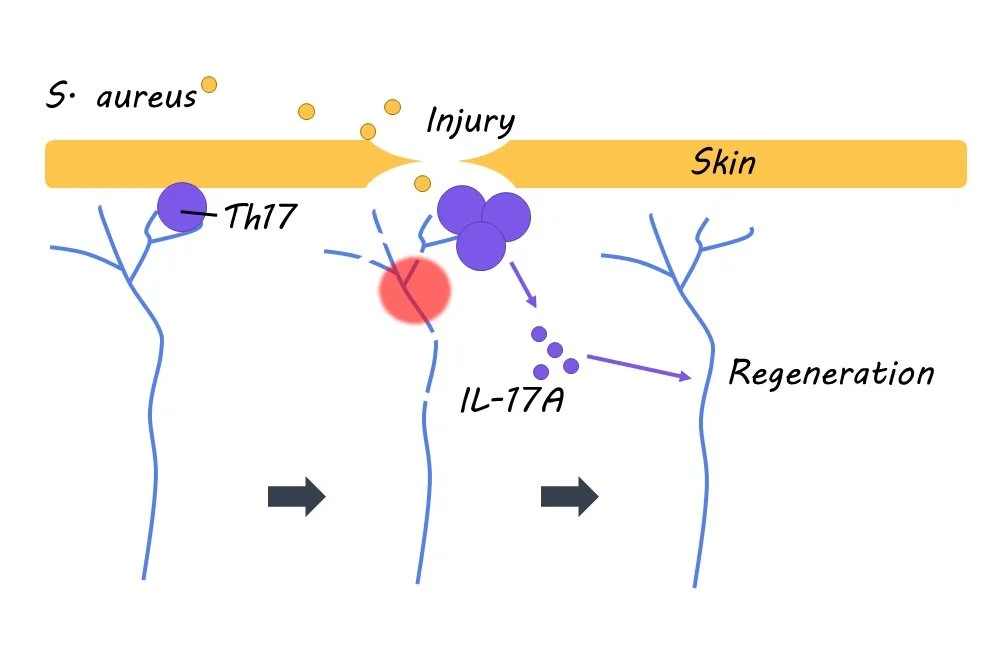
Our skin microbiota, such as the bacteria Staphylococcus aureus, produce an accumulation of immune cells that accelerate sensory neuron regeneration following skin injury.

What's the science?

Barrier tissues, such as our skin, play an important role in both nervous and immune system functions. Our skin contains sensory nerve fibers that are involved in touch, pain, and temperature perception, along with being home to many bacteria, fungi, and viruses that compose the skin microbiota. Following infection or injury, it is important for rapid immune system activation to protect and restore all tissue components, including the sensory nerves. However, the exact role that the microbiota plays in activating the immune system for sensory nerve regeneration is unknown. This week in Cell, Enamorado and colleagues explored the role of microbiota-induced immune activation in sensory neuron regeneration following skin injury.

How did they do it?

The researchers first studied the relationship between the microbiota, immune system, and sensory neuron regeneration during homeostasis (i.e., when there was no skin injury). First, mice received either a topical application or intradermal injection of Staphylococcus aureus (S. aureus) bacteria, which is a microbiota that is commonly found on human skin. When S. aureus is applied topically, it produces an accumulation of T helper 17 cells (Th17) that help produce interleukin 17 (IL-17) and boost future immune system response. On the other hand, when S. aureus is injected intradermally, it causes a pathogenic effect that produces T helper 1 cells (Th1) that actively fight against infection. Following the administration of S. aureus, Th17, and Th1 cells were then collected and sequenced using RNA-seq. Next, to visualize where T cells were located relative to sensory neurons, the researchers topically applied S. aureus to mice engineered for sensory neuron visualization and imaged them using two-photon microscopy.

To test whether S. aureus-induced T cells could contribute to sensory nerve regeneration, the researchers deployed a model of skin injury that causes axonal damage. Mice that previously received topical administration of S. aureus had a small piece of ear skin removed with a small punch biopsy, after which the injury site was imaged under a microscope to visualize Th17 cells.

Finally, the researchers attempted to uncover the immune mechanism that underlies the relationship between the microbiota (i.e., S. aureus) and neuronal regeneration. First, they again deployed the above model of skin injury, this time in mice engineered to block the IL-17a response, after which the injury site was imaged under a microscope to visualize Th17 cells. Then, they isolated sensory neurons in vitro (i.e., in a petri dish), treated them with IL-17A, and sequenced them using RNA-seq.

What did they find?

From the first set of experiments, the researchers found several relevant genes that were upregulated in Th17 cells (i.e., from topical S. aureus) compared to Th1 (i.e., from injected S. aureus) cells. Most notably, several of these genes are responsible for tissue repair (e.g., Tgfb1, Vegfa, Pdgfb, Furin, Mmp10, and Areg), while others are responsible for neuronal interaction and regeneration (e.g., Neu3, Lif, Marveld1, Ramp1, Ramp3, Ccr4, and Tnfsf8). Further, the researchers also found a significant accumulation of Th17 cells that were located close to sensory neurons within the skin. Together, this shows that S. aureus leads to an accumulation of Th17 cells, located in close proximity to sensory neurons, with upregulated genes that are responsible for neuronal regeneration.

From the second experiment, the researchers found that mice who received topical S. aureus had an increased number of Th17 cells accumulating near the injury site compared to controls. This was associated with an increased area and volume of nerve fibers surrounding the injury site, suggesting that the immune response to topical S. aureus enhances neuronal regeneration.

From the final set of experiments, the researchers first found that topical S. aureus does not accelerate neuron regeneration in mice with a blocked IL-17a response. Further, they found that genes implicated in neuronal maintenance, response, and function were unregulated in isolated sensory neurons treated with IL-17A. Together, this suggests a crucial role for IL-17A in promoting sensory neuron regeneration.
What's the impact?

Results from this study show that immunity from the microbiota that live on our skin (e.g., S. aureus) can rapidly jump-start a response to tissue damage by promoting the repair of sensory neurons - an effect that is mediated by IL-17A. Further exploring these relationships may help pave the way for future therapeutic approaches to facilitating sensory neuronal recovery after a skin injury, such as psoriasis.

Access the original scientific publication here.

How Does Nature Benefit the Brain?

Post by Lani Cupo

Why is nature “good” for you?

Many people around the world have the intuition that spending time outside, especially in nature, is good for you. There is evidence to support that this is indeed true - research studies provide a wealth of data linking exposure to the natural environment with improved health outcomes. For example, in a recent systematic review, the authors found that exposure to nature promoted social behavior and physical activity, reduced stress levels and heart rate, and reduced exposure to traffic-induced air pollution. These beneficial relationships were reported in about 70% of papers, while a vast minority (~3%) reported negative effects. Exposure to green space during childhood has further been associated with decreased levels of psychiatric disorders later in life, including mood disorders. Other research shows that nature can have an effect on brain development as well - it has been shown that lifetime exposure to green space is associated with increased gray matter volume in the prefrontal cortex. 

One factor that could potentially explain how some of these studies arrived at different conclusions is that “natural spaces” themselves differ. Researchers often measure exposure to natural environments as exposure to “green space” in urban environments. While the word “nature” may conjure images of sweeping mountain landscapes or the wild seashore, 55% of people worldwide lived in cities as of 2018, and in 2050, 68% of the projected 9.7 billion people are expected to live in urban areas. Therefore, urban green space must be considered a significant opportunity for nature exposure in the increasingly urbanized world. Urban green space is defined by the United States Environmental Protection Agency (EPA) as the “land that is partly or completely covered with grass, trees, shrubs, or other vegetation” which can include “parks, community gardens, and cemeteries.”. In the previously mentioned systematic review, some studies included only farmland or forests, while others examined parks as well. Even restricting comparisons to those examining urban parks, for example, might yield drastic differences, as parks differ on important characteristics, such as the biodiversity of flora and fauna they sustain. One recent paper examining urban biodiversity from 15 parks in Portland, Oregon found significant differences in species richness and biodiversity indices based on the purpose of the park (whether they were geared more towards formal recreation, such as sports, or passive use, such as walking). Factors such as the shape and size of a park, as well as distance to water and connectivity to other green spaces, can also impact biodiversity. These differences could contribute to the mixed results found in studies that synthesize multiple experiments. But why would greater biodiversity improve human health?

How does urban biodiversity relate to mental health?

A multitude of factors could contribute to associations between exposure to green space and improved mental and neurological health. In recent years, however, one set of hypotheses has risen in prominence. As humans evolved, a subset of microbes developed symbiotic relationships with us, inhabiting our bodies (think intestinal tract and skin) and priming our immune system to respond to external threats. The “old friends” hypothesis explains that some microbes co-evolved with the human immune system to establish a defense system against invading microbes. The relationship between the human gut microbiome and the brain was explored in a previous BrainPost by Elisa Guma. As the world undergoes increasing urbanization and the biodiversity of flora and fauna decreases, the beneficial microbes we are exposed to suffer as well. The “biodiversity hypothesis” holds that reduced exposure to the diverse “old friends” we evolved with can increase inflammation, contributing to the myriad diseases that are increasing globally, such as asthma, obesity, allergies, and autoimmune disorders. Additionally, inflammation has been implicated in many psychiatric disorders as well, such as depression, schizophrenia, bipolar disorder, and chronic stress. This relationship may be bi-directional (chronic inflammation can contribute to psychiatric disorders which may, in turn, increase chronic inflammation through lifestyle factors), however, a healthy microbiome can reduce chronic inflammation.

What evidence is there for the Biodiversity Hypothesis?

Evidence from humans and the laboratory supports the link between exposure to a biodiverse environment and a rich gut microbiome. Many human studies are observational, finding differences in microbiomes across gradients of rural-urban, industrialization, and land use. However, with all observational studies, there can be confounding factors, such as socioeconomic status (SES) that could also impact the microbiome. Intervention-based studies can increase experimenter control. For example, one study in Finland introduced forest floor and sod into four urban daycares for children to play with. After 28 days, the authors compared skin and gut bacteria as well as markers of inflammation in the blood between children in these daycares with those from three urban daycares without intervention and three nature-centered daycares. The authors found increased diversity of bacteria on the skin and in the gut of the intervention daycares, comparable to those in nature-centered daycares. This study provided the first interventional evidence in humans supporting the biodiversity hypothesis. Animal models suggest that even exposure to a diverse “aerobiome”, or airborne microbiome, can improve gut microbiome and potentially reduce anxiety-like behavior: Using fans, the authors exposed mouse cages to dust from either a no-soil control, a low diversity soil, or a high-diversity soil. Importantly, the mice did not directly interact with the soil but were exposed to low levels of dust, as might occur if someone commutes through green space to and from work. The authors found exposure to high-biodiversity soil increased the diversity of the gut microbiome and reduced anxiety-like behavior in the most stressed mice. Together, this evidence provides strong support for the biodiversity hypothesis as a means of associating external biodiversity and mental health.

What else mediates the relationship between nature and health?

While the biodiversity hypothesis presents a compelling, interdisciplinary approach linking human and environmental health, there are other important factors linking the two. The human microbiome itself is also influenced by factors like delivery method at birth (natural delivery or Cesarean section), diet, antibiotic use, and age. Diet and access to green space are heavily influenced by socioeconomic status as well. Furthermore, the quality of green space depends on land use and pollutants, which can differ based on a neighborhood’s community SES. There is some evidence to suggest the most economically disadvantaged might benefit the most from exposure to biodiverse natural environments. More intervention-based research in humans could help further develop evidence for the impact of biodiversity and provide recommendations for public policy.

In addition to exposure to a diverse microbiome, exposure to green space can benefit people in a number of other ways. For example, those who access green spaces may spend more time physically active, or socializing with community members and friends, which can improve mental health outcomes as well. Since these factors can work together, it is important not to over-simplify the effects of environmental exposures to the microbiome alone. Therefore, public policy should focus on an integrative approach to human health, intrinsically linked to our environment. 

References +

Hajat A, Diez-Roux AV, Adar SD, Auchincloss AH, Lovasi GS, O’Neill MS, et al. Air pollution and individual and neighborhood socioeconomic status: evidence from the Multi-Ethnic Study of Atherosclerosis (MESA). Environ Health Perspect. 2013;121: 1325–1333.

Roslund MI, Puhakka R, Grönroos M, Nurminen N, Oikarinen S, Gazali AM, et al. Biodiversity intervention enhances immune regulation and health-associated commensal microbiota among daycare children. Sci Adv. 2020;6. doi:10.1126/sciadv.aba2578

Browne HP, Neville BA, Forster SC, Lawley TD. Transmission of the gut microbiota: spreading of health. Nat Rev Microbiol. 2017;15: 531–543.

Bauer ME, Teixeira AL. Inflammation in psychiatric disorders: what comes first? Ann N Y Acad Sci. 2019;1437: 57–67.

von Hertzen L, Hanski I, Haahtela T. Natural immunity. Biodiversity loss and inflammatory diseases are two global megatrends that might be related. EMBO Rep. 2011;12: 1089–1093.

Stanhope J, Breed M, Weinstein P. Biodiversity, Microbiomes, and Human Health. In: Rook GAW, Lowry CA, editors. Evolution, Biodiversity and a Reassessment of the Hygiene Hypothesis. Cham: Springer International Publishing; 2022. pp. 67–104.

Engemann K, Pedersen CB, Arge L, Tsirogiannis C, Mortensen PB, Svenning J-C. Residential green space in childhood is associated with lower risk of psychiatric disorders from adolescence into adulthood. Proc Natl Acad Sci U S A. 2019;116: 5188–5193.

Beninde J, Veith M, Hochkirch A. Biodiversity in cities needs space: a meta-analysis of factors determining intra-urban biodiversity variation. Ecol Lett. 2015;18: 581–592.

Talal ML, Santelmann MV. Plant Community Composition and Biodiversity Patterns in Urban Parks of Portland, Oregon. Frontiers in Ecology and Evolution. 2019;7. doi:10.3389/fevo.2019.00201

Sun L, Chen J, Li Q, Huang D. Dramatic uneven urbanization of large cities throughout the world in recent decades. Nat Commun. 2020;11: 5366.

Epa US, REG. Green Streets and Community Open Space. 2015 [cited 25 Jan 2023]. Available: https://www.epa.gov/G3/green-streets-and-community-open-space

Dadvand P, Nieuwenhuijsen M. Green Space and Health. In: Nieuwenhuijsen M, Khreis H, editors. Integrating Human Health into Urban and Transport Planning: A Framework. Cham: Springer International Publishing; 2019. pp. 409–423.

Lai H, Flies EJ, Weinstein P, Woodward A. The impact of green space and biodiversity on health. Front Ecol Environ. 2019;17: 383–390.

The Link Between Viral Infections and Neurodegenerative Disease

Post by Megan McCullough

The takeaway

In a broad study of biobank health data, 45 different kinds of viral exposures were linked to the development of neurodegenerative disease. This builds on previous research that has linked viral infections with neurodegeneration.

What's the science?

Recent studies have linked an increased risk of developing multiple sclerosis with prior infection of the Epstein-Barr virus. The results of these studies linking viral infection with neurodegenerative disease (NDD), combined with current concerns about the long-term impacts of COVID-19 on cognition, have increased attention and funding towards this area of research. Although previous research has suggested a link between virus infections and the development of a neurodegenerative disease later in life, there are limited longitudinal data on the relationship between the timing of a viral diagnosis and the risk of developing NDD. This week in Neuron, Webb and colleagues aimed to investigate potential associations between viral exposures and developing a common NDD using open-source biobank data.

How did they do it?

The authors utilized health data from over 400,000 individuals from FinnGenn, a Finnish biobank, and from the UK biobank. The FinnGen cohort was used as the discovery set and the UK biobank data was used as the replication set. The authors combed through this dataset searching for individuals who had a diagnosis of either Alzheimer’s disease, ALS, dementia, vascular dementia, Parkinson's disease, or multiple sclerosis. The authors then checked if these individuals ever had a viral infection that had caused them to be hospitalized. Once the associations between NDD and a viral infection had been recorded from this dataset, the authors then searched the UK biobank for the same parameters. An example of an association is an individual diagnosed with Alzheimer's who also was hospitalized for viral encephalitis.

What did they find?

The authors found 45 associations of viral exposures with the development of an NDD in the FinnGenn biobank, with 22 of those associations also being found in the UK biobank. All viruses were associated with an increased risk of developing an NDD, and none showed a protective effect against NDD. Influenza and pneumonia were associated with five of the six neurodegenerative diseases, suggesting the risk of NDD increased after a severe case of those common infections. When associations were checked at different time points (between <1 and 15 years), many associations remained significant for up to 15 years (meaning, risk of an NDD was elevated for up to 15 years post-virus exposure). In general, however, there was a tendency for associations to be highest at the <1 year mark.

What's the impact?

This study is the first systematic investigation of the association between viruses and multiple neurodegenerative disorders. This research provides further evidence of the link between a serious viral infection and developing neurological problems later in life. Since many of the viruses included in this study have vaccinations that are known to reduce hospitalization rates of those infected, vaccinations may lessen the risk of developing neurodegenerative diseases.

Access the original scientific publication here