Does the Placebo Effect Work When You Know It’s a Placebo?

Post by Christopher Chen

The takeaway

Placebos can provide emotional and physiological benefits, but their use raises ethical questions due to the use of deception. New evidence suggests off-label placebos (OLPs) which do not rely on deception, may also have positive health benefits.

What's the science?

Placebos are a form of patient treatment that have no inherent therapeutic value (e.g., sugar pills, saline injection). However, studies time and time again have validated a “placebo effect,” where people who take placebos may still undergo physiological changes that enhance overall health. For example, functional brain imaging reveals placebos can modulate brain circuits associated with emotional regulation and pain, resulting in a painkilling effect. However, ethical concerns surround the use of traditional placebos because they are given to patients who believe the placebo has therapeutic value. To avoid this, researchers have turned to the use of open-label placebos (OLPs), or placebos that patients know have no therapeutic value. Recent studies show patients taking OLPs report symptomatic relief from maladies like depression, anxiety, and irritable bowel syndrome. However, whether OLPs elicit neurological changes like conventional placebos remains unclear. In a recent article in Neuropsychopharmacology, Schaefer et al. reveal that people taking OLPs exhibited enhanced activity in regions associated with emotional regulation and pain, suggesting OLPs do elicit neurological changes even when people know they are placebos.

How did they do it?

Researchers ran two experiments: one tested the effects of OLPs on participant mood and the other tested OLP effects on brain activity. In the first experiment, participants were divided into two groups. One group was told a nasal spray they were taking was an OLP and potentially had health benefits, while the other group was told the nasal spray was a necessary part of the experiment. Following the administration of the nasal spray, both groups went through the same visual task of ranking a series of pictures depicting neutral images or images designed to elicit strong negative feelings. Following the presentation of each picture, participants described their emotional state. The second experiment played out similar to the first, but participants were instead shown the images while inside an MRI (magnetic resonance imaging) machine undergoing an fMRI protocol designed to gauge blood flow as a measure of brain activity. In this experiment, the description of emotional state was given after the MRI portion was complete.

What did they find?

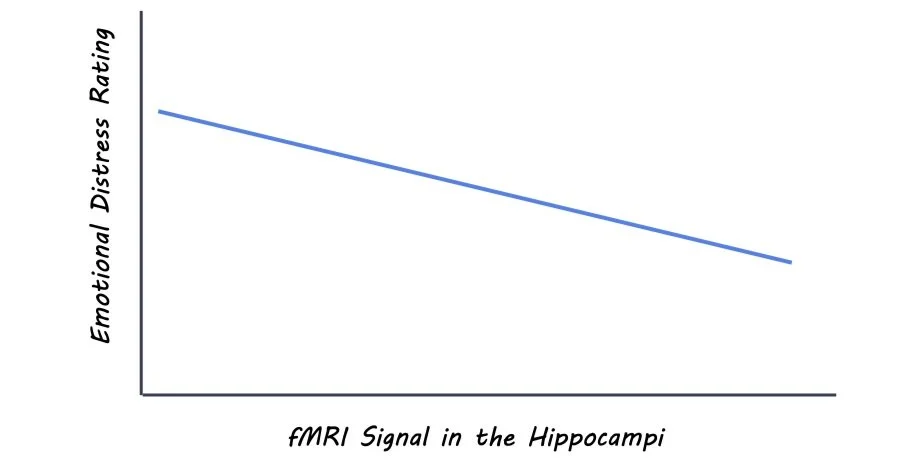
In the first experiment, researchers found that participants from both groups responded similarly to the neutral images, but that participants who were told of the health benefits of OLPs reacted less strongly to the emotional images, suggesting placebos can still help people emotionally regulate even when they know it is a placebo. The second experiment went a step further, showing that the OLP group had greater activation in two regions also known to be activated by traditional placebos, the periaqueductal gray (PAG) and anterior cingulate cortex (ACC). Interestingly, there were two additional key differences in the neural signature of OLPs: 1) activation in the hippocampus, a brain region not known to be activated by normal placebos, and 2) no activation in the prefrontal cortex, a region known to be activated in normal placebos.
What's the impact?

The present study reveals that OLPs elicit activation patterns in the brain that are distinct from patterns associated with traditional placebos. The authors suggest that the lack of PFC activation in OLP treatments may indicate that the PFC is somehow linked to brain processing of deception. The activation of the hippocampus in OLP treatment but not conventional placebo treatments may also indicate how removing deception from the placebo effect may activate more hippocampal-driven processing of emotion and pain. While more research is needed to further validate these findings, this work suggests that the placebo effect holds, even when we know it’s a placebo.
Decoding Hippocampal Activity in Spatial Learning

Post by Elisa Guma

The takeaway

Animals need to learn how to find food, water, or other rewarding stimuli in their environment. To learn how to navigate to these rewards, the CA1 region of the hippocampus uses a common learning algorithm by which synchronized activity activates reinforcement learning in both navigational and non-navigational contexts.

What's the science?

Neural activity in the dorsal CA1 region of the hippocampus is critical for our ability to successfully navigate through space, but also for creating cognitive maps of our environment. These neurons are active during navigation, but they also show bursts of brief synchronous activity in non-navigational contexts (e.g., while animals are at rest or asleep), which may reflect memory recall or consolidation, and may suggest a common algorithm for coding reward in both navigational and non-navigational contexts. This week in Nature Neuroscience, Jiang and colleagues investigate the role of the hippocampus in a navigational and non-navigational foraging task by imaging neural activity in the CA1 region of the mouse hippocampus, while they perform these tasks.

How did they do it?

The authors trained mice in either a navigational or non-navigational spatial foraging task while recording neural activity of the dorsal hippocampal CA1 neurons.  Mice expressing a fluorescent calcium sensory (CGamp6f) - which fluoresces in the presence of calcium, a proxy for neural activity - were mounted with a miniscope over the dorsal hippocampus, which allowed the authors to record cell activity (fluorescence) during each task

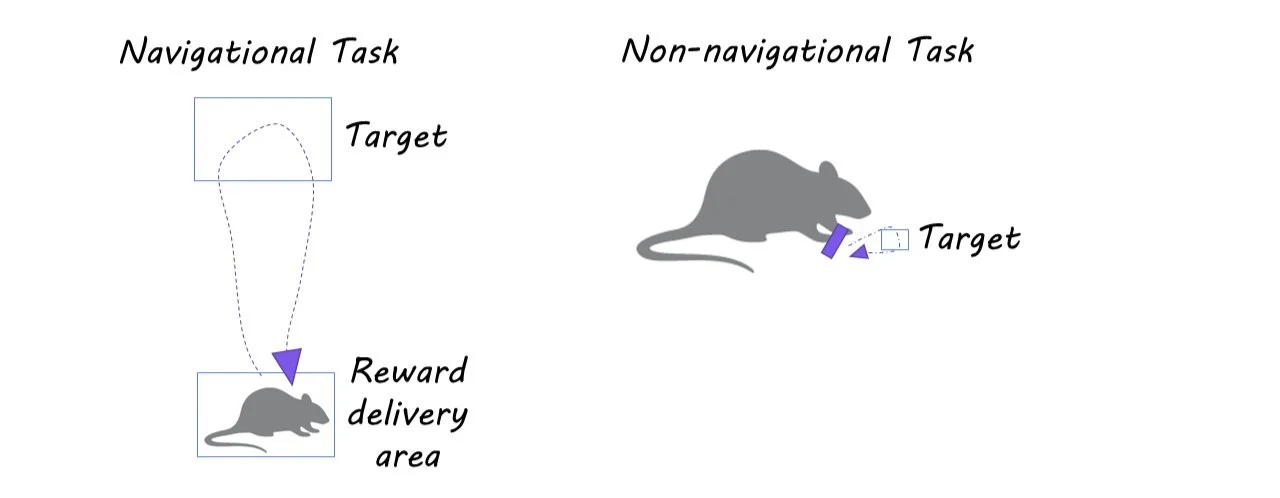
The navigational task required freely moving mice to run to an unmarked target location within a few centimeters of a reward collection area. In the non-navigational task, head-fixed mice had to displace a spring-loaded joystick from a center position to a target distance. In both tasks, reward delivery was dissociated via movement into the target location. In the navigational task, this was accomplished by delivering the reward via a water port at a specific home location (20 cm away from the target location). In the non-navigational task, this was achieved by delivering the water reward with a 1-second delay after movement to the target area.

They examined cell activity during each of the foraging tasks and asked whether responses of individual dorsal CA1 neurons aligned to movements triggered by the water reward. To determine whether patterns of neural activity in the dorsal CA1 region of the hippocampus could predict behaviour, they trained a continuous-time linear decoder (machine learning model) to examine whether movement trajectories could be decoded in both tasks.

The authors identified a specific population of neurons that were synchronously active during non-movement portions of the task, so they wanted to investigate their role in task performance. To test their causal role in consolidating learning in the navigational and non-navigational tasks, the authors used optogenetics to inhibit neural activity in the dorsal CA1 region, at precisely the time that the synchronous population events were observed. A disruption of learning behaviour in response to this manipulation would indicate that the synchronous firing of those neurons was critical for this type of learning.

What did they find?

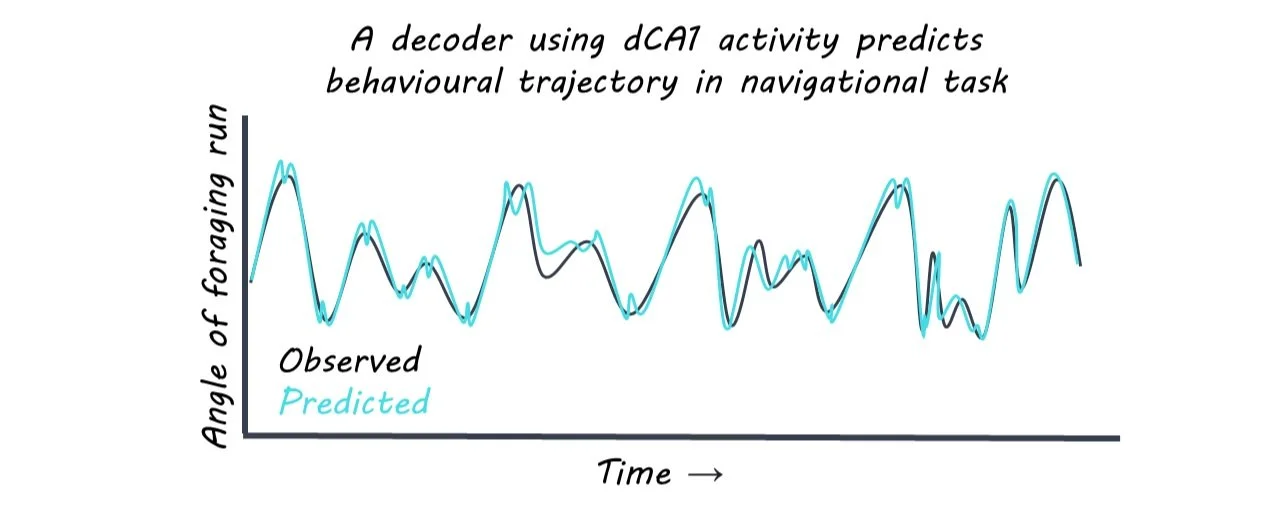
Using the head-mounted miniscope to measure neural activity in the dorsal CA1, the authors were able to detect place field activity in the dorsal CA1 cells along the foraging trajectories, as expected. In both the freely moving and the head fixed tasks, they found that the reliability of activity was high during movement and low during the inter-trial periods. The neural decoder they had trained was successfully able to predict the foraging trajectory of mice based on the activity of the dorsal hippocampus in the freely moving navigational task. However, in the head-fixed task, it was not able to decode forelimb activity based on CA1 activity, suggesting that these cells may be creating a spatial map of reward locations, not possible in the head-fixed task.

In addition to the cell activity observed during the movement portion of the task, the authors identified a subset of neurons that were synchronously active in the absence of movement. In the freely moving navigational foraging task, these events were observed at the end of a foraging run as the mouse approached the reward collection area, and they were more correlated with correct vs. incorrect attempts (although not significantly so). In contrast, in the non-navigational head-fixed task, these synchronous population events were occurring at the initiation of a trial, and they were highly correlated with the quality of task performance in that trial.

Inactivation of dorsal CA1 cells using optogenetics during the navigation tasks did not interfere with the behaviours. However, if the cells were inactivated during the time at which the synchronous population events were observed (i.e., at the end of the navigational task), trial performance was decreased. In contrast, in the non-navigational task, inactivation with optogenetics substantially reduced the probability of initiating a joystick movement, but if mice were indeed able to initiate movement, they were still capable of making coordinated movements of the joystick to trigger reward. This suggests that these circuits may be more important for navigational learning.

What's the impact?

This study provides evidence for different mechanisms by which the dorsal CA1 region of the hippocampus regulates reinforcement learning in navigational and non-navigational contexts.  Activation of synchronous bursts of activity in this region thought to underlie cognitive processing, was associated with successful trial completion if they occurred at the end of the navigational task and at the beginning of the non-navigational task. Interestingly, inactivation of the dorsal hippocampus at the end of a navigational task impaired reinforcement-dependent learning but did not have the same effects in the non-navigational task. This study provides a computational approach to better understand the neural mechanisms underlying spatial navigation and foraging behaviours.

Access the original scientific publication here.

Advancing Our Understanding of Attention

 Post by Megan McCullough

The takeaway

Maps of brain networks involved in attention in humans, generated from functional connectivity analysis, show that subcortical brain structures are essential to both the dorsal attention network and the ventral attention network. This furthers our understanding of the neural correlates of attention, as previous research has mostly focused on the role of the cortex in attention.

What's the science?

Attention — the cognitive task that involves the selection of relevant information for processing — is marked by two distinct attentional networks, the dorsal attention network (DAN) and the ventral attention network (VAN). The DAN is involved in the top-down voluntary orientation to stimuli while the VAN is involved when attention is involuntarily oriented to stimuli. Previous research has focused on these regions in the context of the cortex, but recent electrical recording research, behavioral observations, and animal research have shown the crucial role of subcortical structures in the neural workings of attention. This week in Communications Biology, Alves and colleagues examined the subcortical anatomy of attention networks by aligning functional maps of the DAN and VAN.

How did they do it?

Functional maps of attention networks were drawn from fMRI (functional magnetic resonance imaging) datasets from the Human Connectome Project. The authors utilized resting-state functional analyses to map the subcortical involvement of the DAN and VAN. This technique involves the use of fMRI while the participants are resting in the MRI scanner to generate maps that show the subcortical structures involved in each of the networks. These connectivity maps were then overlayed to examine which subcortical structures were relevant to both networks. The authors then spatially correlated the identified projections with known maps of expression of different receptors and transporters within the brain. This co-mapping of functional and structural data with neurochemical data was done to understand the neural correlates of attention more deeply.

What did they find?

The authors found that subcortical structures such as the pulvinar, superior colliculi, the head of the caudate nucleus, and a group of brainstem nuclei are involved with both attention networks. When the neurochemical data was examined, the authors found that projections in the brainstem nuclei were correlated spatially with acetylcholine nicotinic receptors, serotonin receptors, and dopamine receptors. This builds on previous research that has linked nicotinic receptors with attention. The authors also found that VAN and DAN structural connectivity maps were specific to the right side of the brain.

What's the impact?

This study found that subcortical structures and connectivity are essential in attentional processes. This research builds on previous work that has mostly focused on attention in the context of the cortex. With a stronger model of the VAN and DAN, further research can expand on attention both across species and across brain pathologies. 

 Access the original scientific publication here