
The “Replication Crisis” in Neuroscience: What's the Path Forward?

Post by Lani Cupo

What is replication?

Replication in science is when a second researcher attempts to recreate a previous experiment and find the same result. Over the past several decades researchers in psychology have increasingly found that they are unable to reproduce expected results from many prior experiments. Of course, no study is exactly the same, with different environments, researchers, participants, or equipment, and some variation in results is expected. Nevertheless, a strong effect should be able to be replicated even with differences in experimental conditions. As researchers across fields began to attempt to replicate accepted effects in their fields, it became apparent that psychologists were not the only scientists impacted by the replication crisis.

Is there a replication crisis in neuroscience?

Replication concerns have been documented in many fields of study, including neuroscience. Neuroscience is a broad discipline, investigating everything from single cells in organisms to complex computational models and simulations informed by enormous human datasets. Two neuroscience subfields that have most seriously emphasized reproducibility issues are clinical and computational neuroscience. Replication issues have also been documented in cognitive neuroscience. In fact, some scientific reviews have expressed concerns that “storytelling” or accepting results in line with the literature occur more often than rigorous hypothesis testing.

In clinical research, the replication crisis is especially concerning because the results of these studies can be used to design treatments that may end up being costly, ineffective, and contribute to the high failure rates observed in clinical trials (~90%). Regardless of subfield, the consequences of replication issues are high because they reduce confidence in scientific findings and the scientific process. For example, one study found that in the United States, trust in scientists was lower than in the military in 2016. The peer review process is intended to help identify quality, reliable research. However the fact that studies are sometimes published and later found to be irreproducible indicates that even experts in their own fields could lack all the information necessary to accurately determine which studies are reliable.

Why is there a replication crisis?

Several factors have been identified that potentially contribute to the replication crisis, however, they are still largely debated. These factors are related to all stages of the research process including innate variability in the data, protocol documentation, hypothesis design, and statistical analyses. Variable data are typically anticipated, and researchers leverage the power of inferential statistics. Not all statistical tests are appropriate for every data set, however. The assumptions underlying statistical tests (for example, many statistical tests assume normally distributed data) are often violated, leading scientists to incorrectly interpret data. For example, in situations where researchers should conclude there are no significant differences (null results), they may conclude they are statistically different (false positives). 

The “file-drawer problem”, a term coined in 1979, describes that positive results are more likely to be published than null findings, either because researchers are less likely to submit null results, or because high-impact journals are less likely to publish them. This is an important problem the scientific community is facing since awareness of null findings provides a fuller picture of the current consensus around a particular research topic. This is also related to the “publish or perish” mentality of scientific publishing, where there is immense pressure to publish in high-impact scientific journals for career progression, leading scientists to prioritize publishing over taking the time to get things right, or publishing less exciting or “high impact” findings.

Another issue in replication is the concept of multiple comparisons. Statistical tests, such as t-tests or linear models are often interpreted using an arbitrary cutoff for levels of significance (generally p < 0.05). As the number of tests performed increases (like including additional covariates, testing several regions of interest, multiple brain parcellations, or areas of the brain tested, etc.), the likelihood of false positives increases. Several techniques are used to correct for multiple comparisons (i.e., Bonferroni correction or False Discovery Rate), and for the most reliable results, researchers often must correct for having performed multiple comparisons.

Commonly-used statistical tests were originally designed to test specific hypotheses, such as whether independent variable x (e.g., age) impacts dependent variable y (e.g., total brain volume). Most modern neuroscience studies are several orders of magnitude more complex, and it can be difficult to formulate coherent, accurate interpretations of complex datasets. As a result, more “exploratory” studies, which are not hypothesis-driven, but rather hypothesis-generating are published. Exploratory studies can lead to unexpected, and valuable findings. However, exploratory research needs to be interpreted with caution, and any new hypotheses that are generated from this type of research need to be followed up with to confirm whether they have any merit. Finally, accurate, comprehensive protocols, descriptions of methods, and code are often omitted from publications. Following the methods section of a paper (or perhaps the supplementary methods), a researcher should be able to recreate the experiment exactly using step-by-step methods published by the authors. When this detail is missing, it’s difficult to follow precisely the same experimental procedures for replication.

What can we do about it?

There have been a number of proposed approaches to increase the reproducibility of scientific research. One approach calls for exploratory analyses to clearly be labeled as such by the publisher and encourages exploratory analyses to be accompanied by a confirmatory (i.e. hypothesis-driven) analysis.

Some studies lean heavily into the value of clearly defined, falsifiable hypotheses to address the replication crisis. Others have proposed that the replication crisis has been misunderstood, arguing that what is perceived as the replication crisis is actually a failure to understand the base rate of failed replications. The base rate fallacy is well documented in other fields. For example, if a test is 95% accurate at detecting a disease, and someone receives a positive test, the chance that they have the disease is not 95%. First, the base prevalence of the disease must also be taken into account—if it occurs in 1 in 1,000 individuals, the likelihood this person has the disease is less than 2%. Proponents argue that this base rate fallacy can similarly explain the replication crisis. Researchers must first accept that even rigorous quality science produces far more false positives than expected. Further, they may also need to consider requiring experimental results to pass a more rigorous threshold than p < 0.05.

Another important step forward will be the move towards open research, where there is an open sharing of research methods and results. Further, open sharing of datasets, methods, code or experimental protocols used to obtain the research findings will be critical. The more transparency we have into the research methods involved, the greater the likelihood of being able to understand the approach and replicate the results. Further, publishing methods can also help to call out any potential discrepancies between research methodologies and provide a deeper understanding of why some research may not have been replicated.

A greater acceptance and shift in the scientific community towards the publishing of null findings (i.e. no results or a lack of hypothesis confirmation), will also help to prevent publication bias that gains traction when researchers attempt to find results consistent with those already published in their field. One opinion piece proposed that efforts to remedy the replication crisis should focus on field-specific outcomes, rather than a cookie-cutter approach that is applied across disciplines. As more solutions are proposed, there are still steps you, as a neuroscience reader, can look for in published neuroscience papers to increase your confidence in the results:

  • Is the study marked as exploratory? If so, keep an eye out for confirmatory studies. If not, does it have a clear set of hypotheses?

  • Are the methods clearly explained? Is there a supplement that a researcher could follow to recreate the study?

  • If the authors ran many statistical tests, did they correct for multiple comparisons, following best practices for their field?

  • Do the authors make their code openly available?

References +

Bird A. Understanding the Replication Crisis as a Base Rate Fallacy. Br J Philos Sci. 2021;72: 965–993.

Huber DE, Potter KW, Huszar LD. Less “story” and more “reliability” in cognitive neuroscience. Cortex. 2019;113: 347–349.

Peterson D. The replication crisis won’t be solved with broad brushstrokes. In: Nature Publishing Group UK [Internet]. 8 Jun 2021 [cited 27 Nov 2022]. doi:10.1038/d41586-021-01509-7

Sun D, Gao W, Hu H, Zhou S. Why 90% of clinical drug development fails and how to improve it? Acta Pharm Sin B. 2022;12: 3049–3062.

Rajtmajer SM, Errington TM, Hillary FG. How failure to falsify in high-volume science contributes to the replication crisis. Elife. 2022;11. doi:10.7554/eLife.78830

Miłkowski M, Hensel WM, Hohol M. Replicability or reproducibility? On the replication crisis in computational neuroscience and sharing only relevant detail. J Comput Neurosci. 2018;45: 163–172.
Neural Underpinnings of Impaired Inhibitory Control in Individuals with Heroin Use Disorder

Post by Leanna Kalinowski

The takeaway

Researchers have uncovered a key role for the prefrontal cortex in mediating the impacts of heroin use disorder on inhibitory control.

What's the science?

Substance use disorder is a serious mental health condition in which there is uncontrolled use of a drug despite its harmful consequences. One model that proposes the neurological underpinnings of substance use disorders, called the “Impaired Response Inhibition and Salience Attribution Model,” posits that the disruption of two brain functions contributes to the cycle of substance use disorders. In this model, response inhibition (i.e., the ability to control one’s impulses) is decreased in individuals with a substance use disorder, while salience attribution (i.e., an increase in attention toward drug cues) is increased. These behavioral impacts are associated with decreased activity in the prefrontal cortex. While these behavioral and neural impairments in inhibitory control are seen with substance use disorders across all drugs of abuse, they have been underexplored in heroin use disorder. This week in the Journal of Neuroscience, Ceceli and colleagues mapped the neural underpinnings of impaired inhibitory control in heroin use disorder.

How did they do it?

The researchers recruited 65 participants for this study: 41 individuals with a heroin use disorder (iHUD) and 24 age- and sex-matched controls. After completing a battery of clinical diagnostic tests to measure the severity of their heroin use disorder, participants underwent a test of inhibitory control called the stop-signal task.

The stop-signal task was divided into two types of trials: “go trials” and “stop trials”. During “go trials”, which comprised 75% of the task, participants were shown a white arrow on a computer screen and were instructed to indicate its direction (right or left) as quickly as possible. During “stop trials”, which comprised the remaining 25% of the task, participants were asked to stop themselves from responding when the white arrow turned to red. The length of time that it took for the arrow to change from white to red, called the “stop-signal delay”, was initially set to 200 ms and was subsequently adjusted based on the participant’s performance. If the participant successfully stopped their response, the next stop-signal delay was increased by 50 ms, which made the next trial more difficult. Conversely, if the participant did not successfully stop their response, the next stop-signal delay was decreased by 50 ms, which made the next trial easier. Brain activity was measured during the stop-signal task with functional magnetic resonance imaging (fMRI).

What did they find?

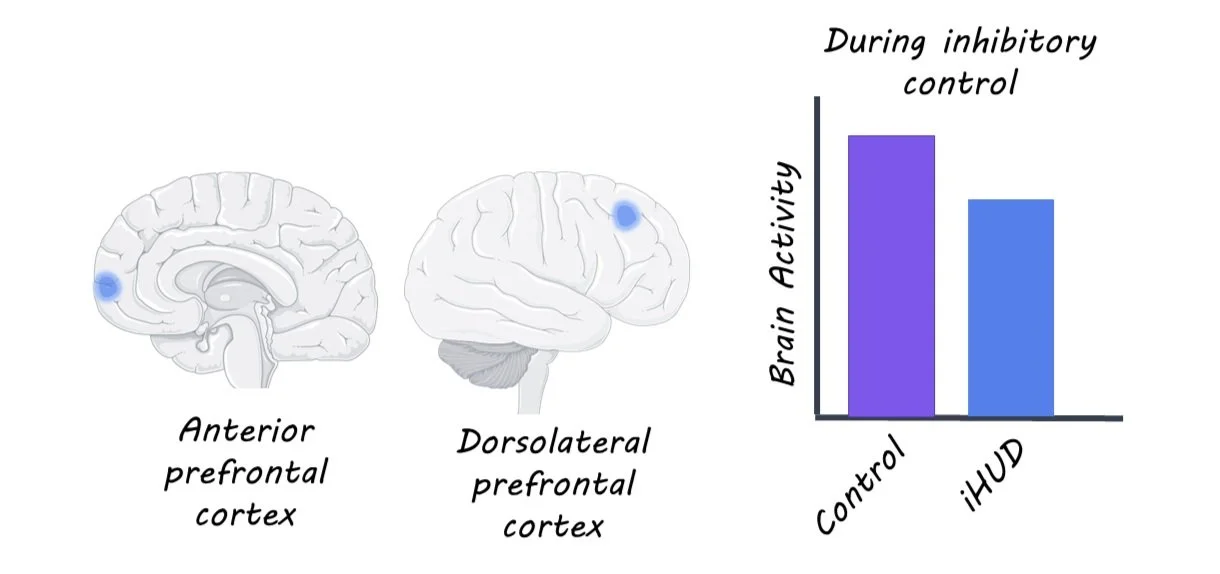
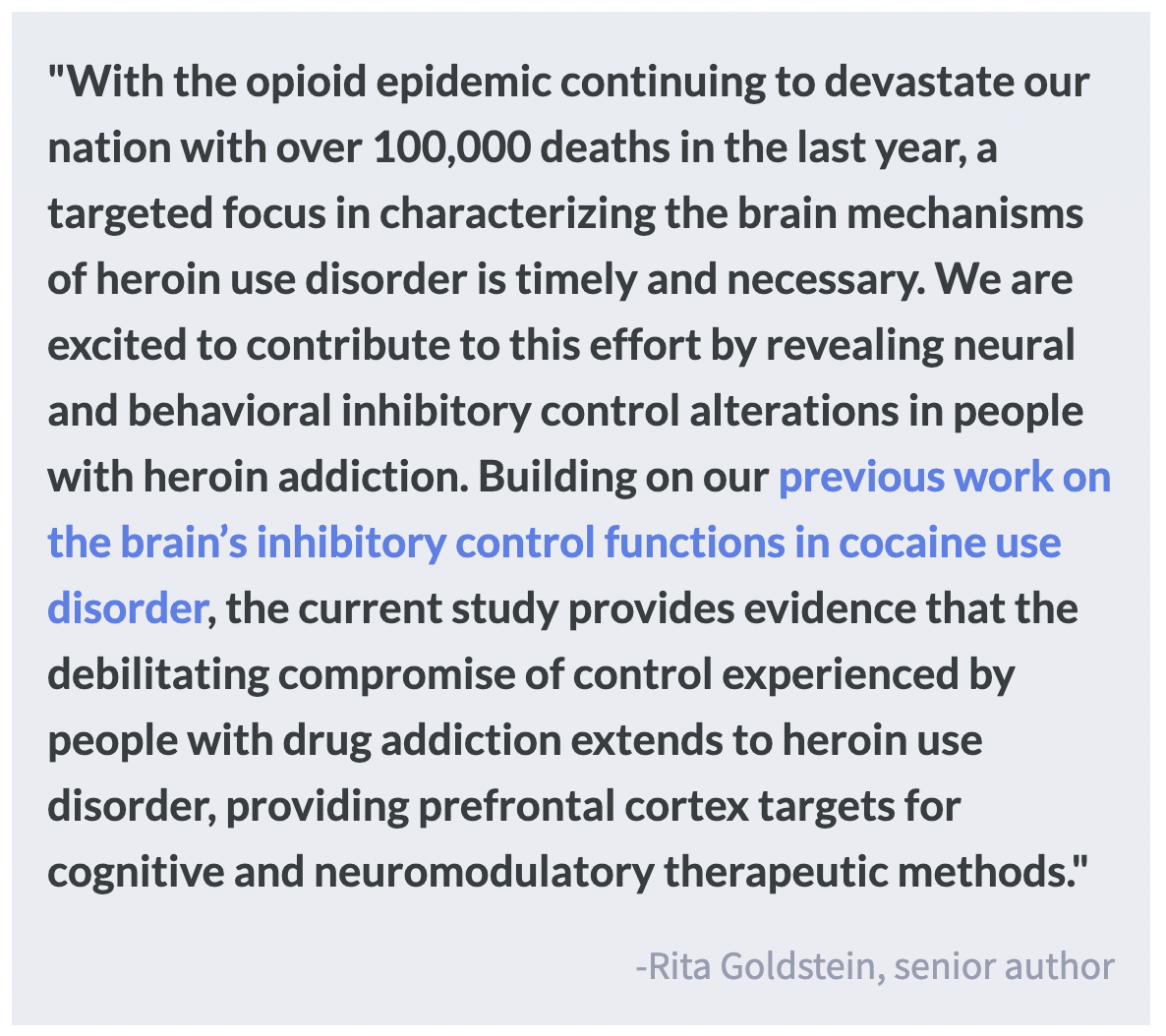
First, the researchers calculated the proportion of responses in “go trials” to false-alarm responses in “stop trials”, and found that iHUD had a significant impairment in distinguishing between the two types of trials. This suggests that iHUD experienced impairment of inhibitory control during this task. Next, the researchers identified several key brain regions that were activated during the task. During inhibitory control, iHUD had lower activity in the anterior and dorsolateral prefrontal cortex, which are key brain regions that regulate cognitive control. This was associated with a higher severity of heroin dependence, suggesting that the behavioral and neurological effects exhibited during inhibitory control are related to heroin use severity.

What's the impact?

Overall, this study uncovered the neurobiological underpinnings of inhibitory control in iHUD, which is the first time that the neurobiology of inhibitory control in heroin use disorder has ever been mapped. Results from this study may help guide future targets for preventing and treating heroin use disorder.

How Mozart is Helping People with Epilepsy

Post by Christopher Chen

The health benefits of music

For thousands of years, music has been used to improve health and well-being. As far back as ancient Greece, records indicate that philosophers/physicians like Hippocrates and Pythagoras extolled the ways playing music to their patients improved the mind and body. In modern times, clinical research has shown that playing music to people with Alzheimer’s disease improves performance on cognitive-based tasks and that pairing music therapy with medication reduces schizophrenic symptoms more than medication alone. 

Using music to help reduce epileptic seizures

Music helps reduce seizure activity in patients with epilepsy. Epilepsy, a brain disorder affecting over 50 million people worldwide, is a brain condition characterized by seizures that if left untreated, can sometimes cause permanent brain damage. Seizures are the result of two events in the brain: 1) high-frequency bursts of action potentials (in neurons), and 2) hypersynchronization of a neuronal population. While most patients with epilepsy can live a normal life with the help of anticonvulsants, roughly 30% have a form of drug-resistant epilepsy. While these patients may eventually find a suitable combination of medications to control seizure activity, music therapy has been used as a non-pharmacological strategy for decades.

However, while studies have shown a range of music types can help reduce seizure activity in epileptics, one song has been shown to have the most robust anticonvulsant effect: Mozart’s K.448 sonata. First reported in 1998, this finding sparked a wave of similar studies across a diverse range of epilepsy types and clinical subjects, with the data largely recapitulating this “Mozart Effect.”

However, using music to help patients with epilepsy is not consistently beneficial. Despite the success of interventions involving the “Mozart Effect”, it is still unclear why it specifically helps reduce seizure activity. And while studies have shown K.448 decreases overall seizure activity, the effect is not universal and in at least one study, there was an increase in seizure activity in ~20% of the patients.  

To further complicate things, there is a rare form of epilepsy called musicogenic epilepsy where musical stimuli actually cause seizures. Though the condition is rare (affecting roughly 1 in 10,000,000 people), seizures in patients with musicogenic epilepsy may follow exposure to specific types of music, a specific type of instrument, or even thinking about music. Studies examining patients with this type of epilepsy indicate there is an emotional component to the seizures, suggesting the seizures may not be directly caused by the music itself but rather in combination with the emotional component associated with it.  

Disentangling music’s role in epilepsy

Researchers are slowly learning more about the biological bases of music’s effects on epileptic seizures. Due in large part to the complex interactions between music and the brain, it has been difficult to determine the science behind music’s effects on epileptic seizures. There has been substantial progress, though, in outlining the basic principles as to why music – and Mozart’s music specifically – can help reduce seizure activity.

Some of the most fascinating findings come from studies comparing Mozart’s music to music from other classical composers. In one study comparing Mozart with music from the German composer Richard Wagner, researchers found that Mozart’s music was more harmonic and repetitive than Wagner’s, suggesting that repetitive and organized structures may have anti-epileptic effects. In a study comparing Mozart and Beethoven, researchers found the brain waves generated by listening to Mozart’s music resembled brain waves from a healthy brain state and were starkly different than the waveforms generated by seizures (Beethoven’s music elicited brain waves more like those found in a seizure state). Thus, listening to Mozart may put the brain in a “healthier” state and protect it against seizures.

Perhaps the most actionable insights come from studies involving dopamine, a neurotransmitter (chemical) in the brain well-known for its role in mood enhancement. Studies have found that several forms of epilepsy have been linked to low dopamine levels in a part of the brain called the striatum. Compellingly, studies have found that in healthy subjects, listening to music induces the release of dopamine into the striatum. Thus, when patients with epilepsy listen to music, this flood of dopamine into the striatum may be helping maintain sufficient levels of dopamine to prevent seizures. 

The future of sound-related strategies to reduce seizure activity in epileptics

The interest in music’s ability to reduce symptoms of epilepsy has led researchers to investigate how other sound-related therapies may reduce seizures in epileptics. One such strategy is using targeted, low-intensity ultrasound. Delivered directly to the scalp, ultrasound treatments have been shown to reduce seizure activity in preclinical and several small, clinical populations. Researchers believe the soundwaves may be altering the physical properties of neurons associated with the seizures, resulting in a reorganized neuronal structure more closely resembling that in a healthy brain. Some drawbacks include overheating of the scalp and the costs associated with the treatment, and the treatment’s efficacy in larger clinical studies remains to be determined.

As for Mozart? His work remains very much involved in current research, with a recent article showing K.448 may be reducing seizure activity in patients via the brain’s higher-order association networks. So even with the introduction of modern anticonvulsant techniques such as ultrasound, epileptics may still benefit from a healthy dose of Mozart.  

References +

Brackney et al. Complementary and Alternative Medicine: The Mozart Effect on Childhood Epilepsy—A Systematic Review. The Journal of School Nursing (2017).

Ferreri et al. Dopamine modulates the reward experiences elicited by music. Proceedings of the National Academy of Sciences (2018).

Fischer et al. Long-Known Music Exposure Effects on Brain Imaging and Cognition in Early-Stage Cognitive Decline: A Pilot Study. Journal of Alzheimer’s Disease (2021).

Hughes et al. The ‘Mozart Effect’ on the Epileptiform Activity. Clinical EEG and Neuroscience (1998).

Jia et al. The effectiveness of adjunct music therapy for patients with schizophrenia: A meta-analysis. Psychiatry Research (2020).

Liang et al. Application of Music Therapy in General Surgical Treatment. BioMed Research International (2021).

Lin et al. Non-invasive ultrasonic neuromodulation of neuronal excitability for treatment of epilepsy. Theranostics (2020).

Maguire, M. Music and epilepsy: A critical review. Epilepsia (2012).

Maguire, M. Wired for sound: The effect of sound on the epileptic brain. Seizure: European Journal of Epilepsy (2022).

Quon et al. Musical components important for the Mozart K448 effect in epilepsy. Scientific Reports (2021).

Rafiee et al. Music in epilepsy: Predicting the effects of the unpredictable. Epilepsy and Behavior (2021).

Stegemann et al. Music Therapy and Other Music-Based Interventions in Pediatric Health Care: An Overview. Medicines (Basel) (2019).