
How Mindfulness-Based Interventions Compare to Escitalopram as a Treatment for Anxiety

Post by Baldomero B. Ramirez Cantu

The takeaway

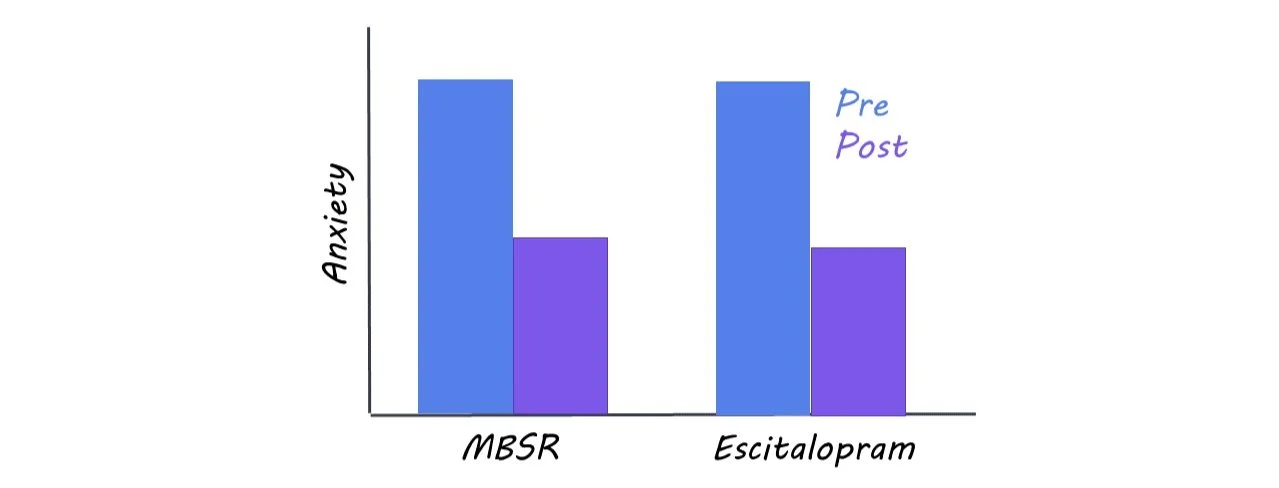
Recently, mindfulness-based practices have become popular as potential treatments for psychiatric disorders. This study shows that a mindfulness-based intervention can be just as effective at reducing anxiety symptom severity as escitalopram, an anti-anxiety drug.

What's the science?

Anxiety disorders are remarkably debilitating and affect millions of individuals around the world. These disorders are complex and patients tend to respond differently to similar treatments. For example, some patients experience significant improvement from pharmacological interventions while others experience no improvement in their anxiety and suffer from debilitating side effects while taking the exact same drug and dosage. Today, it remains unclear what effective alternatives exist for those who are not responsive to drug-based treatments or psychotherapy for anxiety disorders. This week in JAMA Psychiatry, Hoge and colleagues assessed how mindfulness-based stress reduction (MBSR) compared to escitalopram in reducing anxiety symptom severity.

How did they do it?

The authors recruited adult patients diagnosed with generalized anxiety disorder, social anxiety disorder, panic disorder, or agoraphobia for a randomized clinical trial. Eligible patients were invited to attend an in-person evaluation with a physician where their baseline anxiety severity was measured using the CGI-S scale. This scale ranks anxiety severity from not anxious at all (CGI-S = 1) to severely anxious (CGI-S = 7) and was used to measure patient anxiety severity throughout the study. Next, the patients were randomly assigned to either the mindfulness-based (MBSR) or escitalopram intervention groups. 

1) MBSR Intervention: Patients in the MBSR group participated in an 8-week-long protocol consisting of weekly 2.5-hour sessions, a day-long weekend retreat, and daily 45-minute at-home exercises. All activities focused on meditation and mindfulness-based techniques or theory. 2) Escitalopram Intervention: Patients in this group started with 10 mg daily oral doses of escitalopram and in the absence of problematic side effects increased to 20mg daily doses at week two of the protocol. Patients received medication management visits at weeks 1, 2, 4, 6, and 8 of the 8-week protocol.

The authors performed a noninferiority analysis to compare the effects of MBSR versus escitalopram on patient anxiety severity by analyzing the changes in anxiety severity (CGI-S)  relative to baseline anxiety severity levels.

What did they find?

Analysis of patient outcomes after successful completion of the protocol showed that mindfulness-based stress reduction was in fact noninferior to escitalopram. Upon completion of the protocol, the difference between the average reduction in anxiety severity of the MBSR group (Mean CGI-S Reduction = 1.35) and the escitalopram group (Mean CGI-S Reduction = 1.43) was only -0.07 points. This indicates that the difference in the decrease in symptom severity between the two groups was not statistically significant. Individually, however, each treatment did produce a significant reduction in symptoms of anxiety. These results show that both treatments were successful in ameliorating the severity of anxiety symptoms and suggest that some degree of equivalence exists between these two treatments.
What's the impact?

This study is the first to show that mindfulness-based stress reduction can be just as effective as pharmacological interventions. This is important because it positions mindfulness-based stress reduction as a valid alternative to pharmacological treatment for anxiety disorders.

The Impact of Science Communication on Public Perceptions and Beliefs about Contested Scientific Topics

Post by Megan McCullough

The takeaway

Scientific-consensus communication can be a useful tool for making known to the public what the current opinion on scientific topics is among experts, even for contested topics such as global warming and genetically modified foods. This form of scientific communication increased the public’s perception of scientific consensus and belief in scientific facts regarding contested topics.

What's the science?

Inaccurate beliefs can prevent people from taking the necessary steps to tackle certain important societal challenges. Science communication strategies seek to bridge the gap between the scientists who conduct research with the public that benefits from scientific discoveries. One such strategy is scientific-consensus communication, which aims to convey a high level of agreement among scientists on a given topic to the public. Previous research shows that this communication strategy can be a valuable tool for updating personal beliefs about current topics. It is unclear, however, how effective consensus communication is in helping the public understand scientific facts about controversial topics. This week in Psychological Science, Stekelenburg and colleagues aimed to investigate the effects of scientific-consensus communication on public perceptions of scientific consensus and personal beliefs in facts regarding controversial science topics. 

How did they do it?

The authors conducted a meta-analysis on 43 randomized experiments that investigated the effect of scientific-consensus communication on perception and beliefs. The topics presented in the studies were either climate change, genetically modified food, or vaccination. These topics were chosen because public opinion about these topics varies, and the current relevance of these topics led to there being multiple experiments for the authors to analyze. The authors collected articles using electronic databases, examined the reference lists of articles, and contacted authors to ask for other studies. The authors then ran meta-analyses to determine the effects of consensus communication on public perception and beliefs both between topics and overall. Meta-analysis was run because it is an effective research tool; it puts together all the data from multiple experiments to determine the strength of the relationship between variables. The meta-analyses yielded numerous effect sizes, which communicate the strength of the effect of consensus communication on perceptions of consensus and belief in facts related to the three scientific topics.

What did they find?

The authors found that exposing individuals to the current opinion among scientists on contested scientific topics has a positive effect on perceptions of the consensus and on belief in scientific facts. The effect of scientific-consensus communication was more impactful on perception than on personal beliefs. The authors found this result across the three topics; however, since there were limited studies included about vaccination beliefs, there were no conclusions drawn regarding this topic.

What's the impact?

This study found that communicating the current opinions of scientists regarding even contested scientific topics strengthens public perceptions about this consensus as well as belief in facts regarding these topics. This suggests that this is an effective science communication strategy for informing the public about contested science topics such as global warming and genetically modified foods. Effective science communication is a powerful tool for educating the public about scientific topics so that they make informed choices in the future. 

Access the original scientific publication here

Dopaminergic Dual Gating of Obsessive-Compulsive Behaviors

Post by Lincoln Tracy 

The takeaway

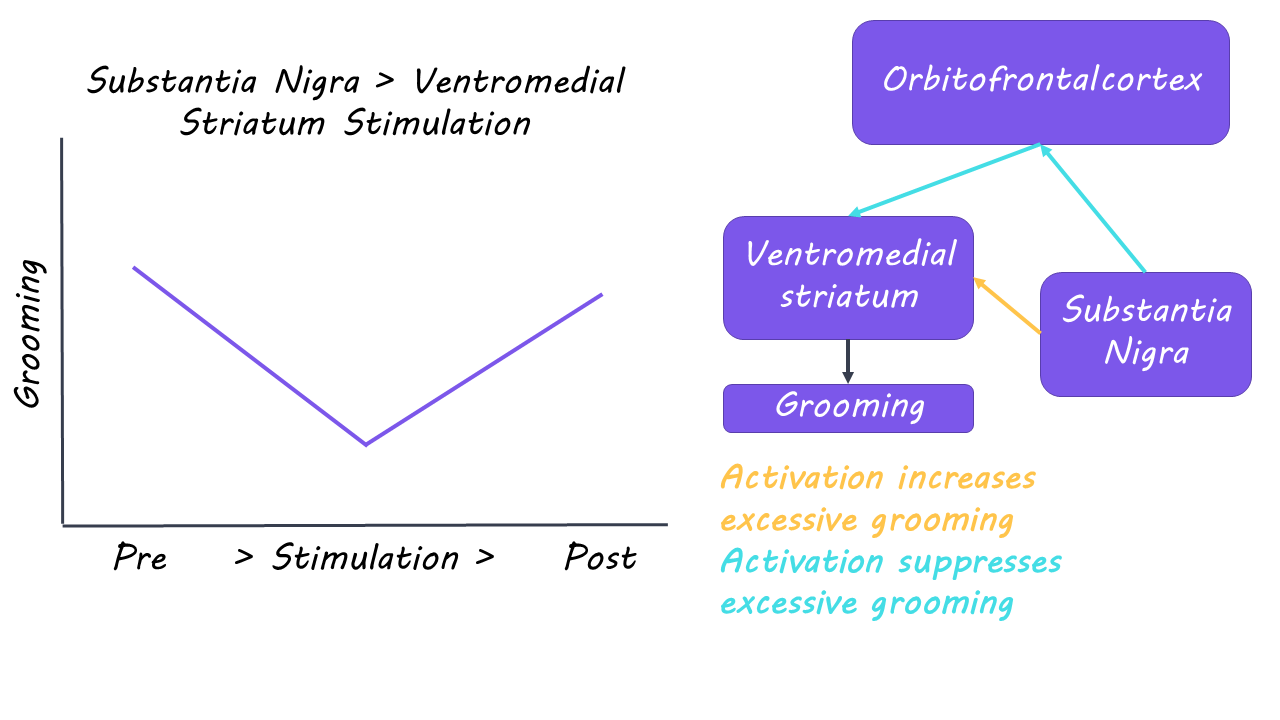
In an animal model of obsessive-compulsive disorder, dopamine neurons in the substantia nigra were found to control repetitive behaviors through a dual gating mechanism involving both striatal and cortical projections. 

What's the science?

Obsessive-compulsive disorder (OCD) is a chronic mental health condition in which patterns of unwanted thoughts and fears (obsessions) lead to repetitive behaviors (compulsions). Dopamine – the brain chemical responsible for allowing us to feel pleasure, satisfaction, and motivation – has been implicated in OCD-like behavior. Studies in mice have shown that excess dopamine results in an increase in OCD-like behaviors while knocking out dopamine receptors reduces such behaviors. While dopamine antagonists are frequently prescribed to people with OCD, the exact role of dopamine receptors and the specific parts of the brain in controlling the repetitive behaviors in OCD is unknown. This week in PNAS, Xue and colleagues used pharmacological and optogenetic manipulation of dopaminergic activity in OCD-like mice to identify the brain circuits involved in the dopaminergic control of the repetitive behaviors in OCD.

How did they do it?

First, the authors used an established method of repeated optogenetic stimulation to generate mice displaying OCD-like repetitive self-grooming behaviors. After establishing an OCD mouse model, the authors again used optogenetic stimulation to manipulate dopaminergic neurons from the substantia nigra and the ventral tegmental area to investigate their potential role in regulating excessive self-grooming behaviors in OCD-like mice. Next, alternative neuronal pathways starting in the substantia nigra were explored using anterograde and retrograde tracing of neuronal pathways, as dopaminergic neurons in the substantia nigra project to multiple brain regions. Finally, they injected the OCD-like mice with antagonists specific to two different types of dopamine receptors to examine the roles of dopamine receptors in mediating the substantia nigra pathways that regulate OCD-like behaviors.  

What did they find?

Inhibiting dopaminergic activity from the substantia nigra, but not from the ventral tegmental area to ventromedial striatum, suppressed excessive grooming behaviors in OCD-like mice. These results suggest dopaminergic inputs from the substantia nigra, but not the ventral tegmental area, facilitate OCD-like repetitive behaviors in mice. The authors identified a novel projection between the substantia nigra and the lateral orbitofrontal cortex. Stimulating this neuronal pathway reduced excessive grooming behaviors in OCD-like mice, while inhibiting this connection increased grooming behaviors. This suggests OCD-like behaviors are regulated by two distinct dopaminergic neural pathways projecting from the substantia nigra. Finally, activity in the two dopaminergic neural pathways affected the compulsive grooming behaviors differently. Activity of the substantia nigra-ventromedial striatum pathway promotes grooming behaviors via D1 receptors, but activity of the substantia nigra-orbitofrontal cortex pathway suppresses grooming behaviors via D2 receptors. This implies the distinct pathways have distinct dopaminergic signaling profiles.

What's the impact?

This study is the first to show that the projection between the substantia nigra and the lateral orbitofrontal cortex not only exists but plays a vital role in the modulation of repetitive behaviors in OCD. This projection is part of a dual gating mechanism through which dopaminergic neurons from the substantia nigra modulate repetitive behaviors. These findings suggest that dopamine-focused treatment strategies may be beneficial to individuals with OCD.