How Diet Influences Your Brain and Mood

Post by Elisa Guma

Brain-body connections that allow food to influence mood

Our moods and emotions govern our lived experiences and are inextricably linked to the function of our brains and bodies. Ingesting certain macro- and micronutrients through our diet can impact the chemicals in our brain that contribute to many emotional states, such as happiness, sleepiness, and sadness. Food choice has been strongly implicated in both mental and overall health and well-being.  Gaining insight into how the nutrients that make up our food affect our brain and behaviour could help us understand how to improve our mental health and overall well-being through our dietary choices.

The role of the vagus nerve

One of the primary pathways through which the brain and body communicate is a bidirectional superhighway known as the vagus nerve. The vagus nerve is the 10th cranial nerve and the longest cranial nerve in the body– starting at the base of your neck, and innervating the brain as well as the organs of the body, including the heart, lungs, stomach, intestines, and liver. Through the vagus nerve, the brain receives information regarding the state of our organs, such as how distended our gut is, how full our intestines are, and how quickly our heart is beating. It can also send motor signals back to the organs, such as telling our heart or our guts to slow their pace. This nerve is one way in which the brain and body are connected and can integrate our emotional states, mood, and well-being. 

Food and neurotransmitters

The production of neurotransmitters such as serotonin, dopamine, and norepinephrine relies on appropriate levels of critical building blocks that we receive from food, such as amino acids, fats, carbohydrates, and minerals. For example, the amino acid L-tyrosine, is a precursor to dopamine and norepinephrine, while both tryptophan (a different amino acid) and carbohydrate-rich foods increase the production of serotonin. Depending on the number of precursors present in the food you eat, you may produce more or less of a certain neurotransmitter. Importantly, imbalances in these neurotransmitters have been associated with numerous neuropsychiatric illnesses, and affect our mood and alertness.

Neurotransmitters are also released in anticipation of and in response to certain foods. For example, the locus coeruleus has been found to release norepinephrine to activate the lateral hypothalamus (the nucleus that regulates food intake) during food preparation. This increases alertness around food, which can lead to feelings of excitement, but also anxiety. Additionally, ingestion of certain foods can induce dopamine release, potentially leading to cravings that cause us to seek out more of that food. For example, certain neurons in the stomach will release dopamine in response to sugar. Interestingly, this is not related to the rewarding sweet flavor of sugary foods, but to specific sugar-sensing neurons in the gut; the same dopamine response occurs even if the sweet taste of sugar is masked. This indicates that there are certain circuits in the body that drive behaviour towards certain types of food based on information that comes directly from our bodies, and not necessarily from our cognitive appraisal of how much we “like” that food. 

Brain-derived neurotrophic factor (BDNF) is an abundant signaling molecule intimately related to both cognitive function and metabolic regulation in the brain. BDNF is involved in reshaping synaptic connections in the context of learning and memory but also plays a role in energy mentalism, appetite suppression, and energy balance in the body. Importantly, low serum levels of BDNF have been identified in individuals with psychiatric diseases, such as schizophrenia and depression, and it is thought to be a key player in mediating the positive effects of antidepressants on the brain. Several studies have investigated the relationship between diet and BDNF and found that diets rich in polyphenols were associated with elevated levels of BDNF. Interestingly, these micronutrients may play a role in disease prevention and longevity as well. 

Omega-3 fatty acids

Omega-3 fatty acids are an integral part of neuronal cell membranes and play a key role in several central nervous system functions including neurotransmission, gene expression, neurogenesis, and neuronal survival. These fatty acids can be found in fatty fish, eggs, flax seeds, hemp seeds, and chia seeds, and can also be ingested as supplements in capsule or liquid form. 

If ingested in the correct ratios (i.e., high omega-3 relative to -6), these fatty acids may have antioxidant and anti-inflammatory properties. In one human study, a low dose (20 mg) of the antidepressant Prozac, a serotonin reuptake inhibitor, and a high dose (1000 mg) of EPA, an essential fatty acid high in omega-3, were found to have similar antidepressant effects. Taken together, the two compounds had synergistic effects, suggesting that the omega-3 fatty acids may amplify the effects of antidepressants. The shift in omega-3 to -6 ratio has been shown to lower inflammation in the body and increase heart rate variability, both of which may improve symptoms of depression and allow antidepressants to do their work.

Micronutrients such as B and D vitamins, zinc, and more

In addition to adequate levels of amino acids, carbohydrates, and fats, our brain, and body also rely on numerous minerals and micronutrients to function optimally. When we are nutritionally deficient in certain micronutrients such as vitamin B12, vitamin B9 (folate), vitamin D, or choline, we may experience symptoms like depression, low mood, fatigue, cognitive decline, and irritability. Similar results have been found for trace minerals such as calcium, zinc, copper, iron, and selenium. Often, diets high in processed food can put individuals at greater risk for nutritional deficiencies, increasing the likelihood of negative impacts on both mood and general cognitive function. Vitamin supplementation has been found to combat cognitive impairment and energy metabolism in both rodent and human studies. 

Conclusions on diet and mental well-being

The nutrients within our food likely have profound effects on our brain and body, affecting both our health and how we feel. Prioritizing and promoting diets that are healthy for our brains may have important benefits for our daily lives. Furthermore, food is a critical component of cultural heritage and can connect us to family and friends, as well as places. Understanding how our mood and well-being are impacted by all these factors can help us to better understand and regulate our emotions and our overall health.

References +

Bremmer JD et al., Diet, Stress and Mental Health. Nutrients, 2020.

Gomez-Pinilla. Brain foods: the effects of nutrients on brain function. Nature Review Neuroscience, 2008.

Gravesteijn E et al., Effects of nutritional interventions on BDNF concentrations in humans: a systematic review. Nutritional Neuroscience, 2022.

Jazayeri S et al., Comparison of Therapeutic Effects of Omega-3 Fatty Acid Eicosapentaenoic Acid and Fluoxetine, Separately and in Combination, in Major Depressive Disorder. Australian & New Zealand Journal of Psychiatry, 2008.

Lachance L & Ramsey D. Food, Mood, and Brain Health: Implications for the Modern Clinician, Missouri Medicine, 2015.

Meeusen R & Decroi L. Nutritional Supplements and the Brain. Int J Sport Nutr Exerc Metab, 2008
The Neural Signature of Mind Blanking

Post by Lani Cupo

The takeaway

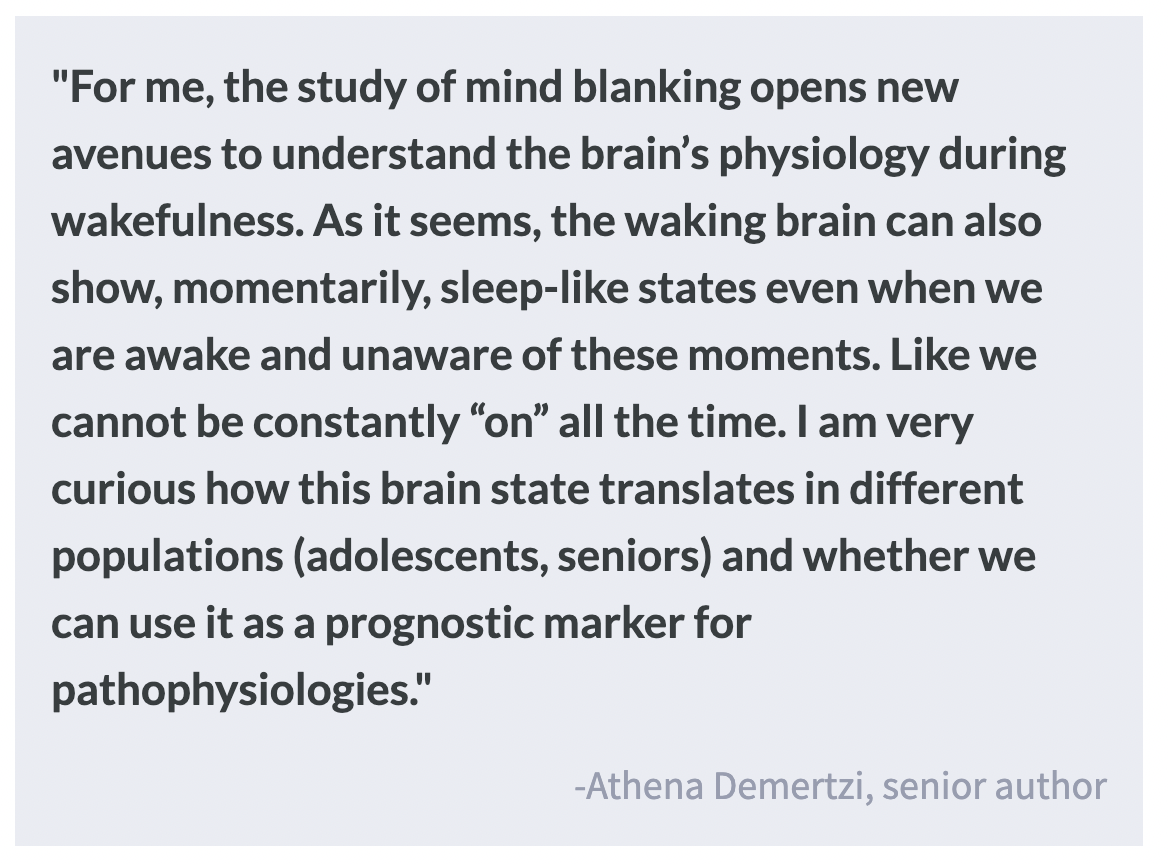
Occasionally while we are awake, our minds seem to go “blank”; we cannot say what we were thinking about. Mind blanking is a state that occurs by default, is characterized by a unique behavioral signature, and is linked to an underlying pattern of brain activity.

What's the science?

In recent years, an increasing number of studies have examined the phenomenon of mind blanking, examining the frequency of “zoning out” compared to other mental states, and characterizing the activation of brain regions during mind blanking. However, despite a growing body of research, the physiological and behavioral processes underlying this state remain inconclusive. This week in PNAS, Mortaheb and colleagues used functional magnetic resonance imaging (fMRI) data to characterize the dynamics of brain activity associated with mind blanking.

How did they do it?

Data were previously acquired from 36 healthy adults (27 women, 9 men) who were at rest (resting quietly) in the MRI scanner with their eyes open to ensure they did not fall asleep. A sound played randomly fifty times throughout the scanning period, prompting the participants to respond with a button to report whether their current mental state was one of four options: mind-blanking, perceiving sensory stimuli, thoughts related to external stimuli (stimuli-dependent), or thoughts independent of external stimuli (stimuli-independent). To characterize the behavioral profiles of mind blanking, the authors examined how frequently it was reported, whether the response time (speed to bush button after the auditory cue played) differed based on the reported state, and the probability to re-report mind blanking multiple times in a row.

To characterize brain activity during the mental states, the authors analyzed a 10-second window around each probe (each auditory stimulus prompting a response). First, they measured the amplitude of the global signal - a physiological proxy of arousal. To do this, the mean absolute value of the signal amplitude for each window is calculated across all regions of interest in the brain, giving a gross estimate of brain activity. Then, to determine whether the functional connectivity of the brain during mind blanking differed from other states, the authors trained a machine learning algorithm to classify participants' reports into different categories based on functional connectivity alone.

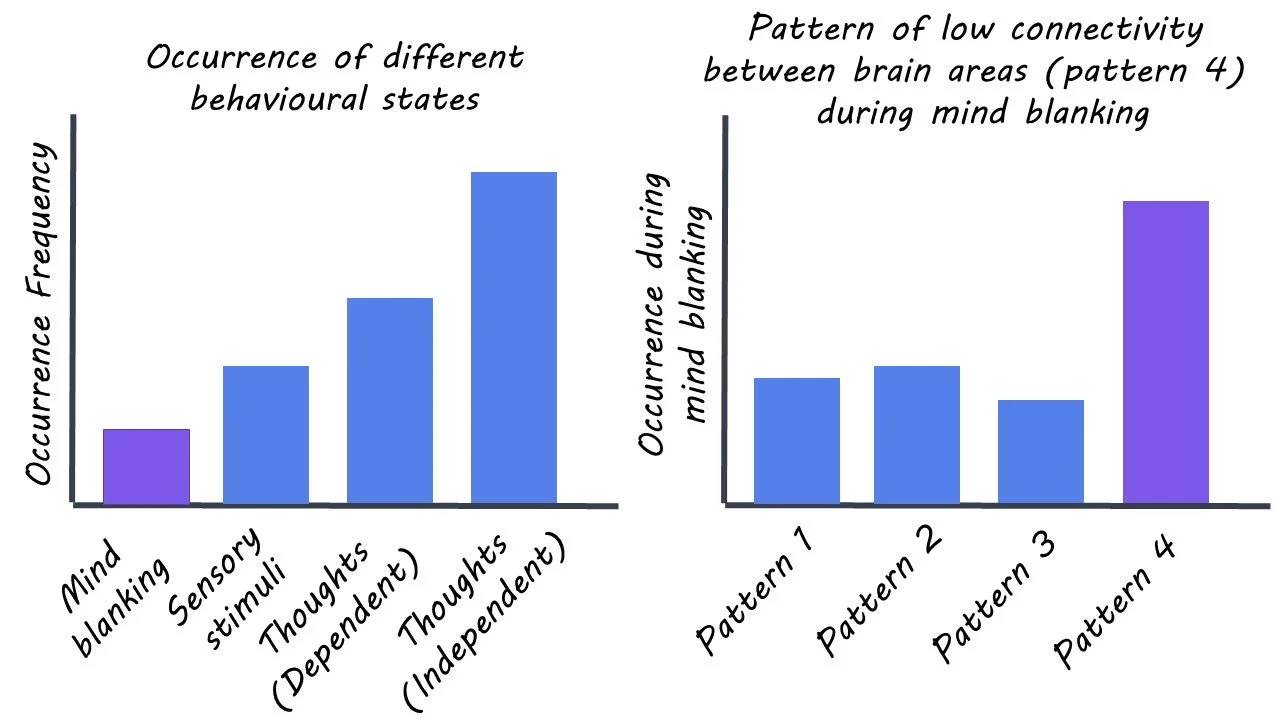
Finally, the authors used a clustering technique to derive four different patterns of connectivity over the entire resting state period and examined whether one of the four patterns was more strongly associated with the patterns of connectivity during mind blanking states.

What did they find?

First, the authors replicated results from previous studies reporting a low frequency of mind blanking compared to other mental states. Additionally, mind blanking was reported relatively fast compared to stimuli-dependent and independent states, potentially implying that content-less states were easier to recognize and report than states with content. It was extremely rare for participants to re-report mind blanking multiple times subsequently, which may suggest mind blanking reflects a transitional state between other states.

Second, there was a subtle difference between the amplitude of the global signal between states, with a slightly higher average signal amplitude in mind blanking than in stimuli-dependent or independent states. Global signal amplitude has been negatively correlated with alertness before, suggesting global silencing during wakefulness. This is consistent with these results which report a high global signal during an attentional lapse.

Third, the authors found that the trained machine learning classifier could accurately separate mind blanking states from the others based on functional connectivity, suggesting mind blanking is accompanied by a unique pattern of brain activity and functional connectivity.

Finally, the authors derived four distinct patterns of functional connectivity during the resting state. The pattern most closely related to the pattern during mind blanking states was characterized by positive functional connectivity between brain areas across the brain, and the similarity between this pattern and mind blanking states was higher than the similarity between this pattern and any other state. Like an increased global signal, this pattern of positive whole-brain functional connectivity may be associated with decreased cortical arousal.

What's the impact?

The results of this study imply that mind blanking is a unique, possibly default, mental state which might represent a transition between other states. Moments of unreportable thoughts during wakefulness can occur spontaneously. These findings challenge traditional ideas of a constantly-accessible conscious human brain.

Predicting rTMS Treatment Outcomes in Major Depression Using EEG

Post by Ewina Pun

What is depression and how can rTMS help?

Depression is a common mental disorder and a major contributor to suicide. It is estimated that over 300 million people suffer from depression globally, equivalent to 4.4% of the world’s population. Major depressive disorder (MDD) is diagnosed with symptoms such as depressed mood, loss of interest and enjoyment, fatigue, disturbed sleep, and change in appetite. While anti-depressant medication and psychotherapy are available forms of treatment, about 30% of people are resistant to these standard therapies. Recently, researchers found that some people with treatment-resistant MDD respond to repetitive transcranial magnetic stimulation (rTMS), a type of noninvasive neuromodulation where repeated electromagnetic pulses are applied outside of the skull to induce changes in functional networks in the brain.

TMS has been shown to be clinically effective in treating neuropsychiatric disorders and typically involves weeks of repeated sessions for improvement to take place. During each visit, patients receive TMS stimulations at a targeted brain area, where the device sends pulses by inducing a magnetic field from a magnetic coil. Stimulations at the left dorsolateral prefrontal cortex (DLPFC) at 5-10Hz elicit an excitatory effect, while at the right DLPFC at 1Hz elicits an inhibitory effect on neural circuitry related to emotion regulation. rTMS can affect brain regions not only at the stimulation site but also others not directly under the coil. About 50% of patients receiving rTMS treatment show improvement in depression symptoms, however, it’s difficult to predict who may benefit from rTMS.

How can we predict positive treatment outcomes?

To better understand the neural mechanism of how rTMS elicits changes in network connectivity associated with clinical improvement, researchers have used electroencephalography (EEG) to identify biomarkers. Recent work suggests that EEG ‘microstates’ may help delineate subtypes of depression. EEG microstates are recurring transient voltage topographies characterized within resting-state brain networks (common patterns of fluctuations in brain activity that can be found while someone is simply resting). Microstates are likely generated by repeated co-activation of large-scale networks between brain areas.

Four to six of these canonical microstate topographies are found consistently across participants, and recent papers have identified microstates characterizing MDD. For example, the proportion and occurrence of some microstates is significantly different in MDD compared to healthy controls. By measuring changes between resting state EEG before and after rTMS treatment, researchers have revealed that there are selective changes in microstates, specifically in MDD patients who responded to treatment (and not in non-responders). Changes in some microstates are believed to correlate with changes in resting state brain networks associated with depression that are elicited by TMS, such as the cognitive control network and default mode network. While further investigation is required, microstates analysis can potentially serve as biological markers for early response in MDD patients and therefore predict future clinical outcomes prior to committing to the weeks-long rTMS treatment.

What’s the takeaway?

People with depression experience a range of symptoms with varying severity and duration. Its underlying etiology can also be heterogeneous. Therefore, predicting which treatments work best for which patients is critical for effective treatment. rTMS is a viable alternative therapy for some antidepressant-resistant patients. EEG helps researchers identify biomarkers related to positive rTMS outcomes and study the underlying mechanisms of these outcomes in different depression subtypes. The combination of TMS-EEG is a promising tool to optimize the process of treatment for MDD and provide better treatment for patients sooner.

References +

Depression and Other Common Mental Disorders: Global Health Estimates. Geneva: World Health Organization. (2017).

Guse et al. Cognitive effects of high-frequency repetitive transcranial magnetic stimulation: a systematic review. Journal of Neural Transmission. (2010).

P. B. Fitzgerald et al., Accelerated repetitive transcranial magnetic stimulation in the treatment of depression. Neuropsychopharmacology. (2018).

M. Murphy et al. Abnormalities in electroencephalographic microstates are state and trait markers of major depressive disorder. Neuropsychopharmacology (2020).

D. Yan et al. Prediction of Clinical Outcomes with EEG Microstate in Patients with Major Depressive Disorder. Front. Psychiatry. (2021).

M. C. Gold et al. Large-scale EEG neural network changes in response to therapeutic TMS. Brain Stimulation. (2022).