
Intrinsic Brain Activity is Associated with the Development and Severity of Glioma

Post by Leanna Kalinowski

The takeaway

Scientists have uncovered an association between higher intrinsic brain activity and the development and severity of gliomas or brain tumors that originate in glial cells.

What's the science?

Gliomas – tumors that originate in glial cells – are the most frequently occurring type of brain tumor. Previous studies have shown that variations in brain activity affect how gliomas behave. For example, the high activity of neurons surrounding gliomas causes an acceleration of tumor growth into those regions. However, it is unknown whether “intrinsic” brain activity – pre-existing levels of activity in healthy controls – impacts glioma occurrence and symptomatology. This week in Brain, Numan and colleagues tested (1) whether brain regions with higher intrinsic brain activity have a higher occurrence of glioma and (2) whether intrinsic brain activity at tumor locations is associated with symptomatology.

How did they do it?

The authors included data from 413 glioma patients across three different cohorts. A glioma mask was drawn for each patient, based on MRI data, to visualize where their tumor was located within the brain. Each mask was then merged into a single heat map per cohort to represent the relative occurrence of tumors within each cohort. To measure symptomatology, the authors reviewed each patient’s medical chart to determine (1) their Karnofsky Performance Status (KPS), which is a standard way to measure a cancer patient’s ability to perform ordinary tasks, and (2) the subtype of their glioma, which indicates its growth potential and aggressiveness.

To collect intrinsic brain activity, 65 healthy controls underwent magnetoencephalography (MEG), which is an imaging technique that measures magnetic fields produced by brain activity. Three measures of brain activity were then calculated from these data: broadband power and offset, which both measure neuronal spiking, and slope, which measures the balance of excitation and inhibition in the brain.

What did they find?

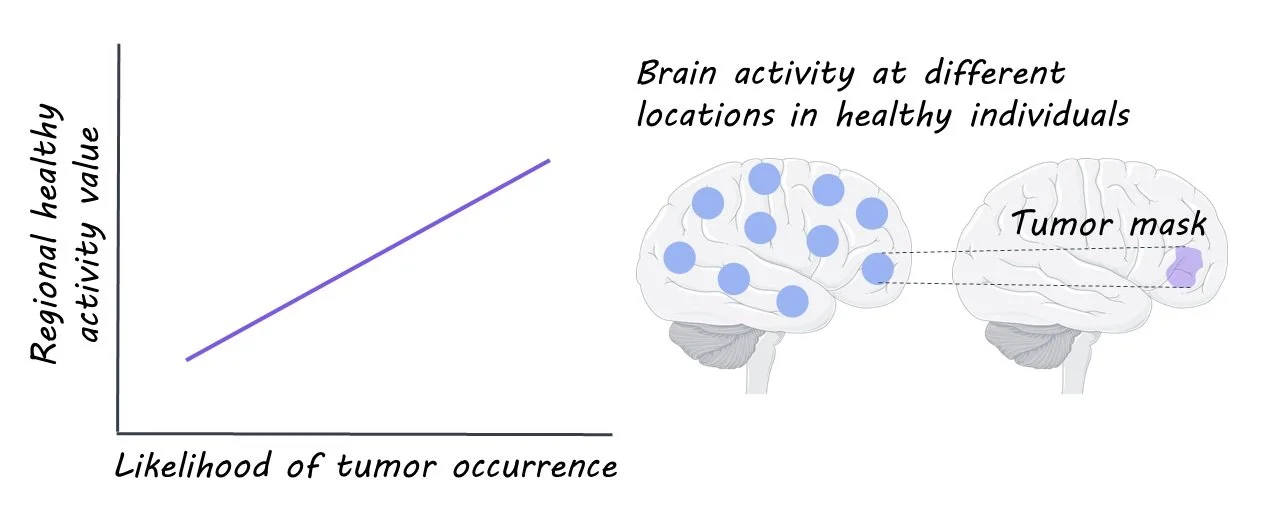
First, when the tumour locations were mapped onto the same locations in the brains of healthy controls, the authors found that greater levels of brain activity (i.e., higher offset values) in controls was associated with a higher occurrence of glioma across all three cohorts. They also found that intrinsic brain activity at individual tumor locations differed based on KPS and glioma subtype. Specifically, grade IV glioblastoma (i.e., the most malignant subtype of glioma) had the lowest ratio of excitation to inhibition, with a lower ratio being associated with a lower KPS (i.e, lower ability to perform ordinary tasks).
What's the impact?

Taken together, these results show that gliomas are more likely to occur in brain regions that have higher intrinsic activity, with the most malignant subtypes of glioma favoring brain regions with a lower ratio of excitation to inhibition. Understanding the relationship between brain activity and gliomas may inform our understanding of glioma, which may aid in the development of more effective treatment strategies in the future.
Access the original scientific publication here.

Sleep-Like Slow Waves Modulate Attention While Awake

Post by Lincoln Tracy

The takeaway

Increases in sleep-like slow wave activity, while we are awake, could explain why we find it hard to sustain attention to something over an extended period of time.

What's the science?

Our ability to sustain attention to a specific task is determined by our level of physiological arousal. Paying attention to a specific thing for an extended period is challenging, and often results in our minds starting to wander. Several neurotransmitters – including noradrenaline, dopamine, and serotonin – modulate both physiological arousal and sustained attention. Electrophysiological markers – brain activity recorded on an electroencephalogram (EEG) – are commonly used to explore the relationship between physiological arousal and attention. Although lapses in sustained attention and dysregulations in arousal have been linked, the physiological mechanisms underlying these associations are unknown. This week in the Journal of Neuroscience, Pinggal and colleagues aimed to explore the relationship between the occurrence of sleep-like slow brain waves and the behavioral consequences of sustained attention failures by pharmacologically manipulating noradrenaline, dopamine, and serotonin levels in a cohort of healthy male participants.

How did they do it?

The authors undertook a secondary analysis of data previously collected from 32 healthy, young right-handed males as part of a four-arm, randomized, placebo-controlled trial. Over four experimental testing sessions, participants were administered methylphenidate (to raise noradrenaline and dopamine levels throughout the brain), atomoxetine (to raise noradrenaline and dopamine levels specifically in the prefrontal cortex), citalopram (to raise serotonin levels), or placebo (as a control) before donning an EEG cap and completing an experimental task which measures sustained attention. As part of the task, participants were presented with a series of pictures presented for just under a second (short trial) or just over a second (long trial). They were instructed to respond (by pressing a computer key) when the picture was presented for the longer period. The authors recorded the proportion of missed targets (when the participant failed to press the key on a long trial) and false alarms (when the participant pressed the key on a short trial), as well as the reaction time for correct responses to the long trials. Sleep-like slow wave activity was recorded throughout the task. Behavioral performance and EEG data after administration of each of the drugs were compared to placebo.   

What did they find?

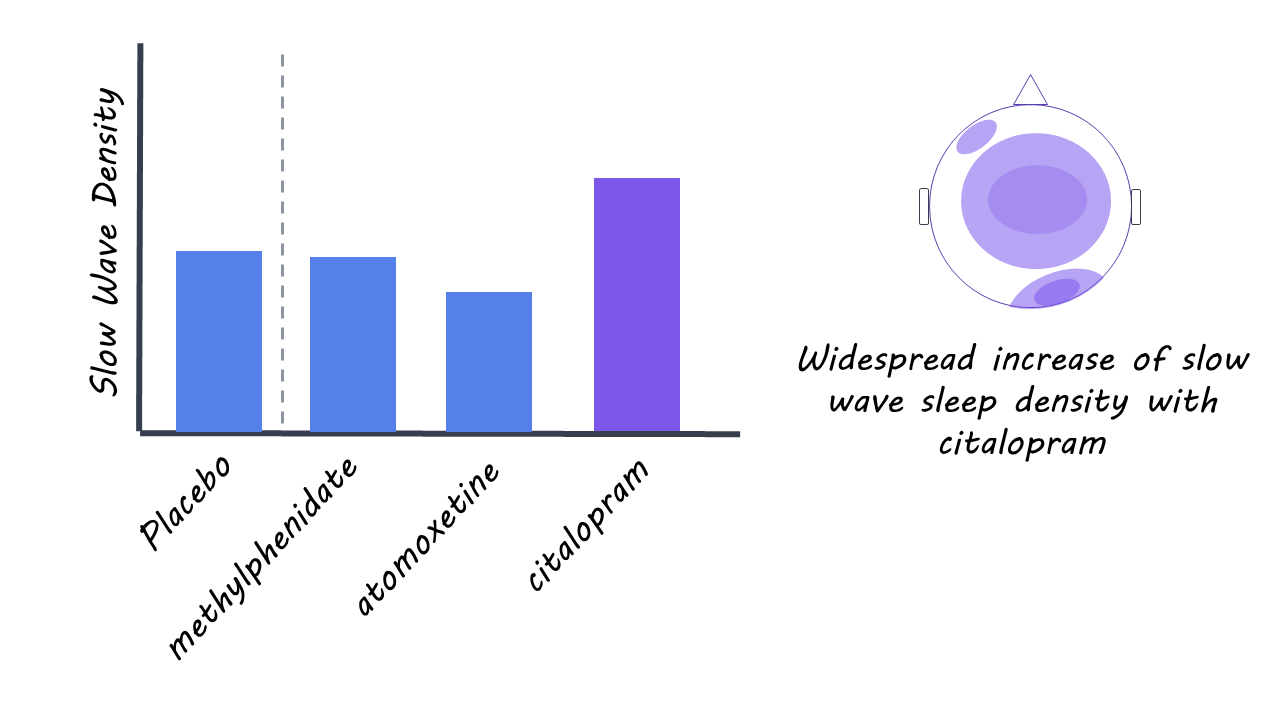
The authors found methylphenidate improved behavioral performance on all measures compared to placebo. This means after taking methylphenidate, participants were faster and better at identifying the long trials, without becoming too overreactive and responding to short trials. In contrast, atomoxetine increased false alarms, and citalopram increased missed long trials. Therefore, the three drugs had unique effects on behavioral performance. With respect to the EEG data, citalopram increased sleep-like slow wave density during the sustained attention task compared to placebo when data from all electrodes were averaged, while methylphenidate and atomoxetine did not affect brain activity. When sleep-like slow wave density was examined across the individual electrodes (to examine how the drugs affected slow wave density in different parts of the brain), citalopram resulted in a widespread increase in density across different regions, while methylphenidate and atomoxetine reduced sleep-like slow wave density in central and frontal brain regions.

What's the impact?

This study found that optimal performance on a sustained attention task requires a delicate balance between activation and inhibition, impulsivity, and sluggishness. Importantly, this delicate balance is achieved through synergistic interactions of multiple neurotransmitters. These findings reinforce the idea that behavioral impairments that occur in disorders such as ADHD may occur through the dysregulation of arousal.

Access the original scientific publication here.

The Effect of Ketamine on Optimism

Post by Megan McCullough

The takeaway 

Individuals with treatment-resistant depression that were given doses of ketamine exhibited more optimism over the course of treatment. This suggests that ketamine’s antidepressant effects may in part be a result of the positive cognitive effects of ketamine.

What's the science?

Ketamine, an anesthetic that blocks NMDA receptors, is currently being investigated as a therapy for treatment-resistant depression (TRD). Although previous randomized clinical trials have shown ketamine to have an antidepressant effect, there is a gap in research concerning the cognitive effects of ketamine and its role in treating TRD. One marker of TRD is the lack of optimism bias, the tendency in healthy individuals to update personal beliefs following good news more than updating beliefs after bad news. This week in JAMA Psychiatry, Bottemanne and colleagues investigated the role of ketamine in restoring optimism bias in individuals with TRD.

How did they do it?

Participants included 30 healthy control individuals and 26 patients with TRD. Participants with TRD were given three doses of ketamine intravenously over the course of a week. Healthy participants received no doses. Participants in the treatment group were assessed throughout the study for depressive symptoms using an established depression rating scale. All participants completed a belief-updating task to measure optimism bias. This task asked participants to estimate their likelihood of experiencing different adverse life events before and after finding out the actual likelihood of these events happening in the general population. Those with TRD would tend to have a more negative outlook on the course of their own compared to healthy individuals. This paradigm was used as a measure of the efficacy of ketamine treatment in the participants with TRD. Statistical tests, including linear mixed-effects models, were then run to examine the effects of ketamine on belief updating.

What did they find?

Overall, the authors found that ketamine decreased depressive symptoms in individuals with TRD. Participants who received ketamine treatments showed an increase in optimism about their personal lives as soon as four hours after their first ketamine dose. This increase in optimism was correlated with a reduction in scores on the depression evaluation. These results suggest that ketamine has cognitive effects that are associated with the alleviation of major depression symptoms such as negative outlook and lack of an optimism bias.

What's the impact?

This study is the first to show that individuals with TRD showed an increase in optimism bias and a decrease in depressive symptoms over the course of a week of ketamine treatments. The data in this study suggest that ketamine has immediate cognitive effects that alleviate symptoms in those with depression.

Access the original scientific publication here