Investigating the Link Between Infections and Dementia

Post by Megan McCullough

The takeaway

There was no link found between common infections and cognitive decline later in life in a large cohort of individuals.

What's the science?

Common infections such as sepsis, pneumonia, and urinary tract infections, have previously been linked to dementia. Although this research has shown an association between infections and cognitive decline, there is limited information on the precise relationship. There might also be a link between infections and neuroimaging markers for dementia such as hippocampal atrophy and white matter hyperintensities (WMH), but data is limited. This week in Translational Psychiatry, Muzambia and colleagues aimed to address these gaps in research by exploring the association between common infections, cognitive decline over time, and neuroimaging markers, using data from the UK Biobank study. 

How did they do it?

The authors recruited participants from the UK Biobank study, a large database with medical information for over half a million individuals across the UK. The authors used data from participants within this study that had primary and secondary care data for at least a year and no history of dementia or cognitive problems. The larger study population was divided into two cohorts: a group with baseline data for cognitive function (16,728 participants), and a group with baseline data for neuroimaging (14,712 participants). To measure cognition, participants completed tests that measured reaction time, visual memory, fluid intelligence, and prospective memory. For the neuroimaging measures, the authors looked at hippocampal volume and WMH; markers for preclinical dementia. Participants with and without infections in the five years before baseline tests were included in the study to measure any link between infections and cognitive and neuroimaging markers for dementia. The cognitive assessments were repeated over time to measure any cognitive decline. Linear regression models were then used to match presence of infection to changes in cognitive function and to any appearance of neuroimaging markers associated with dementia. 

What did they find?

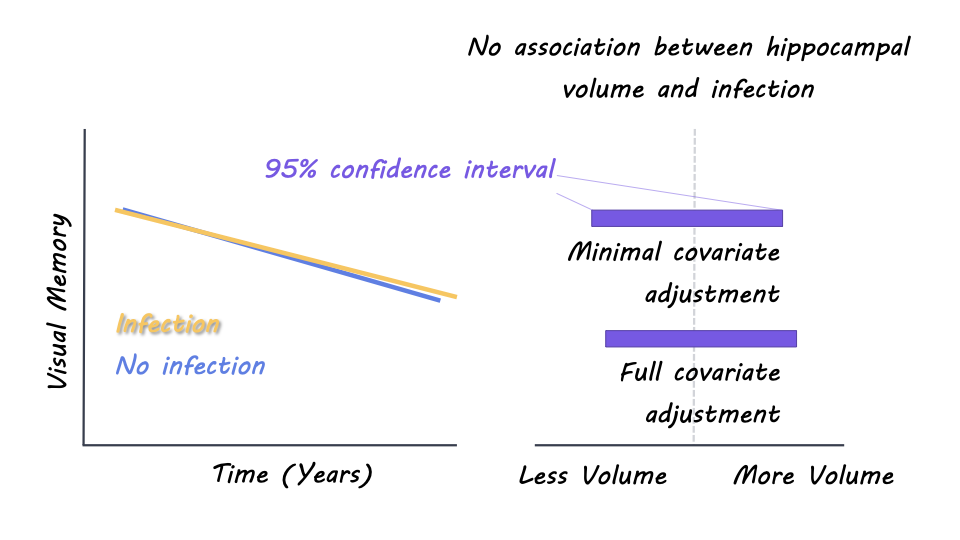
The authors found no link between having an infection and cognitive decline over time except for a small association between the presence of an infection and performance on the visual memory test over time. There was also no association found between infection and hippocampal atrophy or WMH. The UK Biobank study provided vast amounts of demographic and lifestyle information for participants which allowed the authors to adjust for many confounding variables in these analyses. 
What's the impact?

This study is the largest longitudinal study thus far to examine the link between contracting common infections and the development of dementia markers. Overall, the data in the study does not support a link between infections and developing dementia. Although this singular study doesn’t rule out the possibility of a link, these data suggest that other factors are likely more important in the development of dementia. 
Access the original scientific publication here

How is Our Health Impacted by the Physical Environment?

Post by Lani Cupo

A first look at health-environment interaction

In 1854, John Snow made history investigating the connection between the Thames River and cholera epidemics. He found that the areas of London supplied with water contaminated by sewage were associated with high rates of cholera compared with those supplied by clean water. His epidemiological work represents one of the most famous cases of environmental health being linked with human health. As environmentalism gained attention and traction through the 20th century, researchers, activists, and health practitioners began to focus on the relationship between human health and the environment. For example, since the 1980s, researchers have been investigating the relationship between hormones in the environment and developmental disorders. More recently, research has advanced from examining the connection between the environment and communicable or inter-generational diseases to how environmental contamination and degradation negatively impact human mental and neurological health. 

The impact of the environment on mental health can be viewed along a continuum. Sudden disasters (like an earthquake) might have a large, immediate impact while more gradual processes (like drought, climate change, or pollution) might affect health over time. One 2009 study in Western Australia found dryland salinity (the accumulation of salt in surface soil; a gradual process) was associated with an increased risk of hospitalization for depression. The results could indicate a causal relationship, or it could be that there is simply a correlation between soil salinity and socioeconomic status, which impacts mental health. In a similar vein, it is difficult to tease apart the impact of environmental changes on mental health from rising anxiety and despair about environmental destruction and the potential impact on our bodies. Air, water, and land pollution have also been associated with psychiatric disorders. In one study conducted between the United States and Denmark, poor air quality was associated with increased rates of depression and bipolar disorder. However, isolating the impact of air quality on mental health is difficult due to the fact there is a relationship between urban environments in general and mental health.

While the relationship between the environment and human mental health is difficult to parse, a recent review explicitly drew attention to an important missing piece of the puzzle: pharmaceutical drugs used to treat human diseases and disorders are flushed down the toilet and end up in our water system. Without targeted methods at water treatment facilities to remove these pharmaceuticals, they are ingested via drinking water, which could change our neurobiology. Greater interdisciplinary research leveraging ecology to inform human health research is needed to better understand these relationships.

How can we learn about human health from the environment?

The idea of monitoring wastewater to track human health isn’t new and has recently been leveraged to track COVID-19 cases in the United States. In China, wastewater is also surveyed for a broad range of pharmaceuticals, including drugs such as antihypertensives (blood pressure medication), antimicrobials, antipyretics (fever medication), analgesics (pain killers), and anti-inflammatories. While methodologies to tie water levels of pharmaceuticals back to population health statistics are still being developed, these studies indicate the future potential of investigating wastewater to track health at a community level.

In addition to examining human wastewater, some researchers investigate certain wildlife populations as “sentinel species.” These organisms are exposed to similar chemical agents as many humans, and can serve as models for future risks and effects in humans. Creative experiments have used dogs to detect scat from sentinel species such as otters and mink, testing their excrement for contaminants such as pharmaceuticals, heavy metals, anthropogenic organic contaminants (such as microplastics), personal care products, and flame retardants. The behavior of wild animals can also be observed to assess potential pollutants, such as the nest abandonment observed in swallows in environments contaminated by pesticides like dioxins and pollutants like furans.

How do human medications impact the environment? 

While the impact of pharmaceuticals on human and animal health is usually thoroughly investigated in the drug development process, potential environmental impacts are often poorly understood. Pharmaceutical usage has increased in recent decades. Nevertheless, there is a lack of studies investigating the impact of pharmaceuticals on wildlife. The impact is particularly concerning in areas of the developing world with growing pharmaceutical production industries, such as Pakistan. Downstream effects of pharmaceuticals may be different than their intended uses in mammals. For example, histamines are used as neurotransmitters by invertebrates, so antihistamines may inhibit neurotransmission in animals like lobsters. More research is required to better understand whether there is an impact of low-concentration cocktails of medications.

What are the long-term implications for human neuropsychiatric health?

In the final arc of the loop, researchers must establish the impact of low doses of pharmaceuticals on humans who are exposed to them in the environment. Many pharmaceuticals or personal care products are detectable at ultra-low levels in the environment, and there is some controversy over the pertinence of the low-dose effects on humans. However, of high importance is assessing the impact of low-dose pharmaceuticals on developing children, as early life exposure to antidepressants in animals has been associated with Autism-like phenotypes later in life. In the coming years, it will be important to establish 1) first, whether ultra-low concentrations of medications can contribute to the emergence of psychiatric conditions in humans, especially in children, 2) second, what areas have the highest dosages and, therefore risk, and 3) third, how neuroscientists, physicians, and psychiatrists can learn from ecological sciences to better understand how humans impact, and in turn are impacted by, the natural world.

References +

Arnold KE, Boxall ABA, Brown AR, Cuthbert RJ, Gaw S, Hutchinson TH, et al. Assessing the exposure risk and impacts of pharmaceuticals in the environment on individuals and ecosystems. Biol Lett. 2013;9: 20130492.

Ashfaq M, Nawaz Khan K, Saif Ur Rehman M, Mustafa G, Faizan Nazar M, Sun Q, et al. Ecological risk assessment of pharmaceuticals in the receiving environment of pharmaceutical wastewater in Pakistan. Ecotoxicol Environ Saf. 2017;136: 31–39.

Arnold KE, Boxall ABA, Brown AR, Cuthbert RJ, Gaw S, Hutchinson TH, et al. Assessing the exposure risk and impacts of pharmaceuticals in the environment on individuals and ecosystems. Biol Lett. 2013;9: 20130492.

Bossart GD. Marine mammals as sentinel species for oceans and human health. Vet Pathol. 2011;48: 676–690.

Boxall ABA. The environmental side effects of medication. EMBO Rep. 2004;5: 1110–1116.

Chan SJ, Nutting VI, Natterson TA, Horowitz BN. Impacts of Psychopharmaceuticals on the Neurodevelopment of Aquatic Wildlife: A Call for Increased Knowledge Exchange across Disciplines to Highlight Implications for Human Health. Int J Environ Res Public Health. 2021;18. doi:10.3390/ijerph18105094

Colborn T. Environmental estrogens: health implications for humans and wildlife. Environ Health Perspect. 1995;103: 135–136.

Custer CM. Swallows as a Sentinel Species for Contaminant Exposure and Effect Studies. In: Elliott JE, Bishop CA, Morrissey CA, editors. Wildlife Ecotoxicology: Forensic Approaches. New York, NY: Springer New York; 2011. pp. 45–91.

Duan L, Zhang Y, Wang B, Yu G, Gao J, Cagnetta G, et al. Wastewater surveillance for 168 pharmaceuticals and metabolites in a WWTP: Occurrence, temporal variations and feasibility of metabolic biomarkers for intake estimation. Water Res. 2022;216: 118321.

Farkas K, Hillary LS, Malham SK, McDonald JE, Jones DL. Wastewater and public health: the potential of wastewater surveillance for monitoring COVID-19. Curr Opin Environ Sci Health. 2020;17: 14–20.

Khan A, Plana-Ripoll O, Antonsen S, Brandt J, Geels C, Landecker H, et al. Environmental pollution is associated with increased risk of psychiatric disorders in the US and Denmark. PLoS Biol. 2019;17: e3000353.

Lederbogen F, Haddad L, Meyer-Lindenberg A. Urban social stress--risk factor for mental disorders. The case of schizophrenia. Environ Pollut. 2013;183: 2–6.

Tulchinsky TH. John Snow, Cholera, the Broad Street Pump; Waterborne Diseases Then and Now. Case Studies in Public Health. 2018; 77.

Rhomberg LR, Goodman JE. Low-dose effects and nonmonotonic dose-responses of endocrine disrupting chemicals: has the case been made? Regul Toxicol Pharmacol. 2012;64: 130–133.

Richards NL, Tomy G, Kinney CA, Nwanguma FC, Godwin B, Woollett DA (smith). Using Scat Detection Dogs to Monitor Environmental Contaminants in Sentinel Species and Freshwater Ecosystems. In: Richards NL, editor. Using Detection Dogs to Monitor Aquatic Ecosystem Health and Protect Aquatic Resources. Cham: Springer International Publishing; 2018. pp. 193–262.

Rodriguez-Porcel F, Green D, Khatri N, Harris SS, May WL, Lin RCS, et al. Neonatal exposure of rats to antidepressants affects behavioral reactions to novelty and social interactions in a manner analogous to autistic spectrum disorders. Anat Rec. 2011;294: 1726–1735.

Rosi-Marshall EJ, Royer TV. Pharmaceutical Compounds and Ecosystem Function: An Emerging Research Challenge for Aquatic Ecologists. Ecosystems. 2012;15: 867–880.

van der Schalie WH, Gardner HS Jr, Bantle JA, De Rosa CT, Finch RA, Reif JS, et al. Animals as sentinels of human health hazards of environmental chemicals. Environ Health Perspect. 1999;107: 309–315.

The Impact of SSRI Fluoxetine on the Transcriptome and Epigenome

Post by Leanna Kalinowski

The takeaway

The molecular effects of chronic selective serotonin reuptake inhibitor (SSRI) treatment on the brain are not well understood. This research shows that fluoexetine - an SSRI - induces widespread gene expression changes and epigenetic modifications in brain regions known to play a role in depression.

What's the science?

Depression is a common and serious mood disorder that causes persistent feelings of sadness, hopelessness, and emptiness. Despite SSRIs being the most prescribed medication for depression, they are not effective for everyone and often have negative side effects

Another major hurdle in the development of new antidepressants is that the mechanism of action of SSRIs is not fully understood. While the clinical benefits of SSRIs were initially attributed to blocking serotonin reuptake (leaving more serotonin in the brain), additional mechanisms have since been proposed (e.g., adult neurogenesis & synaptic plasticity). Further, the gene regulatory changes induced by SSRIs are not well understood. To develop better treatments for depression, it is important to fully understand the molecular mechanisms that underlie SSRI action. This week in Molecular Psychiatry, Rayan and colleagues used transcriptomic and epigenomic techniques to map the molecular mechanisms of fluoxetine, a widely used SSRI.

How did they do it?

Adult male rats were separated into two groups: the treatment group received daily fluoxetine in their drinking water, while the control group received plain drinking water. Following six weeks of treatment, 27 distinct brain regions were harvested and underwent bulk RNA-sequencing and ChIP-sequencing. Two hippocampal regions were profiled at a finer resolution using single-cell RNA-sequencing.

Bulk RNA-sequencing (RNA-seq) is a technique that measures the expression of genes across the transcriptome, which is a collection of all the gene readouts present in a cell. Rather than pre-selecting a handful of candidate genes, RNA-seq allows for a comprehensive look into how fluoxetine impacts gene expression across the brain. Single-cell RNA-sequencing (scRNA-seq) is similar, but instead measures the expression of genes at the level of individual cells rather than collectively across all cells. ChIP-sequencing (ChIP-seq) is a technique that maps out where proteins bind to DNA in the brain. In this study, the authors were interested in mapping H3K27ac, which is a marker of histone acetylation (i.e., an epigenetic modification that is associated with greater levels of gene transcription).

What did they find?

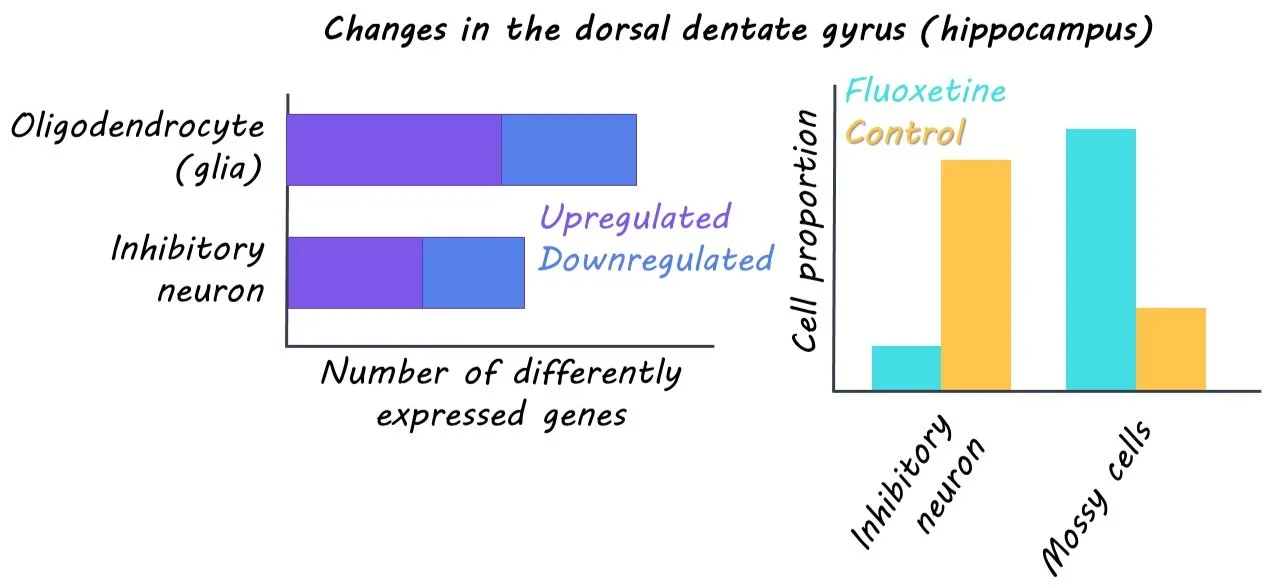
RNA-seq analysis revealed strong and widespread gene expression changes in rats chronically exposed to fluoxetine. Specifically, differences in gene expression between groups were most pronounced in the raphe nucleus, nucleus accumbens core and shell, arcuate nucleus, and locus coeruleus. These brain regions have previously been implicated in monoaminergic (e.g., dopamine, serotonin) action, which supports our previous knowledge that fluoxetine modulates monoaminergic signaling. A similar pattern was observed with the ChIP-seq data, where the authors found stark histone acetylation (a DNA modification that affects gene expression) differences associated with chronic fluoxetine exposure. Notably, the raphe, nucleus accumbens shell, dorsal hippocampus, nucleus accumbens core, and locus coeruleus had the greatest differences in both gene expression and histone acetylation. In addition to the above regions, the study reports diverse effects of fluoxetine in 22 other brain areas, many of which have not been previously studied. Fluoxetine altered as many as 4447 transcripts and 4511 genomic loci in at least one brain region. scRNA-seq revealed that the hippocampal cell types most impacted by fluoxetine treatment are inhibitory neurons, mossy cells, and subtypes of glial cells, which have all previously been implicated in anxiety and depression.

What's the impact?

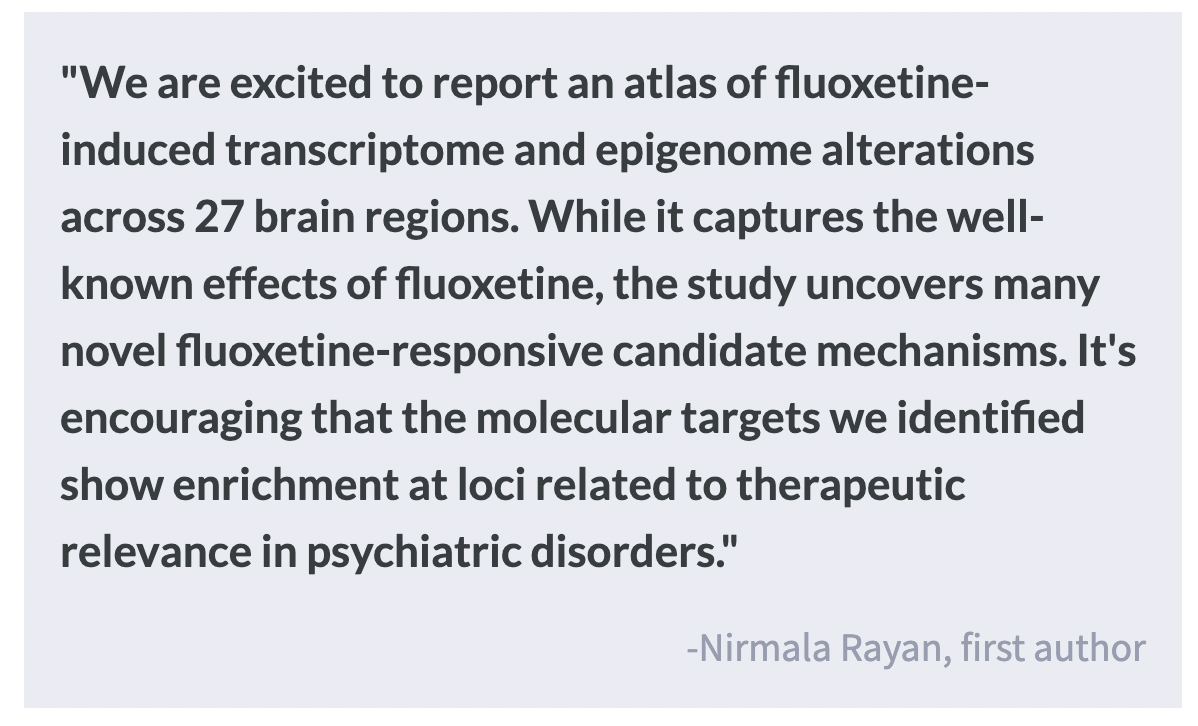
This study was the first of its kind to map the transcriptomic and epigenomic landscape of chronic fluoxetine administration in the brain. This research identified candidate genes, pathways, and cell types that can be further explored, in the hopes of identifying pathways that could be targeted for future antidepressant development. Given that there are stark sex differences in the prevalence of depression and the efficacy of SSRIs, future studies of this nature should also incorporate female subjects.