How Our Behavior Influences Productivity

Post by Leanna Kalinowski and Leigh Christopher

What blocks your productivity?

Have you ever wanted to get something done, but found yourself endlessly putting it off? Or, in an attempt to start the day off on a productive note, been paralyzed by your long list of tasks to do? These experiences have one thing in common: they involve shifts in your attention or motivation. 

Feeling motivated can help us to stay productive, however, our motivation can wax and wane over time. And, sometimes, we simply don’t have the motivation needed to work at our best. We can also become easily distracted throughout the day, or develop bad habits that prevent us from achieving our goals. This is known as the intention-action gap - the concept that our intentions do not always translate into action. 

In an ideal world, we would avoid distractions, work efficiently and accomplish everything we planned. However, as human beings, we’re susceptible to distractions and we have limited willpower. Fortunately, there are helpful strategies that we can use to aid in the development of better productivity habits. BrainPost partnered with Intelligent Change (creators of The Five Minute Journal) to highlight some of the top, scientifically-backed strategies that you can implement to stay on track.

Creating a simple plan to reduce the noise

Why is it so hard to accomplish what we want? Although it may seem like we know exactly what needs to be done, this can often be the first barrier to productivity - noise. There is so much going on in our day-to-day lives that our goals can seem overwhelming. This is why implementation intentions - a simple plan that states where, when, or what we will do- can be immensely helpful. One research study found that those who wrote down where and when they were going to exercise were more than twice as likely to follow through on their exercise plan. This research highlights that it’s not always about boosting inherent motivation. A simple cue in our environment, in this case, like the indication of where or when the action will take place, helps lead to the desired behavior, which then, in turn, encourages even greater motivation later on. 

What else can help us filter through the noise? Another important, but often overlooked concept in productivity, is prioritization. By whittling down our to-do list to just a few or even one very important task, we simplify our lives and lighten our cognitive load. Choosing one task to focus on at a time can also reduce choice overload - when too many choices make it difficult to decide what to do, hindering action. Sometimes, one of the biggest challenges is identifying what is actually most important - and this can be especially uncomfortable when the most important thing is something we’ve been avoiding. This is why prioritizing the most important task to focus on for the day can be a powerful way to follow through on our goals. 

Using sub-goals and progress monitoring to boost motivation

There are pros and cons to setting a significant goal, such as writing a graduate school thesis or training for a marathon. On one hand, difficult goals that require considerable effort lead to higher performance and motivation, because people feel a greater sense of accomplishment after completing something challenging. On the other hand, goals that are too challenging or that exceed the limits of one’s capabilities are more likely to be abandoned midway through. Chunking goals into smaller steps (i.e., setting “sub-goals”) can help make those larger goals more attainable while still retaining the overarching challenge and reward. For example, setting a goal to spend an hour a day working on your thesis can help to provide daily bursts of reward, keeping the sense of accomplishment and motivation going while working towards the larger goal of completion. 

Whether you are setting sub-goals or powering through your larger goal, research shows that monitoring your progress can help improve your likelihood of success. There are several ways to ensure that progress monitoring is most effective. First, be sure to monitor the progress that is specific to the goal that you are trying to achieve: for example, if your goal is to finish a writing piece, focus your goal on metrics directly related to this (e.g., minutes spent writing) rather than metrics that are indirectly related or vague. Second, monitor your progress in a quantifiable way. While simply checking a box saying “I wrote today” can be motivating for some, it can be more helpful for others to assign numerical values to their progress, like the number of paragraphs written for example. Finally, be sure to physically record your progress, as this also helps to increase your chances of following through on your goal. Tracking your progress in a planner or journal, for example, is one great way to visualize how you’re moving forward.
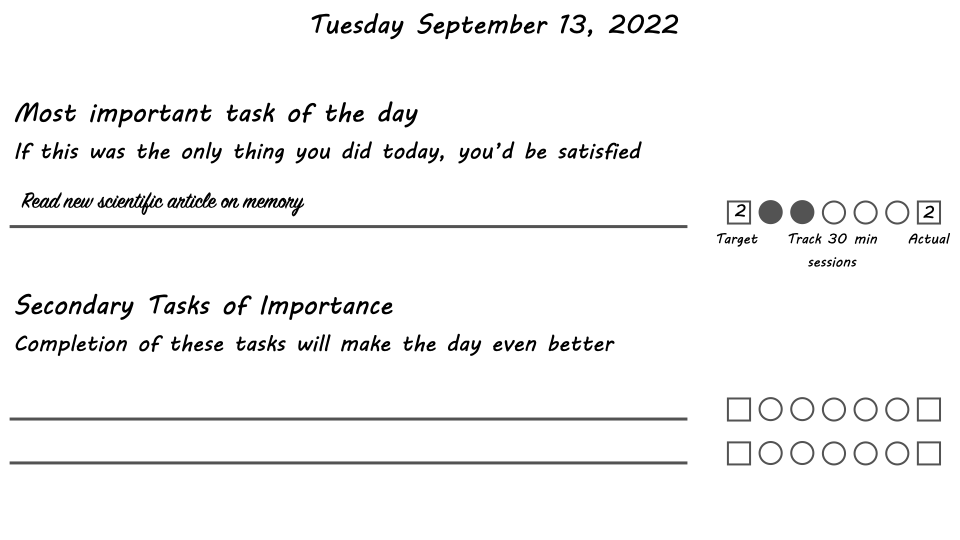
The Productivity Planner, by Intelligent Change, leverages implementation intentions, prioritization, and time tracking.

Turning a behavior into a habit

Ultimately, productivity strategies can vary from person to person. The strategies offered here can be thought of as tools to help you stay on track when pursuing your goals, and some may stick better than others. Having a system in place to help with productivity can be powerful in developing good habits. This is because repeating certain behaviors can help to reinforce a habit by increasing motivation to perform the same action again, eventually leading to a more automatic (i.e. easier) experience. This process is known as a habit formation loop - a cycle whereby repeated behaviors become more naturally rewarding and easier to perform. Although staying productive is important in the accomplishment of our goals, we are only human, and not every day will be productive. This is why introducing some flexibility into goal-setting, and practicing acceptance when things don’t go as planned, can be just as important.

Eye Movements During Sleep May Represent Head Movement in the Virtual Dream World

Post by Lani Cupo

The takeaway

In mice, researchers discovered that eye movements during sleep reflect changes in virtual head direction, suggesting that in dreaming humans’ eye movement may reflect changes in the virtual environment.

What's the science?

It is well known that dreaming occurs during the so-called Rapid Eye Movement “REM” phase of sleep, however, whether the eye movements that give the phase its name represent random muscular activity, or whether they correlate with the virtual environment of dreams is still an open question. This week in Science, Senzai and colleagues used mice to demonstrate that the activity of cells that fire, when the head is in a particular direction, correlates with eye movements during sleep.

How did they do it?

Head direction cells are a population of neurons that fire when the mouse’s head orients in a particular direction. While they can be found in different brain regions, the authors examined them in the thalamus. The authors embedded silicone probes in the thalamus to record the cellular activity while recording eye movements with head-mounted cameras. Mice were allowed to explore an arena and to fall asleep naturally (no anesthesia), with their sleep identified as REM or non-REM. First, the authors examined the relationship between internal representation of head direction (from the cellular activity) with saccade-like eye movements, where the eyes move quickly between two fixation points in the visual field. Second, the authors identified the properties of eye movement during REM sleep. Finally, they examined the relationship between internal representation of head direction and eye movements during REM sleep.

What did they find?

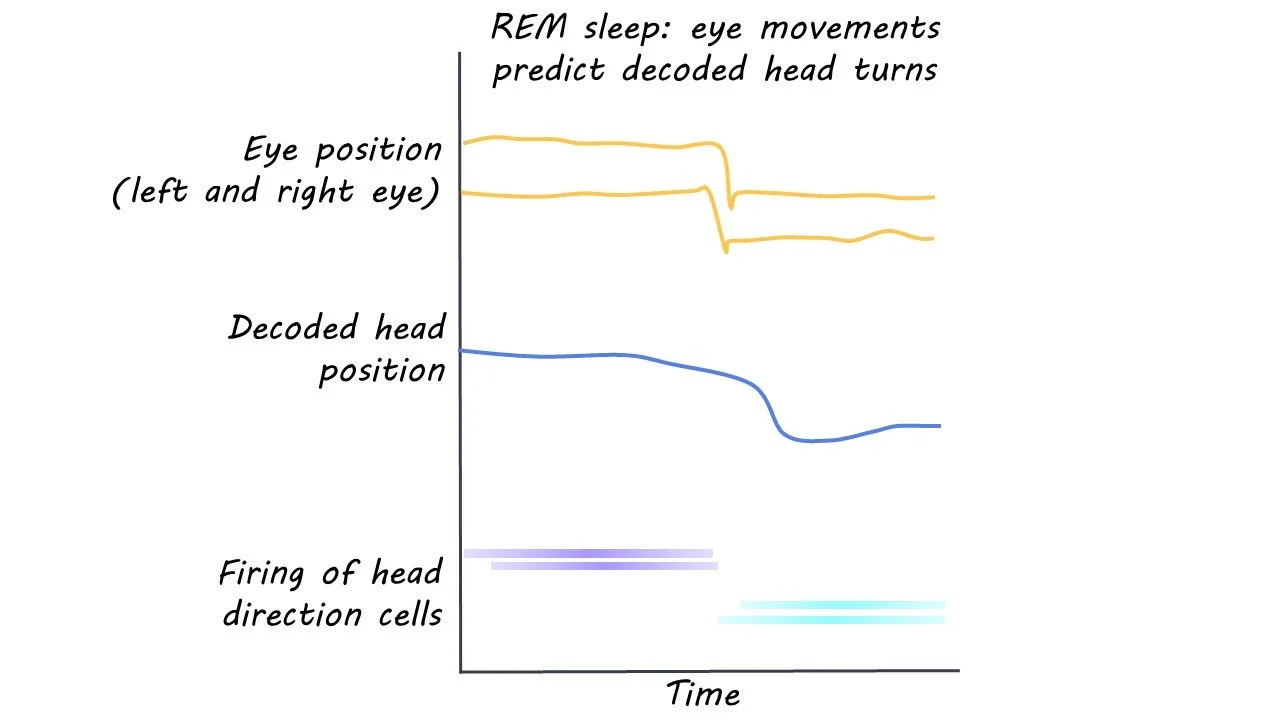
As expected, during wakefulness, clockwise and counterclockwise saccades correlate with head movements clockwise and counterclockwise respectively. The authors trained a statistical model only with data from the head direction cells and found that the model could accurately determine the mouse’s head direction in the environment. To their first question, the vast majority of saccades occurred simultaneously in the same direction as the head movement. Using the model they had trained on head direction cells during wakefulness, in the sleeping phase the authors decoded “virtual heading”, or the head direction indicated by the head direction cells. Changes in virtual head direction occurred with similar patterns to real turns in wakefulness. To their second question, the authors categorized saccades into two groups: “leading” eye movements, which were not preceded by any eye movement for 400 ms, or “followers”, which occurred less than 400 ms after another saccade. To their third question, the authors found that leading saccades predicted not only the direction of virtual head movements but also the amplitude, as represented by the firing cells. In contrast with leading movements, followers tended to recenter the eye, moving in the opposite direction of the leading movement. Thus, most followers tended to be opposite the direction of changes in the virtual head direction, with the exception of those with the largest amplitudes.

What's the impact?

This study provides evidence that eye movements are tightly coupled with internal representations of head direction. Therefore, eye movements during sleep are likely an external readout of internal processes. Ultimately, eye movements may allow a deeper understanding of the neurophysiological mechanisms coordinating the experience of dreaming.

Access the original scientific publication here.

How "Groove" Influences our Brain and Behavior

Post by Anastasia Sares

The takeaway

Making and moving to music is a deep-rooted human behavior. Recent research reveals that groove in music can stimulate reward networks in the brain, hold our attention, and increase our walking speed. Besides being a fascinating subject, the study of groove may lead to therapeutic applications in Parkinson’s disease.

What is groove?

What does it mean for music to have “groove?” In a survey, Janata and colleagues asked people to define the concept and to identify whether pieces of music had high or low groove. Besides “music” and “groove”, the most popular words in people’s definitions were “move,” “beat,” “rhythm,” “dance,” and “feel.” From this, we can understand that groove has something to do with rhythm and movement. The song with the highest groove rating was “Superstition” by Stevie Wonder. In a second experiment with different participants, low, medium, and high groove songs were played and participants either tapped along isochronously (a steady, regular beat), free-form (with whatever rhythm they chose), or not at all. Videos of these sessions were observed for spontaneous movements, like foot-tapping, and there were more of these spontaneous movements in response to high-groove music. This work established groove as a quantifiable concept in psychology.

Since Janata and colleagues’ influential paper, other psychologists have started picking the concept of groove apart. Witek and colleagues demonstrated that the feeling of groove was related to rhythmic syncopation (i.e. when sounds occur off the main beat) and that this followed a classic “inverted U” shape present in many cognitive and emotional phenomena—when there was very little syncopation the groove was rated as low, with more syncopation the groove increased, and when there was too much syncopation the groove was lost. Matthews and colleagues additionally showed that harmonic complexity (the kinds of notes and chords used) can increase the feeling of groove.

How does groove influence us?

Groove grabs our attention and induces feelings of pleasure and reward. Researchers have quantified this with different neuroimaging methods: for example, an MRI study revealed that more groovy music activated key brain areas associated with reward (nucleus accumbens, caudate, and medial orbitofrontal cortex). A recent study using pupillometry (measuring the size of the pupil in the eye) showed that people’s pupils stayed wide for longer when listening to optimally groovy music—this can indicate cognitive engagement, enjoyment, or general physiological arousal. Another study demonstrated that listening to groovy music while walking can increase the length and regularity of our strides.

What are the applications?

One of the major applications of musical rhythm in a clinical context is through a type of music therapy called Rhythmic Auditory Stimulation (RAS). This technique uses strong rhythms to help people with Parkinson’s disease initiate movements like walking. Further, synchronizing auditory cues with movements can help to improve gait, in individuals with Parkinson’s disease or other neurological conditions. Music may be more helpful than a simple metronome for this kind of therapy, and studying groove may help us understand what types of music are most effective for different people.

References +

  1. Janata, P., Tomic, S. T., & Haberman, J. M. (2012). Sensorimotor coupling in music and the psychology of the groove. Journal of Experimental Psychology. General, 141(1), 54–75. https://doi.org/10.1037/a0024208

  2. Stupacher, J., Hove, M. J., Novembre, G., Schütz-Bosbach, S., & Keller, P. E. (2013). Musical groove modulates motor cortex excitability: A TMS investigation. Brain and Cognition, 82(2), 127–136. https://doi.org/10.1016/j.bandc.2013.03.003

  3. Witek, M. A. G., Clarke, E. F., Wallentin, M., Kringelbach, M. L., & Vuust, P. (2014). Syncopation, Body-Movement and Pleasure in Groove Music. PLoS ONE, 9(4), e94446. https://doi.org/10.1371/journal.pone.0094446

  4. Matthews, T., Witek, M., Heggli, O. A., Penhume, V., & Vuust, P. (2019). The sensation of groove is affected by the interaction of rhythmic and harmonic complexity. 29(January), 545–552. https://doi.org/10.1371/journal.pone.0204539

  5. Ready, E. A., McGarry, L. M., Rinchon, C., Holmes, J. D., & Grahn, J. A. (2019). Beat perception ability and instructions to synchronize influence gait when walking to music-based auditory cues. Gait & Posture, 68, 555–561. https://doi.org/10.1016/j.gaitpost.2018.12.038

  6. Matthews, T. E., Witek, M. A. G., Lund, T., Vuust, P., & Penhune, V. B. (2020). The sensation of groove engages motor and reward networks. NeuroImage, 214, 116768. https://doi.org/10.1016/j.neuroimage.2020.116768

  7. Spiech, C., Sioros, G., Endestad, T., Danielsen, A., & Laeng, B. (2022). Pupil drift rate indexes groove ratings. Scientific Reports, 12(1), 11620. https://doi.org/10.1038/s41598-022-15763-w

  8. Ready, E. A., Holmes, J. D., & Grahn, J. A. (2022). Gait in younger and older adults during rhythmic auditory stimulation is influenced by groove, familiarity, beat perception, and synchronization demands. Human Movement Science, 84, 102972. https://doi.org/10.1016/j.humov.2022.102972