
Eye Movements During Sleep May Represent Head Movement in the Virtual Dream World

Post by Lani Cupo

The takeaway

In mice, researchers discovered that eye movements during sleep reflect changes in virtual head direction, suggesting that in dreaming humans’ eye movement may reflect changes in the virtual environment.

What's the science?

It is well known that dreaming occurs during the so-called Rapid Eye Movement “REM” phase of sleep, however, whether the eye movements that give the phase its name represent random muscular activity, or whether they correlate with the virtual environment of dreams is still an open question. This week in Science, Senzai and colleagues used mice to demonstrate that the activity of cells that fire, when the head is in a particular direction, correlates with eye movements during sleep.

How did they do it?

Head direction cells are a population of neurons that fire when the mouse’s head orients in a particular direction. While they can be found in different brain regions, the authors examined them in the thalamus. The authors embedded silicone probes in the thalamus to record the cellular activity while recording eye movements with head-mounted cameras. Mice were allowed to explore an arena and to fall asleep naturally (no anesthesia), with their sleep identified as REM or non-REM. First, the authors examined the relationship between internal representation of head direction (from the cellular activity) with saccade-like eye movements, where the eyes move quickly between two fixation points in the visual field. Second, the authors identified the properties of eye movement during REM sleep. Finally, they examined the relationship between internal representation of head direction and eye movements during REM sleep.

What did they find?

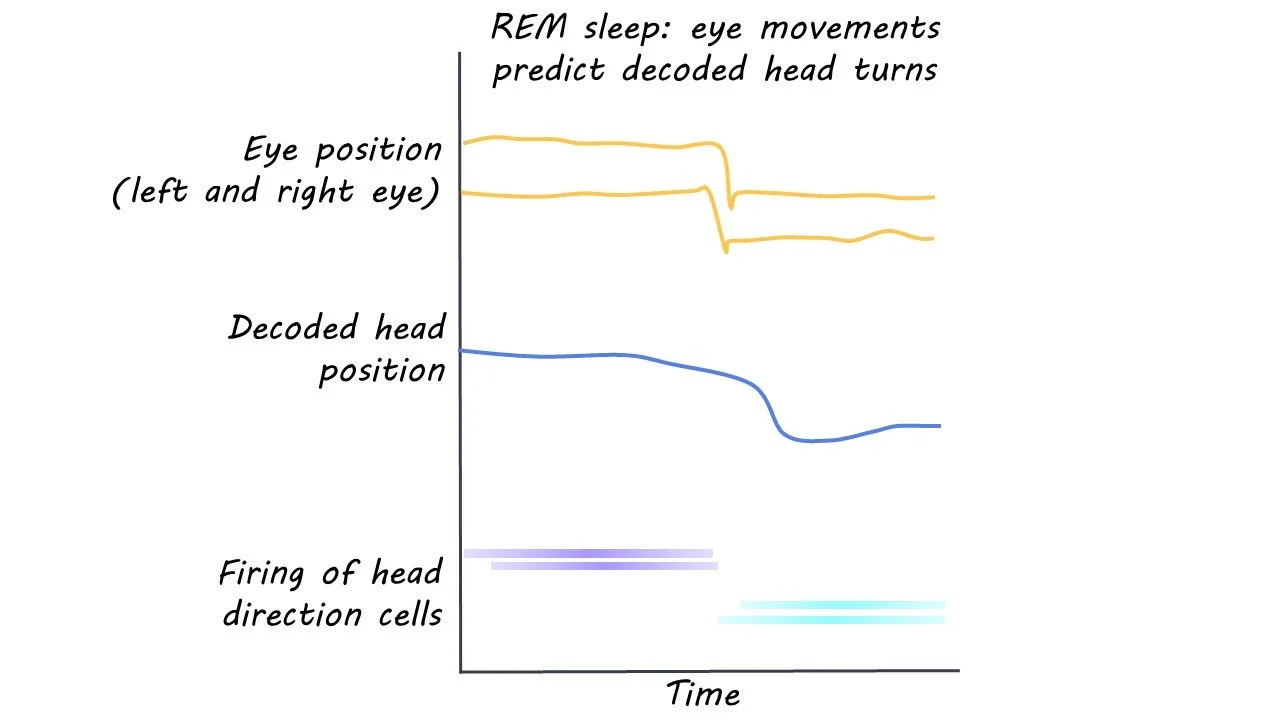
As expected, during wakefulness, clockwise and counterclockwise saccades correlate with head movements clockwise and counterclockwise respectively. The authors trained a statistical model only with data from the head direction cells and found that the model could accurately determine the mouse’s head direction in the environment. To their first question, the vast majority of saccades occurred simultaneously in the same direction as the head movement. Using the model they had trained on head direction cells during wakefulness, in the sleeping phase the authors decoded “virtual heading”, or the head direction indicated by the head direction cells. Changes in virtual head direction occurred with similar patterns to real turns in wakefulness. To their second question, the authors categorized saccades into two groups: “leading” eye movements, which were not preceded by any eye movement for 400 ms, or “followers”, which occurred less than 400 ms after another saccade. To their third question, the authors found that leading saccades predicted not only the direction of virtual head movements but also the amplitude, as represented by the firing cells. In contrast with leading movements, followers tended to recenter the eye, moving in the opposite direction of the leading movement. Thus, most followers tended to be opposite the direction of changes in the virtual head direction, with the exception of those with the largest amplitudes.
What's the impact?

This study provides evidence that eye movements are tightly coupled with internal representations of head direction. Therefore, eye movements during sleep are likely an external readout of internal processes. Ultimately, eye movements may allow a deeper understanding of the neurophysiological mechanisms coordinating the experience of dreaming.
Access the original scientific publication here.

How "Groove" Influences our Brain and Behavior

Post by Anastasia Sares

The takeaway

Making and moving to music is a deep-rooted human behavior. Recent research reveals that groove in music can stimulate reward networks in the brain, hold our attention, and increase our walking speed. Besides being a fascinating subject, the study of groove may lead to therapeutic applications in Parkinson’s disease.

What is groove?

What does it mean for music to have “groove?” In a survey, Janata and colleagues asked people to define the concept and to identify whether pieces of music had high or low groove. Besides “music” and “groove”, the most popular words in people’s definitions were “move,” “beat,” “rhythm,” “dance,” and “feel.” From this, we can understand that groove has something to do with rhythm and movement. The song with the highest groove rating was “Superstition” by Stevie Wonder. In a second experiment with different participants, low, medium, and high groove songs were played and participants either tapped along isochronously (a steady, regular beat), free-form (with whatever rhythm they chose), or not at all. Videos of these sessions were observed for spontaneous movements, like foot-tapping, and there were more of these spontaneous movements in response to high-groove music. This work established groove as a quantifiable concept in psychology.

Since Janata and colleagues’ influential paper, other psychologists have started picking the concept of groove apart. Witek and colleagues demonstrated that the feeling of groove was related to rhythmic syncopation (i.e. when sounds occur off the main beat) and that this followed a classic “inverted U” shape present in many cognitive and emotional phenomena—when there was very little syncopation the groove was rated as low, with more syncopation the groove increased, and when there was too much syncopation the groove was lost. Matthews and colleagues additionally showed that harmonic complexity (the kinds of notes and chords used) can increase the feeling of groove.

How does groove influence us?

Groove grabs our attention and induces feelings of pleasure and reward. Researchers have quantified this with different neuroimaging methods: for example, an MRI study revealed that more groovy music activated key brain areas associated with reward (nucleus accumbens, caudate, and medial orbitofrontal cortex). A recent study using pupillometry (measuring the size of the pupil in the eye) showed that people’s pupils stayed wide for longer when listening to optimally groovy music—this can indicate cognitive engagement, enjoyment, or general physiological arousal. Another study demonstrated that listening to groovy music while walking can increase the length and regularity of our strides.

What are the applications?

One of the major applications of musical rhythm in a clinical context is through a type of music therapy called Rhythmic Auditory Stimulation (RAS). This technique uses strong rhythms to help people with Parkinson’s disease initiate movements like walking. Further, synchronizing auditory cues with movements can help to improve gait, in individuals with Parkinson’s disease or other neurological conditions. Music may be more helpful than a simple metronome for this kind of therapy, and studying groove may help us understand what types of music are most effective for different people.

References +

  1. Janata, P., Tomic, S. T., & Haberman, J. M. (2012). Sensorimotor coupling in music and the psychology of the groove. Journal of Experimental Psychology. General, 141(1), 54–75. https://doi.org/10.1037/a0024208

  2. Stupacher, J., Hove, M. J., Novembre, G., Schütz-Bosbach, S., & Keller, P. E. (2013). Musical groove modulates motor cortex excitability: A TMS investigation. Brain and Cognition, 82(2), 127–136. https://doi.org/10.1016/j.bandc.2013.03.003

  3. Witek, M. A. G., Clarke, E. F., Wallentin, M., Kringelbach, M. L., & Vuust, P. (2014). Syncopation, Body-Movement and Pleasure in Groove Music. PLoS ONE, 9(4), e94446. https://doi.org/10.1371/journal.pone.0094446

  4. Matthews, T., Witek, M., Heggli, O. A., Penhume, V., & Vuust, P. (2019). The sensation of groove is affected by the interaction of rhythmic and harmonic complexity. 29(January), 545–552. https://doi.org/10.1371/journal.pone.0204539

  5. Ready, E. A., McGarry, L. M., Rinchon, C., Holmes, J. D., & Grahn, J. A. (2019). Beat perception ability and instructions to synchronize influence gait when walking to music-based auditory cues. Gait & Posture, 68, 555–561. https://doi.org/10.1016/j.gaitpost.2018.12.038

  6. Matthews, T. E., Witek, M. A. G., Lund, T., Vuust, P., & Penhune, V. B. (2020). The sensation of groove engages motor and reward networks. NeuroImage, 214, 116768. https://doi.org/10.1016/j.neuroimage.2020.116768

  7. Spiech, C., Sioros, G., Endestad, T., Danielsen, A., & Laeng, B. (2022). Pupil drift rate indexes groove ratings. Scientific Reports, 12(1), 11620. https://doi.org/10.1038/s41598-022-15763-w

  8. Ready, E. A., Holmes, J. D., & Grahn, J. A. (2022). Gait in younger and older adults during rhythmic auditory stimulation is influenced by groove, familiarity, beat perception, and synchronization demands. Human Movement Science, 84, 102972. https://doi.org/10.1016/j.humov.2022.102972

Long-Term Memory Formation Occurs Differently During Wakefulness and Sleep

Post by Lincoln Tracy

The takeaway

Long-term memories can be formed while we are awake, not just while we are asleep. However, the quality of memory consolidation varies depending on whether we are awake or asleep.

What's the science?

Sleep has long been heralded as a key promotor of consolidating newly encoded information into actual memories. Recent research suggests long-term memory consolidation can also occur while we are awake, but the mechanisms of wakeful memory consolidation are not well understood. This week in PNAS, Sawangjit and colleagues explored how long-term memory formation following a novel object recognition (NOR) task occurs in rats that had slept or remained awake after the initial encoding period.

How did they do it?

Rats were placed in an open field area and allowed to explore two identical objects for 10 minutes to familiarize themselves with the room, the area, and the objects (encoding phase). Immediately after, the rats had a two-hour post-encoding (or consolidation) phase where they were either allowed to sleep or kept awake. One week later, rats were returned to the area for the retrieval phase, where one of the objects was novel (retrieval or recall phase). The authors compared the time the rat devoted to exploring the novel object in comparison to the old object they had seen the week before. Rearing behavior (i.e., the rat standing on its hind legs) was also analyzed to assess how environmental context contributed to memory recall.

First, the authors tested the effects of sleep and wakefulness on long-term memory formation and recall. Second, they investigated whether the hippocampus makes an essential contribution to long-term memory formation during both sleep and wakefulness. To do this, they injected muscimol, a GABA-A receptor agonist, into the dorsal hippocampus 30 minutes after the rats fell asleep (and at a comparable time for the rats who remained awake) after the initial encoding session. Memory recall was tested one week later. Third, they tested NOR memory recall in a different context to what the rats were originally exposed to. That is, the recall component took place in a different arena, in a different room, with a different experimenter observing the rats. Finally, they analyzed electroencephalography (EEG) recordings of rats that slept after the NOR task to identify the specific mechanisms contributing to sleep-dependent memory consolidation. Like the previous behavioral tasks, they also tested the effect of muscimol on these potential mechanisms.

What did they find?

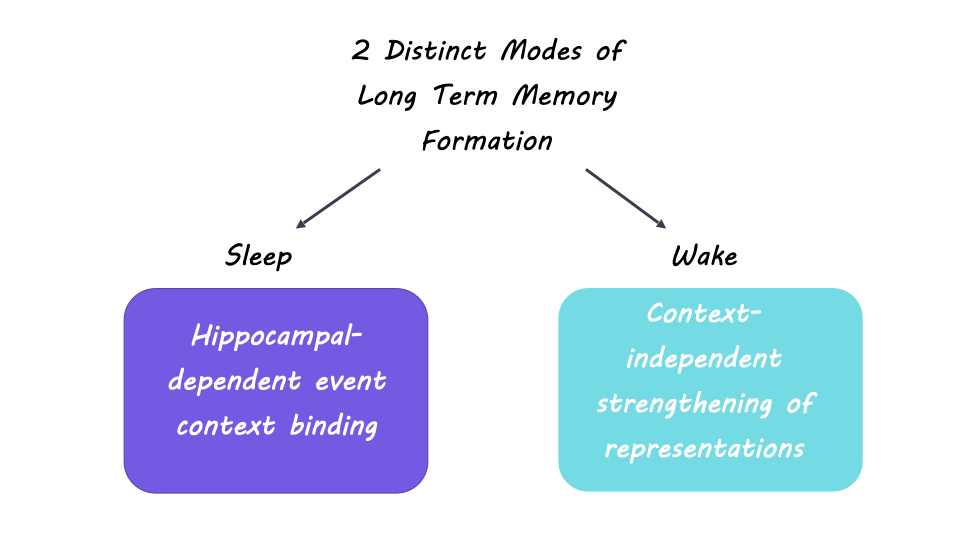
First, the authors found that although the rats that were kept awake displayed some long-term memory recall after a week, rats that slept after the encoding phase spent more time exploring the new object and less time exploring the familiar object (i.e., enhanced NOR performance). This suggests wakeful long-term memory consolidation is less effective than sleep consolidation. In addition, the rats that slept displayed fewer rearing behaviors in the retrieval phase compared to the encoding phase, while the rats that stayed awake displayed the same level of rearing across both sessions. This indicates the rats who were kept awake had no recollection of spatial context. Second, the authors found muscimol administration during sleep decreased NOR performance and maintained a higher level of rearing behavior in retrieval testing. In contrast, rats that were kept awake and received muscimol displayed enhanced NOR performance and did not affect rearing behavior during retrieval testing. Taken together, this suggests hippocampal inactivation influences memory consolidation during sleep and wakefulness in opposite directions, as well as selectively preventing rearing behaviors during sleep. 

Third, the rats who slept after encoding showed no improvements in NOR performance when tested in a different context, while rats that were kept awake displayed robust NOR performance during retrieval testing. This implies object memory after wakeful consolidation is less well integrated with the context in which the information is learned, meaning it can be retrieved more easily in a different context. This implication is corroborated by the changes in rearing behavior. Rats that slept displayed increased rearing behavior during retrieval testing, while rats that were kept awake displayed similar levels. Finally, the authors found sleep spindles and slow oscillation-spindle events were associated with enhanced NOR performance.

What's the impact?

This study found there are two distinct ways that long-term memory formation can occur, albeit with differences in quality and quantity of memory encoding. During sleep, memory consolidation relies on hippocampal involvement and may involve linkages between event and context information. In contrast, wakeful consolidation is disrupted by hippocampal activation and implies that the context in which information was learned is less important.