How the Brain Integrates Our External and Internal Worlds

Post by Lani Cupo

The takeaway

Humans are capable not only of intelligible communication with others, but also private internal thought, both of which are represented separately in the brain. The interaction between the two is facilitated by convergence of these systems in two hub regions of the brain.

What's the science?

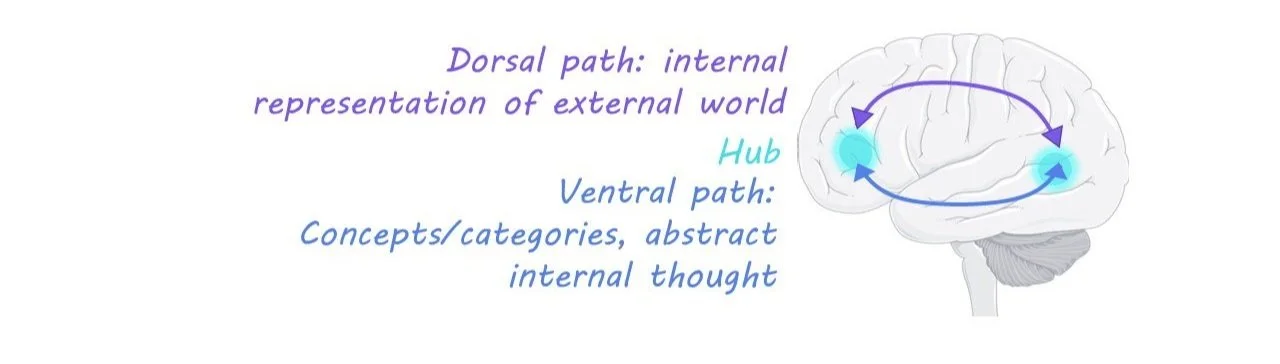
As humans, we perceive the external world through senses, and act upon it with various muscle groups, allowing communication with others. We are also capable of internal thought, allowing us to consider abstract concepts and plan for the future. The brain regions underlying these processes have been fairly well characterized as two segregated systems. There is the dorsal system, which is dedicated to analyzing the external world in terms of space and time, allowing us to perceive and act upon it, while the ventral system is dedicated to meaning, allowing our internal world to comprehend more than the immediate environment. It was previously unknown if and how these systems interact, however this week in NeuroImage, Weiller and colleagues identified hub regions in the brain where the dorsal and ventral systems interact, connecting the “dual-loop” of the dorsal and ventral systems and regulating syntax across cognitive domains, both internal and external.

How did they do it?

The authors used diffusion magnetic resonance imaging (dMRI) data, a technique which allows researchers to estimate reconstructions of white matter tracts in the brain by analyzing the characteristics of water molecules’ diffusion. First the authors modelled the fiber tracts with information about their directional trajectories, known as “streamlines”, as well as where each streamline terminates (where the white matter tract ends). They specifically examined regions of interest corresponding with the dorsal and ventral language systems of the brain. Next, the authors calculated which cortical regions, or hubs, intersected both dorsal and ventral tracts. Finally, they examined hemispherical differences between the hubs, assessing whether the same brain areas were identified on the left and right hemisphere. Having identified the regions, the authors examine the involved brain structures through the context of evolutionary development, with phylogenetic trees and lifetime development with the process of myelination.

What did they find?

First the authors found two major streamline systems that cover the majority of the brain with dorsal streamlines that includes many primary sensory and motor areas, and a ventral streamline system that includes further regions, such as the frontal, temporal, and occipital poles. The authors then identified two cortical hubs at the intersection of the dorsal and ventral tracts: one in the frontal cortex (largely the lateral prefrontal cortex and inferior frontal gyrus [IFG]), and one posterior hub in the middle temporal gyrus (MTG). The hubs close the loop between the dorsal and ventral tracts, which can allow recursive thought and internalization even without external feedback. While the hubs were identified in both the left and right hemispheres, there were inter-hemispheric differences in the exact regions involved, such as increased involvement of the temporal gyrus in the left hemisphere and more regions in the IFG in the right hemisphere. The hub regions are high-level multimodal areas, meaning they receive information from many lower-level processing regions (such as primary sensory regions), and are well connected throughout the brain. In particular, the MTG is responsible for processes related to language comprehension and conceptual knowledge, while the IFG has previously been implicated as an intersection between ventral and dorsal systems. These regions are among some of the last to emerge through evolution, changing significantly between macaque monkeys and humans, and they are also among the last to be myelinated and finish developing.
What's the impact?

This study suggests that the identified regions integrate the ventral and dorsal systems, providing syntax for both external communication and internal thought. Of note, the authors do not suggest that syntax takes place wholly within these regions, but instead these regions are necessary to integrate the parallel computations of the two separate systems. The findings of the authors discuss traits that are uniquely human lending insight into what sets us apart from other animals. 
Access the original scientific publication here.

Electrical Modulation Boosts Memory Performance in Older Adults

Post by Anastasia Sares

The takeaway

Electrical neuromodulation, when “dialed-in” correctly, enhanced certain types of memory in a group of older adults. Depending on the region modulated and the frequency of the alternating electric current, participants’ memory of either the beginning or the end of a list of words improved—which could reflect separate boosts in short and long-term memory.

What's the science?

It has been over 80 years since the introduction of electroconvulsive therapy (ECT). Though its history is fraught with misuse and lack of consent, the technique of electrically modulating the brain has survived to today, becoming more precise, well-researched, and ethically implemented. Nowadays, there are several varieties of electrical neuromodulation, some of which have less intensity and fewer side-effects. They gently modify how neurons fire rather than stimulating new firing. Some of these new techniques are said to increase brain plasticity (the ability for the brain to be malleable and learn new things), which could be especially useful for older adults who are beginning to experience cognitive decline. This week in Nature Neuroscience, Grover and colleagues applied specific electric currents to targeted brain areas in older adults and found that each of these improved memory in a different way.

How did they do it?

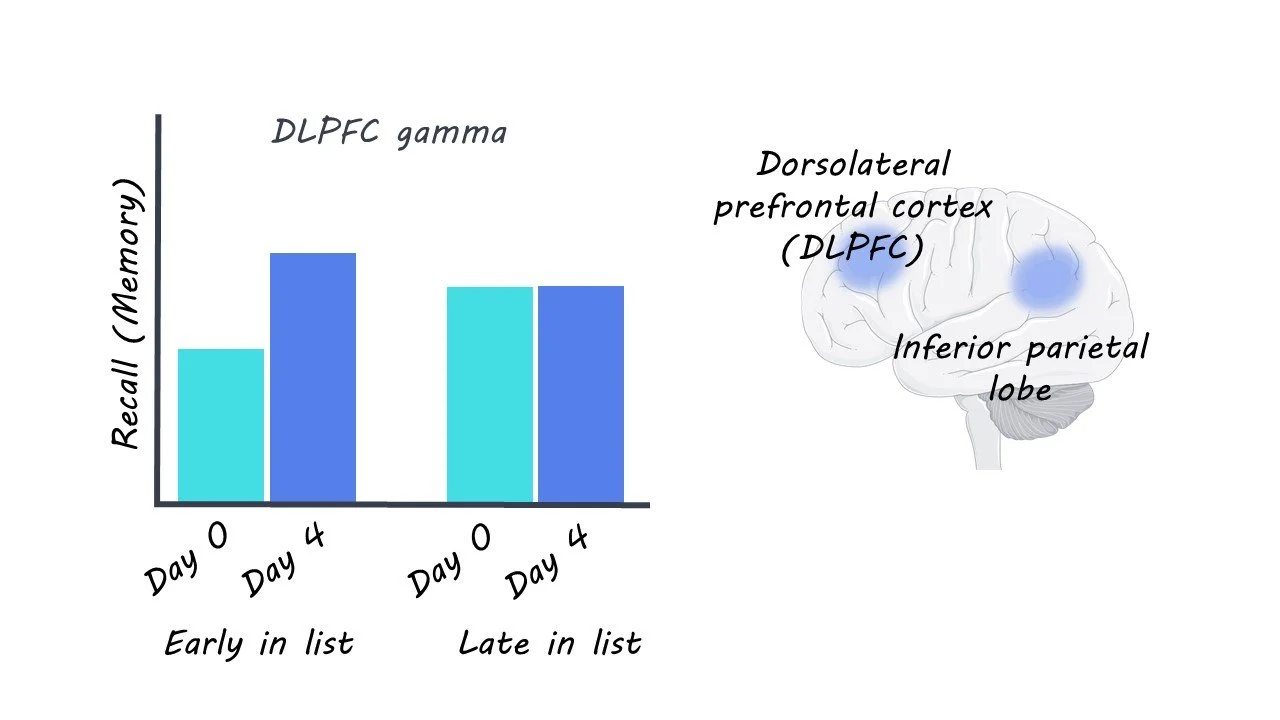
The authors randomly assigned their older adult participants to one of three groups: 1) gamma wave modulation (60 cycles per second) above the dorsolateral prefrontal cortex (in the frontal region of the brain), 2) theta wave modulation (4 cycles per second) above the inferior parietal lobe (further back in the brain, just above and behind the ears), and 3) a sham condition (where the machine was making noises but not actually passing any electric current).

The modulation (transcranial alternating-current stimulation, or tACS) took place over 4 sessions, with a 1-month follow-up to see if there were any longer-lasting effects. During modulation, the participants tried to memorize lists of words, and their performance was recorded. They did this because it has been shown that doing a task during modulation can improve performance specifically for the networks implicated in the task.

Next, they repeated the whole task, but with a different group of people and with the gamma and theta frequencies swapped for the two distinct parts of the brain (theta in frontal and gamma in parietal), to see if it mattered which frequency was used over which brain area. And finally, they performed a third experiment, similar to the first, to see if their results were replicable.

What did they find?

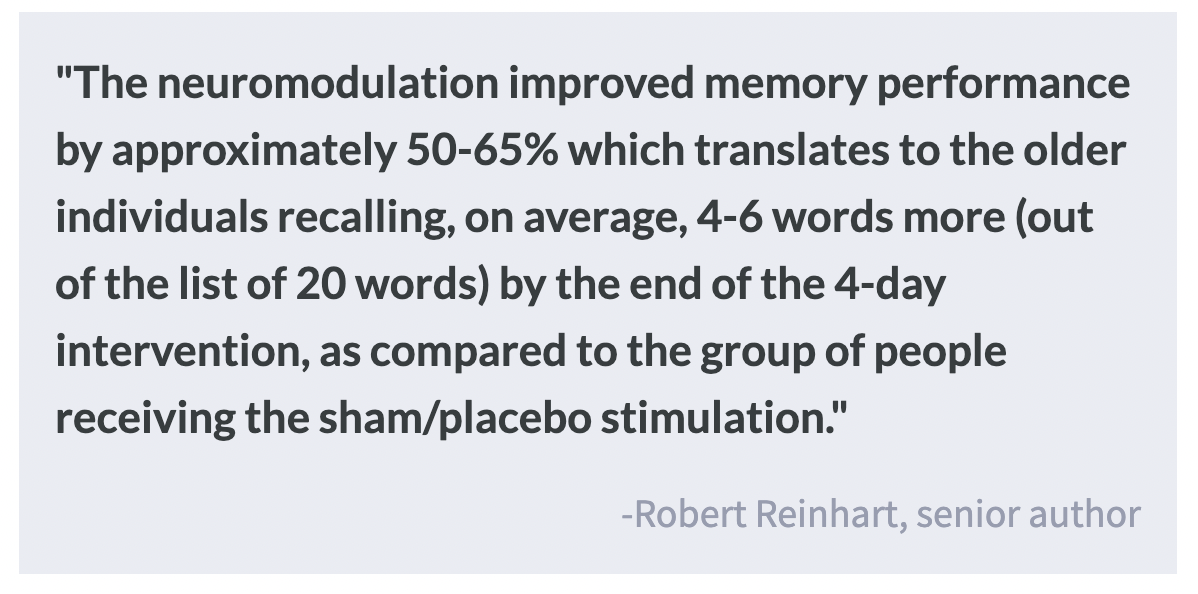
In people who had the sham condition (no actual brain modulation), performance did not improve (as expected). In people who had the gamma wave modulation above frontal regions, memory for words at the beginning of the lists improved. For people who had theta modulation over parietal regions, memory for words at the end of lists improved. The authors emphasized how these results are consistent with the “dual-store” theory of memory, with recall for the beginning of the lists reflected long-term memory and recall for the end of the lists reflected short-term memory (or working memory).

For both experimental groups, improvement could still be seen at the 1-month follow-up. In addition, the greatest benefit was seen in people who had lower cognitive scores to begin with. The findings were replicated in an independent group in the third experiment. In the second experiment where the frequencies were swapped, no memory improvements were observed, meaning that memory performance could only be boosted by a specific frequency of modulation over a specific region of the brain.

What's the impact?

This is an exciting study that shows replicable and lasting effects of neuromodulation on memory in older adults, especially those who have lower cognitive scores. If it can be applied to cases of mild cognitive impairment, before dementia sets in, it could be a revolutionary way to enhance quality of life in the world’s aging population. However, it is important to keep in mind that the neuromodulation had to be paired with a task and repeated many times; it did not offer a global boost to memory capacity.

A New Formula Provides Spatially Precise Gene Editing in the Brain

 Post by Shannon Kelly

The takeaway

Gene editing drugs can be used to change the DNA of brain cells and alter their function. The current study found that a newly developed light-activated gene editing formula allows researchers to control the exact location of gene editing in the brain.

What's the science?

Gene editing is a technology that modifies cells’ DNA and is used both to study gene function and as a therapeutic technique to treat genetic disorders. One of the major limitations to current gene editing techniques is a lack of control over which cells are affected. Previous research examining light-activated gene editing formulas in order to target certain cells has shown limited efficacy and requires invasive techniques. This week in Nature Communications, Rebelo and colleagues demonstrated that a new gene editing formula allows researchers to control where in the brain gene editing occurs using non-invasive near-infrared light waves.

How did they do it?

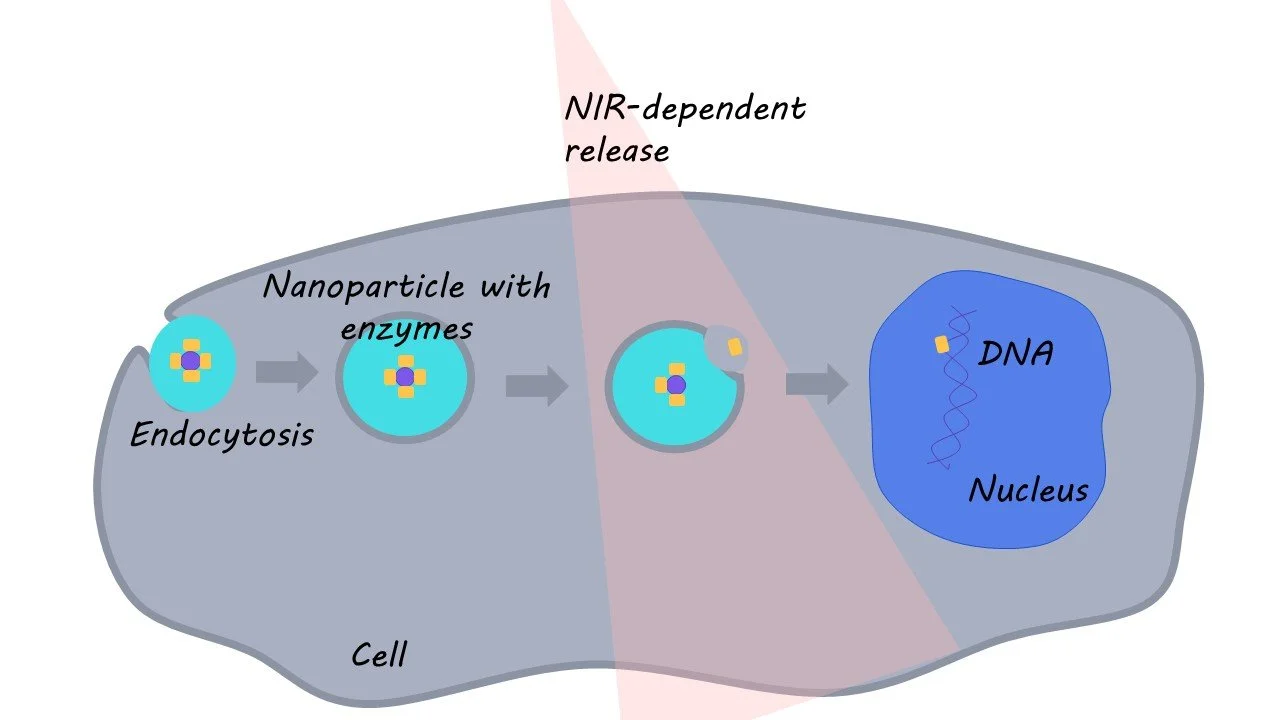
The authors developed a new gene editing method in which gene editing enzymes are attached to nanoparticles which deactivate the enzymes until they are triggered by near-infrared light (NIR; invisible light waves that can safely pass through the skull into the brain). After the formula is injected into the brain and absorbed into brain cells, the researchers selectively exposed some cells to NIR light. If the nanoparticles are exposed to NIR light, they convert it to blue light which breaks their connections to the enzymes. Then, with the help of hydroxychloroquine (a malaria drug), the gene editing enzyme is released from the vesicle which formed as it entered the cell and is free to move to the nucleus where it can modify the cell’s DNA. The authors tested the effects of their gene editing method in the brains of live mice by (1) injecting the drug into the subventricular zone (an area where new brain cells are formed after birth), (2) injecting the drug into the ventral tegmental area (a key component of the reward pathway) and observing mouse behavior, and (3) administering the drug non-invasively through the nose.

What did they find?

In the first experiment, the authors examined stem cells from the subventricular zone after administering the gene editing drug and found that gene editing occurred only in the cells that were exposed to NIR light, demonstrating that NIR light can be used to activate the gene editing formula in select brain cells. In their second experiment, they showed that using the gene editing formula in combination with optogenetics (a method of externally activating brain cells) in the ventral tegmental area affected mouse behavior during a preference test. This finding suggests that the authors were able to influence the mouse’s experience of reward by triggering reward-related brain cell activity. In the final experiment, they found that when the drug was administered intranasally, it dispersed throughout the brain and could be activated in select brain areas using NIR light, suggesting that the drug may be administered effectively using a non-invasive route.

What's the impact?

This study found that a novel technique could provide spatial control of gene editing within the brain. This gene-editing formula may improve the ability of researchers to study brain function at the level of brain cells and circuits. This research also may pave the wave for the development of a new gene therapy technique that could be used to treat brain disorders including those affecting the reward pathway, such as substance use disorder, as well as genetic disorders, such as Fragile X Syndrome.

Access the original scientific publication here.