A New Formula Provides Spatially Precise Gene Editing in the Brain

 Post by Shannon Kelly

The takeaway

Gene editing drugs can be used to change the DNA of brain cells and alter their function. The current study found that a newly developed light-activated gene editing formula allows researchers to control the exact location of gene editing in the brain.

What's the science?

Gene editing is a technology that modifies cells’ DNA and is used both to study gene function and as a therapeutic technique to treat genetic disorders. One of the major limitations to current gene editing techniques is a lack of control over which cells are affected. Previous research examining light-activated gene editing formulas in order to target certain cells has shown limited efficacy and requires invasive techniques. This week in Nature Communications, Rebelo and colleagues demonstrated that a new gene editing formula allows researchers to control where in the brain gene editing occurs using non-invasive near-infrared light waves.

How did they do it?

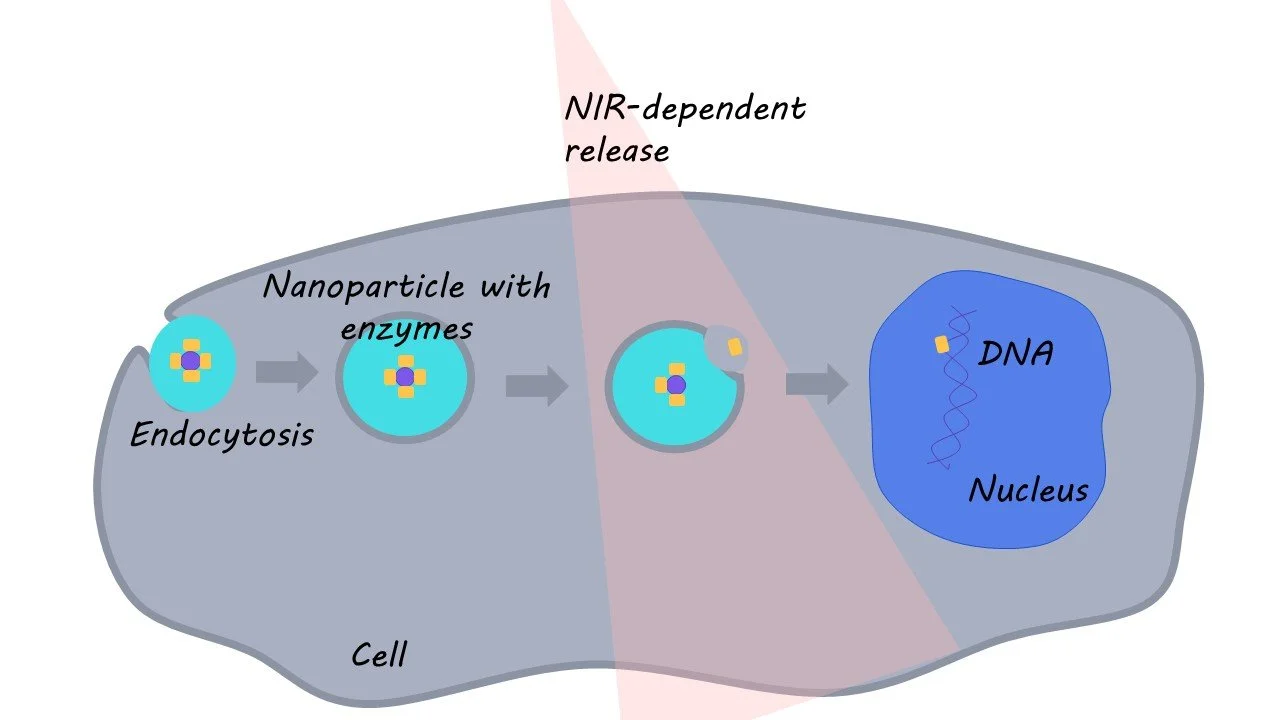
The authors developed a new gene editing method in which gene editing enzymes are attached to nanoparticles which deactivate the enzymes until they are triggered by near-infrared light (NIR; invisible light waves that can safely pass through the skull into the brain). After the formula is injected into the brain and absorbed into brain cells, the researchers selectively exposed some cells to NIR light. If the nanoparticles are exposed to NIR light, they convert it to blue light which breaks their connections to the enzymes. Then, with the help of hydroxychloroquine (a malaria drug), the gene editing enzyme is released from the vesicle which formed as it entered the cell and is free to move to the nucleus where it can modify the cell’s DNA. The authors tested the effects of their gene editing method in the brains of live mice by (1) injecting the drug into the subventricular zone (an area where new brain cells are formed after birth), (2) injecting the drug into the ventral tegmental area (a key component of the reward pathway) and observing mouse behavior, and (3) administering the drug non-invasively through the nose.

What did they find?

In the first experiment, the authors examined stem cells from the subventricular zone after administering the gene editing drug and found that gene editing occurred only in the cells that were exposed to NIR light, demonstrating that NIR light can be used to activate the gene editing formula in select brain cells. In their second experiment, they showed that using the gene editing formula in combination with optogenetics (a method of externally activating brain cells) in the ventral tegmental area affected mouse behavior during a preference test. This finding suggests that the authors were able to influence the mouse’s experience of reward by triggering reward-related brain cell activity. In the final experiment, they found that when the drug was administered intranasally, it dispersed throughout the brain and could be activated in select brain areas using NIR light, suggesting that the drug may be administered effectively using a non-invasive route.
What's the impact?

This study found that a novel technique could provide spatial control of gene editing within the brain. This gene-editing formula may improve the ability of researchers to study brain function at the level of brain cells and circuits. This research also may pave the wave for the development of a new gene therapy technique that could be used to treat brain disorders including those affecting the reward pathway, such as substance use disorder, as well as genetic disorders, such as Fragile X Syndrome.
Access the original scientific publication here.

Self-Modulation of Motor Cortex Activity after Stroke

Post by Elisa Guma

The takeaway

Self-modulation of the motor cortex using neurofeedback training in stroke patients enhances the activity of the affected motor cortex within a training session, but not long term. It also decreases brain white matter asymmetry in the corticospinal tracts detected 1 week after training.

What's the science?

Stroke survivors often face significant motor impairments, which can negatively affect their quality of life. Recent efforts have focused on rehabilitating the brain to improve motor function, rather than the muscles directly, with a particular focus on trying to decrease lateralization of motor cortex activity (i.e., relying less heavily on the unaffected hemisphere). This week in Brain, Sanders and colleagues investigate a novel therapeutic approach in which participants learn to self-modulate brain activity through real-time functional magnetic resonance imaging (fMRI) neurofeedback, which has shown promise in other disorders with aberrant brain activity patterns.

How did they do it?

The authors conducted a double-blind, randomized controlled trial on 24 chronic stroke survivors experiencing motor impairments in their upper limbs (mild to moderate). An initial baseline session was conducted to assess upper limb motor function and to acquire structural and functional magnetic resonance images of the brain. Following a baseline session, participants were equally and randomly split into real (n=12) or sham (n=12) neurofeedback training sessions lasting around 20 minutes for 3 days, with a 24 and then 48-hour break between each session. Participants returned for a 1-week and 1-month follow-up for behavioural assessments and brain imaging.

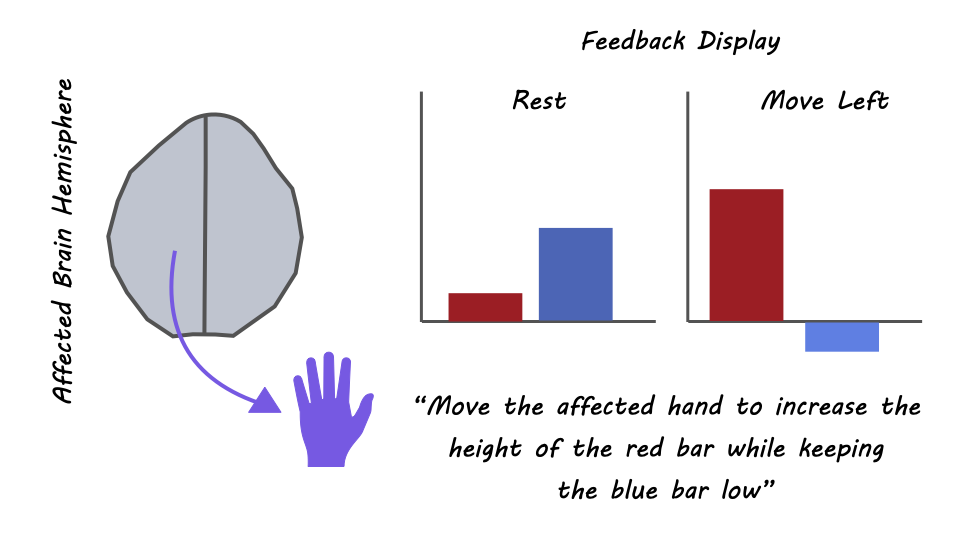
During the neurofeedback training sessions, participants were asked to lie in the fMRI scanner to measure brain activity while they opened and closed their hands (either left or right). Participants were shown two bars - red for the stroke-affected hand, and blue for the non-affected hand - on a screen representing neural activity within the hand knob region of the sensorimotor cortex. The training element of this task required participants to try to increase the size of the red bar (for the stroke-affected hand) while keeping the blue bar the same, using whichever strategy they preferred (ex: closing the hand or tapping individual fingers). Participants in the sham group received the same instructions as the training group, however they were shown the brain activity of a previous participant’s feedback, not their own, which would prevent them from engaging in neural feedback. Additionally (using both fMRI and electroencephalogram), a visuomotor squeeze task assessed neural activity while participants squeezed a force transducer. During this task they could visualize the force generated as a grey bar which they had to increase to a target yellow line (the harder they squeezed, the taller the grey bar became). Finally, in addition to the functional neuroimaging, both structural and diffusion-weighted scans were acquired at baseline and 1-week follow-up.   

Using activity from each of the motor cortices, a laterality index was calculated by subtraction of the activity of the unaffected limb from the affected limb, divided by the sum of the affected and unaffected, with positive values indicating lateralization towards the affected hemisphere, and negative values indicating lateralization towards the unaffected hemisphere. 

What did they find?

First, the authors found that the laterality index of motor cortex activity for the neurofeedback group improved within training days (across the three sessions), but not across the training sessions, which suggests that after multiple training sessions, the participants were better able to engage the motor cortex of their affected limb, but that these results did not last long term (to the next training sessions). Next, the authors found that both the real and sham groups experienced improvements in motor performance over time and that there was no difference between groups overall. However, when focusing on gross vs. fine motor tasks, a greater improvement in performance was observed in the real group relative to sham.

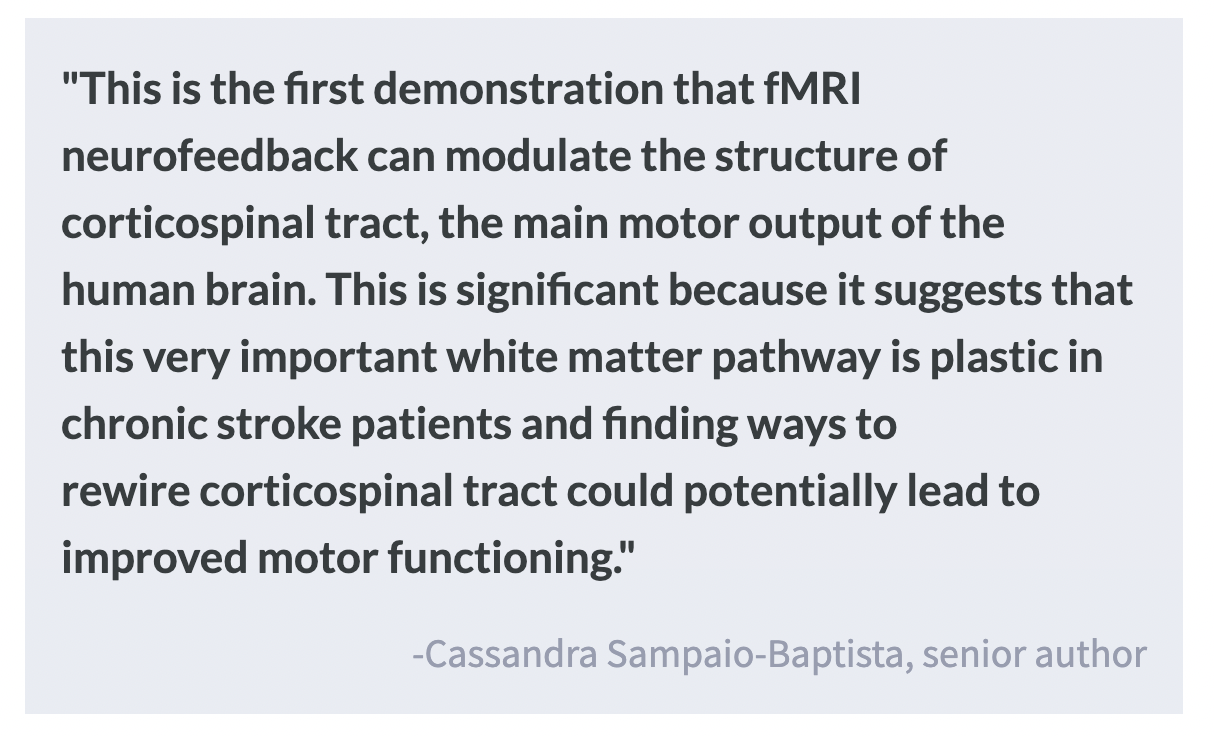
Analysis of the diffusion-weighted data revealed that after 1 week of neurofeedback training, participants experienced a decrease in the asymmetry of white matter structure within the corticospinal tract relative to the sham group. This may reflect an improvement of white matter integrity following neurofeedback, as asymmetry of this white matter bundle has been previously linked with stroke impairment. A correlation between change in white matter structure of the affected corticospinal tract and neurofeedback success was observed in the real group, but not in the sham group. Neurofeedback training did not improve lateralization of brain activity in the visuomotor squeeze task, indicating that there was no carryover effect to other motor functions.

Finally, the authors investigated whether there were changes in brain function outside of the target sensorimotor region and found changes in three significant clusters in the unaffected hemisphere, including the putamen, the lateral occipital cortex, and the parietal operculum cortex, in which the real group increased activity after the neurofeedback training.

What's the impact?

This study finds that stroke survivors were able to use neurofeedback training to increase neural activity in the motor cortex corresponding to their affected limb within a training day, but not across sessions. The neurofeedback also improved gross motor function and reduced structural asymmetry of the corticospinal tract. Overall, this study provides important evidence for the utility of neurofeedback in stroke rehabilitation. Future studies with larger samples and longer follow-ups are needed to determine the utility of this approach for long-term outcomes of stroke patients.

Predicting Cognitive Decline Using Brain Age

Post by Andrew Vo

The takeaway

Brain age is a measure of an individual brain’s deviation from a normative aging trajectory. This measure may serve as a biomarker for personalized prediction, diagnosis, and intervention of age-related cognitive decline and dementia.

What's the science?

Brain age refers to the degree to which an individual’s brain deviates from the average aging process. Greater brain age is associated with cognitive impairment and neurodegenerative diseases such as Alzheimer’s. Previous studies have introduced machine-learning-based brain age models and demonstrated their sensitivity to cognitive functioning as well as amyloid positivity – an indicator of Alzheimer’s disease. However, such models have yet to be independently validated for their generalizability in different ethnic and clinical samples. This week in Molecular Psychiatry, Karim et al. employed their existing brain age model in an independent clinical sample and tested its performance in discriminating patient diagnoses and predicting future cognitive decline.

How did they do it?

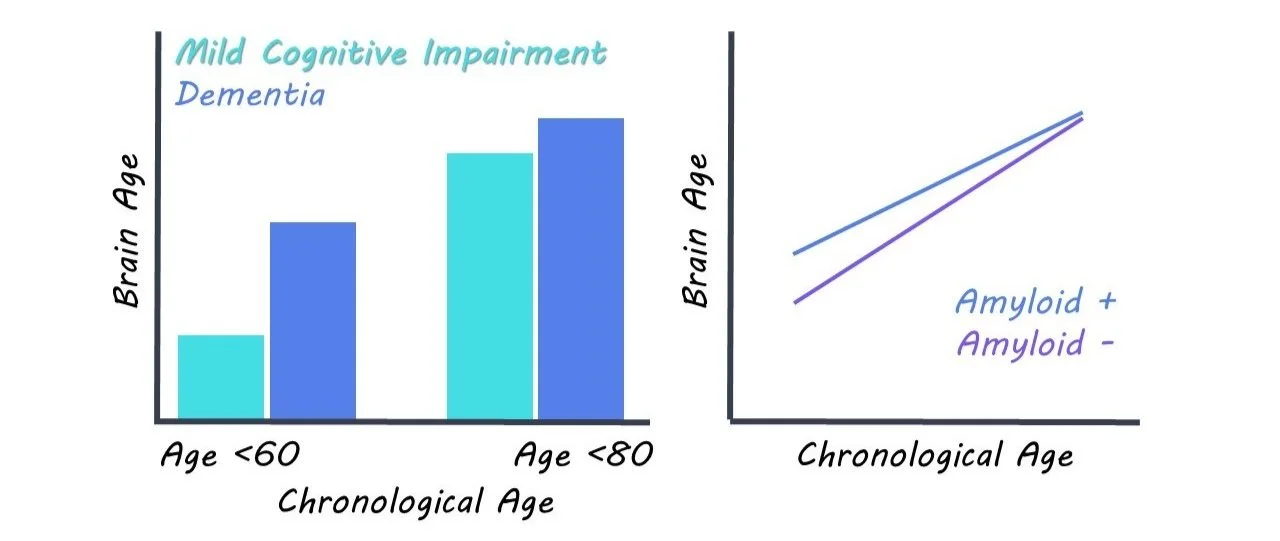
The authors applied their brain age model to a sample of 650 patients from a South Korean memory clinic. Diagnoses ranged from subjective cognitive decline to mild cognitive impairment to overt dementia. All patients underwent magnetic resonance imaging (MRI) to measure grey matter volumes, positron emission tomography (PET) imaging to detect amyloid status, genotyping for APOE4 (the APOE4 genotype places someone at high risk for Alzheimer’s disease), and clinical assessments. A subset of these patients was followed up for cognitive testing one year after baseline. The brain age model used was previously trained on data from a largely Caucasian sample with PET-confirmed amyloid negativity. Each patient’s brain age was estimated as the residual error after regressing out expected effects of age and sex from the normative brain age model. Thus, a higher brain age reflected a brain that appeared “older” than expected at that chronological age. Each patient’s brain age was then related to their clinical measure of cognitive function and longitudinal decline.

What did they find?

Brain ages estimated for the dementia group showed a more pronounced deviation from their chronological age compared to the non-dementia group, particularly for younger patients. Similarly, brain age residuals were greater in patients with dementia compared to those with either subjective cognitive decline or mild cognitive impairment. Greater brain age residuals were associated with more severe cognitive impairment as well as higher amyloid deposition. Examining those patients with longitudinal follow-up data, brain age residual at baseline predicted future cognitive decline even after adjusting for APOE4 or amyloid status.

What's the impact?

This study validated a previous machine-learning-based brain age model in an independent ethnic and clinical sample, demonstrating its generalizability. Brain age differences could be discerned across the dementia continuum and predicted future cognitive decline. Brain age modeling shows promise as a useful tool for predicting and tracking age-related cognitive impairment and neurogenerative disease.

Access the original scientific publication here.