Uncertainty Favors Exploitation While Novelty Drives Exploration

Post by Shireen Parimoo 

The takeaway

The explore-exploit dilemma refers to the competing desires to seek versus avoid novelty and uncertainty. People are more likely to avoid uncertain options in order to maximize reward (exploit bias), except when the option is completely novel (explore bias).

What's the science?

The explore-exploit dilemma is the competition between choosing a known outcome (exploit) or a less known outcome with the potential to learn more (explore). People vary vastly in their decision-making process, especially when it comes to outcome uncertainty. Some people avoid choices with uncertain outcomes (exploit bias), while others seek out uncertainty (explore bias). Similarly, the tendency to explore new options with unknown outcomes also varies across individuals, as novelty inherently contains uncertainty. Computational approaches are useful for modeling behavior because different algorithms reflect different hypotheses about the underlying processes driving behavior. For example, some algorithms prioritize exploration (trying new options) in the beginning to learn the expected reward values, and later favor exploitation (selecting known options) to maximize reward.

Prior research has not distinguished between novelty and uncertainty, making it unclear whether they have different effects on value-based decision-making. This week in Neuron, Cockburn and colleagues used computational modeling and neuroimaging techniques to understand how the brain represents novelty and uncertainty to guide behavior.

How did they do it?

Thirty-two young adults completed 20 blocks of the multi-armed bandit task, a reward-based decision-making task while undergoing fMRI scanning. On each trial, participants were instructed to select one of two slot machines that offered different amounts of monetary reward, with the long-term goal of accumulating as much reward as possible. There were five unique slot machines in each block that were each associated with a fixed reward probability. Three of these machines were familiar and had been encountered on a previous block, while two machines were novel. Importantly, the reward probability value of a familiar machine from a previous block changed across (but not within) blocks. The slot machines varied along three dimensions: (1) reward probability or expected value, (2) novelty, based on the number of previous exposures overall, and (3) uncertainty, based on the number of exposures within that block.

The authors performed logistic regression and computational modeling of the behavioral data to model the influence of expected value, novelty, and uncertainty on the participants’ choice on each trial. The subjective utility of each slot machine choice was determined from the expected value and uncertainty of the choice and was dynamically adapted based on recent reward history and novelty. The authors then identified brain regions that were most responsive to the (1) overall subjective utility of the two choices, (2) total reward value of the two choices, (3) decision-making process associated with the chosen slot machine, as well as their (4) expected value and (5) uncertainty. Finally, they examined patterns of brain activity associated with reward prediction errors with and without the effect of novelty in the computational model to determine how novelty and uncertainty are represented in the brain.

What did they find?

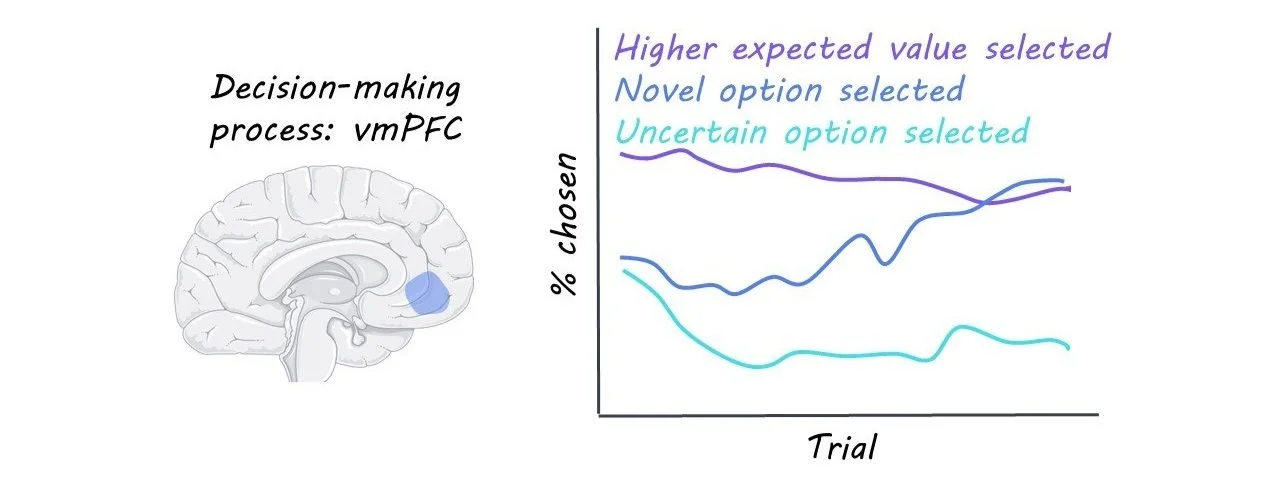
Slot machines with a higher expected reward value were selected more than those with a lower expected value. New machines were chosen over familiar machines when the difference in expected reward was large, whereas the uncertain option was chosen when the difference in expected reward was small (i.e., there was a larger potential payoff from the uncertain machine). The effect of novelty increased as the trials progressed, as participants became more likely to choose the new machine over time. In contrast, the opposite was true for uncertainty as participants avoided the uncertain choice over time. The computational model also captured this pattern of behavior, demonstrating that people favor exploitation and avoid uncertainty over time unless the choice involves a completely novel option.

Several brain regions tracked the subjective utility and total expected reward value of the two choices, including the ventromedial prefrontal cortex (VMPFC), ventral striatum, and the posterior cingulate cortex. The decision-making process was represented in the VMPFC, while regions of the ventral and dorsal medial PFC were associated with expected reward value and degree of uncertainty, respectively. Paralleling the behavioral results, VMPFC activity associated with uncertainty was no longer present when novelty was included in the model, indicating that novelty inhibits the effect of uncertainty on decision-making

What's the impact?

This study is the first to isolate the contribution of both outcome uncertainty and stimulus novelty on value-based decision-making. These findings provide deeper insight into how the brain represents the subjective utility of choices over time and pave the way for future research to explore how people evaluate choices under different circumstances (e.g., under stress).
Access the original scientific publication here.

Common Brain Network for Language Processing Across 45 Different Languages

Post by Elisa Guma

The takeaway

A common language network across 45 diverse languages was identified using functional magnetic resonance imaging. This network is comprised of frontal, temporal, and parietal brain regions lateralized to the left hemisphere. 

What's the science?

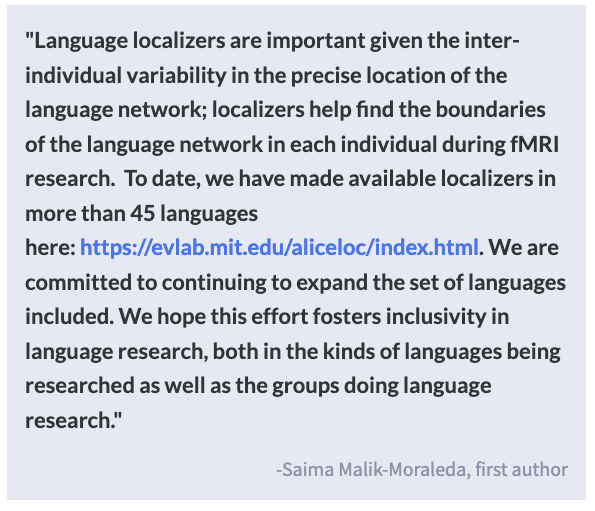
Over 7,000 different languages, originating from over 100 common ancestral languages, are spoken around the world today. While there is great diversity in the complexity, sounds, lexical categories, and rules surrounding sentence structure, there may also be some universal language properties, such as the ability of language to allow for efficient communication. To understand whether there is a shared neural and cognitive architecture of human language, it is imperative that we study a variety of different languages. This week in Nature Neuroscience, Malik-Moraleda and colleagues sought to identify a core neural architecture associated with language using large-scale functional magnetic resonance imaging across native speakers of 45 different languages from 12 different language families.

How did they do it?

The authors’ first goal was to determine whether the core language network characterized in native English speakers is similar in native speakers of other languages. They adopted a ‘shallow’ sampling approach by testing a small number of speakers for each of the 45 different languages included in this study (1 male and 1 female where possible). Additionally, all speakers were fluent in English. The 45 languages came from 12 language families including Afro-Asiatic, Austro-Asiatic, Austronesian, Dravidian, Indo-European, Japonic, Koreanic, Atlantic-Congo, Sino-Tibetan, Turkic, Uralic, and Basque. 

Each participant underwent functional magnetic resonance imaging while performing two different language tasks. In the first task, participants had to read sentences in English and nonword sentences. In a second task, they listened to a short passage from Alice in Wonderland translated into their native language. There were also two control conditions in which they listened to the same passage in an unfamiliar language, or they listened to non-discernible linguistic content (gibberish). Finally, to investigate whether brain regions that support language processing also show selectivity for language, the participants were asked to perform two non-language tasks, including a spatial working memory task and an arithmetic task.

What did they find?

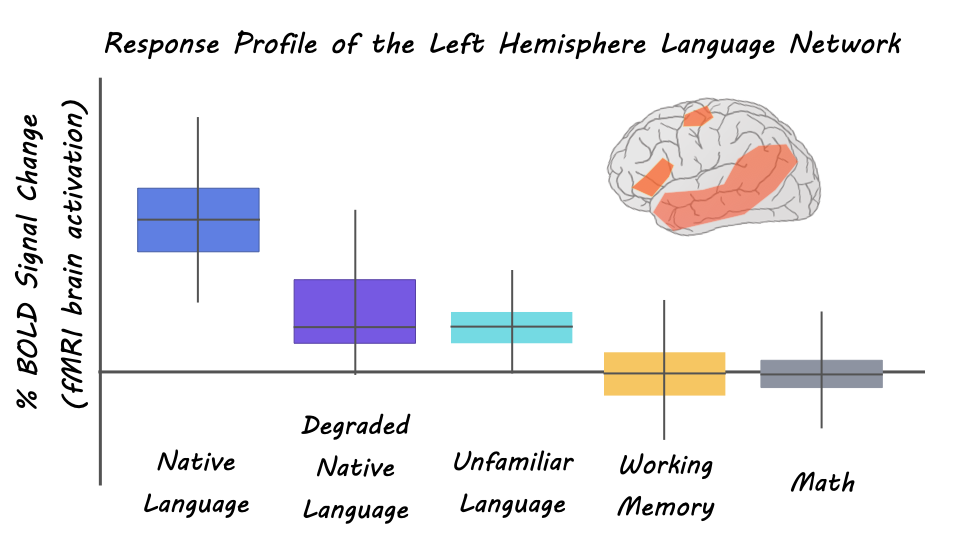
Consistent with previous work, the authors found that high-level language processing areas were more active when participants read sentences relative to nonword sentences in English. These regions lie on the lateral surfaces of the left frontal, temporal, and parietal cortices. Furthermore, higher levels of neural activity were observed when participants heard the passage of Alice in Wonderland in their native language compared to when they heard a degraded language passage or a passage in a language they did not speak. The variability observed across speakers of different languages was similar to variability commonly seen among individuals for a single language. Finally, these brain regions were also significantly more active when participants were engaged in native-language conditions compared to the spatial working memory task or the arithmetic task, suggesting that language regions are indeed specific to language processing. Overall, effects were more pronounced in the left hemisphere than in the right.

What's the impact?

By leveraging native speakers of 45 different languages, the authors identified a common and broad, cross-linguistic language network. This left-lateralized network, comprised of fronto-temporo-parietal regions, was functionally selective for language processing across speakers of 45 different languages. This work furthers our understanding of the cognitive and neural basis of language processing and is the first to study these properties across such a wide variety of languages. 

Neural Correlates of Emotion-Related Impulsivity

Post by Leanna Kalinowski

The takeaway

The structure of the orbitofrontal cortex is associated with the severity of emotion-related impulsivity, which has previously been implicated in the development of several mental disorders.

What's the science?

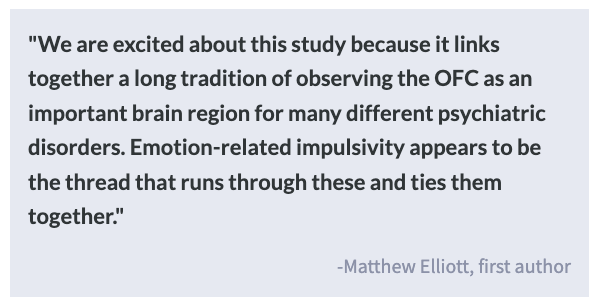
Occasional instances of impulsivity – acting suddenly without careful thought – are a normal part of human behavior. Some manifestations of impulsivity, however, are a hallmark sign of several mental disorders. Particularly, emotion-related impulsivity (ERI) – experiencing a frequent loss of control during strong emotion states, such as giving into cravings or saying regrettable things when upset – is consistently associated with mental disorders including depression, anxiety, and substance use disorders. Despite the well-known association between ERI and mental disorders, there is little known about how ERI is represented in the brain. This week in Biological Psychiatry, Elliott and colleagues studied whether the structure of brain regions responsible for emotion and control is associated with ERI severity.

How did they do it?

The researchers recruited 122 participants with two different displays of psychopathology: individuals with internalizing psychopathology (i.e., disorders where negative emotions are kept internal, such as depression), and individuals with externalizing psychopathology (i.e., disorders where negative emotions are externalized, such as conduct disorder). Psychopathology was assessed through structured clinical interviews.

Impulsivity in these individuals was measured using the Three Factor Impulsivity Index, which consists of two subscales that measure ERI and a third subscale that was a measure of non-emotion-related impulsivity. The authors used this third subscale as a control comparison.

All participants also underwent structural magnetic resonance imaging (MRI) to examine the structure of several brain regions of interest that are known to regulate emotion: the orbitofrontal cortex, insula, amygdala, and nucleus accumbens. Within these regions, the researchers calculated cortical thickness along with the Local Gyrification Index, which measures how much of the brain’s surface is buried in sulci (i.e., the grooves in the cerebral cortex).

What did they find?

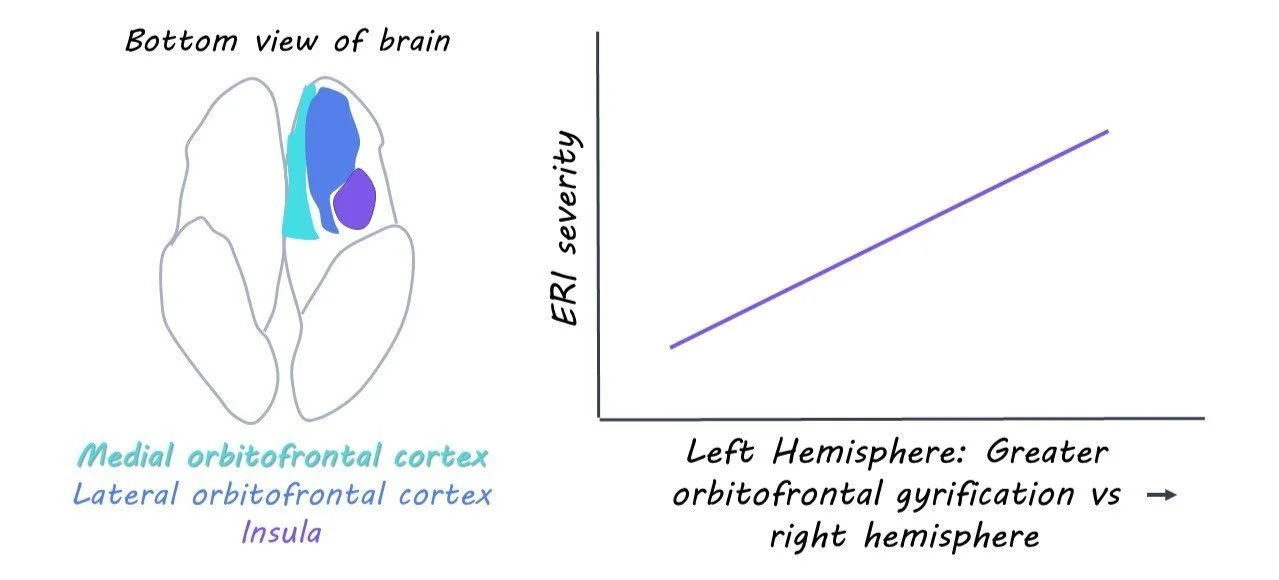
First, the researchers found an association between ERI and the structure of the orbitofrontal cortex. Specifically, individuals with higher ERI had lower gyrification in the orbitofrontal cortex, meaning that these individuals have a smoother cortex and smaller cortical surface area in this brain region. There was no association between ERI and the other three brain regions that were examined. Second, when comparing the structure of the orbitofrontal cortex across the brain’s two hemispheres, the researchers found that an imbalance in gyrification was associated with ERI severity. Specifically, individuals with greater orbitofrontal gyrification in the left hemisphere compared to the right hemisphere had greater ERI severity. Finally, the researchers found no association between non-emotion-related impulsivity and brain structure in these regions.

What's the impact?

This study was the first of its kind to directly investigate the association between ERI and gyrification in the brain. Taken together, these results demonstrate that the structure of the orbitofrontal cortex – specifically, the smoothness of its surface – is associated with ERI severity. These results may help pave the way for developing mental health treatments that more directly target the orbitofrontal cortex in individuals with severe ERI.