Common Brain Network for Language Processing Across 45 Different Languages

Post by Elisa Guma

The takeaway

A common language network across 45 diverse languages was identified using functional magnetic resonance imaging. This network is comprised of frontal, temporal, and parietal brain regions lateralized to the left hemisphere. 

What's the science?

Over 7,000 different languages, originating from over 100 common ancestral languages, are spoken around the world today. While there is great diversity in the complexity, sounds, lexical categories, and rules surrounding sentence structure, there may also be some universal language properties, such as the ability of language to allow for efficient communication. To understand whether there is a shared neural and cognitive architecture of human language, it is imperative that we study a variety of different languages. This week in Nature Neuroscience, Malik-Moraleda and colleagues sought to identify a core neural architecture associated with language using large-scale functional magnetic resonance imaging across native speakers of 45 different languages from 12 different language families.

How did they do it?

The authors’ first goal was to determine whether the core language network characterized in native English speakers is similar in native speakers of other languages. They adopted a ‘shallow’ sampling approach by testing a small number of speakers for each of the 45 different languages included in this study (1 male and 1 female where possible). Additionally, all speakers were fluent in English. The 45 languages came from 12 language families including Afro-Asiatic, Austro-Asiatic, Austronesian, Dravidian, Indo-European, Japonic, Koreanic, Atlantic-Congo, Sino-Tibetan, Turkic, Uralic, and Basque. 

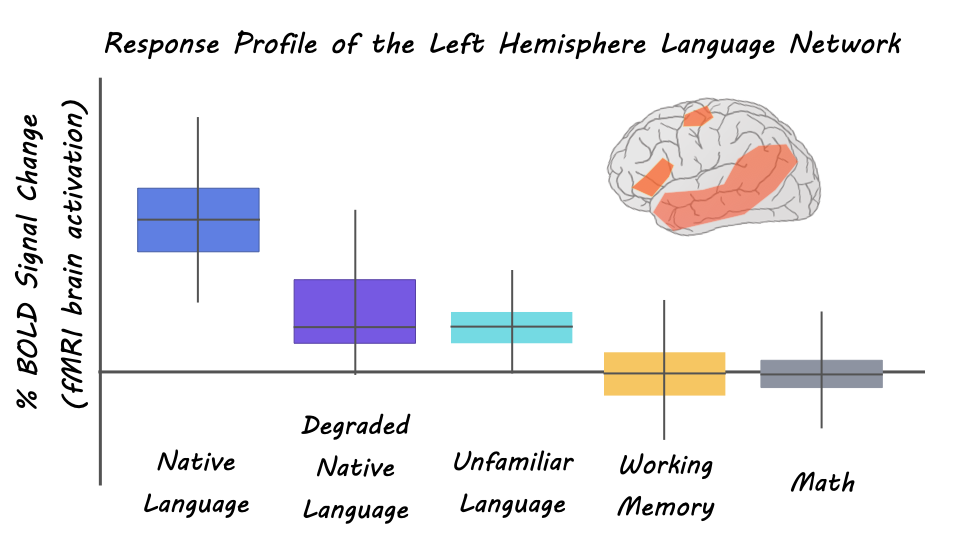
Each participant underwent functional magnetic resonance imaging while performing two different language tasks. In the first task, participants had to read sentences in English and nonword sentences. In a second task, they listened to a short passage from Alice in Wonderland translated into their native language. There were also two control conditions in which they listened to the same passage in an unfamiliar language, or they listened to non-discernible linguistic content (gibberish). Finally, to investigate whether brain regions that support language processing also show selectivity for language, the participants were asked to perform two non-language tasks, including a spatial working memory task and an arithmetic task.

What did they find?

Consistent with previous work, the authors found that high-level language processing areas were more active when participants read sentences relative to nonword sentences in English. These regions lie on the lateral surfaces of the left frontal, temporal, and parietal cortices. Furthermore, higher levels of neural activity were observed when participants heard the passage of Alice in Wonderland in their native language compared to when they heard a degraded language passage or a passage in a language they did not speak. The variability observed across speakers of different languages was similar to variability commonly seen among individuals for a single language. Finally, these brain regions were also significantly more active when participants were engaged in native-language conditions compared to the spatial working memory task or the arithmetic task, suggesting that language regions are indeed specific to language processing. Overall, effects were more pronounced in the left hemisphere than in the right.
What's the impact?

By leveraging native speakers of 45 different languages, the authors identified a common and broad, cross-linguistic language network. This left-lateralized network, comprised of fronto-temporo-parietal regions, was functionally selective for language processing across speakers of 45 different languages. This work furthers our understanding of the cognitive and neural basis of language processing and is the first to study these properties across such a wide variety of languages. 
Neural Correlates of Emotion-Related Impulsivity

Post by Leanna Kalinowski

The takeaway

The structure of the orbitofrontal cortex is associated with the severity of emotion-related impulsivity, which has previously been implicated in the development of several mental disorders.

What's the science?

Occasional instances of impulsivity – acting suddenly without careful thought – are a normal part of human behavior. Some manifestations of impulsivity, however, are a hallmark sign of several mental disorders. Particularly, emotion-related impulsivity (ERI) – experiencing a frequent loss of control during strong emotion states, such as giving into cravings or saying regrettable things when upset – is consistently associated with mental disorders including depression, anxiety, and substance use disorders. Despite the well-known association between ERI and mental disorders, there is little known about how ERI is represented in the brain. This week in Biological Psychiatry, Elliott and colleagues studied whether the structure of brain regions responsible for emotion and control is associated with ERI severity.

How did they do it?

The researchers recruited 122 participants with two different displays of psychopathology: individuals with internalizing psychopathology (i.e., disorders where negative emotions are kept internal, such as depression), and individuals with externalizing psychopathology (i.e., disorders where negative emotions are externalized, such as conduct disorder). Psychopathology was assessed through structured clinical interviews.

Impulsivity in these individuals was measured using the Three Factor Impulsivity Index, which consists of two subscales that measure ERI and a third subscale that was a measure of non-emotion-related impulsivity. The authors used this third subscale as a control comparison.

All participants also underwent structural magnetic resonance imaging (MRI) to examine the structure of several brain regions of interest that are known to regulate emotion: the orbitofrontal cortex, insula, amygdala, and nucleus accumbens. Within these regions, the researchers calculated cortical thickness along with the Local Gyrification Index, which measures how much of the brain’s surface is buried in sulci (i.e., the grooves in the cerebral cortex).

What did they find?

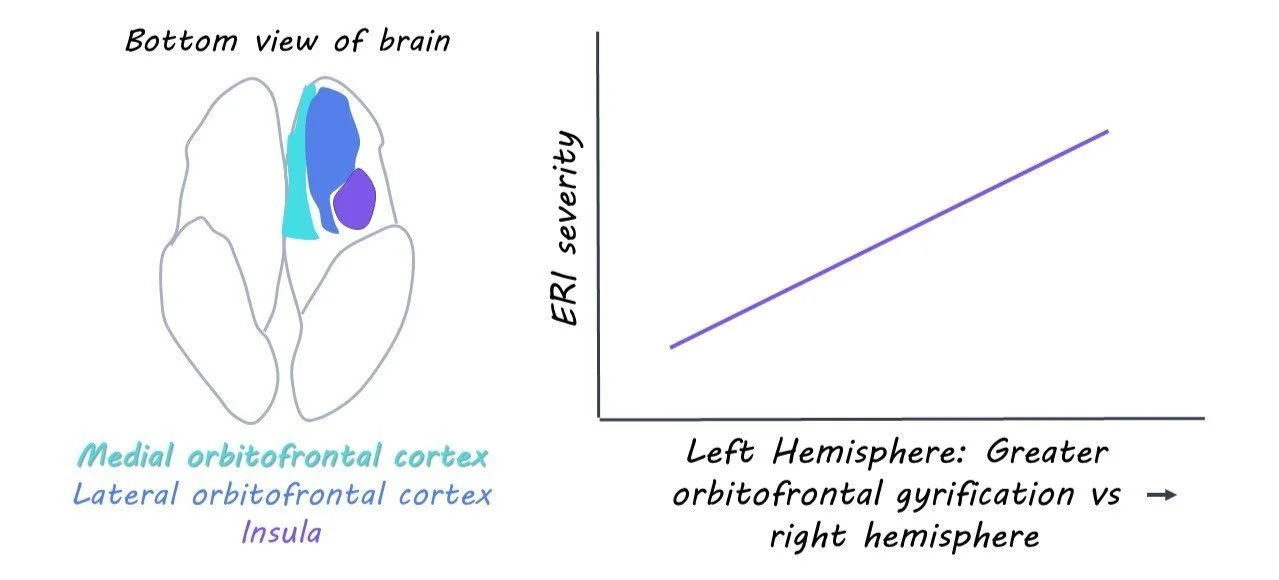
First, the researchers found an association between ERI and the structure of the orbitofrontal cortex. Specifically, individuals with higher ERI had lower gyrification in the orbitofrontal cortex, meaning that these individuals have a smoother cortex and smaller cortical surface area in this brain region. There was no association between ERI and the other three brain regions that were examined. Second, when comparing the structure of the orbitofrontal cortex across the brain’s two hemispheres, the researchers found that an imbalance in gyrification was associated with ERI severity. Specifically, individuals with greater orbitofrontal gyrification in the left hemisphere compared to the right hemisphere had greater ERI severity. Finally, the researchers found no association between non-emotion-related impulsivity and brain structure in these regions.

What's the impact?

This study was the first of its kind to directly investigate the association between ERI and gyrification in the brain. Taken together, these results demonstrate that the structure of the orbitofrontal cortex – specifically, the smoothness of its surface – is associated with ERI severity. These results may help pave the way for developing mental health treatments that more directly target the orbitofrontal cortex in individuals with severe ERI.

Creating an Atlas to Identify the Neurodevelopmental Stage of Human Brain Tumor Cells

Post by Elisa Guma

The takeaway

By creating an atlas of gene expression in the mouse brain throughout the lifespan, the authors were able to identify expression signatures from adult and pediatric human cerebral tumor development. Brain tumors adopt embryonic-like states, providing insight into the mechanisms by which these tumors grow.

What's the science?

The mechanisms driving cerebral tumor growth are still poorly understood. Within a single tumor, there is high heterogeneity in cell types, many of which resemble various stages of normative neural development. To map the stages of tumor cell development, one must first map normative cerebral development to create a point of reference. This week in Nature Communications, Hamed and colleagues characterize the molecular identity of cells that may drive cerebral tumor cell heterogeneity and determine their relationship to normal developmental states and lineages.

How did they do it?

First, the authors set out to create a comprehensive single-cell atlas of precursor cells (those within the neurogenic and gliogenic compartments) over the course of normal cerebral development. They performed single-cell RNA sequencing of the mouse brain throughout development (11 time points), starting from embryonic day 12.5 (mid-gestation), to postnatal day 365 (1 year old). To identify the appropriate cells to sequence, the authors used a transgenic mouse (Sox2eGFP) which has a fluorescent tag (GFP) on the Sox2 gene that is highly expressed in the cortical neurogenic zones across all stages of prefrontal brain development. Clustering methods were applied to the cells’ transcriptional data to differentiate the identity and developmental signature of the cells.  

The second aim of this work was to identify the transcriptional signature of human brain tumor cells. To do so, the authors sequenced human (adult and pediatric) brain tumor cells and used a deconvolution algorithm to map single-cell transcriptomic data acquired from the human brain tumor cells to the mouse clusters they defined above (with a focus on precursor cells). To further validate the reliability of their model the authors aligned human fetal single-cell RNA sequencing data (from a previous publication). They also aligned cells from patient-derived glioblastoma cultures to the mouse clusters identified.  Finally, to validate the existence of precursor cells (radial glial precursors) in adult cortical cancer, the authors leveraged a mouse model that uses Nestin-Cre to generate mice with conditional loss of expression of two tumor suppressor genes, the p53 gene (both alleles) and the PTEN gene (one allele) in embryonic precursors. By targeting Nestin+ embryonic precursor cells, the authors were able to gain more central nervous system specificity for tumor development. Indeed, these mice develop glioblastomas postnatally (due to a loss of tumor suppressors) which the authors extracted and sequenced to compare to their single-cell atlas.

What did they find?

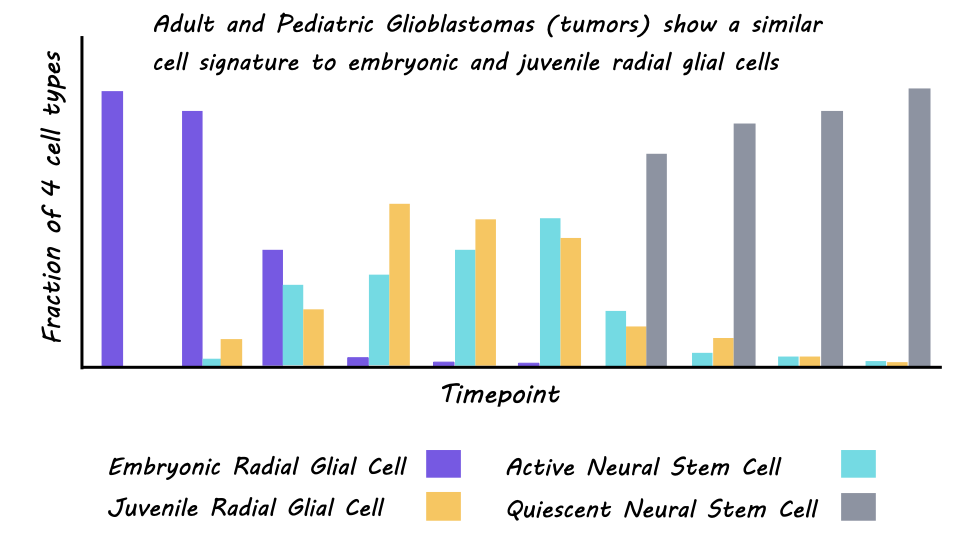
The single-cell atlas of normative brain development comprised 102,504 single cells, with an average of 3,500-13,000 unique molecular identities per cell. These cells could be clustered into three developmental stages: embryonic (mid-late gestation), juvenile (first week of life), and adult (childhood to adulthood). In the embryonic stage, cells were more likely to be undergoing neurogenesis, followed by a switch to gliogenesis which peaked in the juvenile period and continued into young adulthood. Unbiased clustering of the cells also revealed four major clusters with distinct transcriptional profiles. Embryonic radial glial precursor cells denominated the first cluster, juvenile radial glial precursor cells the second, third were glial cells also expressed in the juvenile period, and the fourth was quiescent neural stem cells expressed in the adult period. A deeper characterization of the regional distribution of these cells revealed distinct expression patterns based on the geographical location of the cells within the brain, particularly for the embryonic cells. This incredible resource is publicly available through an app developed by the authors.

The second aim of the study was to use this new atlas to classify the developmental stage of cells from both adult and pediatric brain tumors (glioblastomas). They were able to establish a reliable cross-species mapping between the mouse cells and adult and pediatric human cells, providing another useful resource for the scientific community. Cells from the cerebral gliomas were most similar to those in the embryonic and juvenile stages of the mouse atlas, rather than the adult. This was true for both adult and pediatric tumors. There was also a high similarity between the human fetal cells, cultured glioblastoma cells, and embryonic mouse cells. This both bolsters confidence in the ability of the mouse atlas to characterize cellular heterogeneity in cerebral tumors, and in the embryonic nature of the tumor cells. Finally, malignant tumor cells from the adult mouse brain tumors (from the Nestin-Cre mice with conditional loss of expression of two tumor suppressor genes) also had high similarity to embryonic and juvenile radial glial precursor cells providing further validation for their results. 

What's the impact?

This study presents the most comprehensive single-cell atlas of the developing mouse cortex. Furthermore, by achieving reliable cross-species alignment of single-cell transcriptional profiles, the authors were able to use this atlas to classify tumor cells from human adult and pediatric glioblastomas. They found that expression profiles of human tumor cells specifically overlap with embryonic radial glial precursor cells. These findings provide insight into the origins of human brain tumors and aid in our understanding of how normal cells turn into cancer cells. Further, these findings identified potential molecular targets for the treatment of cerebral tumors.