Specific Meningeal Layers Involved in CNS Autoimmune Responses

Post by Elisa Guma

The takeaway

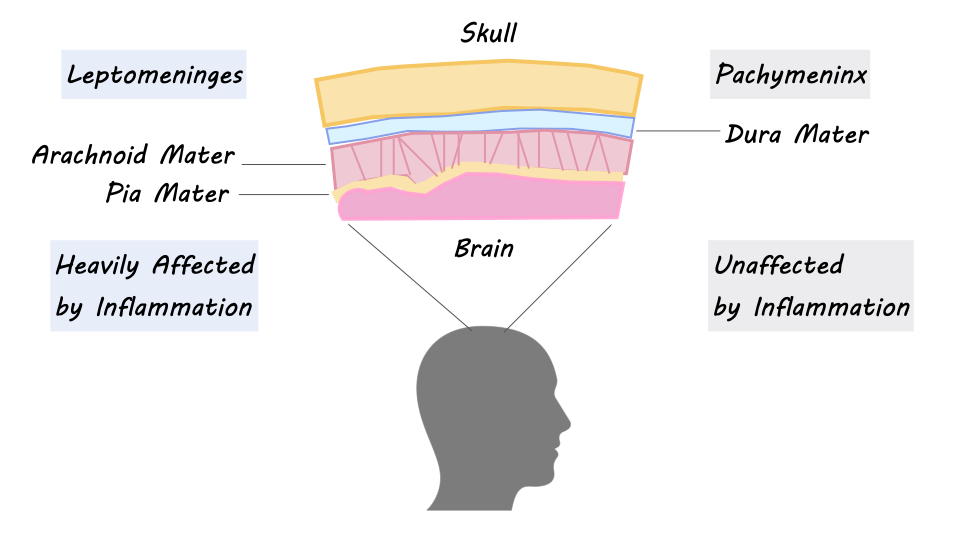
The meningeal layers of the central nervous system play distinct roles in acute and chronic CNS autoimmunity. The outermost dural layer seems to be largely unaffected by inflammation, while the internal leptomeningeal layers are heavily involved in the inflammatory response.

What's the science?

The central nervous system is surrounded and protected by a three-layered membrane called the meninges, which include the leptomeninges (including the pia layer, closest to the brain, followed by the arachnoid layer), and pachymeninx (also known as the dura mater). In addition to their physically protective role, the meningeal layers are densely populated by immune cells and are involved in the autoimmune response of the CNS, both in acute and chronic conditions (such as autoimmune diseases like multiple sclerosis). However, the distinct role of the three meningeal layers in CNS autoimmunity has yet to be fully understood. This week in Nature Neuroscience, Merlini and colleagues investigate the differential role of the meningeal layers in modulating autoimmune inflammation in an animal model of multiple sclerosis, experimental autoimmune encephalomyelitis (EAE), and human MS patients.  

How did they do it?

The authors studied the meninges (pachymeninx or dura mater vs. the leptomeninges) in both rat and mouse models of autoimmune encephalomyelitis (EAE), which exhibits signs of autoimmune inflammation, similar to those seen in human patients with multiple sclerosis. To induce meningeal inflammation, the authors gave healthy rodents T cells that specifically activate in the presence of certain proteins that exist in the brain (myelin basic protein or beta synuclein). Four to five days following exposure, rodents exhibit clinical symptoms. 

To characterize the immune response of the meninges, the authors tracked the migration of fluorescently labeled immune cells using two-photon laser scanning microscopy in the EAE model. Next, to assess the properties of the meningeal vasculature they injected rats with fluorescent tracers that rapidly leak out of vessels and measured accumulation in the perivascular space, which would indicate regions where the vasculature is leaky. 

Next, the authors investigated the stimulatory capacity of T cells present in the dural layer and the leptomeningeal compartment. They also measured the motility of T cells and if they made contact with antigen-presenting cells, a group of cells that mediate the immune response by processing and presenting antigens for recognition to certain T cells, to determine whether differences in immune response across the layers were due to reduced opportunity for inflammation. They also investigated the role of lymphatic drainage in modulating the immune response. Finally, to confirm the observations they made in the rodent autoimmune models, they studied the immune profile of post-mortem samples of the meninges of patients with chronic MS. 

What did they find?

In the rodent EAE models, the authors found evidence of massive inflammation of the leptomeninges and parenchyma but hardly any inflammation in the dura. These results were replicated in meningeal samples from human patients with chronic multiple sclerosis. 
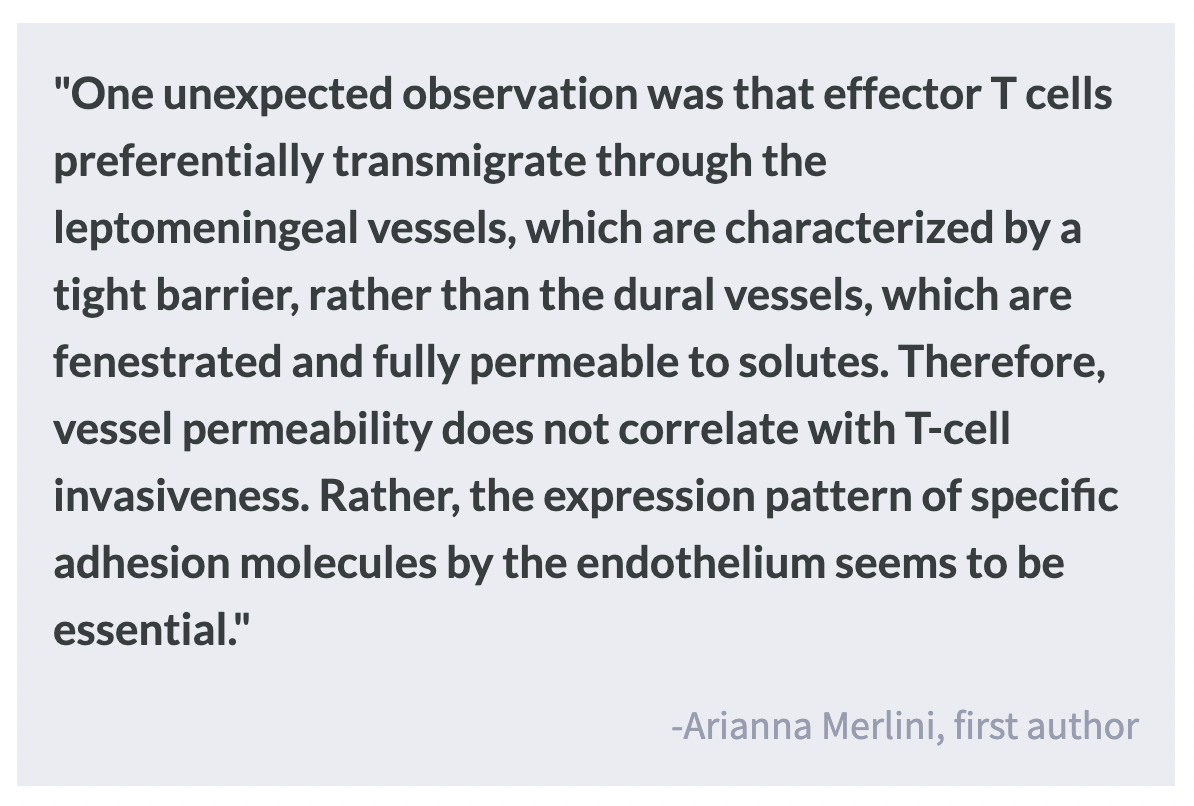
To better understand these results, the authors studied the meningeal vasculature: they found that the dura had high vessel permeability (based on leakage of a fluorescent tracer), which indicated that a lack of permeability is not preventing the dura from accumulating inflammatory cells. Transcriptional analysis of the dural and leptomeningeal vessels identified distinct gene expression profiles, whereby genes encoding blood-brain barrier components, and molecules relevant for effector T cell adhesion to the vessels, were expressed at significantly lower levels in the dura, which may limit the ability of the T cells to adhere to the dural vessels. In inflammatory conditions, however, the dural endothelia enabled T cell adhesion. Therefore, other mechanisms should be accounting for the reduced involvement of the dura in the CNS autoimmune process. 

The authors investigated if the reduced levels of inflammation within the dura could be due to 1) T cell anergy (a state in which cells fail to produce a response), 2) to an immune suppressive environment in the dura, or 3) to the inability of the locally resident phagocytes to present antigen. However, they found that the dural T cells had the same intrinsic stimulatory capacity as the T cells in the leptomeninges and that dural antigen-presenting cells were also fully competent. What they did find was that the substrate for successful autoreactive T cell activation, namely CNS autoantigens, did not reach the dura in sufficient quantities to activate the T cells. 

Finally, the authors investigated the role of lymphatic vessels in the inflammatory response. They found that although antigens could be transported from the CNS to the dura and the deep cervical lymph nodes, there was higher uptake in the leptomeningeal cells than in the dura or deep cervical lymph nodes.  

What's the impact?

This study highlights the differential role of the meningeal layers in both acute and chronic autoimmune disease, with the dura playing a passive role relative to the leptomeninges. The findings presented here are surprising since the dura would be expected to play a more active role in these inflammatory processes, given its location, vascularity, and dense population of immune cells. Future research is needed to investigate potential immunomodulatory therapies specifically targeted at the leptomeninges. 
An Effective Treatment for Post-Traumatic Stress Headaches in Veterans

Post by Megan McCullough

The takeaway

Cognitive behavioral therapies are an effective treatment for veterans with post-traumatic headaches and post-traumatic stress disorder symptoms.

What's the science?

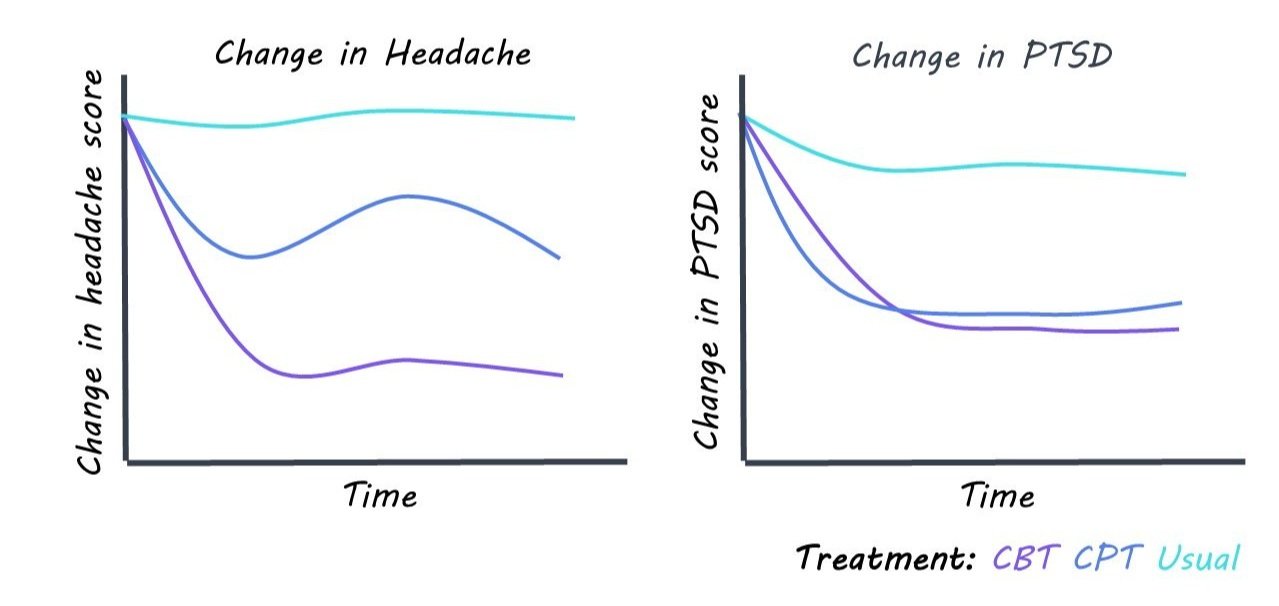
Veterans are more at risk for developing post-traumatic headache (PTH) associated with mild traumatic brain injuries compared to civilians. There are no current treatments for PTH, but previous research suggests that cognitive behavioral therapy (CBT) could offer a safe and effective treatment. Although previous studies have found no benefit of CBT for treating PTH in civilians, veterans could respond differently to treatment because of their higher risk of post-traumatic stress disorder (PTSD) symptoms. This week in JAMA Neurology, McGeary and colleagues tested the efficacy of CBT compared to usual treatments in veterans with mild traumatic brain injury-related headaches and symptoms of PTSD.

How did they do it?

Participants included 193 combat veterans with PTH and PSTD symptoms. Participants were randomized into one of three groups: cognitive behavioral therapy for headaches, cognitive processing therapy, and usual care. Treatment was administered over the course of 6 weeks and participants completed pre-treatment assessments, post-treatment assessments, and 3 and 6-month follow-ups. The CBT treatment focused on behavioral interventions and stress management with a focus on headaches, while the cognitive processing therapy treatment focused on PTSD symptoms. The assessments administered to measure the efficacy of the therapies included self-reports of headache and PTSD symptoms. Statistical analyses were used to determine the effect of each treatment on the alleviation of headache and stress symptoms.

What did they find? 

The authors found that CBT treatment significantly improved headaches in veterans. Specifically, those in the CBT group showed significant improvement in both headache symptoms and PTSD symptoms compared to those who received usual care or cognitive processing therapy. Cognitive processing therapy, which focused on the alleviation of PTSD symptoms, did not improve headache disability but did lead to a significant decrease in the severity of PTSD symptoms.

What's the impact?

This study is the first published randomized clinical trial for PTH treatments in veterans. The data show that CBT improved both headache and PTSD symptoms, while cognitive processing therapy only improved the PTSD symptoms. This suggests that cognitive behavioral therapy can be an effective tool for veterans experiencing the ramifications of trauma and brain injuries.

Access the original scientific publication here.

How Fixational Eye Movements are Related to Covert Attention

Post by Lina Teichmann

The takeaway

Microsaccades are small involuntary eye movements that occur when we are attending to peripheral things in our environment. These eye movements correlate with alpha-band activity (a particular frequency of brain activity) in the brain - a neural signature of spatial attention - but are not necessary for neural modulation to occur. 

What's the science?

When driving a car, we usually attend to what is right in front of us, but at the same time, we need to allocate some of our attentional resources to other things in our periphery like pedestrians or cyclists. This process is known as covert spatial attention and allows us to prioritize relevant information that is not currently in fixation. Covert attention is associated with directional biases in fixational eye movements or microsaccades, which are small jerk-like, involuntary eye movements. In the human brain, alpha activity has commonly been associated with spatial attention. This week in Nature Communication, Liu and colleagues examined if and how the commonly observed biases in microsaccades and the modulation of alpha activity in the brain are related when deploying covert attention.

How did they do it?

Participants completed a spatial memory task while their brain activity data was recorded with electroencephalography (EEG) and their eye movement data was recorded with an eye tracker. To compare the spatial modulation of the alpha activity, the researchers looked at lateralization (i.e., comparing the strength of alpha over the right and left posterior EEG sensors which is typically modulated by whether attention is deployed to the left or right visual field).

In the memory task, participants were asked to recall the orientation of one of two lines which were shown on right and the left of the screen. The researchers then measured whether (1) the presence and direction of eye movements during recall were indicative of performance and (2) whether lateralized alpha activity – a marker for spatial attention – is correlated with attention-directed microsaccades.

What did they find?

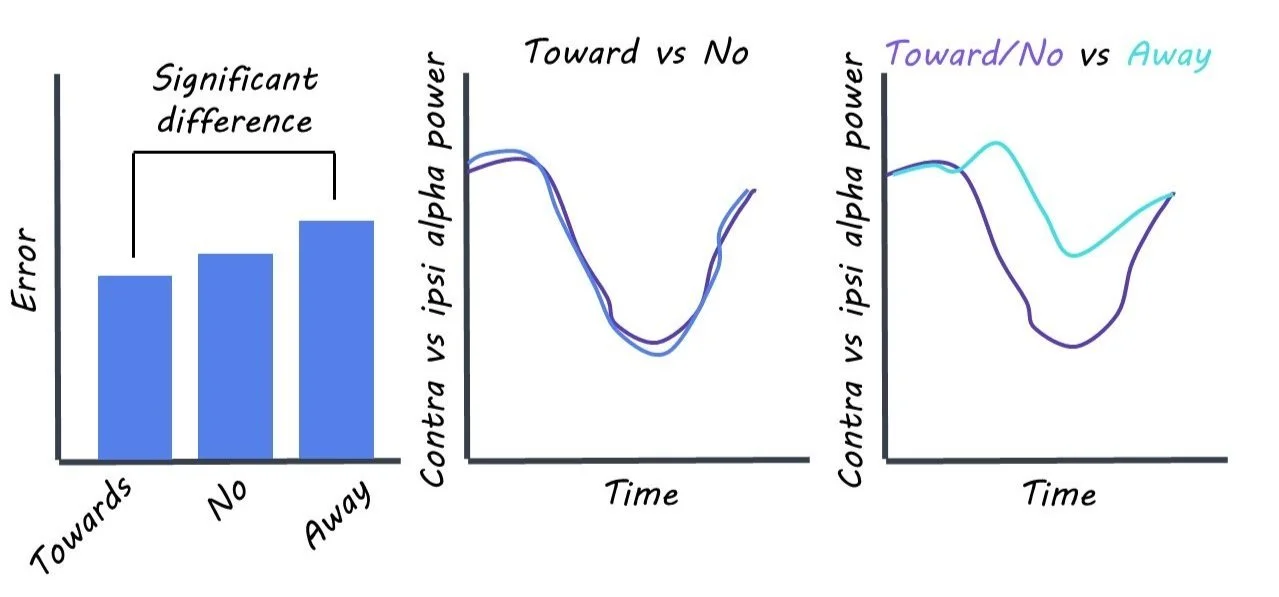
Overall performance was not dependent on microsaccades, as participants recalled the orientation of the line equally well regardless of the presence of an eye movement. However, when an eye movement was present, the direction was linked to performance, with eye movements towards the location of the to-be-recalled item resulting in better performance.

Looking at the neural data, the researchers found that there was clear lateralized alpha (a marker for spatial attention) activity when eye movements occurred towards the location of the to-be-recalled item. However, a highly similar pattern was observed when no eye movement was present, highlighting that eye microsaccades are not necessary for spatial attention. Considering only trials where a microsaccade occurred, the data showed that eye movements away from the location of the to-be-recalled item reduce the lateralized alpha modulation. This highlights that both markers for covert attention, microsaccades, and lateralized alpha-band activity are correlated, but that microsaccades are not necessary for spatial attention.

What's the impact?

Measuring and understanding covert attention is critical for gaining insights into how we navigate through our visual world. Liu and colleagues have found an elegant way to show that there is a correlational but not necessarily an obligatory link between microsaccades and lateralized alpha activity in the brain, which is frequently used as a marker of spatial attention. 

Access the original scientific publication here.