
The Lateral Orbitofrontal Cortex Mediates Stereotyping

Post by Leanna Kalinowski

The takeaway

Actions towards other individuals are often driven by assumptions about what they are like based on their group membership (i.e., stereotypes). Researchers have identified the lateral orbitofrontal cortex as a key brain region that mediates the effect of stereotypes on social behavior. 

What's the science?

Stereotypes, defined as generalized beliefs about a category of people on the basis of gender, age, race, nationality, or occupation, often influence how individuals treat one another. It has previously been observed that stereotypes can be structured along two dimensions of trait perception: warmth, which is the degree to which people have good intentions toward others, and competence, which is the degree to which people are capable of acting on their intentions. Although the impact of stereotypes on social behavior is well-documented, it’s still unclear how traits inferred from social-group membership are represented in the brain, and how these neural representations guide social behavior. This week in PNAS, Kobayashi, and colleagues tested the impact of stereotypes on the distribution of resources in a social decision-making game.

How did they do it?

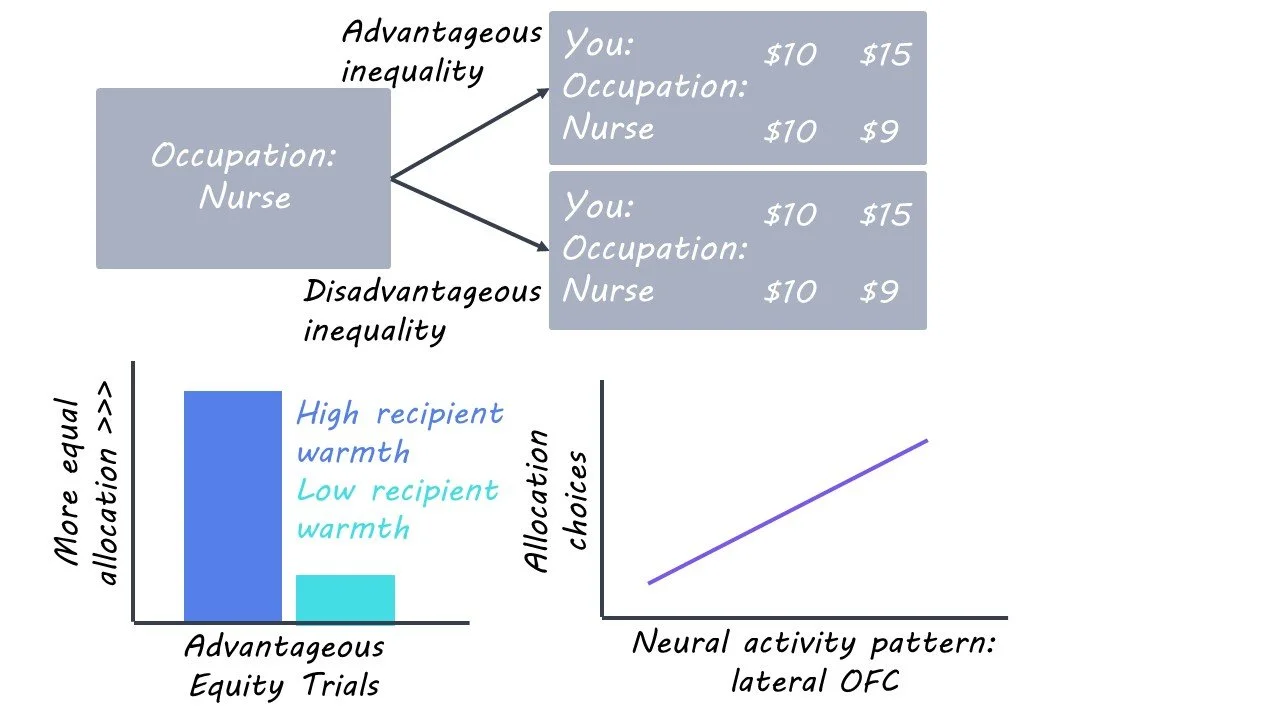
43 participants were asked to choose how to allocate monetary resources between themselves and a series of hypothetical recipients in a task called the Dictator Game. In each trial, the participants first viewed one piece of social-group information about a hypothetical recipient (e.g., “Occupation: Lawyer”). The researchers selected 20 social-group memberships to display, which were based on previous research that showed that these social-group memberships spanned a wide range of the warmth and competence dimensions. 

The participants were then shown two options to allocate the funds. Option one was an equal allocation of money between the participant and recipient, while option two was either (1) advantageous inequity, which was an unequal division of money that favored the participant, or (2) disadvantageous inequity, which was an unequal division of money that favored the recipient. Each participant completed 80 trials each while brain activity was measured using functional magnetic resonance imaging (fMRI).

What did they find?

In advantageous inequity trials (i.e., trials that favored the participant), participants were less likely to choose the unequal allocation of money when the recipient’s warmth was higher. Conversely, in disadvantageous inequity trials (i.e., trials that favored the hypothetical recipient), participants were less likely to choose the unequal allocation of money when the recipient’s competence was higher. Taken together, these results suggest that inferences about other people’s traits exert strong effects on social-decision making. 

Turning to the fMRI data, the researchers first conducted a representational similarity analysis, which looks for (1) brain regions where two recipients with similar traits display similar response patterns and (2) brain regions where two recipients with dissimilar traits display dissimilar response patterns. This analysis revealed that recipients’ warmth and competence are represented in the lateral orbitofrontal cortex (OFC), which has traditionally been associated with inference-based decision-making, along with two brain regions associated with mentalizing (i.e., temporoparietal junction & superior temporal sulcus). Finally, the researchers found that only activation of the lateral OFC predicted individual monetary allocation choices. Taken together, these results suggest that the trait representation in the lateral OFC contributes to allocation decisions.
What's the impact?

This study demonstrates that the effect of stereotypes on behavior is driven by inference-based decision-making processes in the lateral OFC. Future studies should investigate the role of the OFC in other types of inference-based decision-making, such as social projection and learning about traits from experience.
Access the original scientific publication here.

Reducing Neuroinflammation with Brain-Specific Gene Delivery

Post by Leanna Kalinowski

The takeaway

Acute central nervous system (CNS) trauma, which is present in neurological disorders such as multiple sclerosis, triggers the activation of immune cells in the brain causing inflammation. Researchers have developed a brain-specific gene delivery system for brain interleukin-2, which is effective in preventing and treating these neurological disorders in mouse models. 

What's the science?

Acute central nervous system (CNS) trauma is caused by diverse neurological injuries and illnesses, like traumatic brain injury (TBI), multiple sclerosis, or stroke. CNS trauma leads to the damage and loss of neurons, which can result in changes in cognition, sensorimotor function, and personality. Acute CNS trauma also triggers the activation of immune cells in the brain – like microglia and astrocytes – which leads to further negative effects.  

Brain interleukin-2 (IL-2) has been identified as a potential treatment option for acute CNS trauma. IL-2 works by supporting the survival and proliferation of regulatory T (Treg) cells, which have been shown to inhibit neuroinflammation. However, while IL-2 treatment shows promise, it is unclear whether such treatment can be localized to the brain rather than inducing unintended immune effects elsewhere in the body. This week in Nature Immunology, Yshii and colleagues (1) developed a new delivery system for brain-specific IL-2 treatment and (2) tested its effectiveness in preventing and treating models of acute CNS trauma.

How did they do it?

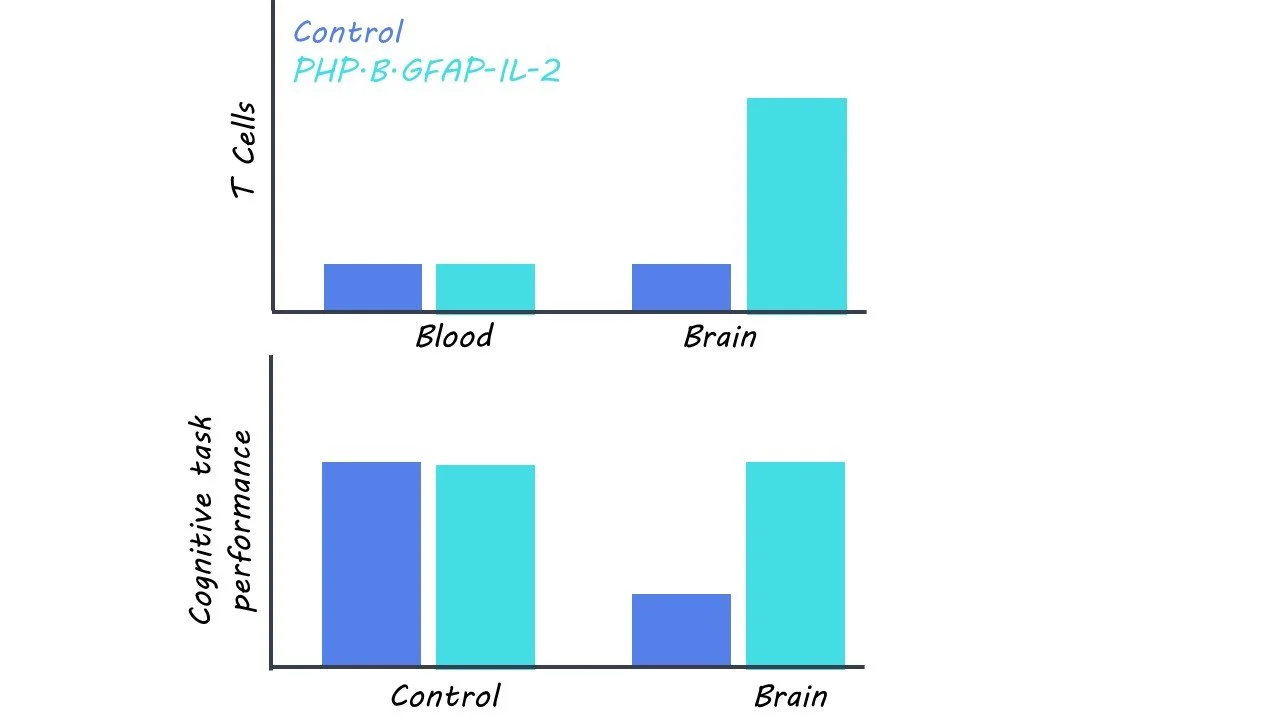
First, the researchers developed a gene delivery approach to increase IL-2 expression in astrocytes, which are a type of glial cell that responds to brain injury. To ensure that they specifically target astrocytes in the brain, the researchers first developed a vehicle for gene delivery by combining (1) a PHP.B-enhanced adeno-associated virus (AAV-PHP.B), which can be injected intravenously and delivers substances across the blood-brain barrier and (2) a modified GFAP promoter, which restricts gene expression to just astrocytes. Then, they incorporated the gene for IL-2 (PHP.B.GFAP-IL-2) into this virus, so that IL-2 is made by astrocytes in the brain, with subsequent measures of IL-2 and Treg cell production in the brain.

Then, they tested the effectiveness of PHP.B.GFAP-IL-2 in preventing acute CNS trauma in mouse models. Mice were first treated either with PHP.B.GFAP-IL-2 or a control virus (PHP.B) and then underwent a procedure to induce TBI. Fourteen days after TBI, neurological damage was assessed using MRI and histology, and behavior was assessed by running mice through two memory tests – Morris Water Maze and the Novel Object Recognition test. To examine other common sources of acute CNS trauma, this procedure was repeated for two other pathologies – ischemic stroke and multiple sclerosis.

Finally, to test the effectiveness of PHP.B.GFAP-IL-2 in curative mouse models of acute CNS trauma, they first subjected mice to acute CNS trauma (i.e., TBI, stroke, and multiple sclerosis). Then, they administered either PHP.B.GFAP-IL-2 or a control virus (PHP.B) and ran the same test battery as above.

What did they find?

First, the researchers found that PHP.B.GFAP-IL-2 was successful in delivering the IL-2 gene to the brain with expression in astrocytes. Over the course of fourteen days following administration, there was a threefold increase in IL-2 production. This was accompanied by an increase in Treg cell production, which was not observed outside of the brain and was not accompanied by any adverse symptoms.

Then, they found that pre-treatment of PHP.B.GFAP-IL-2 decreased the loss of cortical tissue and behavioral deficits in mice with TBI relative to those that received a control virus. Similar protective effects were observed in mouse models of ischemic stroke and multiple sclerosis. They also found that mice treated with PHP.B.GFAP-IL-2 after TBI also experienced lower levels of brain damage than control mice. This effect was mirrored in multiple sclerosis mice, but not in ischemic stroke mice, suggesting that the damaging effects of stroke are too rapid for this treatment to be effective before irreversible brain damage sets in.

What's the impact?

Taken together, the results from this study provide evidence for the effectiveness of brain-specific IL-2 gene delivery in preventing and treating acute CNS trauma. Future work is needed to determine whether such treatment is effective in humans with neurological injuries and diseases. Further, this study may also pave the way for the development of gene delivery therapies for other neurological disorders that require brain-specific delivery.

Understanding Postpartum Depression 

Post by Lani Cupo

In many communities worldwide, childbirth is celebrated as a joyous time. Despite new stressors and nights without sleep, many parents welcome their new child enthusiastically. For almost 20% of people who give birth, however, symptoms of anxiety and depression may occur during the postpartum period. This under-reported experience can bring feelings of confusion and shame to new parents.

What is PPD and what are the risk factors?

According to the Diagnostic and Statistical Manual used by psychiatrists to guide diagnoses, postpartum depression (PPD) refers to the onset of a depressive episode within four weeks of childbirth. Many researchers and clinicians extend this diagnostic window up to a year after giving birth. Physical, hormonal, social, psychological, and emotional factors can all play an important role in triggering PPD. This is referred to as the biopsychosocial model of depression. 

So, what are the strongest risk factors for PPD? Evaluating findings from many studies via meta-analysis, researchers have identified potential risk factors: depression and anxiety during pregnancy, acute sadness during the days following birth (“postpartum blues”), previous history of depression, stressful life events, poor marital relationship, and poor social support. The context of PPD resembles the context of many other depressions, and there is still debate whether PPD is catalyzed by a factor unique to birth, or simply coincidence of childbirth and depression onset. As we move towards regular screening for PPD following childbirth, and identifying high-risk individuals, some have voiced criticism regarding the potential to over-pathologize mood symptoms and overestimate an individual’s risk of PPD.

What’s the underlying biology of PPD?

Since more severe postpartum blues correlates strongly with the emergence of PPD, many researchers have begun to consider symptoms on a spectrum from “blues” to more severe psychiatric outcomes, such as PPD or postpartum psychoses. The predominant hypothesis underlying postpartum blues posits that mood changes result from abrupt hormone withdrawal following birth. In more severe cases of PPD, however, it is likely that other factors play a role in the emotional disturbances experienced after pregnancy. Several hormones rise over the course of pregnancy, including estradiol, a major female sex hormone; progesterone, a steroid hormone involved in menstruation, pregnancy, and embryogenesis; estriol, a minor female sex hormone almost undetectable outside of pregnancy; and estrone, a minor female sex hormone. Research has shown that there is a heightened sensitivity to mood changes in response to these hormonal fluctuations.

A variety of neurochemical changes in the brain have been associated with PPD, in particular to the monoamine system, a key system involved in mood regulation. Levels of MAO-A, an enzyme that metabolizes monoamines like serotonin and norepinephrine, have been shown to be elevated in PPD, suggesting this could be a cause of lower monoamine levels and low mood. Further, research shows that the level of serotonin receptors in the brain is also lower in individuals with PPD, meaning there could be a lower activity of the serotonergic system in PPD. Very few magnetic resonance imaging (MRI) studies investigate the impact of PPD on brain volume, activity, and metabolism, largely due to the difficult nature of recruiting participants soon after delivery. Studies that do investigate PPD with MRI usually demonstrate similarities between PPD and major depressive disorder (MDD) in terms of brain structural changes.

What’s the impact on parent and child?

PPD outcomes can be measured in terms of the parent, the child, and their relationship. For parents, PPD can lower mood and self-esteem, increase anxiety, and impact physical health. Further, PPD has been shown to increase risk of suicide, highlighting the urgent need for treatment for PPD. For infants, there is some evidence that PPD is associated with reduced weight gain, though findings are mixed. Accumulating evidence also associates PPD with diverse infant health concerns, such as overall pain, disrupted sleep, delays in cognitive and language development, increased fear and anxiety, and increased behavioral problems. Finally, examining infant-parent relationships, PPD is correlated with poor parent-infant bonding in the first months of life, lower emotional involvement, insecure attachment, early cessation of breast-feeding, and alterations in maternal behavior. It is important to note, however, that many of the aforementioned studies are purely associative and do not represent causal relationships between PPD and negative outcomes. Future research should be mindful of the criticism many parents already experience, so as not to unintentionally contribute to the stigmatization of parents’ involuntary experience of PPD. 

How do we treat PPD?

There are several treatments for PPD that may be effective. Short-term interpersonal psychotherapy can help reduce depressive symptoms. Antidepressant treatments like SSRIs (influencing the serotonin system) have shown promise in treating PPD, with some research reporting remission and no negative outcomes in children. Nevertheless, there is a growing database of observational data on the side effects of antidepressants in breast-fed infants. Dietary supplements consisting of monoamine precursors (to combat elevated MAO-A enzyme levels) have also demonstrated potential in reducing depressive symptoms in PPD. Risk from PPD must be weighed against risk of possible infant exposure to pharmaceuticals and the benefit conferred by breast-feeding, often an important bonding opportunity for the parent and infant. As clinicians, researchers, and parents become increasingly aware of PPD, the development of advanced screening tools and reduction of stigma around symptomatology may allow for earlier treatment. Together, parents and doctors can develop a plan that best suits their individual needs.

References +

Schiller CE et al. Estradiol modulates anhedonia and behavioral despair in rats and negative affect in a subgroup of women at high risk for postpartum depression. Physiol Behav. 2013. 119: 137–144.

Wang T et al. Injection of oxytocin into paraventricular nucleus reverses depressive-like behaviors in the postpartum depression rat model. Behav Brain Res. 2018. 336: 236–243.

Slomian J et al.. Consequences of maternal postpartum depression: A systematic review of maternal and infant outcomes. Womens Health. 2019.15: 1745506519844044.

Sacher et al. Relationship of Monoamine Oxidase-A Distribution Volume to Postpartum Depression and Postpartum Crying. Neuropsychopharmachology. 2015: 40, 429–435.

Fiorelli M et al. Magnetic Resonance Imaging Studies of Postpartum Depression: An Overview. Behav Neurol. 2015. 2015: 913843.

Zonana J, Gorman JM. The Neurobiology of Postpartum Depression. CNS Spectr. 2005.10: 792–9, 805.

Duan C et al.. Understanding Peripartum Depression Through Neuroimaging: a Review of Structural and Functional Connectivity and Molecular Imaging Research. Curr Psychiatry Rep. 2017.19: 70.

Dowlati et al. Selective dietary supplementation in early postpartum is associated with high resilience against depressed mood. PNAS. 2017. 114(13)3509-3514.

Moses-Kolko et al. Serotonin 1A receptor reductions in postpartum depression: a PET study. Fertility and Sterility. 2008. 89(3): 685-692.