
Understanding Postpartum Depression 

Post by Lani Cupo

In many communities worldwide, childbirth is celebrated as a joyous time. Despite new stressors and nights without sleep, many parents welcome their new child enthusiastically. For almost 20% of people who give birth, however, symptoms of anxiety and depression may occur during the postpartum period. This under-reported experience can bring feelings of confusion and shame to new parents.

What is PPD and what are the risk factors?

According to the Diagnostic and Statistical Manual used by psychiatrists to guide diagnoses, postpartum depression (PPD) refers to the onset of a depressive episode within four weeks of childbirth. Many researchers and clinicians extend this diagnostic window up to a year after giving birth. Physical, hormonal, social, psychological, and emotional factors can all play an important role in triggering PPD. This is referred to as the biopsychosocial model of depression. 

So, what are the strongest risk factors for PPD? Evaluating findings from many studies via meta-analysis, researchers have identified potential risk factors: depression and anxiety during pregnancy, acute sadness during the days following birth (“postpartum blues”), previous history of depression, stressful life events, poor marital relationship, and poor social support. The context of PPD resembles the context of many other depressions, and there is still debate whether PPD is catalyzed by a factor unique to birth, or simply coincidence of childbirth and depression onset. As we move towards regular screening for PPD following childbirth, and identifying high-risk individuals, some have voiced criticism regarding the potential to over-pathologize mood symptoms and overestimate an individual’s risk of PPD.

What’s the underlying biology of PPD?

Since more severe postpartum blues correlates strongly with the emergence of PPD, many researchers have begun to consider symptoms on a spectrum from “blues” to more severe psychiatric outcomes, such as PPD or postpartum psychoses. The predominant hypothesis underlying postpartum blues posits that mood changes result from abrupt hormone withdrawal following birth. In more severe cases of PPD, however, it is likely that other factors play a role in the emotional disturbances experienced after pregnancy. Several hormones rise over the course of pregnancy, including estradiol, a major female sex hormone; progesterone, a steroid hormone involved in menstruation, pregnancy, and embryogenesis; estriol, a minor female sex hormone almost undetectable outside of pregnancy; and estrone, a minor female sex hormone. Research has shown that there is a heightened sensitivity to mood changes in response to these hormonal fluctuations.

A variety of neurochemical changes in the brain have been associated with PPD, in particular to the monoamine system, a key system involved in mood regulation. Levels of MAO-A, an enzyme that metabolizes monoamines like serotonin and norepinephrine, have been shown to be elevated in PPD, suggesting this could be a cause of lower monoamine levels and low mood. Further, research shows that the level of serotonin receptors in the brain is also lower in individuals with PPD, meaning there could be a lower activity of the serotonergic system in PPD. Very few magnetic resonance imaging (MRI) studies investigate the impact of PPD on brain volume, activity, and metabolism, largely due to the difficult nature of recruiting participants soon after delivery. Studies that do investigate PPD with MRI usually demonstrate similarities between PPD and major depressive disorder (MDD) in terms of brain structural changes.

What’s the impact on parent and child?

PPD outcomes can be measured in terms of the parent, the child, and their relationship. For parents, PPD can lower mood and self-esteem, increase anxiety, and impact physical health. Further, PPD has been shown to increase risk of suicide, highlighting the urgent need for treatment for PPD. For infants, there is some evidence that PPD is associated with reduced weight gain, though findings are mixed. Accumulating evidence also associates PPD with diverse infant health concerns, such as overall pain, disrupted sleep, delays in cognitive and language development, increased fear and anxiety, and increased behavioral problems. Finally, examining infant-parent relationships, PPD is correlated with poor parent-infant bonding in the first months of life, lower emotional involvement, insecure attachment, early cessation of breast-feeding, and alterations in maternal behavior. It is important to note, however, that many of the aforementioned studies are purely associative and do not represent causal relationships between PPD and negative outcomes. Future research should be mindful of the criticism many parents already experience, so as not to unintentionally contribute to the stigmatization of parents’ involuntary experience of PPD. 

How do we treat PPD?

There are several treatments for PPD that may be effective. Short-term interpersonal psychotherapy can help reduce depressive symptoms. Antidepressant treatments like SSRIs (influencing the serotonin system) have shown promise in treating PPD, with some research reporting remission and no negative outcomes in children. Nevertheless, there is a growing database of observational data on the side effects of antidepressants in breast-fed infants. Dietary supplements consisting of monoamine precursors (to combat elevated MAO-A enzyme levels) have also demonstrated potential in reducing depressive symptoms in PPD. Risk from PPD must be weighed against risk of possible infant exposure to pharmaceuticals and the benefit conferred by breast-feeding, often an important bonding opportunity for the parent and infant. As clinicians, researchers, and parents become increasingly aware of PPD, the development of advanced screening tools and reduction of stigma around symptomatology may allow for earlier treatment. Together, parents and doctors can develop a plan that best suits their individual needs.

References +

Schiller CE et al. Estradiol modulates anhedonia and behavioral despair in rats and negative affect in a subgroup of women at high risk for postpartum depression. Physiol Behav. 2013. 119: 137–144.

Wang T et al. Injection of oxytocin into paraventricular nucleus reverses depressive-like behaviors in the postpartum depression rat model. Behav Brain Res. 2018. 336: 236–243.

Slomian J et al.. Consequences of maternal postpartum depression: A systematic review of maternal and infant outcomes. Womens Health. 2019.15: 1745506519844044.

Sacher et al. Relationship of Monoamine Oxidase-A Distribution Volume to Postpartum Depression and Postpartum Crying. Neuropsychopharmachology. 2015: 40, 429–435.

Fiorelli M et al. Magnetic Resonance Imaging Studies of Postpartum Depression: An Overview. Behav Neurol. 2015. 2015: 913843.

Zonana J, Gorman JM. The Neurobiology of Postpartum Depression. CNS Spectr. 2005.10: 792–9, 805.

Duan C et al.. Understanding Peripartum Depression Through Neuroimaging: a Review of Structural and Functional Connectivity and Molecular Imaging Research. Curr Psychiatry Rep. 2017.19: 70.

Dowlati et al. Selective dietary supplementation in early postpartum is associated with high resilience against depressed mood. PNAS. 2017. 114(13)3509-3514.

Moses-Kolko et al. Serotonin 1A receptor reductions in postpartum depression: a PET study. Fertility and Sterility. 2008. 89(3): 685-692.
A Critical Period for Development of the Prefrontal Cortex

Post by Megan McCullough

The takeaway

Thalamic activity during a critical period in development plays a role in shaping the prefrontal cortex. Inhibiting thalamic input to the prefrontal cortex during this critical period creates long-lasting anatomical and behavioral effects that persist into adulthood.

What's the science?

Critical periods are windows of time after birth where there is increased plasticity in the brain. Experiences during this period are essential for proper development and disruptions to learning during this time can have long-lasting consequences. Although previous research identifies a critical period for signals from the thalamus leading to the development of the sensory cortex, it is unknown whether a critical period exists for thalamic activity shaping the development of the prefrontal cortex. The prefrontal cortex is a crucial brain region for study, as this region is functionally responsible for processes like memory and attention, and prefrontal cortex dysfunction is linked to neurodevelopmental disorders. This week in Nature Neuroscience, Benoit and colleagues aimed to examine the role of thalamic activity in the maturation of the prefrontal cortex by inhibiting the thalamus in adolescent mice.

How did they do it?

First, the authors inhibited the mediodorsal and midline thalamus in a group of adolescent mice by injecting the mice with a virus containing hM4Dgi, a designer inhibitory receptor. To test the long-term cognitive effects of inhibiting thalamic activity in adolescence, these mice completed working memory and attention tasks  – tasks that rely on the prefrontal cortex – in adulthood. The authors then assessed changes in prefrontal cortex circuit function due to thalamic inhibition via slice physiology, measuring excitatory and inhibitory activity in a layer that receives projections from the thalamus. Next, a fluorescent protein (GFP), was injected into the adult mice to identify any anatomical changes in neuronal tracts from the thalamus.

These tests were administered to the adult mice who had experienced the thalamic disruption in adolescence as well as to adult mice who had experienced the thalamic disruption in adulthood. The authors studied both age groups to identify the existence of a critical period for prefrontal cortical maturation due to signals from the thalamus.

What did they find?

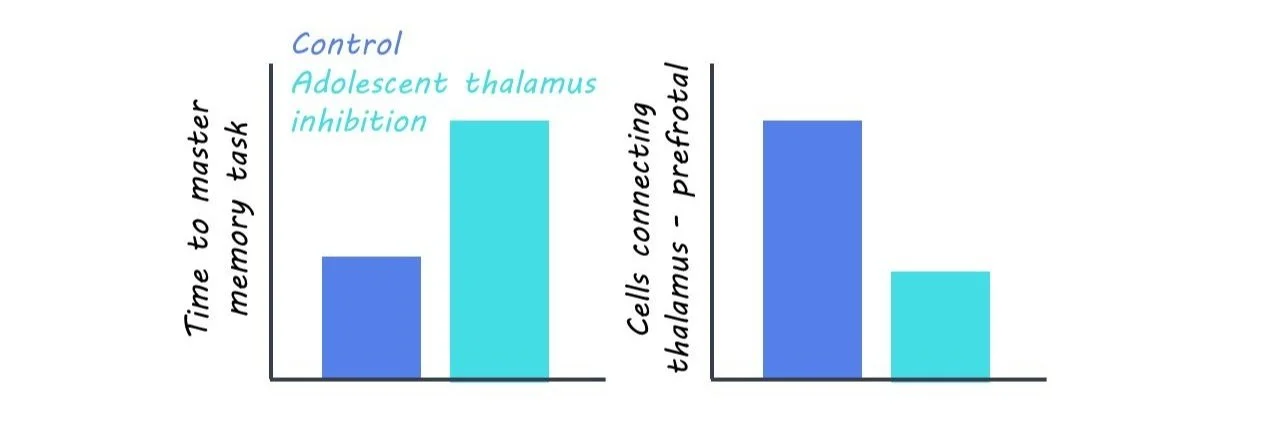
The authors found that inhibiting the thalamus during adolescence leads to deficits in circuit function in the prefrontal cortex as well as cognitive deficits that persist into adulthood. These deficits were not found when the thalamus was inhibited in adult mice. These results suggest that there is a critical period in development for the maturation of the prefrontal cortex through excitatory input from the thalamus; disrupting these signals during this time period has long-lasting anatomical, functional, and cognitive effects. Specifically, in the adult mice that underwent thalamic inhibition during their adolescence, there was reduced excitatory drive to pyramidal cells in the prefrontal cortex, a reduction in the density of thalamic-prefrontal projections, and reduced performance on memory and attention tasks. Importantly, the authors also found that the behavioral deficits seen in adulthood could be rescued through excitation of the thalamus in the adult mouse.

What's the impact?

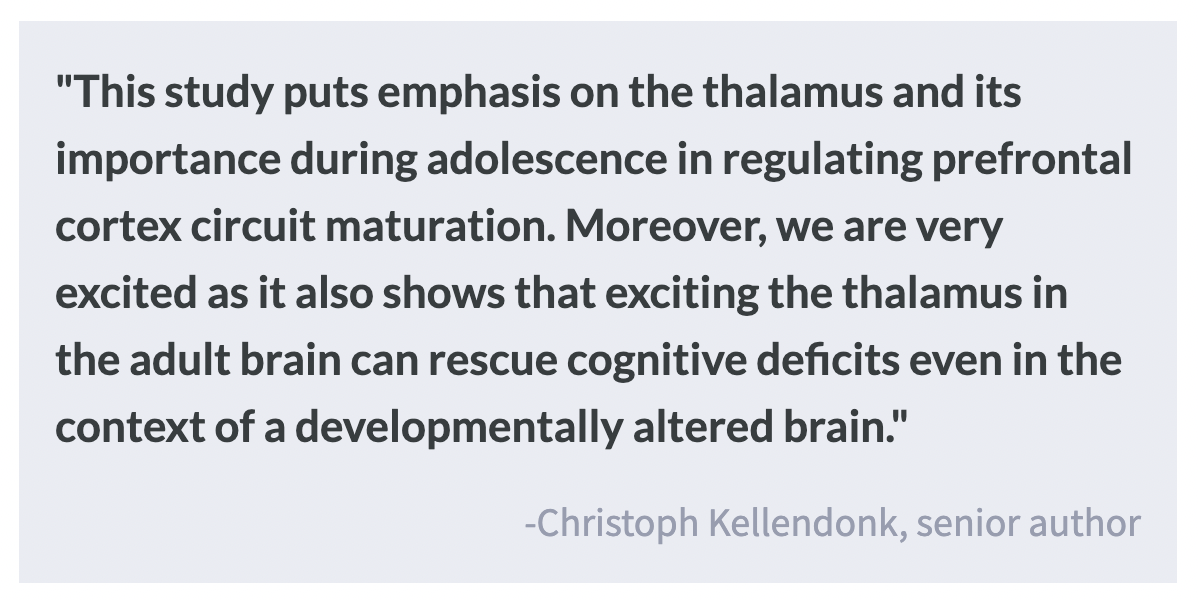
This study is the first to show that thalamic input to the prefrontal cortex during a critical period in development is essential for proper prefrontal maturation. Inhibiting activity in the thalamus led to deficits that persisted into adulthood. This has therapeutic relevance as neurodevelopmental disorders such as schizophrenia are linked to disruptions in proper cortical development thought to occur in adolescence.   

What is Neurofeedback and How is it Used?

Post by Ewina Pun

Sensory feedback and neuroplasticity

Have you ever tried to walk in a straight line with your eyes closed, or eat a meal in complete darkness? Movement control becomes significantly harder when sensory feedback is limited. When we’re learning, we rely heavily on various forms of feedback, such as tactile, visual, and audio feedback. For some individuals, sensory feedback is lost due to injuries and neural deficits. Fortunately, our brain has the ability to quickly adapt to new circumstances - also known as neuroplasticity.

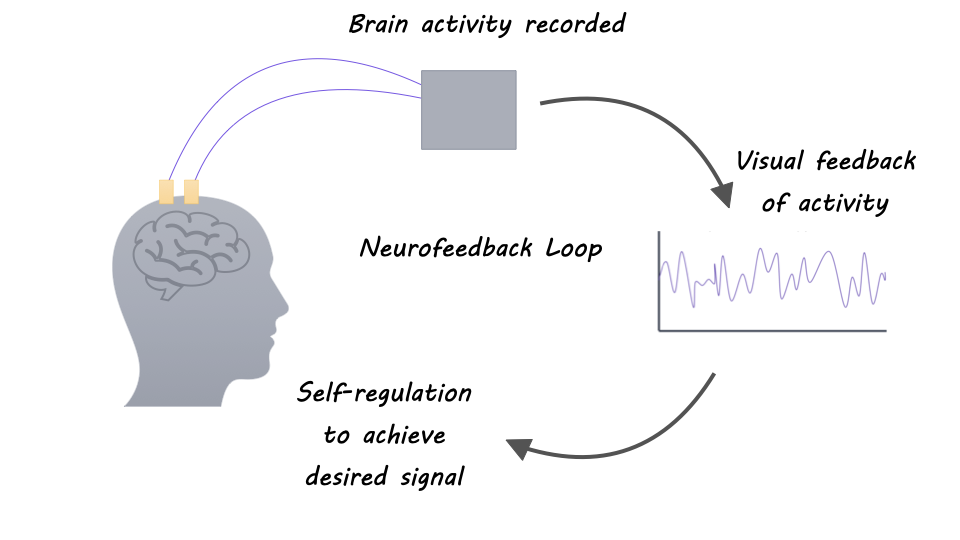
Some researchers study neuroplasticity with neurofeedback: a form of biofeedback that provides a representation of the recorded neural activity as a visual, auditory, or other signal back to the individual in real-time to facilitate self-regulation. In other words, one can modulate their brain activity by integrating information about one’s own brain activity to elicit a different behavior or pathology. Neuroplasticity not only enables cognitive and perceptual learning but also forms the basis of clinical neurorehabilitation. And researchers have begun to investigate the use of neurofeedback for treatments of brain and behavioral disorders.

Neurofeedback to study brain networks

Research suggests that there is a specific network of brain regions involved in self-regulation. Changes in brain activity during neurofeedback can be seen via changes in electroencephalography (EEG) amplitudes and blood oxygen level-dependent signals in functional magnetic resonance imaging (fMRI) in brain areas such as the anterior insular cortex, anterior cingulate cortex, dorsal lateral prefrontal cortex, inferior parietal lobule, basal ganglia, and thalamus. This indicates that neurofeedback involves networks involved in reward processing, cognitive control, and learning and memory.

Neurofeedback for clinical application

Neurofeedback has been extensively studied to treat attention deficit hyperactivity disorder (ADHD). For instance, neurofeedback therapy can provide information about the patient’s brain state to allow the patient to consciously match to and maintain the desired brain state through reinforcement. EEG-based Neurofeedback helps reduce the elevated low-frequency (theta/delta) synchronization observed in children with ADHD and improved ADHD symptoms.

Studies have also found several benefits of neurofeedback for stroke recovery. One study showed that severely impaired, chronic stroke patients learned to upregulate ipsilesional sensorimotor rhythm (SMR) through controlling a brain-computer-interface (BCI) with a hand orthosis, and the neurofeedback training also improved their upper limb functions. In addition, virtual reality in combination with EEG-BCI can offer a more immersive representation of neurofeedback for stroke rehabilitation and increase the perceived embodiment (sense of control as their own). However, more robust evidence is needed to support the efficacy of neurofeedback therapies for ADHD and stroke rehabilitation.

Neurofeedback for BCI motor control

The use of neurofeedback is not exclusive to self-regulate one’s neural state. It is also widely used in BCI for closed-loop motor control. In motor BCI, individuals can directly manipulate an external device with their neural signals being translated into action commands. For example, after training, a BCI maps neural activity patterns to control commands in real-time and provides visual feedback of the current position of the external device being controlled. Such real-time feedback allows users to reevaluate, refine and correct their control. With trial-and-error, people with paralysis can decide which set of mental motor imagery (e.g., imagining controlling a joystick or a computer mouse) was most effective for control. With minimal practice using an intracortical BCI, people with paralysis were able to coordinate movements of a seven degrees-of-freedom robotic arm, control a computer cursor, or functionally stimulate muscles for movement restoration.

Bidirectional closed-loop neurofeedback

In addition to providing just visual feedback, researchers try to directly restore tactile and cutaneous sensations in arm and hand function, which is important during grasping or manipulation of objects. A bidirectional BCI for motor control refers to a system that (1) decodes neural signals in the motor cortex into commands to control a device and (2) provides somatosensory feedback by delivering electric stimulation patterns to the primary somatosensory cortex (S1) or the spinal cord. Microstimulation of the cortical surface of M1 and S1 using high-density electrocorticography (ECoG) has provided tactile sensations such as “buzzing”, “tingling”, “brushing”, “light tapping,” or a “feeling of movement” to participants with paralysis. An adaptive deep brain stimulation framework targeted at the thalamus is capable of concurrent biomimicry stimulation and sensing for better closed-loop therapies for psychiatric disorders, epilepsy, or chronic pain. More research is needed to quantify perceptual qualities and improve naturalistic sensations to provide functional benefits for BCI control.

What’s next?

Neurofeedback is a novel and valuable way to study brain function and neuroplasticity. Further, neurofeedback has exciting potential as a therapeutic tool. Although researchers have begun to understand some of the mechanisms underlying neurofeedback, future research will likely further clarify the psychological and neural underpinnings of self-regulation, which will help to design more-effective neurofeedback technologies for treating a variety of diseases and conditions.

References +

Sitaram et al. Closed-loop brain training: the science of neurofeedback. Nature. (2016)

Saha et al. Progress in Brain Computer Interface: Challenges and Opportunities. Front. Syst. Neurosci. (2021)

Ramos-Murguialday, et al. Brain–machine interface in chronic stroke rehabilitation: a controlled study. Ann. Neurol. (2013).

Zotev et al. Self-regulation of human brain activity using simultaneous real-time fMRI and EEG neurofeedback. Neuroimage (2014).

Collinger et al. High-performance neuroprosthetic control by an individual with tetraplegia Lancet (2013).

Hochberg et al. Neuronal ensemble control of prosthetic devices by a human with tetraplegia. Nature (2006).

Hughes et al. Bidirectional brain-computer interfaces. Handbook of Clinical Neurology (2020).

Ansó et al, Concurrent stimulation and sensing in bi-directional brain interfaces: a multi-site translational experience. Journal of Neural Engineering (2022).