Brain and Body Signals Synchronize with Eye Contact

Post by Anastasia Sares

The takeaway

The expression “being in sync” with another person is more true than we might think: both brain and body signals can start to synchronize when we make eye contact with someone—even more so if we are close with that person.

What's the science?

Most neuroimaging studies focus on what is happening in a single brain during some computer-based task. But humans are inherently social creatures, and likely respond much differently when face-to-face with another person. Enter hyperscanning: the method of scanning more than one brain at a time during a real interaction. This technique has been used to study musicians playing duets, parent-infant pairs, and more.

This week in Neurophontonics, Guglielmini and colleagues added physiological signals into a hyperscanning study, monitoring body signals like heart rate and blood pressure between people as they made eye contact.

How did they do it?

The experimental design was simple: seat two people across from each other at a table, first with eyes closed, and then with eyes open and making eye contact, for 10 minutes each. Some of these people knew each other well (siblings or couples), and others less well (colleagues or strangers). The authors used fNIRS (functional Near-Infrared Spectroscopy) to detect blood hemoglobin levels in the brain using infrared light, along with skin conductance, blood pressure, heart rate, etc. They broke down the signals into different frequency bands (fast oscillations, slow oscillations, very slow oscillations). They then lined up the signals for each pair of participants that had interacted to see how well the signals correlated in the eyes-closed versus eye-contact conditions. As a control condition, they compared the signals of people from different testing sessions who had not been paired.

What did they find?

The authors observed more synchronized blood flow in the brain (measured by total hemoglobin levels) during the eye-contact condition, while body temperatures were better synchronized in the eyes-closed condition. Signals from people who had been in the same testing session were more synchronized than the (control) signals of people who had been in different testing sessions. Most measures of synchronization were greater for people who knew each other well, like blood flow in the brain but also in heart rate and diastolic blood pressure. Skin temperature and electrical activity in the skin were also correlated with blood flow in the brain across people.

What's the impact?

This study demonstrates that eye contact results in significant changes in synchronization between individuals. Beyond that, it shows that it is possible to combine physiological data coming from the body with brain blood-flow measures in a hyperscanning experiment, expanding our ideas about what is possible with hyperscanning.
The Neural Correlates of Abrupt Visual Learning

 Post by Megan McCullough

The takeaway

Rapid visual learning, which can be thought of as a moment of insight, is characterized by synchronized neural activity in the inferotemporal and prefrontal cortices.

What's the science?

Although most learning in adult humans requires multiple learning sessions and involves slow changes in the brain, abrupt learning refers to the circumstances in which adults learn after one or only a few exposures to a stimulus. One example of abrupt learning is recognizing a person’s face after one introduction. Previous studies have examined the role of oscillatory synchronization (brainwaves occurring at the same time) in learning over time, but its role in abrupt learning is unknown. This week in Current Biology, Csorba and colleagues aimed to study the role of synchronization of neural activity between the prefrontal (PFC) and inferotemporal (IT) regions in facilitating abrupt learning by recording neuronal activity in non-human primates.

How did they do it?

The authors recorded neuronal activity in the PFC and IT cortex of two adult rhesus macaque monkeys while they participated in an oculomotor foraging task. The task consisted of three phases: the presentation of a scene, a foraging phase, and the reward phase. First, each animal was presented with a natural image. Next, the animals were allowed to explore the image visually. Finally, the animals were rewarded when their gaze reached an unmarked reward zone and the time it took the animals to find the reward zone after being presented with the scene was recorded. This task was chosen because the learning was abrupt, performance improved significantly after only a few trials. To examine the relationship between neural activity in the regions of interest and abrupt learning, the authors measured the relationship between the local field potential (LFP) signals in each area.

What did they find?

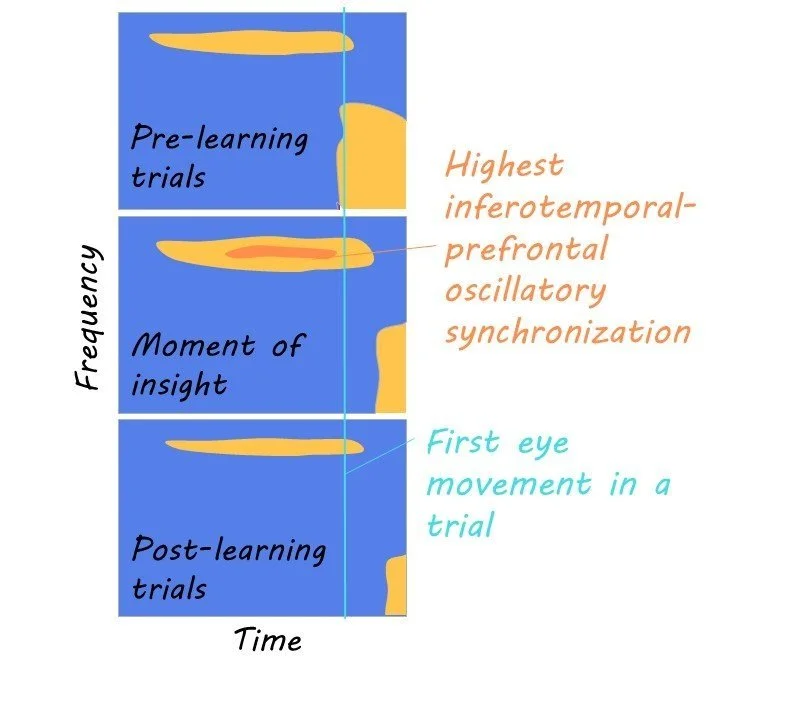
The animals learned to recognize the images presented to them and associate them with specific reward areas, showing that this task involved abrupt visual learning. The authors found an increase in synchronization of LFPs in the PFC and IT region around the time the animals had their moment of insight. Furthermore, the synchronized activity in these two brain regions could predict the changes in performance of the monkeys. The data show that the strength of the synchronization was highest around the moment of insight but also carried into the post-learning phases of the task. This coordinated activity appears to link visual inputs with reward outcomes.

What's the impact?

This study uncovered the neural correlates of abrupt visual learning. Because the animals were allowed to freely look at natural images, the results of this study may provide a look into learning that occurs in natural settings outside of a laboratory. This research illustrates the role that coordinated activity between brain regions has in allowing quick visual learning.

Access the original scientific publication here

The Impact of Online Communication at Work on Creativit

Post by Megan McCullough

The takeaway

Videoconferencing as a means of communication inhibits the production of creative ideas. This is because the narrow visual field of those using a digital screen correlates with a narrower cognitive focus.

What's the science?

As a result of the COVID-19 pandemic, there has been a switch to full-time or hybrid remote employment. This shift is projected to outlast the pandemic, with 20% of all U.S workdays estimated to take place remotely even after the pandemic ends. Because of the impact of collaboration on workplace productivity, recent studies have examined the effect of working remotely on the quality and quantity of creative ideas. This week in Nature, Brucks and Levav examined the impact of the physical difference between remote and in-person work on generating and selecting creative ideas.

How did they do it?

The authors conducted two separate studies to examine the productivity differences between online and in-person collaboration. The first study took place in a laboratory setting. The authors randomly paired 602 college undergraduates and randomly assigned them to a virtual or an in-person condition. All pairs were tasked with generating alternative uses for a product and then selecting their most creative task. The authors recorded the number of ideas each pair generated and assigned creativity scores to each idea to measure the decision-making skills of each pair. To test the hypothesis that any differences in creativity between the two groups is due to the effect of screens on narrowing the visual scope of the user, the authors measured the ability of participants to recall props placed around the room and recorded eye gaze during the task. 

The second study involved 1,490 engineers in a realistic work setting. It was conducted to extend the findings of the laboratory study to a more realistic environment. These participants were randomly paired and assigned to one of the two groups. Then they were asked to generate product ideas and select one to submit to their company. As in the first experiment, the authors recorded the number of ideas each pair generated and assigned creativity scores to each idea.

What did they find?

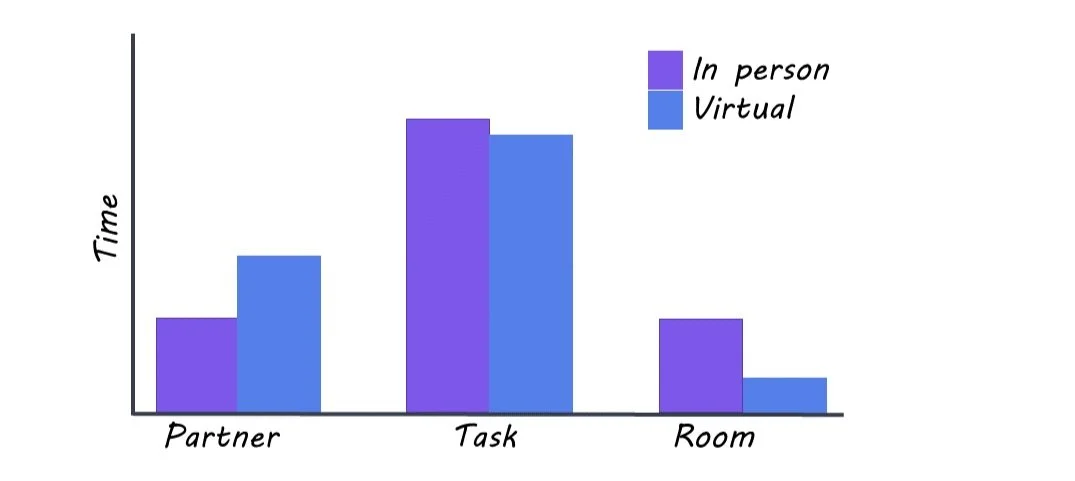
In both the laboratory and field experiments, the authors found that pairs in the virtual groups generated fewer total ideas and fewer creative ideas. There was no statistically significant impact of condition on the ability to select an idea. One hypothesis as to why the difference occurs is that narrowing one’s visual focus to a screen also narrows cognitive focus. The data supported this hypothesis: virtual pairs spent more time looking at their partners and less time looking around the room. The ability to recall the props placed around the room and increased gaze around the room were correlated with an increase in creative ideas.

What's the impact?

This study found that there are differences in the generation of creative ideas between colleagues who collaborate in person compared to those who collaborate through videoconferencing. Videoconferencing groups were less effective at generating creative ideas than their in-person counterparts. This research suggests that there is an advantage to in-person work when it comes to creativity and idea generation. As companies move forward in developing remote work policies after the pandemic, this area of research will become important in the formation of those policies.