The Anterior Cingulate Cortex Signals the Need to Control Intrusive Thoughts

Post by Leanna Kalinowski

The takeaway

The human brain has evolved mechanisms that enable it to suppress unwanted memories from coming to mind. This study identified a crucial role for the anterior cingulate cortex in detecting and responding to these intrusive thoughts.

What's the science?

Recalling an unwanted memory can be distressing, but luckily, the human brain has adapted to be able to prevent such memories from coming to mind. When such memories intrude, the brain detects a need for control, which engages the prefrontal cortex to inhibit activity in the hippocampus, which then stops retrieval of the unwanted memory. However, it is unknown which brain region is responsible for detecting and coordinating a response to this need for control. During non-memory contexts (e.g., moments of surprise), many scientists believe that the anterior cingulate cortex (ACC) coordinates a need for control, but this region’s role in inhibiting unwanted memories has not yet been examined. This week in the Journal of Neuroscience, Crespo García and colleagues tested the role of the ACC in processing and preventing unwanted memories.

How did they do it?

Twenty-four participants first underwent the “study phase”. Here, they were tasked with studying 64 pairs of words that were shown side-by-side on a computer screen for 5 seconds each. After being shown each word pair, they were given one word from each pair and were asked to recall its associated word. Each participant repeated the study phase until they were able to correctly recall at least 50% of the words, and the words that they recalled were then used in the subsequent phase.

Participants next underwent the “Think, No-Think (TNT) phase”. This phase consisted of six blocks, each containing 80 words. During “Think” trials, a word appeared with a green frame around it, and participants were asked to recall and think about its associated word. During “No-Think” trials, a word appeared with a red frame around it, and participants were asked to pay full attention to the word on the screen but to actively prevent the associated word from entering their memory. During this phase, participants underwent functional magnetic resonance imaging (fMRI) scans and electroencephalography (EEG) recordings to measure brain activity.

Finally, they performed two types of tests: a same probe test, in which they were shown a word and were asked to say out loud its associated word, and an independent probe test, where they were given a category and were asked to say out loud any word from the original list that was within this category (e.g., category = “vehicle”).

What did they find?

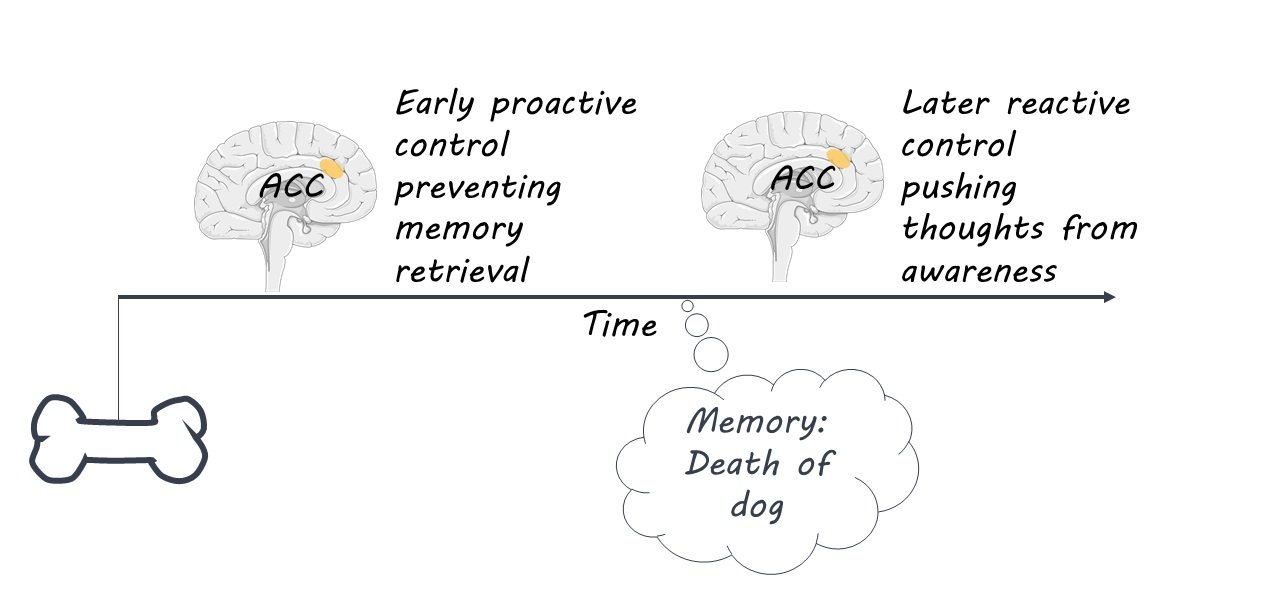
From the EEG recordings, the researchers found that theta signals in the ACC play a role in detecting a need for memory control, particularly during two key time points. The first time point was early in the “No-Think” trials, which suggests a proactive control prior to the unwanted memory. This signal was associated with reduced activity (via fMRI) in the hippocampus, ACC, and prefrontal cortex, suggesting that the suppression of memory early on led to a decrease in demand for activity from these brain regions. The second time point was later into the “No-Think” trial, which suggests a reactive response following the successful intrusion of the unwanted memories. This was associated with increased communication from the ACC, to the prefrontal cortex, to the hippocampus, suggesting that these brain regions work together to facilitate forgetting of the unwanted memory.
What's the impact?

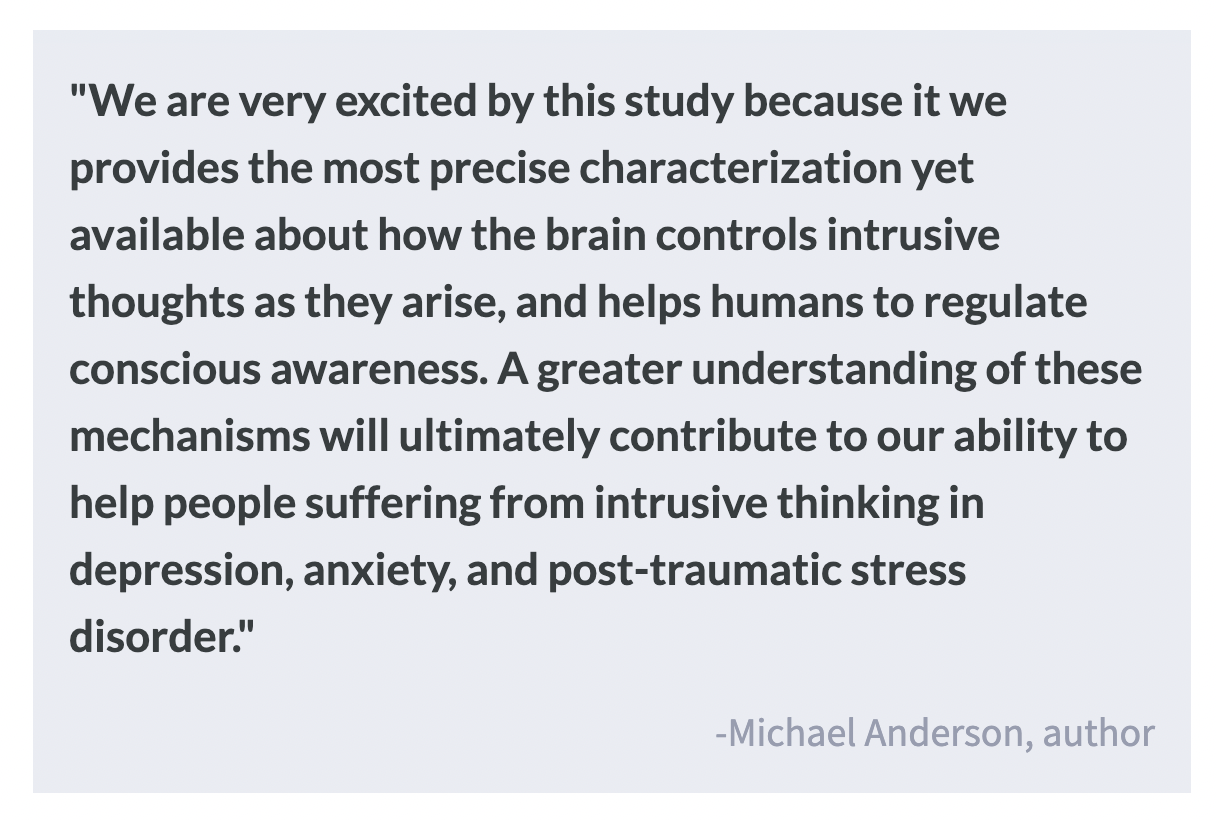
This study showed that the ACC not only detects the need for memory control but also responds proactively and reactively to unwanted memories by triggering other brain regions that are necessary for memory processing. During instances where unwanted memories still emerge, the ACC communicates with the prefrontal cortex, and these regions then work together to inhibit the hippocampus and suppress the intrusive thought.
The Effects of Living in High Crime Neighborhoods on Neonatal Brain Function

Post by Elisa Guma

The takeaway

Living in neighborhoods with high rates of crime has an impact on neonatal brain activity at birth, and this is mediated by maternal psychosocial stress. Weaker neonatal brain connectivity in some areas of the brain is directly associated with higher crime rates.

What's the science?

Maternal exposure to stress and adversity during pregnancy has been shown to impact fetal brain development, with lasting effects in postnatal life. Exposure to adversity may increase mothers’ stress and inflammatory factors, which may cross the placenta and interfere with fetal development. Previous work has found that mothers living in high-crime neighborhoods may not only have an increased risk of being victims of crime (a significant risk factor) but also experience higher levels of psychological stress. This week in Biological Psychiatry, Brady and colleagues investigate the relationship between neighborhood crime and neonatal brain function at birth.

How did they do it?

Mother-infant pairs were recruited as part of a larger birth-cohort study at Washington University in St. Louis. Shortly after birth, fed and swaddled neonates, underwent T2-weighted structural magnetic resonance and resting-state functional imaging. Reliable fetal brain networks were identified and connections between limbic regions (amygdala, hippocampus, thalamus) and frontal networks (anterior default mode network, anterior frontal-parietal network) were examined.

Crime data was obtained from a commercial database with data from law enforcement agencies and sorted into two categories: violent (i.e., crimes committed against persons such as murder, rape, robbery, and aggravated assault) or property crimes (i.e., burglary, larceny, and motor vehicle theft). Maternal addresses at birth were used to determine their block level crime exposure.  

The authors also assessed potential protective actors or additive factors of socioeconomic status, referred to as “advantage”. This included family income relative to household size, insurance status, maternal education, area deprivation index (based on census data ranking neighborhood socioeconomic status based on income, education, employment, and housing quality), and maternal nutrition. At each trimester during pregnancy, measures of psychosocial stress were obtained, including measures of maternal depression, lifetime stressor exposure, and racial discrimination.  

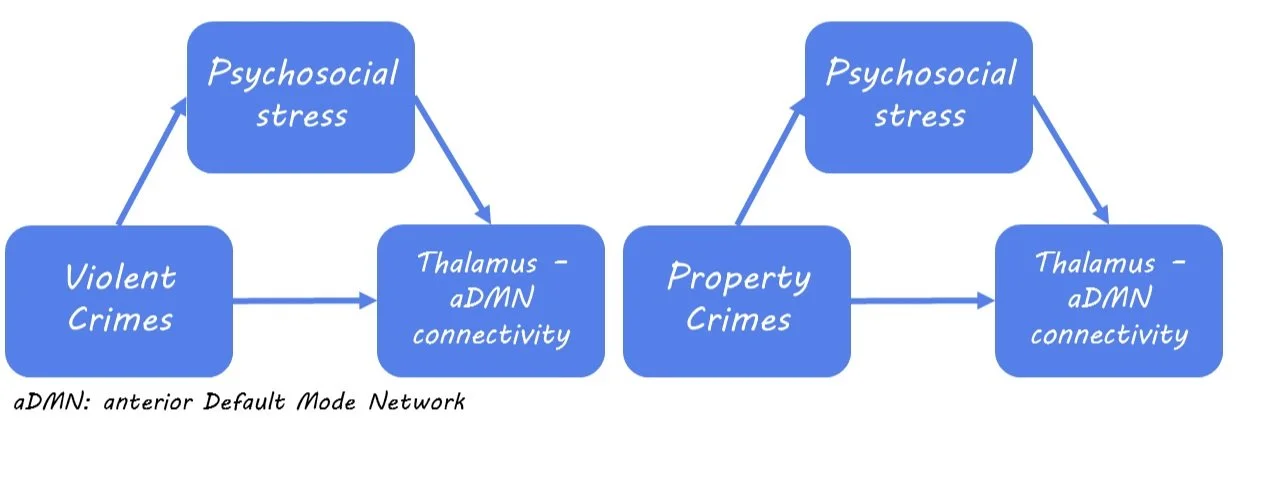
Researchers investigated the effects of prenatal exposure to crime on fronto-limbic connectivity as alterations in their connectivity have been previously associated with violent crime exposure, correcting for “advantage”. Potential mediating effects of maternal psychosocial stress were also investigated.

What did they find?

The authors found that disadvantaged mothers tended to live in areas with higher crime rates, but were widely distributed across both safe and dangerous neighborhoods, whereas advantaged mothers almost exclusively lived in areas with lower crime levels. Additionally, the women living in higher crime neighborhoods had higher psychosocial stress during pregnancy. 

Exposure to violent and property crime during pregnancy, when correcting for “advantage”, was related to weaker connectivity between neonates' thalamus and anterior default mode network. Exposure to violent crime was additionally related to weaker amygdala-hippocampus connectivity. Furthermore, maternal psychosocial stress partially mediated the direct associations between the thalamus and anterior default mode network for both violent and property crimes.

What's the impact?

These important findings indicate that living in neighborhoods with objectively higher violent and property crime rates may have specific effects on neonatal brain function above and beyond those due to living in impoverished areas. Additionally, these effects may be mediated by maternal psychosocial stress associated with these circumstances. The work presented here sheds light on the pervasive, intergenerational effects of crime, which disproportionately impact minority communities. Future work should investigate the long-term impact of this prenatal exposure.

Layer 5 Pyramidal Neurons Contribute to Loss of Consciousness During General Anesthesia

Post by Negar Mazloum-Farzaghi

The takeaway

Layer 5 of the brain’s cortex is a major cortical output layer. In mice, synchronous activity across layer 5 pyramidal neurons may contribute to the loss of consciousness during general anesthesia.

What's the science?

The cortex contains six layers, and each layer has distinct neuronal cell types. In particular, L5 is a uniquely organized layer with many recurrent connections. This layer contains excitatory pyramidal neurons which communicate both between cortical areas, and from the cortex to other brain areas. 

All general anesthetics result in a loss of consciousness. However, different general anesthetics often induce loss of consciousness via different modes of molecular action. Despite this, unconsciousness caused by anesthesia is accompanied by common changes in cortical activity. For example, there is a common shift in the power spectrum of cortical activity to lower frequencies during unconsciousness. This shift is thought to be due to an increase in cortical synchrony. Methods used to investigate the common effects of different anesthetics on the cortex lack spatial resolution within the populations of neurons recorded or fail to distinguish cell-type specificity. Thus, in the context of general anesthesia, recording activity from many neurons of a specific type across a wide area of cortex remains to be investigated.

This week in Neuron, Bharioke, Munz and colleagues investigated features of cortical activity in individual cortical cell types that are common across different general anesthetics.

How did they do it?

In this study, the authors used three different general anesthetics: isoflurane (Iso), Fentanyl-Medetomidine-Midazolam (FMM), and Ketamine-Xylazine (Ket-Xyl). To measure spontaneous activity in specific cell types of the cortex, the authors performed in vivo two-photon calcium imaging (a technique used to monitor the activity of distinct neurons in brain tissue) from neurons in the mouse visual cortex, in genetic mouse lines labeling specific cell types. They conducted the imaging in both awake and anesthetized states. Moreover, to identify a common effect of general anesthesia, they compared the neuronal synchrony (correlation of activity of individual neurons with the activity of the remaining population) induced by FMM, Iso, and Ket-Xyl in cell types in L1, L2/3, L4, L5, and L6. Computing neuronal synchrony allows for both periodic (oscillatory) and aperiodic (non-oscillatory) alignment of activity in a neuronal population to be observed.

To further assess changes in neuronal synchrony in cortical cell types, the authors examined neuronal synchrony during the loss of consciousness and the recovery of consciousness. To examine the timing of increases in neuronal synchrony in the visual cortex during the loss of consciousness due to anesthesia administration, the authors compared probability distributions. They also examined the timing of decreases in neuronal synchrony during the recovery of consciousness.

What did they find?

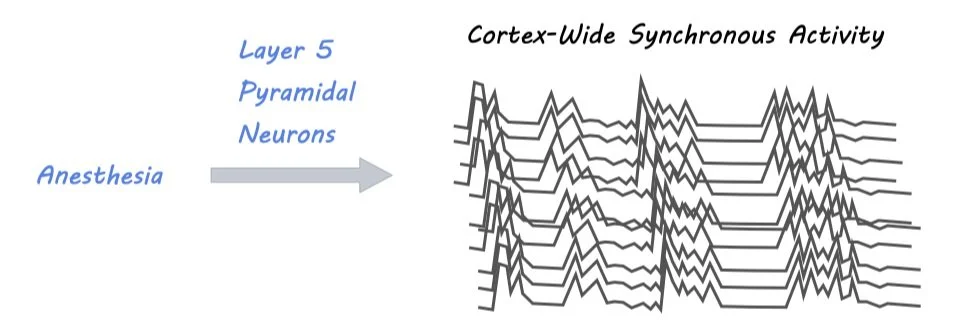
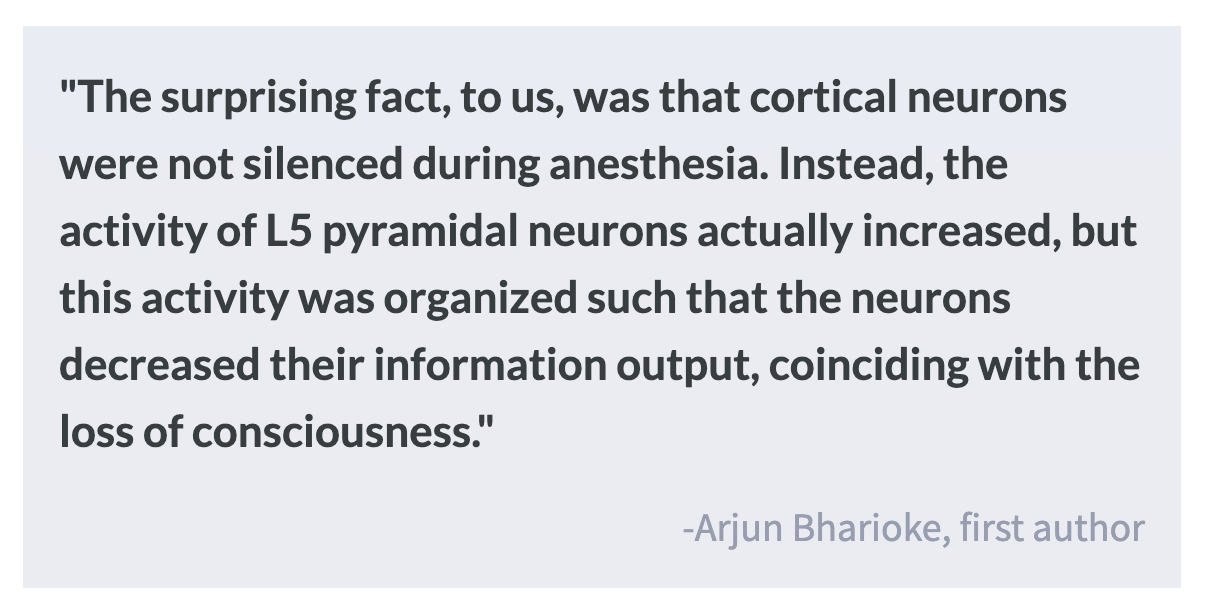
The authors found that a common effect across all anesthetics was high synchrony in L5 pyramidal neurons. Each anesthetic showed different combinations of changes in synchrony and overall activity across cortical cell types (L1, L2/3, L4, and L6), with the exception of L5 pyramidal neurons. In other words, L5 pyramidal neurons were the only cell type to show a consistent increase in synchrony. Finally, the transition time of neuronal synchrony in L5 pyramidal neurons closely matched the transition time of EEG spectral power and motor behaviours that were associated with the loss and recovery of consciousness. This suggests that L5 pyramidal neurons are involved in regulating the loss and recovery of consciousness.

What's the impact?

This study found that during general anesthesia, the cortex shifts from a mode characterized by asynchronous L5 outputs to a mode characterized by synchronous L5 outputs. This change appears to be mediated by L5 pyramidal neurons, which may be involved in regulating the loss and recovery of consciousness.