Gender Biases about Intelligence are Transmitted Across Generations

Post by Lani Cupo

The takeaway

Historically, many cultures have harbored a belief that boys are innately better at mathematics than girls. Being in a classroom with children whose parents subscribe to this belief was found to negatively impacts girls’ performance in mathematics and increase the likelihood that the children adopt this belief.

What's the science?

In many countries worldwide, there is still a strong belief among parents and children that boys are innately better at mathematics than girls, which can negatively impact girls’ enthusiasm and effort for the subject in school, ultimately contributing to a gender imbalance in science, technology, engineering, and mathematics fields. Previous research has shown that middle-school-aged children represent an age group with increased flexibility for updating their beliefs, allowing them to dynamically adapt their belief systems in response to new information. It is still unknown what role parental beliefs hold in impacting the belief systems of children, and how these beliefs are passed on to children. This week in Nature Human Behavior, Eble and colleagues studied how beliefs about gendered math ability transmit from parents to children and peers in randomly-assigned middle-school classrooms in China.

How did they do it?

The researchers employed a quasi-experimental method in which students were randomly assigned to classrooms, as it would be unethical to sort students based on the beliefs of their parents, potentially negatively impacting their academic performance. Participants included 8,057 students in 215 classrooms across 86 middle schools sampled across the 31 provinces of China. Data on parental beliefs came from the China Education Panel Survey (CEPS), which collected data on whether parents of these students believe boys are innately better at math than girls. The belief was held by 41% of parents (despite the fact that girls tend to outperform boys at this level in schooling), with the remaining 59% disagreeing. This measure allows the authors to assign a number to each child (ranging from 0 to 0.833) representing the proportion of the peers’ parents who in each classroom who hold the belief. For each child, a higher value indicates that a greater proportion of the child’s peers’ parents believe boys have greater innate talent than girls for math. The authors examine two potential routes of belief transmission: (1) from peer’s parents to the child or (2) from the peers’ parents to the peer and from the peer to the child.

As outcome variables, the authors first examine whether peers’ parents’ beliefs  affect the beliefs or math ability of a given child. Finally, they study alternative explanations for these two outcomes, investigating peers’ parents’ education level, income, and family background, as well as gender composition and cognitive ability in the classroom.

What did they find?

The authors found not only a correlation between a child and their parents’ belief that boys were innately better at math than girls, but also a positive correlation between a child and their peers’ parents belief in the same idea. Of interest, exposure to same-gender peers whose parents hold this belief has a greater likelihood of impacting that child’s belief than exposure to other-gendered peers, meaning if a girl spends more time with another girl whose parents believe boys are better at math than girls, the first girl will be more likely to hold this belief than if she spends time with a boy whose parents have the same opinion. Thus biases are transmitted not only parent-to-child but also from peer parent-to-peer and then peer-to-child. 
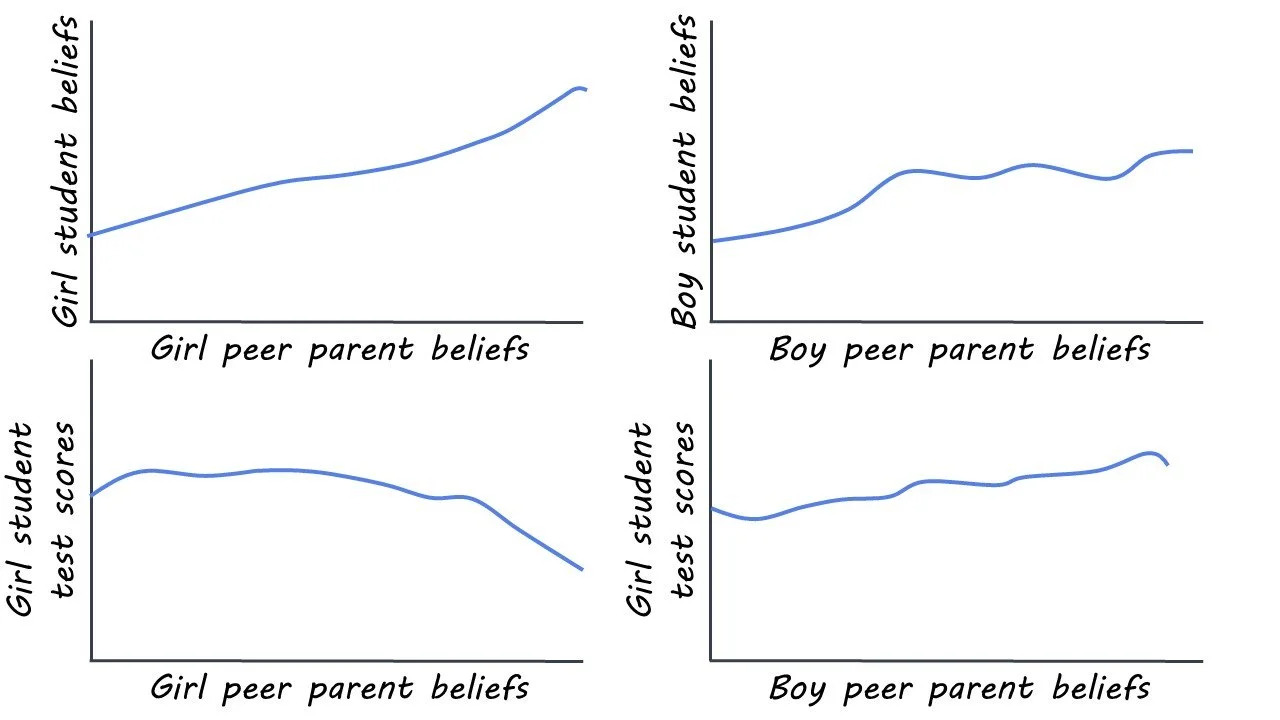
Further, following exposure to peer parent beliefs from same-gender peers, the authors show a trending increase in boys' performance on mid-term math exams and a significant decrease in girls' performance on the exams. The authors demonstrate that the findings vary little when additional metrics were included, such as: peers’ parents’ education, income, family background, classroom gender composition, and cognitive ability. This suggests that the findings are a direct result of the children’s peer’s parents beliefs rather than potential confounding variables.

What's the impact?

This study found that parents' beliefs regarding math performance in boys versus girls affect not only their own children’s beliefs, but also the beliefs of their children’s peers. Increased belief in the gender bias is reflected in a similar belief in children in the classroom, as well as a trending effect of worse performance among girls than their male classmates. These findings provide evidence for how beliefs transmit through generations, parent-to-child and peer-to-peer. Ultimately, this article investigates how children form their biases and beliefs at a young age, and demonstrates how these beliefs may impact their academic performance and potentially even future career choices.

The Clinical Potential of Wireless, Implantable Brain-Computer Interfaces

Post by Ewina Pun

What is a BCI?

Brain-computer interfaces (BCI) aim to provide improved access to assistive technologies for people with paralysis. People with paralysis due to brainstem stroke, amyotrophic lateral sclerosis, spinal cord injury, or other disorders can become unable to move or speak despite being awake and alert. Yet, researchers have shown that neural pathways modulating movement intention are still active even years after the injury. But what if we could bypass the damaged motor pathways and engineer a system that decodes and sends movement intentions straight from the brain to an external device? This kind of neural interface could allow the user to directly interact with and control devices (say, a computer cursor) in real time just by imagining or attempting natural hand movements.

Implantable devices such as microelectrode arrays or electrocorticography are placed directly on top of the motor cortex to record neural activities. Unlike devices placed further from actual brain cells – for example, devices placed on the scalp – implanted devices can record high-resolution, information-rich signals, and enable effective and intuitive neural control compared to traditional assistive devices that rely on residual motor functions. Recently, the development of wireless BCI signal transmission has moved us toward functional, everyday BCI use. Wireless BCI can provide a greater range of unconstrained mobility and many other potential clinical benefits.

BCI’s for restoring communication and mobility

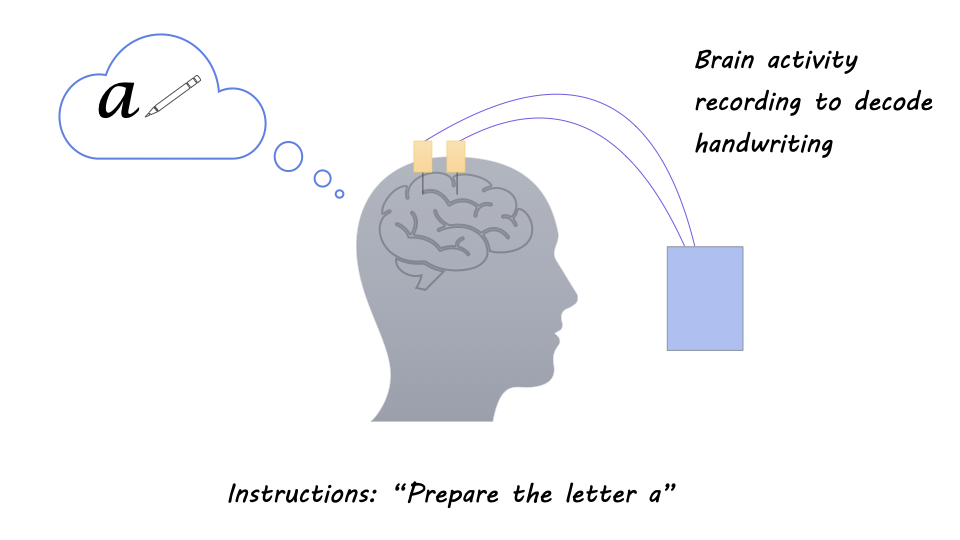
Restoration of communication is a top priority for people with locked-in syndrome, a condition of total paralysis and inability to communicate despite complete awareness, as well as other forms of paralysis. One method of communication for people with locked-in syndrome is through typing. An online decoder can guide cursor movements by interpreting brain activity differences in motor areas when attempting various movements. Intracortical BCIs can offer reliable point-and-click cursor control for patients with tetraplegia to type ~39 correct characters per minute (ccpm) on a virtual keyboard. A more recent paper demonstrated an intracortical BCI that decodes attempted handwriting with a recurrent neural network. This resulted in double the performance, with a typing rate of ~85 ccpm, significantly outperforming non-implanted technology and approaching the typing speed of an able-bodied person on a typical smartphone. Beyond the ability to type, participants can also use the same cursor control on a personal desktop computer, tablet, and smart phone for other activities such as web browsing, listening to music, and sending emails and texts.

Another main goal of BCI is mobility restoration and rehabilitation. Decoded movement intentions can be fed as commands to control a prosthesis system that restores mobility of individuals with paralysis. One impressive example is the ability to use brain signals to perform complex reach-and-grasp movements using a robotic arm. Combining BCI with functional electrical stimulation, a person with cervical spinal cord injury (paralysis from the neck down) was able to perform multi-joint arm movements using his own paralyzed arm to drink from a mug and feed himself. These tools provide disabled individuals ways to interact with their environment independently without the help of a caregiver. 

The benefits of wireless systems

Many standard intracortical BCI systems limit the range of movement because neural recordings from the implanted device are sent to the decoding computer via a connected cable. Alternatively, a wireless recording system can overcome this limitation. In 2021, Simeral and colleagues demonstrated the first human use of a wireless broadband intracortical BCI for two participants with tetraplegia. Not only does the wireless system offer reliable closed-loop control performance equivalent to the wired configuration, the transmitter is also lightweight, low-power, and more importantly, allows continuous, long-term use for over 24 hours at the user’s home. To restore mobile and complex motor activities for people with paralysis (like walking), an implantable wireless communication system will be a critical design consideration to provide the unconstrained movement needed to perform daily activities.

What's the takeaway?

For people with severe motor impairment, untethered wireless recording of intracortical signals is a major step toward clinically viable neuroprostheses that can provide independent communication and restore mobility. High-resolution BCI technology also provides neuroscientists a unique opportunity to understand how ensembles of individual neurons encode information. While researchers devote their efforts to advancing BCIs for various applications, careful attention must continue to be placed on mitigating risk, maximizing potential benefit, and assessing the safety of emerging neurotechnology.

References +

Hochberg et al. Neuronal ensemble control of prosthetic devices by a human with tetraplegia. Nature (2006).

Pandarinath et al. High performance communication by people with paralysis using an intracortical brain-computer interface. Elife (2017).

Aflalo et al. Neurophysiology. Decoding motor imagery from the posterior parietal cortex of a tetraplegic human. Science (2015)

Willett et al. High-performance brain-to-text communication via handwriting. Nature (2021).

Nuyujukian et al., Cortical control of a tablet computer by people with paralysis. PLoS One. (2018)

Collinger et al. High-performance neuroprosthetic control by an individual with tetraplegia Lancet. (2013)

Wang et al. An Electrocorticographic Brain Interface in an Individual with Tetraplegia. Plos One (2013)

Wodlinger et al. Ten-dimensional anthropomorphic arm control in a human brain-machine interface: difficulties, solutions, and limitations. J. Neural Eng. (2015)

Ajiboye et al. Restoration of reaching and grasping movements through brain-controlled muscle stimulation in a person with tetraplegia: a proof-of-concept demonstration. Lancet. (2017)

Bockbrader et al. Clinically Significant Gains in Skillful Grasp Coordination by an Individual with Tetraplegia Using an Implanted Brain-Computer Interface With Forearm Transcutaneous Muscle Stimulation. Arch Phys Med Rehabil. (2019)

Johns Hopkins Applied Physics Laboratory. Quadriplegic patient uses brain signals to feed himself with two advanced prosthetic arms. (2020)

Simeral et al. Home Use of a Percutaneous Wireless Intracortical Brain-Computer Interface by Individuals with Tetraplegia. IEEE Trans. Biomedical Engineering (2021).

Borton et al. An implantable wireless neural interface for recording cortical circuit dynamics in moving primates. Journal of Neural Engineering (2013).


Psilocybin Reduces Depressive Symptoms by Reorganizing Functional Brain Networks

Post by Shireen Parimoo

The takeaway

Psilocybin, a psychedelic drug commonly known as magic mushrooms, is increasingly viewed as a viable treatment option for psychiatric conditions like major depression. It reduces the severity of depressive symptoms by reorganizing the functional connectivity of brain networks.

What's the science?

Major depressive disorder is commonly treated using serotonin-selective reuptake inhibitors (SSRIs) that increase serotonin concentrations in the brain. Psychedelic drugs like psilocybin are now being considered viable options for treating major depression as they also increase serotonin levels. In the brain, serotonin receptors are present in many brain regions, including brain regions that comprise the default mode (DMN) and executive control/salience networks (E/SN). The DMN is generally active during self-referential thinking and is over-activated in individuals with depression, while the E/SN are associated with attentional processes that are impaired in depression. One possibility is that psilocybin alters the functional properties of these networks by acting on serotonin receptors in the brain. This week in Nature Medicine, Daws and colleagues used clinical and resting-state fMRI (rs-fMRI) data from two clinical trials to investigate the effects of psilocybin treatment on brain network organization and depressive symptoms.

How did they do it?

The authors used data from two clinical trials on psilocybin treatment for major depressive disorder:  an open-label trial with 16 treatment-resistant patients who knew they would receive psilocybin treatment, and a double-blind randomized-controlled trial (DB-RCT) with patients who either received psilocybin or an SSRI. Although the patients in the DB-RCT did not know which treatment they received, they were informed that they would either receive a high dose or a negligible dose of psilocybin. In both trials, participants underwent rs-fMRI scanning and completed the Beck Depression Inventory I for an assessment of their depressive symptoms. The authors used functional connectivity analyses to identify the extent to which brain networks were integrated or segregated from each other. Lastly, they estimated the dynamic flexibility of the networks (i.e., how often different brain regions switched network membership over time) in the DB-RCT.

In the open-label trial, participants were given one low dose of psilocybin and a higher dose one week later. A clinical assessment and rs-fMRI scan were performed at baseline (prior to the first dose) and one day after the second dose of psilocybin. Clinical follow ups were also conducted three and six months after the second dose to examine the long-term effect of psilocybin treatment on depression. In the DB-RCT, participants underwent clinical assessments and scanning followed by psilocybin or SSRI treatment at baseline and three weeks later. They also took a daily capsule with psilocybin, placebo, or the SSRI for six weeks following the first dose. Finally, clinical follow-ups were conducted two weeks, four weeks, and six weeks after the first dose.

What did they find?

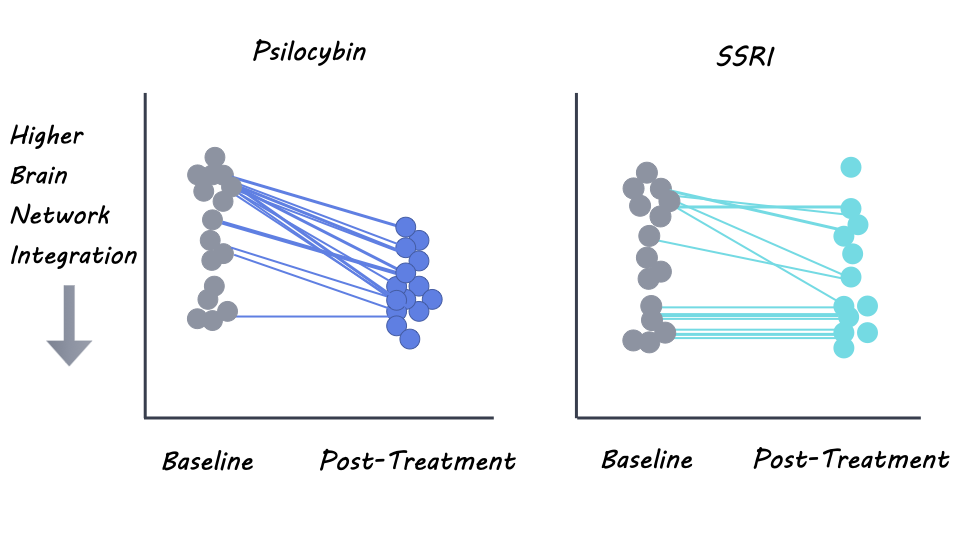
Psilocybin treatment reduced depressive symptom severity in both the short-term (1-6 weeks) and in the long-term (3-6 months) across both clinical trials. Moreover, in the DB-RCT, psilocybin was found to be more effective than the SSRI treatment. In both trials, there was an increase in the global integration of the brain's functional networks that followed psilocybin therapy. The increase in connectivity between the brain's networks correlated with improvements in the long-term well-being of patients. There were no observed changes in the global integration of the brain networks in patients who received the SSRI treatment. 

Digging deeper, the brain's higher-order networks that are associated with cognition and the flexible adaptation of behaviour showed significant changes after psilocybin. This was expected because these networks house the highest densities of serotonin receptors and function abnormally in depression. In the open-label trial, the DMN was less segregated and more integrated with the E/SN one day after treatment. This means that psilocybin reduced the extent to which DMN regions were connected to each other and increased their connectivity with regions of the E/SN. In the DB-RCT, greater dynamic flexibility of the E/SN was associated with greater symptom improvements after receiving psilocybin. Again, these changes were not observed in patients who received the SSRI treatment.

What's the impact?

This study shows that the rapid and sustained antidepressant effect of psilocybin works differently from a conventional SSRI. The brains of patients with depression that received psilocybin became more integrated and flexible, in a manner that is conducive to better mental health and well-being. This work is particularly exciting because the effects of psilocybin on clinical symptoms lasted for up to 6 months in patients who were previously resistant to SSRIs, making it a viable alternative to conventional treatments.